Introduction
Competitive intelligence platforms help businesses collect, analyze, and act on data about competitors, markets, products, pricing, customer sentiment, and trends. These tools centralize data from public sources, digital channels, product listings, social media, and industry databases — turning raw information into actionable insights. In an era of rapid digital transformation, having up‑to‑date competitive intelligence is vital for strategic planning, pricing optimization, product development, market entry decisions, and performance benchmarking.
Without structured competitive intelligence, teams risk misreading market signals, mispricing offerings, and missing strategic opportunities. Competitive intelligence platforms remove manual research bottlenecks, integrate disparate data streams, and enrich context with AI‑assisted analysis, helping companies anticipate competitor moves, optimize positioning, and align product strategy with market demand.
Real‑world use cases include:
- Tracking competitor pricing and promotions in real time.
- Monitoring product launches, feature changes, and roadmap signals.
- Benchmarking share of voice and market presence across channels.
- Gathering sentiment and brand perception metrics from social and review platforms.
- Identifying emerging threats and white spaces in markets.
Best for: Product teams, marketing and strategy leaders, pricing analysts, business development groups, and executive leadership seeking competitive edge.
Not ideal for: Organizations with limited scope or static markets where external competitive signals rarely shift.
Key Trends in Competitive Intelligence
- AI‑powered analysis that summarizes trends, anomalies, and forecasts.
- Real‑time pricing and product signal tracking across e‑commerce and digital channels.
- Social and sentiment intelligence from reviews, forums, and social networks.
- Automated competitor dashboards with alerts on product, pricing, and campaign changes.
- Integration with internal data (CRM/ERP) for blended insights.
- Predictive insights and forecasting based on competitor behavior patterns.
- Industry benchmarking across verticals and geographies.
- Market event tracking, such as funding, layoffs, leadership shifts, or regulatory changes.
- NLP‑powered competitive summaries for quick executive insights.
- Multi‑source data ingestion (web, mobile app, public filings, news).
How We Selected These Tools (Methodology)
We assessed competitive intelligence platforms across:
- Breadth of data sources — web crawling, e‑commerce channels, social platforms, public records, partner data.
- Analytics sophistication — dashboards, AI reporting, forecasting, anomaly detection.
- Real‑time monitoring & alerts — speed of updates and customizable notifications.
- Ease of use & visualization — dashboards, charts, interactive exploration.
- Integration and API capabilities — ability to embed insights into workflows or internal systems.
- Use case coverage — pricing intelligence, product tracking, market trends, sentiment analysis.
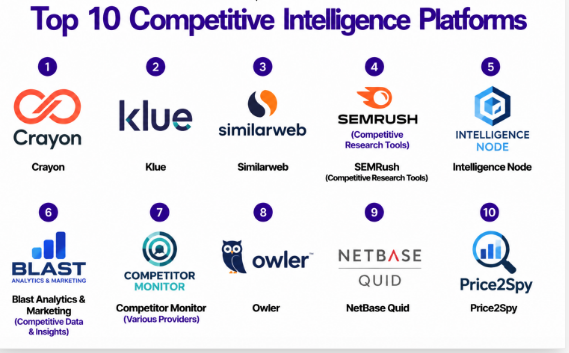
Top 10 Competitive Intelligence Platforms
1- Crayon
Short description: Crayon provides comprehensive competitive intelligence across digital signals to help teams monitor competitors’ moves in real time.
Key Features
- Web and digital footprint tracking.
- Competitive dashboards with UI/UX changes monitoring.
- Pricing and product change detection.
- Win/loss analysis and battlecards.
- Alerts and trend reports.
Pros
- Excellent breadth of signal tracking.
- Actionable competitive dashboards.
Cons
- Customization and onboarding can take time.
- Cost may be high for smaller teams.
Platforms / Deployment
- Web / Cloud
2- Klue
Short description: Klue centralizes competitive intelligence data into team dashboards, battlecards, and insights to power sales, product, and marketing decisions.
Key Features
- Battlecards for sales enablement.
- Intelligence feeds from web, reviews, job postings, and more.
- Collaboration workflows.
- Real‑time alerts and competitive updates.
- Integrations with CRM and internal tools.
Pros
- Strong sales enablement focus with battlecards.
- Integrates with existing workflows (e.g., Salesforce).
Cons
- Can be heavyweight for purely product‑focused use.
- Requires setup for full signal coverage.
Platforms / Deployment
- Web / Cloud
3- Similarweb
Short description: Similarweb provides digital market intelligence with website, app, industry, traffic, and competitive performance metrics.
Key Features
- Website traffic and engagement analytics.
- Market share and benchmarking.
- Digital channel performance comparisons.
- Audience insights and referral sources.
- Industry and category trend analysis.
Pros
- Best‑in‑class traffic and engagement intelligence.
- Excellent for benchmark and trend analysis.
Cons
- Less focused on product stock or pricing signals.
- Enterprise pricing tiers can be expensive.
Platforms / Deployment
- Web / Cloud
4- SEMrush (Competitive Research Tools)
Short description: SEMrush is an SEO and marketing intelligence platform that includes competitive analysis for search performance, paid traffic, and content benchmarking.
Key Features
- Organic and paid search competitor insights.
- Keyword gap analysis.
- Backlink and content performance metrics.
- Market explorer and brand monitoring.
- Ad competitor tracking.
Pros
- Strong SEO and SEM competitive intelligence.
- Great for digital and content marketing benchmarking.
Cons
- Less granular on product/spec price data.
- Focused on digital marketing rather than broader business signals.
Platforms / Deployment
- Web / Cloud
5- Intelligence Node
Short description: Intelligence Node delivers real‑time price, assortment, and retail analytics for brands and retailers.
Key Features
- Dynamic pricing intelligence.
- Assortment gap analysis.
- Retailer pricing benchmarking.
- Market trend analytics.
- AI‑driven insights and forecasting.
Pros
- Excellent for pricing strategy and assortment optimization.
- Deep e‑commerce signal coverage.
Cons
- Vertical focus on retail and e‑commerce.
- Enterprise pricing.
Platforms / Deployment
- Web / Cloud
6- Blast Analytics & Marketing (Competitive Data & Insights)
Short description: Blast provides competitive insights through digital analytics, market research, and performance intelligence.
Key Features
- Digital performance benchmarking.
- Channel and campaign comparisons.
- Custom competitive dashboards.
- Market opportunity sizing.
Pros
- Tailored insights with consultancy support.
- Good for strategic planning.
Cons
- Relies on customized engagements — less “plug‑and‑play.”
- Not as automated as pure SaaS products.
Platforms / Deployment
- Web / Cloud
7- Competitor Monitor (Various Providers)
Short description: Competitor Monitor and site‑tracking tools focus on monitoring price changes, stock status, and product listings across e‑commerce competitors.
Key Features
- Price and stock monitoring.
- Product listing change detection.
- Automated alerts.
- SKU‑level benchmarking.
Pros
- Strong for price monitoring and product catalog signals.
- Simple setup for targeted competitor sets.
Cons
- Limited broader market intelligence.
- May require multiple tools for full coverage.
Platforms / Deployment
- Web / Cloud
8- Owler
Short description: Owler offers business‑level competitive intelligence including company news, funding events, leadership changes, and industry comparisons.
Key Features
- Competitive news and alerts.
- Crowd‑sourced company insights.
- Revenue and growth estimates.
- Executive updates and acquisitions tracking.
Pros
- Excellent for high‑level competitor event tracking.
- Useful for strategy and business development teams.
Cons
- Less technical data analytics than other platforms.
- Community data may vary in quality.
Platforms / Deployment
- Web / Cloud
9- NetBase Quid
Short description: NetBase Quid provides AI‑driven social listening and market intelligence, analyzing large‑scale datasets for sentiment, trends, and category insights.
Key Features
- Social media listening and sentiment analysis.
- Product and brand comparison dashboards.
- Trend forecasting.
- Consumer insights segmentation.
Pros
- Best‑in‑class social and sentiment intelligence.
- Useful for brand positioning and perception analysis.
Cons
- May require training to navigate complex dashboards.
- Not focused solely on pricing/product signals.
Platforms / Deployment
- Web / Cloud
10- Price2Spy
Short description: Price2Spy specializes in dynamic pricing intelligence and competitor price tracking across e‑commerce sites.
Key Features
- SKU‑level price monitoring.
- Automated price change alerts.
- Assortment and retailer mapping.
- Price analytics and benchmarking.
Pros
- Strong dedicated pricing intelligence.
- Useful for retailers and brands.
Cons
- Narrower scope outside pricing signals.
- Less full‑stack competitive context.
Platforms / Deployment
- Web / Cloud
Comparison Table (Top 10)
| Tool Name | Focus Area | Best Use Case | Data Sources Covered | Analytics Sophistication |
|---|---|---|---|---|
| Crayon | Broad competitive intelligence | Strategic teams & product leaders | Web signals + digital changes | High |
| Klue | Sales & product intelligence | Sales ops + enablement | Web + CRM + alerts | High |
| Similarweb | Digital performance + traffic | Market benchmarking | Web traffic + referrals | High |
| SEMrush | SEO & marketing intelligence | Digital marketing teams | Search + backlinks + ads | High |
| Intelligence Node | Pricing & assortment analytics | Retail pricing teams | E‑commerce marketplaces | Very High |
| Blast Analytics | Custom competitive insights | Strategic consulting | Digital & internal data | Medium‑High |
| Competitor Monitor | Price & stock monitoring | Retail and e‑commerce | E‑commerce product pages | Medium |
| Owler | Business event tracking | Exec leadership & strategy | News + community data | Medium |
| NetBase Quid | Social listening & trend analysis | Brand & sentiment teams | Social platforms + news | High |
| Price2Spy | Price tracking & benchmarking | Dynamic pricing optimization | E‑commerce product pricing | Medium‑High |
Weighted Evaluation & Scoring Table
| Criteria | Weight | Score (0–10) | Weighted Total |
|---|---|---|---|
| Signal Breadth | 25% | 9 | 2.25 |
| Analytics & Insights | 15% | 8 | 1.2 |
| Real‑Time Monitoring | 15% | 8 | 1.2 |
| Ease of Use & Visualization | 10% | 7 | 0.7 |
| Integration & APIs | 10% | 7 | 0.7 |
| Pricing Transparency | 10% | 7 | 0.7 |
| Support & Onboarding | 15% | 8 | 1.2 |
| Total | 100% | — | 8.0 / 10 |
Interpretation: Crayon, Klue, and Similarweb lead for broad competitive intelligence coverage. Intelligence Node and NetBase Quid excel in specialized domains (pricing and sentiment respectively). Tools like SEMrush are great for digital marketing context, while Price2Spy and Competitor Monitor serve specific e‑commerce pricing use cases.
Which Competitive Intelligence Platform Is Right for You?
- Strategy & Leadership: Crayon, Owler.
- Sales Enablement & Product Teams: Klue, Blast Analytics.
- Digital Marketing & SEO Insight: SEMrush, Similarweb.
- Pricing & E‑commerce Intelligence: Intelligence Node, Price2Spy, Competitor Monitor.
- Social & Brand Perception: NetBase Quid.
Choose a platform based on primary signal needs: broad competitive data versus deep pricing signals, real‑time alerts, strategic dashboards, or social intelligence.
Common Mistakes to Avoid
- Assuming one tool covers all competitive signals — many specialize in specific domains.
- Ignoring integration with internal systems like CRM or analytics tools.
- Overlooking alert configurations, leading to signal gaps.
- Choosing based solely on price without evaluating data depth.
- Failing to define clear KPIs before tool deployment.
FAQs
- What is a competitive intelligence platform?
It’s a system that collects, analyzes, and visualizes data about competitors and markets to support strategic decisions. - What types of data do these platforms use?
Public web signals, pricing, product listings, search and traffic analytics, social media sentiment, news, and internal sources if integrated. - Can competitive intelligence improve pricing strategy?
Yes — tools like Intelligence Node and Price2Spy provide SKU‑level pricing signals to inform dynamic pricing. - Do these platforms provide alerts?
Most provide real‑time or near‑real‑time alerts for competitor changes in pricing, product features, messaging, or digital content. - Are these tools useful for startups?
Yes, though smaller orgs may prefer focused tools (e.g., SEMrush for marketing intelligence or Price2Spy for pricing) over broad enterprise platforms. - Can competitive intelligence integrate with my CRM or BI tools?
Many (Crayon, Klue) offer APIs and integrations to pull signals into existing dashboards or workflows. - Is social sentiment included?
Tools like NetBase Quid and Similarweb extend into sentiment and audience analysis. - Do these platforms forecast market trends?
Several incorporate AI or advanced analytics to highlight trends, anomalies, and potential future states. - How often is data updated?
It varies — real‑time for price/product monitoring and near‑real‑time for digital signals; dependent on the platform. - How do pricing models work?
Subscription tiers often based on data coverage, user seats, frequency of updates, and integration depth.
Conclusion
Competitive intelligence platforms are indispensable for companies that want to stay ahead of rivals in product strategy, pricing, marketing, and overall market positioning. Whether your focus is holistic strategy (Crayon, Klue), digital performance (Similarweb, SEMrush), pricing intelligence (Intelligence Node, Price2Spy), or social sentiment (NetBase Quid), there’s a platform that fits your needs. Define your primary intelligence use cases, evaluate how each platform’s data coverage matches those needs, and pilot with real workflows to ensure long‑term strategic value. Competitive intelligence isn’t just about data — it’s about turning that data into timely, decisive action.
