Introduction
Search Relevance Tuning for RAG (Retrieval-Augmented Generation) refers to the set of techniques, tools, and pipelines used to improve how accurately a system retrieves the most relevant context before sending it to a large language model. In RAG systems, retrieval quality is the foundation of response quality—if the wrong documents are retrieved, even the best LLM will produce incorrect or hallucinated answers.
Relevance tuning combines keyword ranking, vector similarity, hybrid search, reranking models, query rewriting, embedding optimization, metadata filtering, and feedback loops. The goal is to ensure that retrieved chunks are not only semantically similar but also contextually correct, fresh, and aligned with user intent.
Modern AI systems rely heavily on relevance tuning in enterprise search, AI copilots, customer support bots, legal discovery systems, healthcare assistants, and knowledge management platforms.
Evaluation Criteria for Buyers
When evaluating search relevance tuning solutions, consider:
- Retrieval accuracy (precision and recall balance)
- Support for hybrid search (lexical + vector)
- Reranking quality (cross-encoder or LLM-based)
- Query rewriting capabilities
- Embedding optimization strategies
- Feedback loop integration
- Real-time tuning capability
- Observability and evaluation tools
- Latency and performance overhead
- Scalability for enterprise workloads
- Integration with vector databases
- Support for A/B testing of ranking strategies
Best for: AI teams building RAG systems, enterprise search platforms, AI copilots, and organizations optimizing retrieval quality at scale.
Not ideal for: Simple search systems, static websites, or applications that do not use embeddings or LLM-based retrieval.
What’s Changed in Search Relevance Tuning for RAG
- Shift from static ranking to LLM-driven adaptive reranking
- Widespread use of query rewriting using LLM agents
- Real-time relevance optimization based on user feedback
- Hybrid retrieval as the default architecture
- Deep integration of rerankers (cross-encoders, LLM scorers)
- Vector + keyword fusion scoring models
- Automated chunk-level relevance scoring
- Continuous evaluation pipelines for retrieval quality
- Agent-based search orchestration systems
- Multimodal relevance tuning (text, image, audio)
- Cost-aware ranking and retrieval optimization
- Strong observability for retrieval performance
Quick Buyer Checklist
- Supports hybrid search (keyword + vector)
- Includes reranking models (cross-encoders or LLM-based)
- Enables query rewriting or expansion
- Provides relevance evaluation metrics
- Supports A/B testing of ranking strategies
- Integrates with vector databases
- Allows metadata-based filtering
- Provides feedback loop integration
- Offers observability dashboards
- Supports real-time tuning adjustments
- Enables cost-performance optimization
- Reduces hallucination risk in RAG
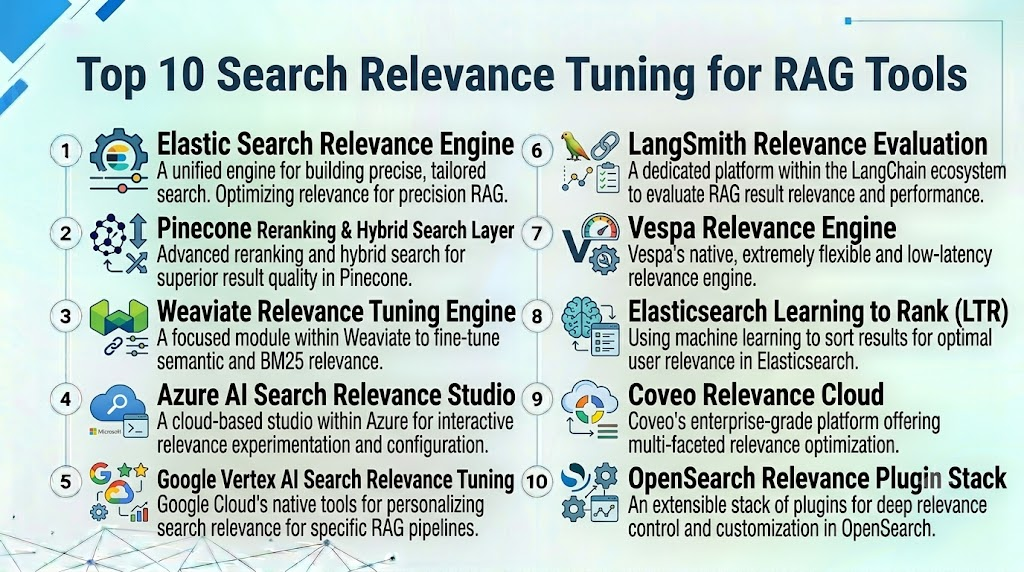
Top 10 Search Relevance Tuning for RAG Tools
1- Elastic Search Relevance Engine
One-line verdict: Best enterprise-grade relevance tuning system for hybrid search and RAG.
Short description:
Elastic provides advanced relevance tuning through BM25 ranking, vector search, semantic ranking, and AI-powered reranking pipelines for enterprise-scale systems.
Standout Capabilities
- BM25 + vector fusion ranking
- Learning-to-rank support
- Semantic reranking
- Query boosting rules
- Real-time indexing
- Hybrid scoring pipelines
- Observability dashboards
AI-Specific Depth
- Model support: BYO rerankers + embeddings
- RAG integration: Strong support
- Evaluation: Built-in relevance testing tools
- Guardrails: Access control + filtering rules
- Observability: Query performance metrics
Pros
- Highly scalable
- Mature relevance engine
- Strong hybrid search support
Cons
- Complex tuning configuration
- Resource-intensive
- Requires expertise
Deployment & Platforms
- Cloud
- Self-hosted
- Hybrid
Best-Fit Scenarios
- Enterprise search
- AI copilots
- Large RAG systems
2- Pinecone Reranking & Hybrid Search Layer
One-line verdict: Best vector-native platform with strong relevance tuning for RAG pipelines.
Short description:
Pinecone provides vector search with hybrid scoring and reranking capabilities designed specifically for production RAG systems.
Standout Capabilities
- Vector similarity search
- Hybrid retrieval scoring
- Metadata filtering
- Reranking pipeline support
- Real-time updates
- Low-latency retrieval
- Scalable architecture
AI-Specific Depth
- Model support: Multi-embedding + external rerankers
- RAG integration: Native-first
- Evaluation: External tools required
- Guardrails: Metadata filtering
- Observability: Query logs and metrics
Pros
- Extremely fast
- Easy to deploy
- RAG optimized
Cons
- Vendor lock-in risk
- Limited lexical tuning
- Cloud dependency
Best-Fit Scenarios
- AI assistants
- RAG pipelines
- Semantic search apps
3- Weaviate Relevance Tuning Engine
One-line verdict: Best open-source hybrid search relevance tuning platform.
Short description:
Weaviate supports hybrid search, reranking modules, and configurable relevance tuning for AI-driven search applications.
Standout Capabilities
- Hybrid search scoring
- Module-based reranking
- Vector + keyword fusion
- Real-time indexing
- Graph + semantic integration
- Custom ranking functions
- Open-source flexibility
AI-Specific Depth
- Model support: BYO embeddings + rerankers
- RAG integration: Strong support
- Evaluation: External + module-based
- Guardrails: Schema constraints
- Observability: Query insights
Pros
- Highly flexible
- Open-source core
- Strong AI ecosystem
Cons
- Requires engineering effort
- Operational complexity
- Smaller enterprise tooling
Best-Fit Scenarios
- AI startups
- Custom RAG systems
- Knowledge search platforms
4- Azure AI Search Relevance Studio
One-line verdict: Best enterprise relevance tuning system for Microsoft ecosystems.
Short description:
Azure AI Search provides semantic ranking, hybrid search, and AI-powered relevance tuning within the Microsoft cloud ecosystem.
Standout Capabilities
- Semantic ranking models
- Hybrid search scoring
- Custom scoring profiles
- AI enrichment pipelines
- Query boosting rules
- Enterprise indexing
- Security-aware ranking
AI-Specific Depth
- Model support: Azure AI models + BYO
- RAG integration: Native support
- Evaluation: Not publicly stated
- Guardrails: Strong enterprise policies
- Observability: Azure monitoring
Pros
- Enterprise-ready
- Strong security model
- Deep Azure integration
Cons
- Azure lock-in
- Complex configuration
- Cost scaling
Best-Fit Scenarios
- Enterprise copilots
- Microsoft-based AI systems
- Knowledge search platforms
5- Google Vertex AI Search Relevance Tuning
One-line verdict: Best AI-native relevance tuning system for Google Cloud environments.
Short description:
Vertex AI Search uses LLM-powered ranking and hybrid retrieval to improve relevance in enterprise search systems.
Standout Capabilities
- LLM-based ranking
- Hybrid search support
- Query understanding models
- Multimodal retrieval
- Enterprise indexing
- Real-time updates
- AI-powered boosting
AI-Specific Depth
- Model support: Google AI models
- RAG integration: Native support
- Evaluation: Not publicly stated
- Guardrails: IAM-based controls
- Observability: Cloud logging
Pros
- Strong AI integration
- Scalable architecture
- Managed service
Cons
- Google Cloud dependency
- Limited customization
- Enterprise pricing
Best-Fit Scenarios
- Enterprise search
- AI assistants
- Knowledge discovery
6- LangSmith Relevance Evaluation
One-line verdict: Best observability and relevance evaluation tool for RAG pipelines.
Short description:
LangSmith focuses on tracing, evaluation, and debugging of retrieval pipelines to improve search relevance in LLM applications.
Standout Capabilities
- Query tracing
- RAG evaluation metrics
- Retrieval debugging
- Dataset testing
- Experiment tracking
- Ranking comparison
- Feedback loop integration
AI-Specific Depth
- Model support: Multi-LLM compatible
- RAG integration: Core focus
- Evaluation: Strong built-in tools
- Guardrails: External implementation
- Observability: Full pipeline tracing
Pros
- Excellent evaluation tooling
- Developer-friendly
- Strong RAG focus
Cons
- Not a search engine
- Requires integration
- Limited ranking control
Best-Fit Scenarios
- RAG evaluation
- AI development teams
- Retrieval debugging
7- Vespa Relevance Engine
One-line verdict: Best large-scale relevance tuning system for ranking-heavy applications.
Short description:
Vespa provides advanced ranking models, hybrid retrieval, and machine learning-based relevance tuning for large-scale systems.
Standout Capabilities
- Learning-to-rank support
- Hybrid search scoring
- Real-time ranking
- ML-based ranking models
- Large-scale indexing
- Streaming updates
- Custom ranking logic
Pros
- Extremely powerful ranking
- Highly scalable
- Flexible architecture
Cons
- Complex setup
- Steep learning curve
- Requires expertise
Best-Fit Scenarios
- Recommendation systems
- Search engines
- Large AI platforms
8- Elasticsearch Learning to Rank (LTR)
One-line verdict: Best plugin-based relevance tuning system for Elasticsearch.
Short description:
Elasticsearch LTR enables machine learning-based ranking models on top of traditional search pipelines.
Standout Capabilities
- Learning-to-rank models
- Query feature engineering
- Ranking experimentation
- BM25 + ML fusion
- Feature logging
- Real-time ranking updates
- A/B testing support
Pros
- Highly flexible
- Mature ecosystem
- Strong hybrid support
Cons
- Requires tuning expertise
- Plugin complexity
- Resource-heavy
Best-Fit Scenarios
- Enterprise search tuning
- AI ranking systems
- Hybrid retrieval pipelines
9- Coveo Relevance Cloud
One-line verdict: Best enterprise SaaS platform for AI-powered search relevance optimization.
Short description:
Coveo provides AI-driven relevance tuning, personalization, and ranking optimization for enterprise search applications.
Standout Capabilities
- AI relevance ranking
- Personalization engine
- Behavioral learning
- Query understanding
- Feedback loops
- Enterprise connectors
- Search analytics
Pros
- Strong enterprise UX
- Built-in AI ranking
- Easy deployment
Cons
- Enterprise pricing
- Limited deep customization
- SaaS lock-in
Best-Fit Scenarios
- Customer support search
- Enterprise knowledge systems
- E-commerce search
10- OpenSearch Relevance Plugin Stack
One-line verdict: Best open-source alternative for customizable relevance tuning pipelines.
Short description:
OpenSearch provides hybrid search and plugin-based relevance tuning for flexible AI search systems.
Standout Capabilities
- BM25 + vector hybrid scoring
- Plugin-based ranking
- Custom scoring scripts
- Real-time indexing
- Observability tools
- Open-source ecosystem
- Security controls
Pros
- No vendor lock-in
- Highly customizable
- Strong community
Cons
- Requires DevOps effort
- Manual tuning required
- Limited AI-native features
Best-Fit Scenarios
- Open-source search systems
- AI retrieval pipelines
- Enterprise self-hosted search
Comparison Table
| Tool | Best For | Deployment | Model Flexibility | Strength | Watch-Out | Public Rating |
|---|---|---|---|---|---|---|
| Elastic | Enterprise search | Hybrid | High | Relevance engine | Complexity | N/A |
| Pinecone | RAG systems | Cloud | High | Vector speed | Lock-in | N/A |
| Weaviate | Open-source AI | Hybrid | High | Flexibility | Ops complexity | N/A |
| Azure AI Search | Enterprise AI | Cloud | High | Governance | Azure lock-in | N/A |
| Vertex AI | Google AI search | Cloud | High | AI ranking | Cloud dependency | N/A |
| LangSmith | RAG evaluation | Cloud | High | Observability | Not a search engine | N/A |
| Vespa | Large-scale ranking | Self-hosted | High | ML ranking | Complexity | N/A |
| Elasticsearch LTR | Ranking models | Hybrid | High | Flexibility | Tuning effort | N/A |
| Coveo | Enterprise SaaS search | Cloud | Medium | Personalization | Cost | N/A |
| OpenSearch | Open-source search | Hybrid | High | Customization | Ops burden | N/A |
Scoring & Evaluation
| Tool | Core | Reliability | Guardrails | Integrations | Ease | Performance | Security | Support | Weighted Total |
|---|---|---|---|---|---|---|---|---|---|
| Elastic | 10 | 9 | 9 | 10 | 7 | 9 | 10 | 9 | 9.2 |
| Pinecone | 9 | 8 | 7 | 9 | 9 | 10 | 8 | 8 | 8.7 |
| Weaviate | 9 | 8 | 7 | 9 | 7 | 8 | 8 | 8 | 8.2 |
| Azure AI Search | 9 | 9 | 9 | 9 | 8 | 9 | 10 | 9 | 9.0 |
| Vertex AI | 9 | 9 | 8 | 9 | 8 | 9 | 9 | 8 | 8.8 |
| Vespa | 9 | 8 | 7 | 8 | 6 | 10 | 8 | 7 | 8.1 |
| LangSmith | 8 | 8 | 7 | 9 | 9 | 8 | 7 | 8 | 8.2 |
| Elasticsearch LTR | 9 | 8 | 7 | 8 | 7 | 9 | 8 | 8 | 8.3 |
| Coveo | 8 | 8 | 8 | 8 | 8 | 8 | 8 | 8 | 8.0 |
| OpenSearch | 8 | 8 | 8 | 8 | 7 | 8 | 9 | 8 | 8.1 |
Conclusion
Search Relevance Tuning for RAG has become one of the most important components in modern AI systems because retrieval quality directly determines LLM output quality. As organizations adopt RAG architectures, hybrid search, and AI copilots, relevance tuning ensures that the right context is retrieved, ranked, and delivered to models.
The ecosystem is evolving toward LLM-driven ranking, adaptive query rewriting, and continuous feedback-based optimization. Enterprise platforms like Elastic, Azure AI Search, and Vertex AI dominate large-scale deployments, while developer-focused tools like LangSmith, Weaviate, and OpenSearch enable flexible experimentation and customization.
