Introduction
AI Self-Service Help Portals use artificial intelligence, natural language processing, knowledge retrieval, and automation to help customers and employees find answers, resolve common issues, and access support resources without direct assistance from support agents.
Modern organizations receive large volumes of repetitive questions related to products, services, accounts, troubleshooting, and internal processes. Traditional help centers often depend on manually maintained articles and keyword-based searches, which may not always provide accurate answers. AI-powered self-service portals improve this experience by understanding user intent, retrieving relevant information, generating responses, and guiding users toward faster resolutions.
These platforms help businesses reduce support workload, improve customer satisfaction, increase operational efficiency, and provide 24/7 access to information.
Real-world use cases:
- Customer FAQ automation
- AI-powered knowledge search
- Product troubleshooting assistance
- Employee self-service support
- Account and service guidance
- Automated customer onboarding
- IT help desk self-service
- Knowledge discovery
- Support ticket reduction
- Personalized user assistance
Evaluation Criteria for Buyers:
- AI search accuracy
- Knowledge retrieval quality
- Conversational support capability
- Integration with business systems
- Self-service automation features
- Content management capabilities
- Security and access controls
- Analytics and reporting
Best for
Customer support teams, SaaS companies, enterprises, IT service teams, ecommerce businesses, and organizations managing large support volumes.
Not ideal for
Organizations with limited support needs or businesses requiring only human-assisted customer service.
Key Trends
- AI-powered customer self-service
- Conversational knowledge search
- Generative AI support experiences
- Automated issue resolution
- Employee service portals
- Intelligent knowledge discovery
- Omnichannel customer support
- AI-powered FAQ generation
- Personalized support experiences
- Integration with CRM and ITSM platforms
Methodology
- Selected tools based on AI self-service portal capabilities
- Evaluated AI search, automation, integrations, scalability, and security
- Considered solutions for customer and employee support environments
- Prioritized platforms supporting modern knowledge workflows
- Reviewed usability, customization, and analytics capabilities
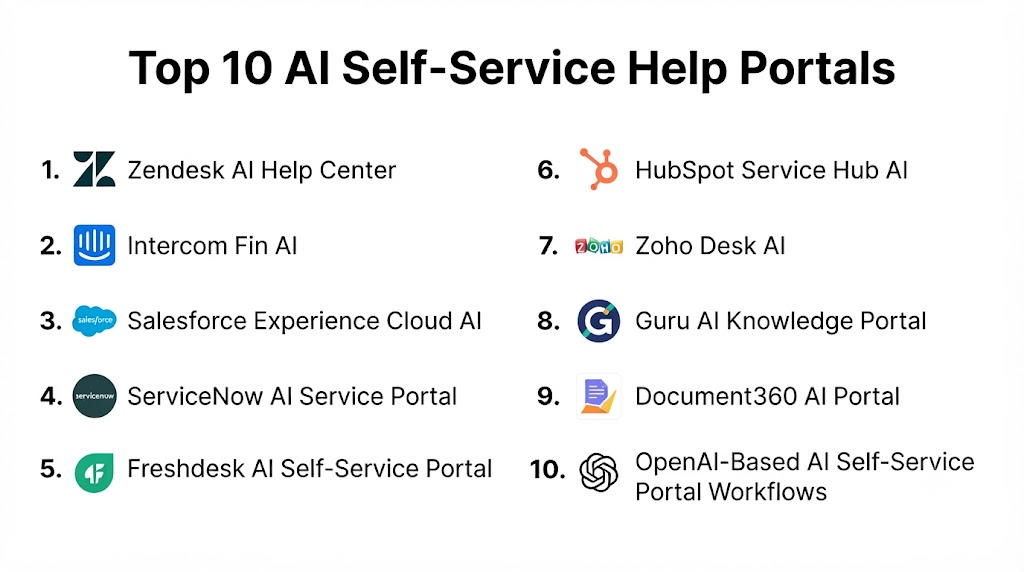
Top 10 AI Self-Service Help Portals
1. Zendesk AI Help Center
Verdict: AI-powered customer self-service platform integrated with support workflows.
Short Description: Zendesk AI Help Center helps organizations create intelligent self-service experiences using AI search, knowledge management, and automated customer assistance.
Key Features:
- AI-powered search
- Knowledge base integration
- Customer self-service
- Automated answers
- Support analytics
Pros:
- Strong customer support ecosystem
- Easy integration with helpdesk workflows
Cons:
- Best within Zendesk environment
- Advanced capabilities require configuration
Deployment: Cloud-based
Security & Compliance: Enterprise security controls
Integrations & Ecosystem: CRM, helpdesk, communication platforms
Support & Community: Large user community
Pricing Model: Subscription-based
Best-Fit Scenarios: Customer support teams
2. Intercom Fin AI
Verdict: AI customer self-service solution for conversational support.
Short Description: Intercom Fin AI helps businesses provide automated customer answers by connecting AI with knowledge sources and support workflows.
Key Features:
- AI conversations
- Knowledge retrieval
- Customer assistance
- Automated responses
- Support workflow integration
Pros:
- Strong conversational experience
- Good customer self-service automation
Cons:
- Requires quality knowledge content
- Best suited for digital businesses
Deployment: Cloud-based
Security & Compliance: Enterprise security options
Integrations & Ecosystem: Customer support platforms and business tools
Support & Community: Product support ecosystem
Pricing Model: Subscription-based
Best-Fit Scenarios: SaaS and online businesses
3. Salesforce Experience Cloud AI
Verdict: Enterprise self-service portal platform connected with CRM workflows.
Short Description: Salesforce Experience Cloud AI helps organizations create customer portals, knowledge experiences, and automated support journeys.
Key Features:
- Customer portals
- AI knowledge assistance
- CRM integration
- Self-service workflows
- Customer insights
Pros:
- Strong enterprise CRM integration
- Highly customizable
Cons:
- Requires Salesforce expertise
- Complex implementation
Deployment: Cloud-based
Security & Compliance: Enterprise security controls
Integrations & Ecosystem: Salesforce platform and business applications
Support & Community: Enterprise support
Pricing Model: Subscription-based
Best-Fit Scenarios: Large enterprises
4. ServiceNow AI Service Portal
Verdict: Enterprise AI self-service platform for employee and IT support.
Short Description: ServiceNow AI Service Portal helps employees find answers, submit requests, and resolve issues through intelligent self-service experiences.
Key Features:
- AI knowledge search
- Employee support
- Automated workflows
- Service requests
- Virtual assistance
Pros:
- Strong IT service management capabilities
- Enterprise automation features
Cons:
- Complex deployment
- Higher enterprise cost
Deployment: Cloud-based
Security & Compliance: Enterprise security standards
Integrations & Ecosystem: ITSM and enterprise applications
Support & Community: Enterprise support
Pricing Model: Subscription-based
Best-Fit Scenarios: Enterprise IT service teams
5. Freshdesk AI Self-Service Portal
Verdict: AI-enhanced customer support portal for growing businesses.
Short Description: Freshdesk AI helps businesses create self-service experiences with knowledge articles, AI answers, and automated support workflows.
Key Features:
- AI search
- Knowledge base
- Customer portals
- Automated responses
- Support analytics
Pros:
- Easy deployment
- Good SMB support features
Cons:
- Advanced customization varies
- Best within Freshworks ecosystem
Deployment: Cloud-based
Security & Compliance: Enterprise controls
Integrations & Ecosystem: Freshworks products and business applications
Support & Community: Customer community
Pricing Model: Subscription-based
Best-Fit Scenarios: Growing companies
6. HubSpot Service Hub AI
Verdict: AI-powered customer self-service solution connected with CRM.
Short Description: HubSpot Service Hub AI helps businesses create knowledge bases, automate customer answers, and improve service experiences.
Key Features:
- Knowledge base creation
- AI assistance
- Customer portals
- CRM integration
- Customer insights
Pros:
- Strong CRM connection
- Easy business adoption
Cons:
- Best within HubSpot ecosystem
- Limited advanced enterprise workflows
Deployment: Cloud-based
Security & Compliance: Enterprise security options
Integrations & Ecosystem: CRM and marketing platforms
Support & Community: Large user community
Pricing Model: Subscription-based
Best-Fit Scenarios: SMB and mid-market businesses
7. Zoho Desk AI
Verdict: AI-assisted customer service portal for support teams.
Short Description: Zoho Desk AI helps organizations provide self-service support through knowledge bases, AI assistance, and automated customer workflows.
Key Features:
- AI assistant
- Knowledge articles
- Ticket automation
- Customer portals
- Support analytics
Pros:
- Cost-effective option
- Good business integrations
Cons:
- Less enterprise-focused
- Advanced AI features vary
Deployment: Cloud-based
Security & Compliance: Security controls available
Integrations & Ecosystem: Zoho applications and business tools
Support & Community: Customer support
Pricing Model: Subscription-based
Best-Fit Scenarios: Small and medium businesses
8. Guru AI Knowledge Portal
Verdict: AI-powered internal knowledge self-service platform.
Short Description: Guru AI helps employees quickly find trusted company information through intelligent search and knowledge management.
Key Features:
- AI enterprise search
- Knowledge cards
- Content verification
- Employee assistance
- Information discovery
Pros:
- Strong employee knowledge workflows
- Good content management
Cons:
- Mainly internal focused
- Requires knowledge governance
Deployment: Cloud-based
Security & Compliance: Enterprise security controls
Integrations & Ecosystem: Collaboration and workplace tools
Support & Community: Customer support
Pricing Model: Subscription-based
Best-Fit Scenarios: Employee self-service portals
9. Document360 AI Portal
Verdict: AI-powered documentation portal for customer and internal knowledge.
Short Description: Document360 AI helps organizations build searchable knowledge portals with AI-assisted content creation and management.
Key Features:
- Knowledge portals
- AI article creation
- Search optimization
- Documentation management
- Analytics
Pros:
- Strong documentation capabilities
- Good knowledge organization
Cons:
- Requires content maintenance
- Less focused on live conversations
Deployment: Cloud-based
Security & Compliance: Enterprise security controls
Integrations & Ecosystem: Business applications and support tools
Support & Community: Customer support
Pricing Model: Subscription-based
Best-Fit Scenarios: Documentation-driven organizations
10. OpenAI-Based AI Self-Service Portal Workflows
Verdict: Custom AI approach for creating intelligent self-service experiences.
Short Description: AI-powered workflows can connect knowledge bases, customer data, support systems, and business applications to create customized self-service portals.
Key Features:
- Conversational assistance
- Knowledge retrieval
- Automated answers
- Custom workflows
- Business integrations
Pros:
- Highly customizable
- Supports different industries
Cons:
- Requires implementation effort
- Needs governance and monitoring
Deployment: API and custom environments
Security & Compliance: Depends on implementation
Integrations & Ecosystem: APIs, CRM, ITSM, knowledge platforms
Support & Community: Developer ecosystem
Pricing Model: Usage-based
Best-Fit Scenarios: Custom enterprise solutions
Comparison Table
| Platform | AI Search | Self-Service | Knowledge Management | Integrations | Best Use |
|---|---|---|---|---|---|
| Zendesk AI Help Center | Very High | Very High | High | Excellent | Customer support |
| Intercom Fin AI | Very High | Very High | High | High | Conversational support |
| Salesforce Experience Cloud AI | High | Very High | High | Excellent | Enterprise portals |
| ServiceNow AI Service Portal | Very High | Very High | Excellent | Excellent | IT service |
| Freshdesk AI Portal | High | High | High | High | Growing businesses |
| HubSpot Service Hub AI | High | High | Medium | Excellent | CRM support |
| Zoho Desk AI | High | High | Medium | High | SMB support |
| Guru AI | Very High | High | Very High | High | Employee knowledge |
| Document360 AI | High | High | Very High | High | Documentation portals |
| OpenAI Workflows | Very High | Custom | Custom | Custom | Custom solutions |
Evaluation & Scoring Table
| Platform | AI Quality 25% | Search 15% | Automation 15% | Integrations 15% | Security 10% | Ease 10% | Value 10% | Total |
|---|---|---|---|---|---|---|---|---|
| Zendesk AI Help Center | 25 | 15 | 14 | 15 | 9 | 10 | 9 | 97 |
| Intercom Fin AI | 25 | 14 | 15 | 14 | 9 | 10 | 8 | 95 |
| Salesforce Experience Cloud AI | 24 | 13 | 14 | 15 | 10 | 8 | 8 | 92 |
| ServiceNow AI Service Portal | 25 | 15 | 15 | 15 | 10 | 8 | 8 | 96 |
| Freshdesk AI Portal | 22 | 13 | 14 | 13 | 9 | 10 | 9 | 90 |
| HubSpot Service Hub AI | 22 | 13 | 13 | 15 | 9 | 10 | 9 | 91 |
| Zoho Desk AI | 21 | 12 | 13 | 13 | 8 | 10 | 10 | 87 |
| Guru AI | 23 | 15 | 14 | 13 | 9 | 9 | 9 | 92 |
| Document360 AI | 23 | 14 | 13 | 13 | 9 | 9 | 9 | 90 |
| OpenAI Workflows | 25 | 14 | 15 | 12 | 8 | 8 | 9 | 91 |
Which AI Self-Service Help Portal Is Right for You?
- Customer Support Portals: Zendesk AI, Intercom Fin AI
- Enterprise Service Portals: ServiceNow AI, Salesforce Experience Cloud AI
- Employee Knowledge Portals: Guru AI, ServiceNow AI
- Documentation-Based Portals: Document360 AI
- CRM-Driven Support: HubSpot Service Hub AI
- Small Business Support: Zoho Desk AI, Freshdesk AI
- Custom AI Portals: OpenAI-based workflows
Common Mistakes
- Launching portals with outdated information
- Ignoring knowledge quality
- Not monitoring AI responses
- Creating complex user experiences
- Missing human escalation options
Frequently Asked Questions
What are AI self-service help portals?
They are AI-powered platforms that help users find answers and resolve issues without direct support assistance.
How do AI self-service portals work?
They use AI search, knowledge retrieval, and conversational capabilities to provide relevant answers.
Can AI portals reduce support tickets?
Yes. They help users solve common problems through automated assistance.
Do AI help portals use knowledge bases?
Yes. Most connect with knowledge articles, documents, and business information.
Can businesses customize AI portal responses?
Many platforms allow organizations to customize workflows and content.
Are AI self-service portals useful for employees?
Yes. They help employees access internal information quickly.
Can AI portals integrate with CRM systems?
Many support CRM, ITSM, and business application integrations.
Are AI self-service portals secure?
Organizations should review access controls and data protection features.
Can small businesses use AI help portals?
Yes. Many solutions support smaller organizations.
Do AI portals replace customer support teams?
No. They reduce repetitive requests while supporting human agents.
Can AI portals support multiple languages?
Many platforms provide multilingual support capabilities.
How should organizations implement AI self-service portals?
Start with common questions, improve knowledge sources, and expand gradually.
Conclusion
AI Self-Service Help Portals are transforming customer and employee support by providing faster access to information, reducing repetitive support requests, and improving service efficiency. Platforms such as Zendesk AI Help Center, Intercom Fin AI, ServiceNow AI Service Portal, and Salesforce Experience Cloud AI provide different approaches for organizations adopting intelligent self-service experiences.
Organizations should select solutions based on support volume, knowledge requirements, integration needs, and security expectations. Combining AI-powered self-service with human expertise enables better customer experiences, improved productivity, and more scalable support operations.
#hashtags: #AISelfService, #CustomerSupport, #KnowledgeManagement, #EnterpriseAI, #ConversationalAI
