Introduction
AI Audio Generation Tools use artificial intelligence (AI), large language models (LLMs), generative AI, speech synthesis, deep learning, and machine learning (ML) to generate high-quality speech, voiceovers, music, sound effects, podcasts, and other audio content from text prompts, scripts, or existing recordings. These platforms help organizations accelerate audio production, improve accessibility, localize content, and reduce production costs while maintaining professional audio quality.
The growing demand for digital content has significantly increased the need for voiceovers, podcasts, audiobooks, training materials, customer support audio, advertising, and multimedia production. Traditional audio production often requires professional voice actors, recording studios, editors, and significant post-production effort. AI-powered audio generation platforms automate much of this workflow, allowing creators and businesses to produce high-quality audio quickly and at scale.
Modern AI audio generation platforms support text-to-speech (TTS), AI voice cloning, multilingual narration, podcast generation, music composition, sound effect creation, dubbing, speech enhancement, audio restoration, and conversational voice applications.
These solutions combine neural speech synthesis, voice modeling, generative AI, multilingual language processing, audio editing, workflow automation, and API integrations to improve productivity and enable scalable audio content creation.
Modern AI audio generation platforms integrate with Digital Asset Management (DAM), Content Management Systems (CMS), Customer Relationship Management (CRM), marketing automation platforms, collaboration software, cloud storage, media production tools, and business intelligence solutions.
They support industries including marketing, advertising, education, media, entertainment, gaming, healthcare, financial services, software, customer service, publishing, e-commerce, and corporate training.
Real-world Use Cases
- AI voiceovers
- Podcast production
- Audiobook narration
- Marketing audio
- Customer support automation
- Training content
- Multilingual dubbing
- Music generation
- Sound effect creation
- Accessibility content
Evaluation Criteria for Buyers
When selecting an AI Audio Generation Platform, consider:
- Audio quality
- Voice naturalness
- Multilingual support
- Voice cloning capabilities
- API availability
- Workflow automation
- Scalability
- Security controls
- Commercial licensing
- Ease of deployment
Best For
- Content creators
- Marketing teams
- Media companies
- Educational organizations
- Enterprise communication teams
Not Ideal For
Organizations requiring only basic audio playback or manual recording workflows.
Key Trends
- Neural text-to-speech
- AI voice cloning
- Generative music creation
- AI podcast production
- Multilingual voice generation
- Real-time speech synthesis
- AI-assisted audio editing
- Synthetic voice assistants
- Enterprise audio automation
- Personalized voice experiences
Methodology
The platforms below were evaluated based on:
- AI audio quality
- Voice realism
- Enterprise integration
- Workflow automation
- Scalability
- Industry adoption
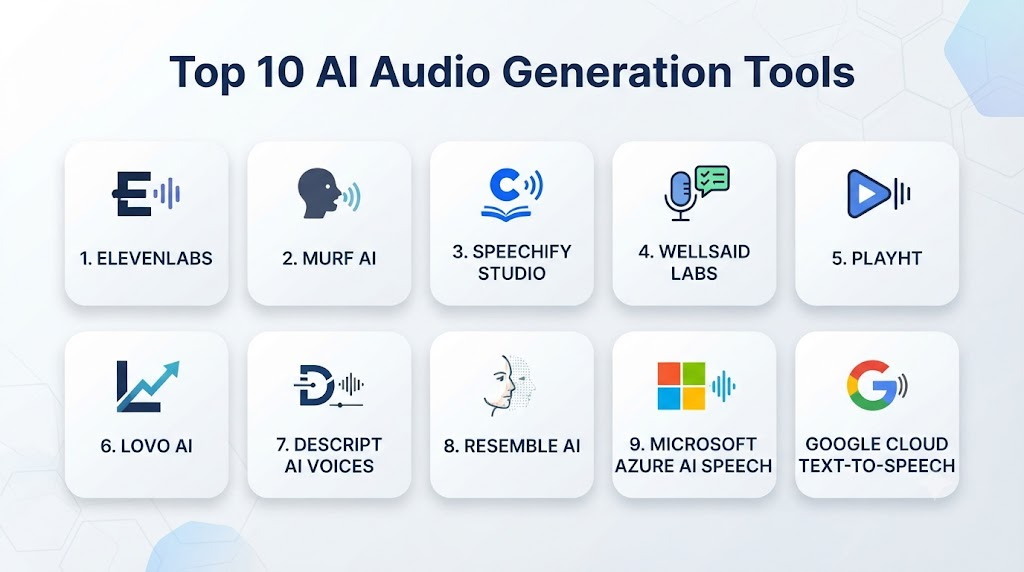
Top 10 AI Audio Generation Tools
1. ElevenLabs
Verdict: Best overall AI audio generation platform.
Short Description: ElevenLabs delivers highly realistic AI voice generation, multilingual speech synthesis, voice cloning, dubbing, and audio production for enterprise and creative use cases.
Key Features
- Text-to-speech
- Voice cloning
- Multilingual voices
- AI dubbing
- Speech synthesis
Pros
- Exceptional voice quality
- Natural speech generation
- Extensive language support
Cons
- Advanced voice cloning features require higher-tier plans
Deployment: Cloud-based platform
Security & Compliance: Enterprise-grade security controls
Integrations & Ecosystem: APIs, CMS, media platforms, creative workflows
Support & Community: Enterprise and developer support
Pricing Model: Subscription and usage-based
Best-Fit Scenarios: Professional voice generation
2. OpenAI Audio Models
Verdict: Best for conversational audio generation.
Short Description: OpenAI provides advanced speech generation, text-to-speech, speech understanding, and conversational voice capabilities through multimodal AI.
Key Features
- Text-to-speech
- Speech generation
- Voice interaction
- Natural narration
- API integration
Pros
- Excellent conversational quality
- Strong API ecosystem
Cons
- Advanced customization may require API development
3. Google Cloud Text-to-Speech
Verdict: Enterprise speech synthesis platform.
Short Description: Google Cloud offers scalable neural speech synthesis with multiple voices, languages, and enterprise integrations.
Key Features
- Neural TTS
- Multilingual voices
- SSML support
- API access
- Cloud scalability
Pros
- Reliable enterprise platform
- Wide language coverage
Cons
- Best suited for Google Cloud environments
4. Microsoft Azure AI Speech
Verdict: Enterprise AI speech platform.
Short Description: Azure AI Speech provides speech synthesis, custom neural voices, speech translation, and conversational AI integration.
Key Features
- Neural speech
- Custom voices
- Speech translation
- Voice synthesis
- Speech APIs
Pros
- Strong Microsoft ecosystem
- Enterprise security
Cons
- Advanced customization requires configuration
5. Amazon Polly
Verdict: Cloud-native AI voice generation platform.
Short Description: Amazon Polly delivers realistic speech synthesis, multilingual voice generation, and scalable cloud-based audio production.
Key Features
- Text-to-speech
- Neural voices
- SSML support
- Voice customization
- Cloud APIs
Pros
- High scalability
- AWS ecosystem integration
Cons
- Best suited for AWS deployments
6. Murf AI
Verdict: AI voiceover platform for business content.
Short Description: Murf AI specializes in professional voiceovers, presentations, e-learning narration, and marketing audio.
Key Features
- Voiceovers
- AI narration
- Voice editing
- Presentation audio
- Commercial voices
Pros
- Easy to use
- High-quality business voices
Cons
- More focused on voiceovers than music generation
7. PlayAI
Verdict: AI conversational voice platform.
Short Description: PlayAI provides realistic AI voices, conversational speech generation, voice cloning, and multilingual voice experiences.
Key Features
- AI voices
- Voice cloning
- Speech generation
- API integration
- Multilingual support
Pros
- Strong conversational voices
- Flexible APIs
Cons
- Enterprise features may require premium plans
8. Suno
Verdict: AI-powered music generation platform.
Short Description: Suno enables users to generate original music, vocals, instrumentals, and complete songs using AI prompts.
Key Features
- Music generation
- AI vocals
- Song creation
- Lyrics support
- Audio generation
Pros
- Excellent music quality
- Easy creative workflow
Cons
- Primarily focused on music generation
9. Udio
Verdict: AI music creation platform.
Short Description: Udio specializes in AI-generated songs, vocals, music production, and creative audio generation.
Key Features
- Song generation
- AI vocals
- Music creation
- Prompt-based composition
- Audio editing
Pros
- Strong music creativity
- High-quality generated songs
Cons
- Limited enterprise voiceover features
10. OpenAI-Based Custom AI Audio Production Assistant
Verdict: Flexible AI assistant for enterprise audio production.
Short Description: Organizations can build custom AI audio production assistants using large language models integrated with DAM systems, CMS platforms, marketing automation software, media production tools, customer support systems, and creative workflows. These assistants can generate scripts, narrations, voiceovers, multilingual audio, podcast outlines, accessibility content, and production recommendations while supporting human review before publication.
Key Features
- Voiceover generation
- Script narration
- Podcast planning
- Multilingual audio
- Workflow automation
Pros
- Highly customizable
- Flexible enterprise integrations
- Accelerates audio production
Cons
- Human review recommended before publishing
- Requires well-structured scripts and brand voice guidance
Comparison Table
| Platform | Voice Quality | Voice Cloning | Multilingual Support | Enterprise Integration | Best Use |
|---|---|---|---|---|---|
| ElevenLabs | Excellent | Excellent | Excellent | High | Professional Voice Generation |
| OpenAI Audio Models | Excellent | High | Excellent | High | Conversational AI |
| Google Cloud Text-to-Speech | High | Medium | Excellent | Excellent | Enterprise Speech |
| Microsoft Azure AI Speech | High | Excellent | Excellent | Excellent | Microsoft Ecosystem |
| Amazon Polly | High | Medium | Excellent | Excellent | AWS Applications |
| Murf AI | High | Medium | High | High | Business Voiceovers |
| PlayAI | High | High | High | High | Conversational Voice |
| Suno | Excellent | N/A | Medium | Medium | AI Music Generation |
| Udio | Excellent | N/A | Medium | Medium | AI Music Creation |
| OpenAI Custom | Custom | Custom | Custom | Custom | AI Audio Assistant |
Evaluation & Scoring Table
| Platform | AI Capability 20% | Audio Quality 20% | Features 15% | Integration 15% | Security 10% | Ease 10% | Value 10% | Total |
|---|---|---|---|---|---|---|---|---|
| ElevenLabs | 20 | 20 | 15 | 14 | 10 | 9 | 9 | 97 |
| OpenAI Audio Models | 20 | 19 | 15 | 14 | 10 | 9 | 8 | 95 |
| Google Cloud Text-to-Speech | 18 | 18 | 14 | 15 | 10 | 8 | 8 | 91 |
| Microsoft Azure AI Speech | 19 | 18 | 15 | 15 | 10 | 8 | 8 | 93 |
| Amazon Polly | 18 | 18 | 14 | 15 | 10 | 8 | 9 | 92 |
| Murf AI | 18 | 18 | 14 | 13 | 10 | 9 | 9 | 91 |
| PlayAI | 18 | 18 | 14 | 13 | 10 | 9 | 9 | 91 |
| Suno | 19 | 19 | 13 | 10 | 9 | 9 | 9 | 88 |
| Udio | 19 | 19 | 13 | 10 | 9 | 9 | 9 | 88 |
| OpenAI Custom | 20 | 18 | 13 | 15 | 8 | 8 | 9 | 91 |
Which AI Audio Generation Platform Is Right for You?
| If your priority is… | Recommended Platform |
|---|---|
| Professional AI voice generation | ElevenLabs |
| Conversational AI audio | OpenAI Audio Models |
| Enterprise speech synthesis | Google Cloud Text-to-Speech |
| Microsoft ecosystem | Microsoft Azure AI Speech |
| AWS cloud deployment | Amazon Polly |
| Business voiceovers | Murf AI |
| Conversational voice experiences | PlayAI |
| AI music generation | Suno |
| AI song creation | Udio |
| Custom enterprise audio assistant | OpenAI-Based AI Assistant |
Implementation Playbook
First 30 Days
- Define audio production goals
- Establish brand voice guidelines
- Identify priority use cases
- Select pilot teams
Days 31–60
- Integrate CMS, DAM, and media platforms
- Configure AI audio workflows
- Validate voice quality
- Train marketing and content teams
Days 61–90
- Scale AI audio production
- Standardize review workflows
- Optimize multilingual content
- Measure production efficiency
Common Mistakes
- Using poorly written scripts
- Ignoring pronunciation validation
- Publishing AI-generated audio without review
- Weak governance for voice cloning
- Poor workflow integration
- Limited multilingual testing
- Infrequent voice model updates
- Failure to monitor listener experience
Frequently Asked Questions
1. What are AI Audio Generation Tools?
They are AI-powered platforms that generate speech, voiceovers, music, sound effects, podcasts, and other audio content from text prompts or existing recordings.
2. How does AI generate audio?
AI uses neural speech synthesis, deep learning, generative models, and language understanding to convert text or prompts into natural-sounding audio.
3. Can AI create commercial voiceovers?
Yes. Many platforms support commercial voiceover production, marketing narration, training content, and customer communications, subject to their licensing terms.
4. Which industries use AI audio generation platforms?
Marketing, education, media, entertainment, healthcare, software, gaming, publishing, customer service, financial services, and e-commerce.
5. What data is required?
Scripts, text prompts, brand voice guidelines, pronunciation dictionaries, reference recordings, and creative requirements.
6. Can AI generate audio in multiple languages?
Yes. Many platforms support multilingual speech synthesis, dubbing, translation, and localized audio production.
7. Do these platforms integrate with enterprise software?
Many integrate with CMS platforms, DAM systems, cloud storage, marketing automation tools, media production software, customer support systems, and collaboration platforms.
8. Is AI-generated audio always production-ready?
Audio quality depends on script quality, voice selection, language support, AI model capabilities, and workflow configuration. Human review is recommended before publishing.
9. How are voice recordings and audio assets protected?
Organizations should implement encryption, access controls, secure storage, governance policies, audit logging, and comply with applicable privacy and intellectual property regulations.
10. What should companies evaluate before adoption?
Consider voice quality, multilingual support, voice cloning capabilities, integrations, scalability, governance, security, workflow automation, licensing, and operational compatibility.
Conclusion
AI Audio Generation Tools are transforming digital audio production by enabling realistic voice synthesis, multilingual narration, AI-powered voiceovers, music generation, and scalable content creation. By combining artificial intelligence, neural speech synthesis, generative AI, and deep learning, these platforms help organizations accelerate production, reduce costs, improve accessibility, and deliver engaging audio experiences across multiple channels.Organizations implementing AI audio generation solutions should prioritize strong governance for voice usage, high-quality scripts, seamless integration with DAM, CMS, marketing automation, and media production platforms, continuous review of AI-generated audio, and close collaboration between marketing teams, content creators, audio engineers, legal teams, and executive leadership. Platforms such as ElevenLabs, OpenAI Audio Models, Google Cloud Text-to-Speech, Microsoft Azure AI Speech, and Murf AI demonstrate how artificial intelligence is enabling faster, smarter, and more scalable audio production.
