Introduction
AI KYC Identity Verification with ML Tools use artificial intelligence, machine learning, computer vision, biometric analysis, and document intelligence technologies to help organizations verify customer identities, prevent fraud, and automate Know Your Customer (KYC) processes.
Identity verification is a critical requirement for industries such as banking, financial services, insurance, healthcare, fintech, telecommunications, and online platforms. Organizations must verify customer identities while maintaining security, compliance, and a smooth user experience.
Traditional KYC processes often depend on manual document checks, human reviews, and fragmented verification workflows. These approaches can be slow, costly, and vulnerable to identity fraud.
AI-powered KYC identity verification platforms automate identity checks by analyzing government documents, biometric information, facial recognition data, customer information, and risk signals. Machine learning models help detect suspicious activities, forged documents, and potential identity threats.
These tools help organizations:
- Automate identity verification
- Reduce manual KYC reviews
- Detect identity fraud
- Improve customer onboarding
- Support regulatory compliance
- Verify documents faster
- Enhance security controls
AI KYC solutions are used by:
- Banks
- Fintech companies
- Insurance providers
- Payment platforms
- E-commerce businesses
- Cryptocurrency platforms
- Healthcare organizations
- Government services
Modern AI identity verification platforms combine optical character recognition (OCR), machine learning, biometric verification, liveness detection, fraud detection, risk scoring, and compliance automation.
The goal of these solutions is to provide secure, accurate, and scalable identity verification while improving customer experiences.
How AI KYC Identity Verification with ML Works
Document Verification
AI analyzes:
- Identity cards
- Passports
- Driver licenses
- Business documents
- Proof-of-address documents
Machine learning models detect:
- Missing information
- Document inconsistencies
- Alterations
- Fake documents
Optical Character Recognition
OCR extracts information such as:
- Names
- Dates
- Identification numbers
- Addresses
- Document details
Biometric Verification
AI compares:
- Facial images
- Selfies
- Identity documents
- Biometric patterns
Liveness Detection
AI determines whether verification is performed by:
- A real person
- A photo
- A video replay
- A manipulated identity
Risk Analysis
Machine learning evaluates:
- Fraud indicators
- Behavioral patterns
- Identity risks
- Verification confidence
Common Use Cases
- Customer onboarding
- Banking KYC
- Account verification
- Digital payments
- Fraud prevention
- AML compliance support
- Remote identity checks
- Insurance applications
- Marketplace verification
- Employee verification
Why AI KYC Identity Verification Tools Matter
Faster Customer Onboarding
AI reduces the time required for identity checks.
Fraud Prevention
Machine learning helps detect suspicious identities and fraudulent documents.
Better Compliance
Organizations can maintain stronger KYC processes.
Improved Customer Experience
Automated verification reduces friction during registration.
Scalable Verification
Businesses can verify large numbers of users efficiently.
Evaluation Criteria for Buyers
Identity Verification Accuracy
Platforms should provide reliable document and biometric verification.
Fraud Detection Capability
Strong solutions should detect fake identities and suspicious activities.
Machine Learning Performance
AI models should improve detection and reduce false positives.
Global Document Support
Solutions should support different countries and document formats.
Security and Privacy
Identity data requires strong protection and access controls.
Integration Capability
Platforms should integrate with onboarding systems, banking platforms, and compliance tools.
User Experience
Verification should be simple and convenient for customers.
Key Trends
AI-Based Digital Identity Verification
Organizations are moving toward automated identity verification workflows.
Advanced Fraud Detection
Machine learning models are improving detection of sophisticated fraud attempts.
Biometric Authentication Growth
Facial recognition and liveness verification are becoming common in digital onboarding.
Automated Compliance Operations
AI is helping organizations manage KYC and regulatory requirements.
Real-Time Verification
Businesses are adopting faster identity verification experiences.
Privacy-Focused Identity Solutions
Organizations are focusing on secure handling of identity information.
Methodology
The following platforms were evaluated using:
- Identity verification capabilities
- Machine learning features
- Fraud detection capabilities
- Ease of use
- Integrations and ecosystem
- Security and privacy
- Performance and reliability
- Support and community
- Price and value
Top 10 AI KYC Identity Verification with ML Tools
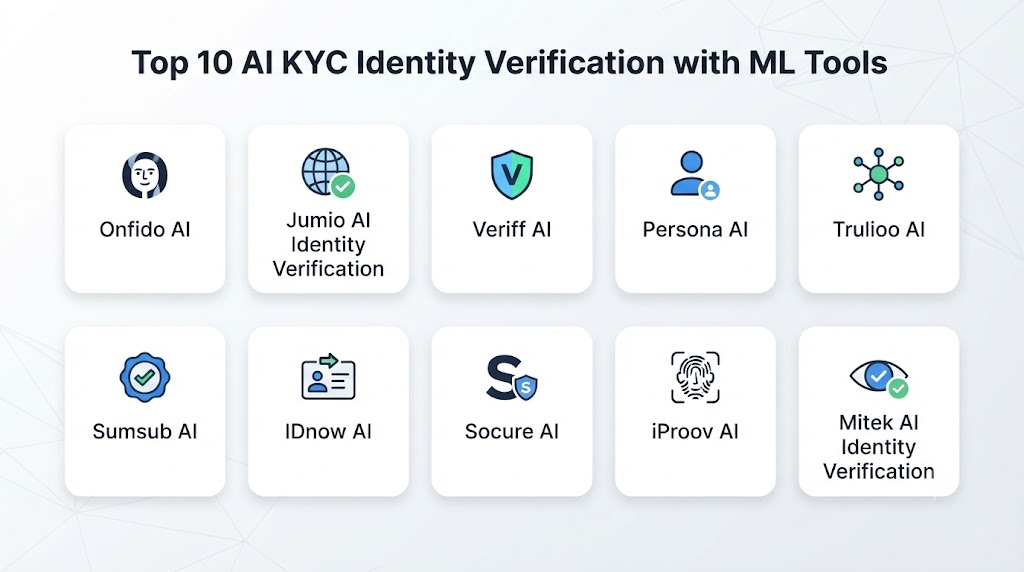
- Jumio
- Onfido
- Veriff
- Persona
- Trulioo
- Socure
- IDnow
- Sumsub
- Mitek
- GBG
1. Jumio
Jumio provides AI-powered identity verification and fraud prevention solutions using machine learning and biometric technologies.
Key Features
- AI identity verification
- Document verification
- Facial recognition
- Liveness detection
- Fraud detection
- Risk assessment
- Identity authentication
- Global document support
- Compliance support
- Verification workflows
Pros
- Strong identity verification capabilities
- Global document coverage
- Advanced fraud detection
- Enterprise adoption
- Supports regulated industries
Cons
- Enterprise-focused
- Implementation effort required
- Pricing varies
Platforms
Web and mobile applications.
Deployment or Support
Cloud-based identity verification platform.
Security & Compliance
Security controls vary.
Integrations & Ecosystem
Banking systems, fintech platforms, onboarding applications, and compliance workflows.
Support & Community
Enterprise support.
2. Onfido
Onfido provides AI-powered digital identity verification using document checks and biometric verification.
Key Features
- Identity verification
- AI document analysis
- Facial biometrics
- Liveness detection
- Fraud prevention
- Identity risk assessment
- Automated verification
- Mobile verification
- Workflow integration
- Reporting
Pros
- Strong biometric technology
- Good user experience
- Fast verification
- Developer-friendly integrations
- Global support
Cons
- Requires integration setup
- Advanced features depend on plan
- Enterprise pricing
Platforms
Web and mobile platforms.
Deployment or Support
Cloud-based identity verification service.
Security & Compliance
Security practices vary.
Integrations & Ecosystem
Fintech platforms, marketplaces, financial applications, and onboarding systems.
Support & Community
Customer support.
3. Veriff
Veriff provides AI-powered identity verification solutions designed to prevent fraud and automate customer onboarding.
Key Features
- AI identity verification
- Document analysis
- Facial verification
- Fraud detection
- Liveness detection
- Risk scoring
- Automated decisions
- Global identity support
- Verification analytics
- Compliance workflows
Pros
- Strong fraud prevention
- Fast verification
- Global capabilities
- Good automation
- User-friendly experience
Cons
- Enterprise-focused
- Requires configuration
- Pricing varies
Platforms
Web and mobile platforms.
Deployment or Support
Cloud-based identity verification platform.
Security & Compliance
Security controls vary.
Integrations & Ecosystem
Digital onboarding systems, fintech platforms, and business applications.
Support & Community
Customer support.
4. Persona
Persona provides customizable identity verification and fraud prevention infrastructure.
Key Features
- Identity verification
- Document checks
- Biometric verification
- Workflow customization
- Risk signals
- Fraud detection
- Identity verification APIs
- Case management
- User onboarding
- Compliance workflows
Pros
- Highly customizable
- Developer-friendly platform
- Flexible workflows
- Strong identity infrastructure
- Good automation
Cons
- Requires technical setup
- Customization needs expertise
- Enterprise deployment considerations
Platforms
Web and mobile platforms.
Deployment or Support
Cloud-based identity infrastructure platform.
Security & Compliance
Enterprise controls vary.
Integrations & Ecosystem
APIs, onboarding systems, fintech platforms, and enterprise applications.
Support & Community
Developer and customer support.
5. Trulioo
Trulioo provides global identity verification and digital identity solutions.
Key Features
- Global identity verification
- Document verification
- Identity data checks
- Risk assessment
- Fraud prevention
- Compliance support
- Business verification
- Customer onboarding
- Data intelligence
- Verification workflows
Pros
- Global identity coverage
- Strong data verification
- Supports international businesses
- Enterprise capabilities
- Good compliance support
Cons
- Complex global requirements
- Enterprise-focused
- Pricing varies
Platforms
Web-based platform.
Deployment or Support
Cloud-based identity verification platform.
Security & Compliance
Security controls vary.
Integrations & Ecosystem
Financial platforms, marketplaces, compliance systems, and APIs.
Support & Community
Enterprise support.
6. Socure
Socure provides AI-powered identity verification and fraud prevention solutions.
Key Features
- Machine learning identity verification
- Digital identity analysis
- Fraud detection
- Risk scoring
- Identity intelligence
- Predictive analytics
- Customer onboarding
- Verification workflows
- Compliance support
- Reporting
Pros
- Strong ML capabilities
- Fraud prevention focus
- Predictive analytics
- Supports financial services
- Advanced risk scoring
Cons
- Industry-focused
- Requires integration
- Enterprise pricing
Platforms
Web-based platform.
Deployment or Support
Cloud-based identity intelligence platform.
Security & Compliance
Security controls vary.
Integrations & Ecosystem
Financial institutions, fintech platforms, and compliance systems.
Support & Community
Enterprise support.
7. IDnow
IDnow provides identity verification solutions combining AI automation and human verification options.
Key Features
- AI identity verification
- Document checks
- Video identification
- Biometric verification
- Fraud prevention
- Compliance workflows
- Customer onboarding
- Identity management
- Verification reporting
- Risk analysis
Pros
- Supports multiple verification methods
- Strong European market presence
- Flexible workflows
- Compliance support
- Hybrid verification options
Cons
- Regional focus
- Requires setup
- Pricing varies
Platforms
Web and mobile platforms.
Deployment or Support
Cloud-based identity verification platform.
Security & Compliance
Security controls vary.
Integrations & Ecosystem
Banking systems, fintech platforms, and compliance workflows.
Support & Community
Customer support.
8. Sumsub
Sumsub provides AI-powered identity verification and compliance automation solutions.
Key Features
- Identity verification
- KYC automation
- AML support
- Document verification
- Biometric checks
- Fraud prevention
- Risk scoring
- Customer onboarding
- Compliance monitoring
- Reporting
Pros
- Broad compliance capabilities
- Supports multiple verification types
- Good automation
- Global support
- Useful risk management
Cons
- Requires configuration
- Complex compliance workflows
- Enterprise features vary
Platforms
Web and mobile platforms.
Deployment or Support
Cloud-based compliance platform.
Security & Compliance
Security controls vary.
Integrations & Ecosystem
Fintech platforms, payment systems, and compliance workflows.
Support & Community
Customer support.
9. Mitek
Mitek provides AI-powered identity verification and mobile capture solutions.
Key Features
- Document verification
- Identity authentication
- Mobile identity capture
- Fraud detection
- Digital onboarding
- Image analysis
- Biometric verification
- Risk assessment
- Verification workflows
- Security features
Pros
- Strong document capture technology
- Mobile verification experience
- Established identity solutions
- Fraud prevention capabilities
- Enterprise adoption
Cons
- Requires integration
- Enterprise-oriented
- Pricing varies
Platforms
Mobile and web platforms.
Deployment or Support
Cloud-based identity technology platform.
Security & Compliance
Security controls vary.
Integrations & Ecosystem
Banking applications, fintech systems, and digital onboarding platforms.
Support & Community
Enterprise support.
10. GBG
GBG provides identity verification, fraud prevention, and compliance technology solutions.
Key Features
- Identity verification
- Fraud detection
- Data verification
- Customer onboarding
- Risk assessment
- Compliance support
- Identity intelligence
- Document verification
- Analytics
- Global verification
Pros
- Strong identity data capabilities
- Global presence
- Fraud prevention expertise
- Enterprise support
- Compliance solutions
Cons
- Enterprise-focused
- Implementation complexity
- Pricing varies
Platforms
Web-based platform.
Deployment or Support
Cloud-based identity verification platform.
Security & Compliance
Security controls vary.
Integrations & Ecosystem
Financial systems, compliance platforms, and enterprise applications.
Support & Community
Enterprise support.
Comparison Table
| Tool Name | Best For | Platform(s) Supported | Deployment | Standout Feature | Public Rating |
|---|---|---|---|---|---|
| Jumio | Enterprise identity verification | Web/Mobile | Cloud | AI fraud detection | N/A |
| Onfido | Digital onboarding | Web/Mobile | Cloud | Biometric verification | N/A |
| Veriff | Fraud prevention | Web/Mobile | Cloud | Automated verification | N/A |
| Persona | Custom identity workflows | Web/Mobile | Cloud | Flexible identity infrastructure | N/A |
| Trulioo | Global verification | Web | Cloud | Global identity data | N/A |
| Socure | ML fraud detection | Web | Cloud | Predictive identity analytics | N/A |
| IDnow | Hybrid verification | Web/Mobile | Cloud | Multiple verification methods | N/A |
| Sumsub | KYC automation | Web/Mobile | Cloud | Compliance workflows | N/A |
| Mitek | Document verification | Web/Mobile | Cloud | Identity capture technology | N/A |
| GBG | Identity intelligence | Web | Cloud | Global verification | N/A |
Weighted Evaluation
| Tool Name | Core Features 25% | Ease of Use 15% | Integrations & Ecosystem 15% | Security & Compliance 10% | Performance & Reliability 10% | Support & Community 10% | Price/Value 15% | Total |
|---|---|---|---|---|---|---|---|---|
| Jumio | 25 | 13 | 14 | 10 | 10 | 10 | 10 | 92 |
| Onfido | 24 | 14 | 14 | 10 | 10 | 10 | 11 | 93 |
| Veriff | 24 | 14 | 13 | 10 | 10 | 10 | 11 | 92 |
| Persona | 24 | 13 | 15 | 10 | 10 | 10 | 11 | 93 |
| Trulioo | 24 | 12 | 15 | 10 | 10 | 10 | 10 | 91 |
| Socure | 24 | 13 | 14 | 10 | 10 | 10 | 10 | 91 |
| IDnow | 23 | 13 | 13 | 10 | 10 | 10 | 11 | 90 |
| Sumsub | 23 | 14 | 14 | 9 | 10 | 10 | 12 | 92 |
| Mitek | 22 | 13 | 14 | 10 | 10 | 10 | 11 | 90 |
| GBG | 23 | 12 | 14 | 10 | 10 | 10 | 10 | 89 |
Which AI KYC Identity Verification with ML Tool Is Right for You?
Choose Jumio when organizations need enterprise identity verification with strong fraud detection.
Choose Onfido when digital onboarding and biometric verification are priorities.
Choose Veriff when automated identity verification and fraud prevention matter.
Choose Persona when customizable identity workflows are required.
Choose Trulioo when global identity verification is important.
Choose Socure when machine learning-based identity intelligence is needed.
Choose IDnow when multiple verification methods are required.
Choose Sumsub when KYC and compliance automation are priorities.
Choose Mitek when document verification and mobile identity capture are important.
Choose GBG when global identity intelligence and fraud prevention are required.
Implementation Playbook
Phase 1: Define Verification Requirements
- Identify customer verification needs
- Select verification methods
- Define compliance requirements
- Establish fraud detection goals
- Determine user experience requirements
Phase 2: Prepare Integration
- Connect identity systems
- Configure workflows
- Set security controls
- Review data handling requirements
- Test verification processes
Phase 3: Deploy AI Verification
- Enable document checks
- Configure biometric verification
- Activate risk scoring
- Review verification results
- Train operational teams
Phase 4: Monitor Performance
- Track fraud detection
- Review false positives
- Measure onboarding speed
- Improve workflows
- Analyze verification trends
Phase 5: Maintain Identity Security
- Update verification rules
- Monitor fraud patterns
- Review compliance requirements
- Improve AI models
- Protect identity data
Common Mistakes
- Relying only on automated verification
- Ignoring privacy requirements
- Using outdated identity data
- Poor integration planning
- Not monitoring fraud trends
- Failing to review false positives
- Ignoring user experience
- Not updating verification processes
FAQs
1. What are AI KYC Identity Verification Tools?
AI KYC Identity Verification Tools use artificial intelligence and machine learning to verify customer identities, detect fraud, and automate onboarding processes.
2. How does machine learning improve KYC verification?
Machine learning helps identify fraud patterns, analyze identity information, and improve verification accuracy.
3. Can AI replace manual identity verification completely?
AI can automate many verification steps, but human review may still be needed for complex cases.
4. What documents can AI KYC tools verify?
They can verify passports, identity cards, driver licenses, and other identity documents.
5. How does facial verification work?
AI compares facial information from a user with identity documents and checks authenticity.
6. What is liveness detection in KYC?
Liveness detection determines whether verification is performed by a real person rather than a photo or recording.
7. Which industries use AI KYC verification?
Banks, fintech companies, insurance providers, marketplaces, and regulated businesses use these tools.
8. Are AI KYC tools secure?
Organizations should evaluate encryption, access controls, privacy practices, and compliance features.
9. Can AI KYC systems detect fake identities?
Many platforms use machine learning models to identify suspicious documents and fraud indicators.
10. What should companies consider before selecting an AI KYC platform?
Companies should evaluate accuracy, fraud detection, security, integrations, compliance support, scalability, and cost.
Conclusion
AI KYC Identity Verification with ML Tools are transforming customer onboarding and fraud prevention by combining artificial intelligence, biometric verification, document intelligence, and risk analytics.Jumio, Onfido, Veriff, and Persona provide strong identity verification capabilities, while Trulioo, Socure, Sumsub, and GBG support broader identity intelligence and compliance requirements.
