Introduction
AI Fraud Detection for Benefits Programs Tools use artificial intelligence, machine learning, anomaly detection, and predictive analytics to help government agencies, insurance providers, financial institutions, and organizations identify fraudulent activities in benefit distribution programs.
Benefits programs such as healthcare assistance, unemployment benefits, social support programs, insurance claims, and financial aid systems process millions of applications and transactions. Managing these programs manually can make it difficult to identify fraudulent claims, duplicate applications, identity misuse, and suspicious behavior patterns.
Traditional fraud detection methods often rely on manual reviews, predefined rules, and historical investigations. These approaches may miss complex fraud patterns and require significant resources to analyze large volumes of beneficiary data.
AI-powered fraud detection platforms analyze application data, transaction histories, identity information, behavioral patterns, and external signals to detect suspicious activities. Machine learning models continuously improve by learning from new fraud patterns and investigation outcomes.
These tools help organizations:
- Detect fraudulent benefit claims
- Identify suspicious applications
- Reduce financial losses
- Improve investigation efficiency
- Automate risk scoring
- Prevent duplicate payments
- Strengthen program integrity
AI fraud detection solutions are used by:
- Government benefit agencies
- Healthcare programs
- Insurance providers
- Financial assistance organizations
- Public service departments
- Social security programs
- Compliance teams
Modern platforms combine machine learning, identity verification, anomaly detection, network analysis, predictive analytics, case management, and investigation workflows.
The goal of these solutions is to protect benefit programs while ensuring legitimate recipients receive support efficiently.
How AI Fraud Detection for Benefits Programs Works
Data Collection
AI systems analyze:
- Application information
- Identity records
- Payment history
- Claim details
- Behavioral data
- External risk signals
Pattern Detection
Machine learning identifies:
- Unusual applications
- Duplicate records
- Suspicious relationships
- Abnormal transactions
Risk Scoring
AI assigns risk levels based on:
- Fraud indicators
- Historical patterns
- User behavior
- Transaction characteristics
Investigation Support
Platforms provide:
- Case prioritization
- Fraud alerts
- Investigation workflows
- Evidence analysis
Continuous Learning
AI improves through:
- New fraud cases
- Investigation results
- Updated risk patterns
Common Use Cases
- Social benefit fraud detection
- Healthcare benefit fraud prevention
- Insurance fraud analysis
- Unemployment claim monitoring
- Identity fraud detection
- Duplicate claim detection
- Payment integrity programs
- Eligibility verification
- Public assistance monitoring
- Financial aid fraud prevention
Why AI Fraud Detection Tools Matter
Reduce Financial Losses
AI helps identify fraudulent activity before funds are misused.
Faster Fraud Investigation
Automation helps investigators focus on high-risk cases.
Better Accuracy
Machine learning identifies complex fraud patterns.
Improve Program Integrity
Organizations can maintain trust in benefit systems.
Efficient Resource Allocation
Teams can prioritize investigations based on risk.
Evaluation Criteria for Buyers
Fraud Detection Accuracy
Platforms should identify real fraud while reducing false alerts.
AI Analytics Capability
Tools should detect complex behavioral patterns.
Identity Verification
Solutions should support secure identity validation.
Case Management
Platforms should support investigation workflows.
Integration Capability
Important integrations include:
- Government databases
- Claims systems
- Payment platforms
- Identity services
- Enterprise applications
Security and Privacy
Sensitive beneficiary data requires strong protection.
Scalability
Solutions should handle large benefit programs.
Key Trends
AI-Based Program Integrity
Organizations are adopting AI to improve fraud prevention.
Predictive Fraud Analytics
Machine learning is helping identify fraud before losses occur.
Identity Intelligence
AI is improving identity verification and beneficiary validation.
Automated Investigation Support
Fraud teams are using AI to prioritize cases.
Network-Based Fraud Detection
AI is identifying relationships between suspicious entities.
Explainable AI
Organizations are focusing on transparent fraud decisions.
Methodology
The following platforms were evaluated using:
- Fraud detection capabilities
- AI and machine learning features
- Case management functionality
- Identity verification support
- Ease of use
- Integrations and ecosystem
- Security and privacy
- Performance and reliability
- Support and community
- Price and value
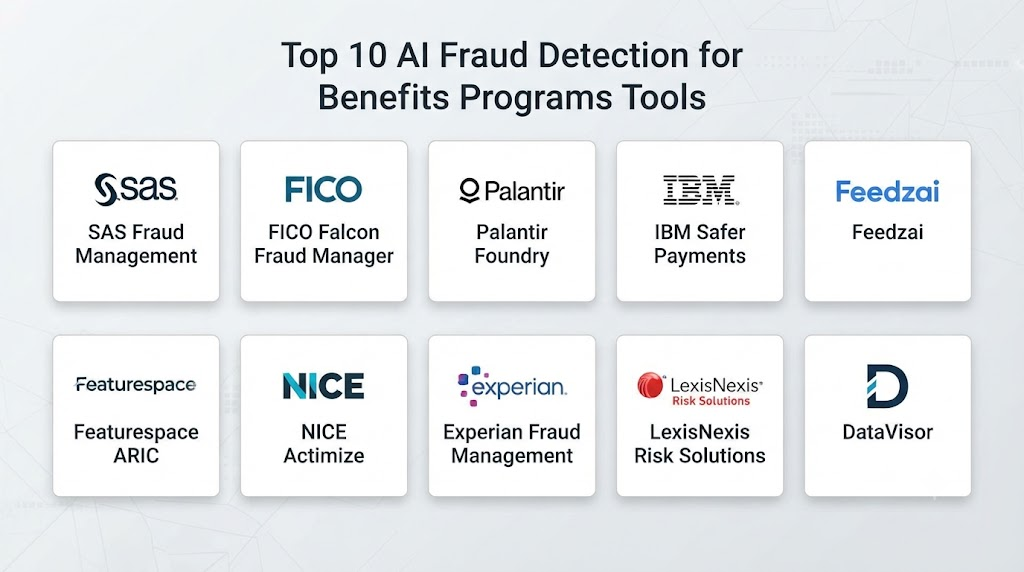
Top 10 AI Fraud Detection for Benefits Programs Tools
1. SAS Fraud Management
SAS Fraud Management provides AI-powered fraud analytics and investigation capabilities.
Key Features
- Machine learning fraud detection
- Risk scoring
- Anomaly detection
- Predictive analytics
- Case management
- Investigation workflows
- Fraud monitoring
- Reporting dashboards
- Behavioral analytics
- Decision automation
Pros
- Strong analytics capabilities
- Enterprise adoption
- Advanced fraud detection
- Flexible modeling
- Supports complex programs
Cons
- Requires technical expertise
- Enterprise implementation
- Configuration complexity
Platforms
Cloud and enterprise platforms.
Deployment or Support
Cloud and enterprise deployment options.
Security & Compliance
Enterprise security controls.
Integrations & Ecosystem
Government systems, databases, payment platforms, and enterprise applications.
Support & Community
Enterprise support.
2. FICO Falcon Fraud Manager
FICO Falcon provides AI-based fraud detection and risk management capabilities.
Key Features
- Machine learning models
- Fraud scoring
- Identity risk analysis
- Behavioral analytics
- Transaction monitoring
- Predictive intelligence
- Case management
- Risk alerts
- Decision automation
- Reporting
Pros
- Strong fraud analytics
- Mature technology
- Real-time risk scoring
- Enterprise scalability
- Proven fraud prevention capabilities
Cons
- Enterprise-focused
- Requires integration
- Implementation effort
Platforms
Cloud and enterprise platforms.
Deployment or Support
Enterprise deployment options.
Security & Compliance
Enterprise security controls.
Integrations & Ecosystem
Payment systems, databases, government platforms, and business applications.
Support & Community
Professional support.
3. Palantir Foundry
Palantir Foundry provides data integration, analytics, and operational intelligence capabilities.
Key Features
- Data integration
- Fraud analytics
- Pattern detection
- Entity resolution
- Investigation workflows
- Risk analysis
- Data visualization
- Collaboration tools
- Decision support
- AI analytics
Pros
- Strong data integration
- Advanced analytics
- Handles complex datasets
- Good investigation support
- Enterprise scalability
Cons
- Requires expertise
- Complex implementation
- Enterprise-focused
Platforms
Cloud and enterprise platforms.
Deployment or Support
Cloud and private deployment options.
Security & Compliance
Enterprise security controls.
Integrations & Ecosystem
Government systems, databases, analytics platforms, and enterprise applications.
Support & Community
Enterprise support.
4. IBM Safer Payments
IBM Safer Payments provides real-time fraud prevention and payment monitoring.
Key Features
- Fraud detection
- Risk scoring
- Payment monitoring
- Machine learning analytics
- Rule management
- Transaction analysis
- Investigation support
- Reporting
- Decision automation
- Compliance support
Pros
- Strong payment fraud capabilities
- Real-time analysis
- Flexible rules
- Enterprise-ready
- Good analytics
Cons
- Requires configuration
- Enterprise-focused
- Technical expertise needed
Platforms
Enterprise platform.
Deployment or Support
Cloud and enterprise deployment options.
Security & Compliance
Enterprise security controls.
Integrations & Ecosystem
Payment systems, databases, and enterprise applications.
Support & Community
Enterprise support.
5. Feedzai
Feedzai provides AI-powered financial crime and fraud detection solutions.
Key Features
- Machine learning detection
- Risk scoring
- Behavioral analysis
- Identity intelligence
- Real-time monitoring
- Fraud alerts
- Investigation support
- Analytics dashboards
- Decision automation
- Case management
Pros
- Strong AI fraud detection
- Real-time analytics
- Good behavioral analysis
- Scalable platform
- Advanced risk scoring
Cons
- Enterprise-oriented
- Requires integration
- Pricing varies
Platforms
Cloud-based platform.
Deployment or Support
Cloud deployment.
Security & Compliance
Enterprise security controls.
Integrations & Ecosystem
Financial systems, payment platforms, and enterprise applications.
Support & Community
Customer support.
6. Featurespace ARIC
Featurespace ARIC provides adaptive behavioral analytics for fraud detection.
Key Features
- Behavioral analytics
- Machine learning models
- Fraud detection
- Risk scoring
- Pattern recognition
- Real-time monitoring
- Alerts
- Investigation support
- Analytics
- Decision automation
Pros
- Strong behavioral analysis
- Adaptive machine learning
- Real-time detection
- Good fraud insights
- Scalable
Cons
- Requires technical setup
- Enterprise-focused
- Integration effort
Platforms
Cloud-based platform.
Deployment or Support
Cloud deployment.
Security & Compliance
Security controls vary.
Integrations & Ecosystem
Payment systems, databases, and business platforms.
Support & Community
Customer support.
7. NICE Actimize
NICE Actimize provides financial crime and fraud management capabilities.
Key Features
- Fraud analytics
- Risk monitoring
- Case management
- Investigation workflows
- Machine learning
- Alerts
- Compliance reporting
- Behavioral analysis
- Decision automation
- Analytics
Pros
- Comprehensive fraud platform
- Strong compliance features
- Enterprise adoption
- Good investigation tools
- Supports large programs
Cons
- Complex deployment
- Requires expertise
- Enterprise-focused
Platforms
Cloud and enterprise platforms.
Deployment or Support
Cloud and enterprise deployment.
Security & Compliance
Enterprise security controls.
Integrations & Ecosystem
Financial systems, databases, compliance tools, and enterprise applications.
Support & Community
Enterprise support.
8. Experian Fraud Management
Experian provides identity verification and fraud prevention solutions.
Key Features
- Identity verification
- Fraud scoring
- Risk analytics
- Data intelligence
- Identity monitoring
- Decision automation
- Reporting
- Verification workflows
- Risk assessment
- Analytics
Pros
- Strong identity intelligence
- Large data ecosystem
- Useful fraud scoring
- Supports verification processes
- Enterprise capabilities
Cons
- Requires integration
- Enterprise-oriented
- Scope depends on data access
Platforms
Cloud-based platform.
Deployment or Support
Cloud deployment.
Security & Compliance
Security controls vary.
Integrations & Ecosystem
Identity systems, databases, government platforms, and business applications.
Support & Community
Customer support.
9. LexisNexis Risk Solutions
LexisNexis Risk Solutions provides identity intelligence and fraud prevention capabilities.
Key Features
- Identity verification
- Fraud analytics
- Risk scoring
- Entity resolution
- Data intelligence
- Identity insights
- Monitoring
- Reporting
- Investigation support
- Compliance tools
Pros
- Strong identity data capabilities
- Good risk analytics
- Supports fraud investigations
- Large data network
- Enterprise-ready
Cons
- Requires integration
- Enterprise pricing
- Data complexity
Platforms
Cloud-based platform.
Deployment or Support
Cloud deployment.
Security & Compliance
Security controls vary.
Integrations & Ecosystem
Government systems, financial platforms, and enterprise applications.
Support & Community
Professional support.
10. DataVisor
DataVisor provides AI-based fraud detection and risk analytics.
Key Features
- Machine learning detection
- Fraud analytics
- Anomaly detection
- Risk scoring
- Identity intelligence
- Behavioral analysis
- Investigation support
- Reporting
- Real-time monitoring
- Automation
Pros
- Strong AI capabilities
- Detects unknown fraud patterns
- Real-time analytics
- Good scalability
- Advanced detection models
Cons
- Requires integration
- Enterprise-focused
- Implementation effort
Platforms
Cloud-based platform.
Deployment or Support
Cloud deployment.
Security & Compliance
Security controls vary.
Integrations & Ecosystem
Financial systems, databases, and enterprise applications.
Support & Community
Customer support.
Comparison Table
| Tool Name | Best For | Platform(s) Supported | Deployment | Standout Feature | Public Rating |
|---|---|---|---|---|---|
| SAS Fraud Management | Enterprise fraud analytics | Cloud/Enterprise | Hybrid | Predictive analytics | N/A |
| FICO Falcon | Risk scoring | Cloud/Enterprise | Hybrid | Fraud intelligence | N/A |
| Palantir Foundry | Data-driven investigations | Cloud | Cloud | Data integration | N/A |
| IBM Safer Payments | Payment fraud | Enterprise | Hybrid | Real-time detection | N/A |
| Feedzai | AI fraud prevention | Cloud | Cloud | Behavioral analytics | N/A |
| Featurespace ARIC | Adaptive fraud detection | Cloud | Cloud | Machine learning | N/A |
| NICE Actimize | Fraud management | Cloud/Enterprise | Hybrid | Investigation workflows | N/A |
| Experian Fraud Management | Identity fraud | Cloud | Cloud | Identity intelligence | N/A |
| LexisNexis Risk Solutions | Identity analytics | Cloud | Cloud | Risk data | N/A |
| DataVisor | AI fraud detection | Cloud | Cloud | Unknown fraud detection | N/A |
Weighted Evaluation
| Tool Name | Core Features 25% | Ease of Use 15% | Integrations & Ecosystem 15% | Security & Compliance 10% | Performance & Reliability 10% | Support & Community 10% | Price/Value 15% | Total |
|---|---|---|---|---|---|---|---|---|
| SAS Fraud Management | 25 | 12 | 15 | 10 | 10 | 10 | 10 | 92 |
| FICO Falcon | 25 | 12 | 15 | 10 | 10 | 10 | 10 | 92 |
| Palantir Foundry | 24 | 11 | 15 | 10 | 10 | 10 | 11 | 91 |
| IBM Safer Payments | 23 | 12 | 14 | 10 | 10 | 10 | 11 | 90 |
| Feedzai | 24 | 13 | 14 | 10 | 10 | 10 | 11 | 92 |
| Featurespace ARIC | 23 | 13 | 13 | 10 | 10 | 10 | 11 | 90 |
| NICE Actimize | 24 | 11 | 15 | 10 | 10 | 10 | 10 | 90 |
| Experian Fraud Management | 23 | 13 | 14 | 10 | 10 | 10 | 11 | 91 |
| LexisNexis Risk Solutions | 23 | 12 | 14 | 10 | 10 | 10 | 11 | 90 |
| DataVisor | 23 | 13 | 13 | 10 | 10 | 10 | 11 | 90 |
Which AI Fraud Detection for Benefits Programs Tool Is Right for You?
Choose SAS Fraud Management when advanced analytics and enterprise fraud prevention are required.
Choose FICO Falcon when organizations need mature fraud scoring capabilities.
Choose Palantir Foundry when complex data investigations are important.
Choose IBM Safer Payments when payment fraud monitoring is the priority.
Choose Feedzai when real-time AI fraud detection is needed.
Choose Featurespace ARIC when behavioral analytics are important.
Choose NICE Actimize when comprehensive fraud investigation workflows are required.
Choose Experian Fraud Management when identity intelligence is the focus.
Choose LexisNexis Risk Solutions when identity verification and risk data are needed.
Choose DataVisor when detecting emerging fraud patterns is important.
Implementation Playbook
Phase 1: Define Fraud Prevention Goals
- Identify fraud risks
- Define program requirements
- Select data sources
- Establish investigation processes
- Set success metrics
Phase 2: Prepare Data Sources
- Connect benefit systems
- Integrate identity data
- Clean historical records
- Configure risk indicators
- Establish security controls
Phase 3: Deploy AI Fraud Detection
- Train models
- Configure risk scoring
- Monitor alerts
- Review cases
- Improve detection rules
Phase 4: Measure Performance
- Reduce fraud losses
- Improve investigation speed
- Monitor false positives
- Optimize workflows
- Review outcomes
Phase 5: Maintain Program Integrity
- Update fraud models
- Monitor new patterns
- Review investigations
- Improve policies
- Maintain compliance
Common Mistakes
- Relying only on AI decisions
- Ignoring false positives
- Poor data quality
- Weak identity verification
- Lack of investigation workflows
- Ignoring privacy requirements
- Not updating fraud models
- Poor integration planning
FAQs
1. What are AI Fraud Detection for Benefits Programs Tools?
These tools use artificial intelligence to identify suspicious activities, fraudulent claims, and unusual patterns in benefit programs.
2. How does AI detect benefits fraud?
AI analyzes application data, transaction patterns, identities, and behavioral signals to identify potential fraud.
3. Can AI prevent all fraud?
No. AI helps reduce fraud risk but requires human investigation and governance.
4. What types of fraud can these tools detect?
They can detect identity misuse, duplicate claims, false applications, and suspicious transactions.
5. Are these tools useful for government programs?
Yes. They help government agencies improve benefit program integrity.
6. How does machine learning improve fraud detection?
Machine learning identifies complex patterns and adapts to changing fraud behaviors.
7. Are AI fraud detection systems secure?
Organizations should evaluate privacy controls, security practices, and data protection measures.
8. Can these tools integrate with existing benefit systems?
Many solutions integrate with databases, claims platforms, and government systems.
9. How do organizations measure fraud detection success?
They measure fraud reduction, investigation efficiency, accuracy, and program savings.
10. What should organizations consider before selecting an AI fraud detection tool?
Organizations should evaluate accuracy, scalability, integrations, security, analytics capabilities, and cost.
Conclusion
AI Fraud Detection for Benefits Programs Tools are helping organizations protect public resources and improve program integrity through intelligent analytics, automated risk scoring, and advanced fraud detection.SAS Fraud Management, FICO Falcon, Feedzai, and NICE Actimize provide strong fraud analytics capabilities, while Palantir, Experian, LexisNexis, and DataVisor support advanced identity and investigation needs.The most effective fraud prevention strategy combines AI-powered detection with human expertise, transparent decision-making, strong data governance, and continuous monitoring. AI should help organizations reduce fraud while ensuring legitimate beneficiaries receive essential support.
