Introduction
AI Tax Compliance Risk Scoring Tools use artificial intelligence, machine learning, predictive analytics, and data intelligence technologies to help tax authorities, financial organizations, and enterprises identify, evaluate, and manage tax compliance risks.
Tax compliance involves analyzing large volumes of financial records, transactions, filings, invoices, payments, and business information. Traditional tax review processes often depend on manual audits, rule-based checks, and historical investigations, which can be time-consuming and may not identify complex risk patterns.
AI-powered tax compliance risk scoring platforms analyze financial data, taxpayer behavior, transaction patterns, reporting history, and regulatory information to identify potential compliance issues. These systems help organizations prioritize reviews, detect anomalies, and improve tax governance.
These tools help organizations:
- Identify high-risk tax activities
- Prioritize tax audits and reviews
- Detect unusual financial patterns
- Improve compliance monitoring
- Reduce manual assessment efforts
- Support tax decision-making
- Improve revenue protection
AI tax compliance risk scoring solutions are used by:
- Tax authorities
- Government revenue departments
- Large enterprises
- Accounting firms
- Financial institutions
- Compliance teams
- Corporate tax departments
Modern platforms combine machine learning, anomaly detection, predictive analytics, risk scoring, data integration, and compliance workflow automation.
The goal of these solutions is to improve tax compliance efficiency while helping organizations make better risk-based decisions.
How AI Tax Compliance Risk Scoring Works
Data Collection
AI systems analyze:
- Tax filings
- Financial statements
- Transaction records
- Payment information
- Business profiles
- Historical compliance data
Data Analysis
Machine learning identifies:
- Reporting inconsistencies
- Unusual transactions
- Risk patterns
- Compliance gaps
Risk Scoring
AI assigns risk levels based on:
- Tax behavior
- Financial activity
- Historical records
- Industry patterns
Review Prioritization
Organizations can focus on:
- High-risk taxpayers
- Suspicious transactions
- Complex cases
Continuous Improvement
Models improve through:
- Audit outcomes
- New compliance data
- Changing regulations
Common Use Cases
- Tax audit prioritization
- Corporate tax risk management
- VAT compliance monitoring
- Income tax risk analysis
- Transaction anomaly detection
- Revenue protection programs
- Tax fraud detection
- Compliance reporting
- Regulatory investigations
- Financial risk assessment
Why AI Tax Compliance Risk Scoring Tools Matter
Better Risk Identification
AI helps detect complex tax compliance patterns.
Faster Reviews
Organizations can prioritize important cases.
Improved Audit Efficiency
Tax teams can focus resources on higher-risk areas.
Reduced Compliance Risk
AI supports proactive identification of potential issues.
Data-Driven Decisions
Organizations gain better insights from financial data.
Evaluation Criteria for Buyers
Risk Scoring Accuracy
Platforms should provide reliable compliance risk assessments.
AI Analytics Capability
Solutions should identify patterns across large datasets.
Data Integration
Tools should connect with financial, tax, and business systems.
Regulatory Support
Platforms should support changing tax requirements.
Reporting and Analytics
Organizations need clear risk dashboards.
Security and Privacy
Tax information requires strong protection.
Scalability
Solutions should support large taxpayer or enterprise environments.
Key Trends
AI-Based Tax Analytics
Organizations are adopting AI to improve compliance monitoring.
Predictive Tax Risk Assessment
Machine learning is helping identify potential issues before audits.
Automated Tax Review
AI is reducing manual analysis of financial information.
Real-Time Compliance Monitoring
Businesses are moving toward continuous tax oversight.
Data-Driven Revenue Management
Tax authorities are using analytics to improve collection processes.
Explainable AI in Tax Decisions
Organizations are focusing on transparent risk scoring.
Methodology
The following platforms were evaluated using:
- AI tax analytics capabilities
- Risk scoring functionality
- Compliance management features
- Data analysis capabilities
- Ease of use
- Integrations and ecosystem
- Security and privacy
- Performance and reliability
- Support and community
- Price and value
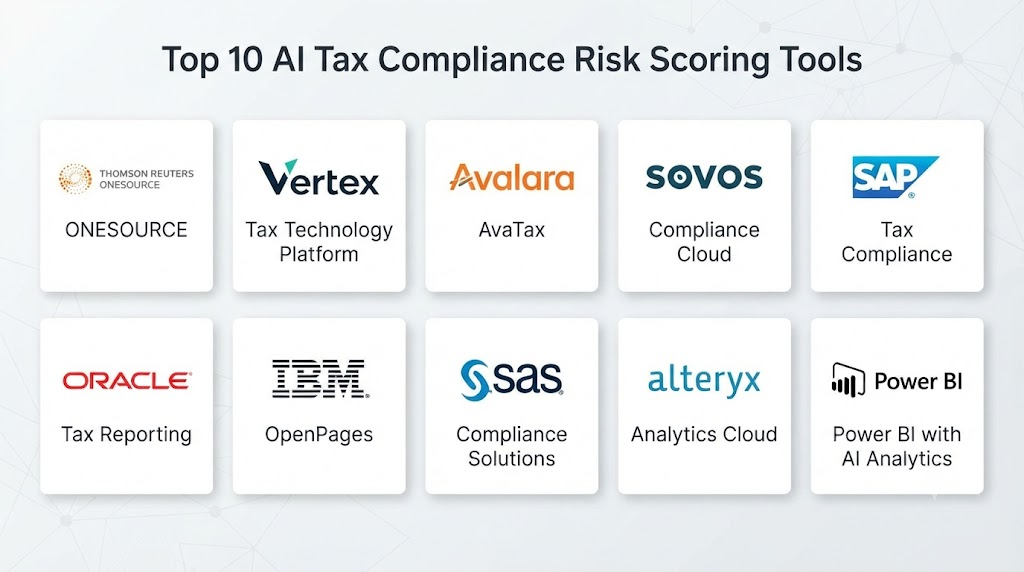
Top 10 AI Tax Compliance Risk Scoring Tools
1. Thomson Reuters ONESOURCE
Thomson Reuters ONESOURCE provides tax technology solutions for compliance, reporting, and tax management.
Key Features
- Tax compliance management
- Tax reporting
- Risk analysis
- Data management
- Tax workflow automation
- Regulatory updates
- Analytics
- Reporting dashboards
- Compliance tracking
- Enterprise integrations
Pros
- Strong tax domain expertise
- Broad compliance capabilities
- Enterprise adoption
- Good reporting features
- Supports global tax operations
Cons
- Enterprise-focused
- Requires configuration
- Implementation effort
Platforms
Cloud-based platform.
Deployment or Support
Cloud enterprise deployment.
Security & Compliance
Enterprise security controls.
Integrations & Ecosystem
ERP systems, finance platforms, tax systems, and enterprise applications.
Support & Community
Enterprise support.
2. Vertex Tax Technology Platform
Vertex provides tax automation and compliance management solutions.
Key Features
- Tax calculation
- Compliance management
- Tax reporting
- Risk analysis
- Transaction monitoring
- Data integration
- Tax automation
- Analytics
- Regulatory support
- Reporting
Pros
- Strong tax automation
- Enterprise scalability
- Good ERP integrations
- Tax-focused capabilities
- Global support
Cons
- Requires implementation
- Enterprise pricing
- Configuration complexity
Platforms
Cloud-based platform.
Deployment or Support
Cloud and enterprise deployment.
Security & Compliance
Enterprise security controls.
Integrations & Ecosystem
ERP systems, finance applications, and business platforms.
Support & Community
Professional support.
3. Avalara AvaTax
Avalara AvaTax provides automated tax calculation and compliance capabilities.
Key Features
- Tax calculation
- Compliance automation
- Transaction analysis
- Reporting
- Tax determination
- Data integration
- Risk monitoring
- Regulatory updates
- Workflow support
- Analytics
Pros
- Easy integration
- Strong tax automation
- Suitable for businesses of different sizes
- Good compliance support
- Cloud-based platform
Cons
- More focused on tax calculation
- Advanced risk analytics vary
- Requires configuration
Platforms
Cloud-based platform.
Deployment or Support
Cloud deployment.
Security & Compliance
Security controls vary.
Integrations & Ecosystem
Commerce platforms, ERP systems, and financial applications.
Support & Community
Customer support.
4. Sovos Compliance Cloud
Sovos provides tax compliance and regulatory reporting solutions.
Key Features
- Tax compliance
- Regulatory reporting
- Transaction monitoring
- Tax risk analysis
- Compliance workflows
- Data validation
- Reporting dashboards
- Automation
- Global tax support
- Integration tools
Pros
- Strong compliance focus
- Global tax capabilities
- Regulatory expertise
- Good automation
- Enterprise support
Cons
- Complex implementation
- Enterprise-focused
- Requires configuration
Platforms
Cloud-based platform.
Deployment or Support
Cloud deployment.
Security & Compliance
Enterprise security controls.
Integrations & Ecosystem
ERP systems, finance platforms, and government reporting systems.
Support & Community
Enterprise support.
5. SAP Tax Compliance
SAP Tax Compliance provides tax monitoring and compliance management capabilities.
Key Features
- Tax risk analysis
- Compliance monitoring
- Financial data analysis
- Exception detection
- Reporting
- Audit support
- Workflow automation
- ERP integration
- Risk scoring
- Analytics
Pros
- Strong SAP integration
- Enterprise financial visibility
- Good compliance workflows
- Supports large organizations
- Data-driven analysis
Cons
- Best for SAP environments
- Requires expertise
- Enterprise implementation
Platforms
Enterprise cloud platform.
Deployment or Support
Cloud and enterprise deployment.
Security & Compliance
Enterprise security controls.
Integrations & Ecosystem
SAP systems and enterprise applications.
Support & Community
Enterprise support.
6. Oracle Tax Reporting
Oracle provides tax reporting and compliance management capabilities.
Key Features
- Tax reporting
- Financial analytics
- Compliance management
- Data integration
- Risk monitoring
- Reporting dashboards
- Workflow automation
- Financial data analysis
- Enterprise integration
- Governance support
Pros
- Strong enterprise ecosystem
- Good financial integration
- Scalable platform
- Reporting capabilities
- Supports complex organizations
Cons
- Enterprise-focused
- Requires configuration
- Implementation complexity
Platforms
Cloud platform.
Deployment or Support
Oracle Cloud deployment.
Security & Compliance
Enterprise security controls.
Integrations & Ecosystem
Oracle applications, ERP systems, and enterprise platforms.
Support & Community
Enterprise support.
7. IBM OpenPages
IBM OpenPages provides governance, risk, and compliance analytics capabilities.
Key Features
- Risk management
- Compliance workflows
- Risk scoring
- Analytics
- Reporting
- Control management
- Workflow automation
- Data analysis
- Governance support
- Enterprise integrations
Pros
- Strong GRC capabilities
- Enterprise adoption
- Good risk analytics
- Flexible workflows
- Supports complex compliance programs
Cons
- Requires implementation
- Enterprise-focused
- Configuration complexity
Platforms
Cloud-based platform.
Deployment or Support
Cloud and enterprise deployment.
Security & Compliance
Enterprise security controls.
Integrations & Ecosystem
Business systems, GRC platforms, and enterprise applications.
Support & Community
Enterprise support.
8. SAS Compliance Solutions
SAS provides advanced analytics and risk management capabilities.
Key Features
- Predictive analytics
- Risk scoring
- Anomaly detection
- Data analysis
- Compliance monitoring
- Reporting
- Machine learning models
- Decision support
- Data visualization
- Risk management
Pros
- Strong analytics capabilities
- Advanced machine learning
- Good data processing
- Enterprise scalability
- Flexible modeling
Cons
- Requires technical expertise
- Implementation effort
- Enterprise-focused
Platforms
Cloud and enterprise platforms.
Deployment or Support
Hybrid deployment options.
Security & Compliance
Enterprise controls.
Integrations & Ecosystem
Data platforms, databases, analytics systems, and enterprise applications.
Support & Community
Enterprise support.
9. Alteryx Analytics Cloud
Alteryx provides analytics automation and predictive analysis capabilities.
Key Features
- Data preparation
- Machine learning
- Predictive analytics
- Data workflows
- Risk analysis
- Automation
- Data visualization
- Reporting
- Data integration
- Analytics collaboration
Pros
- Strong analytics automation
- Flexible data workflows
- Good predictive capabilities
- Supports large datasets
- User-friendly analytics
Cons
- Not tax-specific
- Requires analytics expertise
- Configuration needed
Platforms
Cloud and desktop platforms.
Deployment or Support
Cloud deployment.
Security & Compliance
Security controls vary.
Integrations & Ecosystem
Databases, business applications, and analytics platforms.
Support & Community
Community and enterprise support.
10. Microsoft Power BI with AI Analytics
Microsoft Power BI provides analytics and AI capabilities for tax risk reporting and analysis.
Key Features
- Data visualization
- AI insights
- Risk dashboards
- Data modeling
- Predictive analytics
- Reporting
- Data integration
- Business intelligence
- Analytics automation
- Collaboration
Pros
- Strong visualization
- Broad integrations
- Flexible dashboards
- Large ecosystem
- Accessible analytics
Cons
- Not tax-specific
- Requires customization
- Depends on data quality
Platforms
Cloud, desktop, and mobile.
Deployment or Support
Microsoft cloud deployment.
Security & Compliance
Enterprise security controls.
Integrations & Ecosystem
Microsoft services, databases, ERP systems, and business applications.
Support & Community
Large support ecosystem.
Comparison Table
| Tool Name | Best For | Platform(s) Supported | Deployment | Standout Feature | Public Rating |
|---|---|---|---|---|---|
| Thomson Reuters ONESOURCE | Tax compliance management | Web | Cloud | Tax expertise | N/A |
| Vertex | Tax automation | Web | Cloud | Tax processing | N/A |
| Avalara AvaTax | Automated tax compliance | Web | Cloud | Tax calculation | N/A |
| Sovos | Regulatory compliance | Web | Cloud | Global tax support | N/A |
| SAP Tax Compliance | Enterprise tax monitoring | Web | Enterprise | SAP integration | N/A |
| Oracle Tax Reporting | Financial tax reporting | Web | Cloud | Enterprise integration | N/A |
| IBM OpenPages | Risk management | Web | Cloud | GRC analytics | N/A |
| SAS Compliance | Predictive analytics | Web | Hybrid | Machine learning | N/A |
| Alteryx Analytics Cloud | Data analytics | Web | Cloud | Predictive analytics | N/A |
| Power BI AI Analytics | Reporting and dashboards | Web | Cloud | Visualization | N/A |
Weighted Evaluation
| Tool Name | Core Features 25% | Ease of Use 15% | Integrations & Ecosystem 15% | Security & Compliance 10% | Performance & Reliability 10% | Support & Community 10% | Price/Value 15% | Total |
|---|---|---|---|---|---|---|---|---|
| Thomson Reuters ONESOURCE | 25 | 13 | 14 | 10 | 10 | 10 | 11 | 93 |
| Vertex | 24 | 13 | 15 | 10 | 10 | 10 | 11 | 93 |
| Avalara AvaTax | 23 | 15 | 14 | 10 | 10 | 10 | 12 | 94 |
| Sovos | 24 | 13 | 14 | 10 | 10 | 10 | 11 | 92 |
| SAP Tax Compliance | 24 | 11 | 15 | 10 | 10 | 10 | 10 | 90 |
| Oracle Tax Reporting | 23 | 12 | 15 | 10 | 10 | 10 | 10 | 90 |
| IBM OpenPages | 24 | 12 | 14 | 10 | 10 | 10 | 10 | 90 |
| SAS Compliance | 24 | 11 | 14 | 10 | 10 | 10 | 10 | 89 |
| Alteryx Analytics Cloud | 22 | 13 | 14 | 9 | 10 | 10 | 11 | 89 |
| Power BI AI Analytics | 22 | 15 | 15 | 10 | 10 | 10 | 12 | 94 |
Which AI Tax Compliance Risk Scoring Tool Is Right for You?
Choose Thomson Reuters ONESOURCE when organizations need comprehensive tax compliance management.
Choose Vertex when tax automation and enterprise tax processing are priorities.
Choose Avalara AvaTax when automated tax compliance is required.
Choose Sovos Compliance Cloud when regulatory reporting is important.
Choose SAP Tax Compliance when SAP financial environments are used.
Choose Oracle Tax Reporting when Oracle enterprise integration is needed.
Choose IBM OpenPages when tax risk is part of broader GRC programs.
Choose SAS Compliance Solutions when advanced analytics are required.
Choose Alteryx Analytics Cloud when flexible data analysis is needed.
Choose Microsoft Power BI with AI Analytics when customizable tax dashboards are required.
Implementation Playbook
Phase 1: Define Tax Risk Objectives
- Identify compliance risks
- Define risk indicators
- Establish reporting needs
- Identify data sources
- Set evaluation criteria
Phase 2: Prepare Tax Data
- Connect financial systems
- Clean historical records
- Integrate tax information
- Configure analytics models
- Establish security controls
Phase 3: Deploy AI Risk Scoring
- Analyze tax data
- Generate risk scores
- Identify anomalies
- Prioritize reviews
- Support investigations
Phase 4: Measure Results
- Improve review efficiency
- Reduce compliance risks
- Monitor detection accuracy
- Optimize workflows
- Track outcomes
Phase 5: Maintain Tax Intelligence
- Update models
- Review regulations
- Improve risk indicators
- Monitor tax changes
- Maintain governance
Common Mistakes
- Using inaccurate data sources
- Treating AI scores as final decisions
- Ignoring regulatory changes
- Poor integration planning
- Not validating risk models
- Ignoring explainability
- Lack of human review
- Weak data security
FAQs
1. What are AI Tax Compliance Risk Scoring Tools?
AI Tax Compliance Risk Scoring Tools use artificial intelligence to analyze financial and tax information and identify potential compliance risks.
2. How does AI improve tax compliance?
AI identifies patterns, detects anomalies, and helps organizations prioritize tax reviews.
3. Can AI replace tax professionals?
No. AI supports tax professionals by improving analysis and decision-making.
4. What risks can AI tax tools identify?
They can identify unusual reporting patterns, transaction risks, and potential compliance issues.
5. Are these tools useful for tax authorities?
Yes. They help authorities prioritize audits and improve revenue protection.
6. Can businesses use AI tax risk scoring?
Yes. Businesses use these tools to manage internal tax compliance risks.
7. How accurate are AI tax risk scores?
Accuracy depends on data quality, models, and human validation.
8. Do AI tax tools integrate with ERP systems?
Many solutions integrate with ERP, finance, and tax systems.
9. Are AI tax compliance platforms secure?
Organizations should evaluate security controls, privacy practices, and data protection measures.
10. What should organizations consider before selecting an AI tax risk scoring tool?
Organizations should evaluate analytics capabilities, integrations, compliance support, security, scalability, and cost.
Conclusion
AI Tax Compliance Risk Scoring Tools are helping organizations modernize tax governance by combining artificial intelligence, analytics, and automation. These platforms improve risk identification, audit prioritization, and compliance monitoring.Thomson Reuters ONESOURCE, Vertex, Avalara, and Sovos provide strong tax-focused capabilities, while SAP, Oracle, IBM, SAS, and analytics platforms support broader enterprise risk management needs.The most effective tax compliance strategy combines AI-powered risk insights with expert tax judgment, transparent processes, and strong governance. AI should help organizations reduce compliance risks while improving accuracy, efficiency, and decision-making.
