Introduction
AI Algorithmic Trading Platforms use artificial intelligence, machine learning, quantitative models, and automated execution systems to analyze financial markets, identify trading opportunities, and execute investment strategies with minimal manual intervention. These platforms process large volumes of market data, price movements, trading signals, sentiment indicators, and historical patterns to support faster and more data-driven trading decisions.
Traditional algorithmic trading systems rely heavily on predefined rules and historical strategies. AI-powered algorithmic trading solutions improve these approaches by learning from market behavior, detecting complex patterns, optimizing strategies, and adapting to changing market conditions.
These platforms are used by hedge funds, quantitative trading firms, asset managers, institutional investors, proprietary trading firms, and fintech companies to automate trading operations, improve execution efficiency, and develop advanced investment strategies.
Real-world use cases:
- Automated stock trading strategies
- Quantitative investment models
- High-frequency trading support
- Market trend prediction
- Portfolio rebalancing automation
- Risk-based trading decisions
- Algorithmic strategy testing
- Trading signal generation
- Sentiment-based market analysis
- Automated order execution
Evaluation Criteria for Buyers:
- AI modeling capabilities
- Strategy development flexibility
- Market data integration
- Backtesting capabilities
- Execution speed
- Risk management features
- Automation support
- Security and reliability
Best for
Hedge funds, quantitative analysts, financial institutions, trading firms, and advanced investors building automated trading strategies.
Not ideal for
Beginner traders looking for simple manual trading tools or organizations without quantitative expertise.
Key Trends
- AI-powered trading strategies
- Machine learning market prediction
- Automated trading execution
- Alternative data analysis
- Reinforcement learning for trading
- Algorithmic portfolio management
- Real-time market intelligence
- Cloud-based trading infrastructure
- AI-driven risk management
- Quantitative investment automation
Methodology
- Selected platforms based on AI algorithmic trading capabilities
- Evaluated strategy development, analytics, execution, and integrations
- Considered institutional and developer use cases
- Prioritized platforms supporting automated trading workflows
- Reviewed scalability, security, and usability features
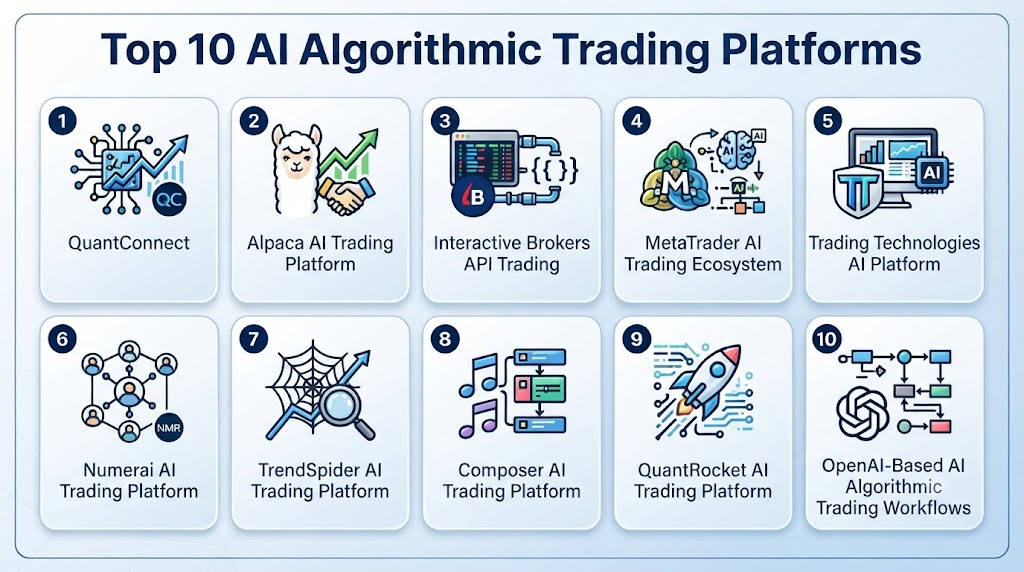
Top 10 AI Algorithmic Trading Platforms
1. QuantConnect
Verdict: AI-powered algorithmic trading platform for developing and testing quantitative strategies.
Short Description: QuantConnect helps traders and developers create, backtest, optimize, and deploy algorithmic trading strategies using market data and machine learning techniques.
Key Features:
- Algorithm development
- Backtesting engine
- Market data access
- Strategy optimization
- Automated execution
Pros:
- Strong developer ecosystem
- Extensive quantitative tools
Cons:
- Requires programming knowledge
- Advanced strategies need expertise
Deployment: Cloud-based
Security & Compliance: Platform security controls
Integrations & Ecosystem: Broker and market data integrations
Support & Community: Developer community
Pricing Model: Subscription-based
Best-Fit Scenarios: Quant developers and traders
2. Alpaca AI Trading Platform
Verdict: API-first AI trading platform for automated investment strategies.
Short Description: Alpaca provides trading APIs and infrastructure that allow developers and businesses to build automated trading applications.
Key Features:
- Trading APIs
- Automated execution
- Market data access
- Portfolio management
- Strategy automation
Pros:
- Developer-friendly APIs
- Easy integration
Cons:
- Requires strategy development
- Limited enterprise analytics
Deployment: Cloud-based
Security & Compliance: Financial security controls
Integrations & Ecosystem: Broker APIs and applications
Support & Community: Developer support
Pricing Model: Usage-based
Best-Fit Scenarios: Developers and fintech platforms
3. Interactive Brokers API Trading
Verdict: Professional trading infrastructure supporting automated algorithmic strategies.
Short Description: Interactive Brokers API enables traders and institutions to build automated trading systems across multiple markets.
Key Features:
- Trading automation
- Multi-market access
- Order execution
- Market data
- Portfolio management
Pros:
- Broad market coverage
- Professional trading infrastructure
Cons:
- Requires technical expertise
- Complex for beginners
Deployment: Cloud and desktop environments
Security & Compliance: Financial security standards
Integrations & Ecosystem: Trading platforms
Support & Community: Trading community
Pricing Model: Transaction-based
Best-Fit Scenarios: Professional traders
4. MetaTrader AI Trading Ecosystem
Verdict: Popular automated trading environment supporting AI-enhanced trading strategies.
Short Description: MetaTrader allows traders to develop automated trading systems using expert advisors, indicators, and algorithmic strategies.
Key Features:
- Automated trading bots
- Strategy testing
- Market analysis
- Trading indicators
- Expert advisors
Pros:
- Large trading community
- Widely used platform
Cons:
- AI capabilities depend on customization
- Requires trading expertise
Deployment: Desktop and cloud environments
Security & Compliance: Platform security controls
Integrations & Ecosystem: Broker integrations
Support & Community: Large community
Pricing Model: Platform-based
Best-Fit Scenarios: Retail and professional traders
5. Trading Technologies AI Platform
Verdict: Enterprise trading platform supporting advanced algorithmic execution.
Short Description: Trading Technologies provides professional trading infrastructure, analytics, and automated execution capabilities for financial markets.
Key Features:
- Algorithmic execution
- Market connectivity
- Trading analytics
- Risk controls
- Order management
Pros:
- Enterprise-grade infrastructure
- Strong market connectivity
Cons:
- Designed for professional users
- Complex implementation
Deployment: Cloud-based
Security & Compliance: Enterprise financial controls
Integrations & Ecosystem: Global markets
Support & Community: Enterprise support
Pricing Model: Subscription-based
Best-Fit Scenarios: Institutional traders
6. Numerai AI Trading Platform
Verdict: Machine learning-driven investment platform using AI models for market prediction.
Short Description: Numerai combines machine learning models and data science approaches to generate investment signals.
Key Features:
- AI prediction models
- Machine learning competitions
- Market signals
- Model evaluation
- Data science workflows
Pros:
- AI-first approach
- Strong ML community
Cons:
- Requires data science knowledge
- Specialized investment model
Deployment: Cloud-based
Security & Compliance: Platform security controls
Integrations & Ecosystem: Data science ecosystem
Support & Community: Developer community
Pricing Model: Platform-based
Best-Fit Scenarios: ML researchers
7. TrendSpider AI Trading Platform
Verdict: AI-powered technical analysis platform for trading insights.
Short Description: TrendSpider uses automation and AI-assisted analytics to help traders analyze charts, identify patterns, and develop trading strategies.
Key Features:
- Automated technical analysis
- Chart pattern detection
- Market scanning
- Trading alerts
- Strategy testing
Pros:
- Strong technical analysis automation
- User-friendly interface
Cons:
- More analysis-focused
- Limited institutional features
Deployment: Cloud-based
Security & Compliance: Platform security controls
Integrations & Ecosystem: Trading tools
Support & Community: Customer support
Pricing Model: Subscription-based
Best-Fit Scenarios: Active traders
8. Composer AI Trading Platform
Verdict: AI-assisted strategy creation platform for automated investing.
Short Description: Composer helps users create, test, and automate investment strategies using visual strategy-building tools.
Key Features:
- Strategy creation
- Automated investing
- Portfolio automation
- Backtesting
- Investment workflows
Pros:
- Easy strategy creation
- Low-code approach
Cons:
- Limited advanced quant features
- Primarily retail-focused
Deployment: Cloud-based
Security & Compliance: Platform security controls
Integrations & Ecosystem: Investment platforms
Support & Community: Customer support
Pricing Model: Subscription-based
Best-Fit Scenarios: Individual investors
9. QuantRocket AI Trading Platform
Verdict: Quantitative trading platform for building automated investment systems.
Short Description: QuantRocket provides infrastructure for research, backtesting, and deployment of quantitative trading strategies.
Key Features:
- Algorithm research
- Backtesting
- Data management
- Trading automation
- Strategy deployment
Pros:
- Strong quant workflow
- Flexible development environment
Cons:
- Requires technical skills
- Developer-focused
Deployment: Cloud and self-hosted
Security & Compliance: Platform security controls
Integrations & Ecosystem: Broker and data integrations
Support & Community: Developer community
Pricing Model: Subscription-based
Best-Fit Scenarios: Quant teams
10. OpenAI-Based AI Algorithmic Trading Workflows
Verdict: Custom AI approach for developing organization-specific algorithmic trading systems.
Short Description: AI workflows can analyze market data, trading signals, financial news, and strategy rules to support automated trading research and decision-making.
Key Features:
- Market analysis
- Trading signal generation
- Strategy optimization
- Risk analysis
- Custom automation workflows
Pros:
- Highly customizable
- Supports unique trading strategies
Cons:
- Requires AI and financial expertise
- Needs strong risk controls
Deployment: API and custom environments
Security & Compliance: Depends on implementation
Integrations & Ecosystem: Market data platforms, brokers, databases
Support & Community: Developer ecosystem
Pricing Model: Usage-based
Best-Fit Scenarios: Custom trading solutions
Comparison Table
| Platform | AI Capability | Strategy Development | Automation | Market Access | Best Use |
|---|---|---|---|---|---|
| QuantConnect | Excellent | Excellent | Excellent | High | Quant trading |
| Alpaca AI | High | High | Excellent | High | Trading APIs |
| Interactive Brokers API | Medium | High | Excellent | Excellent | Professional trading |
| MetaTrader AI | High | High | Excellent | High | Automated trading |
| Trading Technologies | High | High | Excellent | Excellent | Institutional trading |
| Numerai AI | Excellent | High | High | Medium | ML investing |
| TrendSpider AI | High | Medium | High | Medium | Technical trading |
| Composer AI | High | High | High | Medium | Retail automation |
| QuantRocket AI | Excellent | Excellent | Excellent | High | Quant teams |
| OpenAI Workflows | Excellent | Custom | Custom | Custom | Custom systems |
Evaluation & Scoring Table
| Platform | AI Accuracy 25% | Strategy Tools 15% | Automation 15% | Integrations 15% | Security 10% | Ease 10% | Value 10% | Total |
|---|---|---|---|---|---|---|---|---|
| QuantConnect | 25 | 15 | 15 | 14 | 10 | 8 | 9 | 96 |
| Alpaca AI | 23 | 14 | 15 | 15 | 10 | 10 | 9 | 96 |
| Interactive Brokers API | 22 | 14 | 15 | 15 | 10 | 8 | 9 | 93 |
| MetaTrader AI | 23 | 14 | 15 | 14 | 9 | 9 | 9 | 93 |
| Trading Technologies | 24 | 14 | 15 | 15 | 10 | 8 | 8 | 94 |
| Numerai AI | 25 | 14 | 13 | 12 | 9 | 8 | 9 | 90 |
| TrendSpider AI | 22 | 13 | 14 | 13 | 9 | 10 | 9 | 90 |
| Composer AI | 22 | 14 | 14 | 12 | 9 | 10 | 9 | 90 |
| QuantRocket AI | 24 | 15 | 15 | 13 | 10 | 8 | 8 | 93 |
| OpenAI Workflows | 25 | 15 | 15 | 12 | 8 | 8 | 9 | 92 |
Which AI Algorithmic Trading Platform Is Right for You?
- Quantitative Trading Teams: QuantConnect, QuantRocket
- Professional Traders: Interactive Brokers API, Trading Technologies
- AI Research Models: Numerai AI
- Retail Automated Trading: Composer AI, MetaTrader AI
- Technical Analysis Automation: TrendSpider AI
- Custom Trading Systems: OpenAI-based workflows
Implementation Playbook
30 Days
- Define trading objectives
- Select market data sources
- Identify strategy requirements
60 Days
- Build and test trading models
- Connect broker APIs
- Validate strategy performance
90 Days
- Deploy automated workflows
- Monitor trading results
- Optimize strategies continuously
Common Mistakes
- Overfitting trading models
- Ignoring risk management
- Using poor-quality market data
- Expecting guaranteed returns
- Deploying strategies without testing
Frequently Asked Questions
What are AI algorithmic trading platforms?
They are AI-powered systems that automate market analysis and trading strategy execution.
How does AI improve algorithmic trading?
AI identifies patterns, analyzes data, and helps optimize trading decisions.
Can AI predict stock prices accurately?
AI can analyze market signals, but market outcomes remain uncertain.
Do hedge funds use AI trading systems?
Yes. Many quantitative firms use AI and algorithmic strategies.
Can beginners use AI trading platforms?
Some platforms support beginners, while advanced systems require technical skills.
Do AI trading tools automate buying and selling?
Many platforms support automated execution based on defined strategies.
Can AI reduce trading risks?
AI can improve analysis and risk management but cannot remove market risk.
Do these platforms support multiple markets?
Many support stocks, futures, forex, and other financial instruments.
Are AI trading systems secure?
Users should evaluate platform security and access controls.
Can AI replace human traders?
AI assists traders but does not eliminate the need for human oversight.
What data do AI trading systems use?
They may analyze prices, market data, indicators, and alternative signals.
How should companies implement AI algorithmic trading?
Start with research, backtesting, risk controls, and gradual deployment.
Conclusion
AI Algorithmic Trading Platforms are transforming financial markets by enabling automated strategy development, faster analysis, and data-driven trading decisions. Platforms such as QuantConnect, Alpaca AI, Trading Technologies, and QuantRocket provide powerful capabilities for developers, traders, and financial institutions.Organizations should select solutions based on trading goals, technical expertise, market requirements, and risk management needs. Combining AI-powered trading systems with disciplined investment strategies helps firms improve efficiency, analyze opportunities, and build more advanced trading operations.
