Introduction
AI Bioprocess Control Systems use artificial intelligence (AI), machine learning (ML), automation, predictive analytics, and advanced process control technologies to optimize biological manufacturing processes. These systems help biotechnology and pharmaceutical organizations improve production efficiency, quality control, scalability, and operational consistency across bioprocessing workflows.
Bioprocessing involves complex biological manufacturing activities such as cell culture, fermentation, purification, and production of biologics, vaccines, enzymes, and therapeutic products. These processes depend on multiple variables including temperature, pH, oxygen levels, nutrient supply, cell growth, and production conditions. Managing these parameters manually can be challenging due to biological variability.
AI-powered bioprocess control platforms analyze real-time process data from sensors, laboratory instruments, manufacturing systems, and historical production records. They use machine learning models, digital twins, predictive analytics, and automation technologies to optimize process conditions, detect anomalies, predict outcomes, and improve product quality.
Modern AI bioprocess control solutions integrate with Manufacturing Execution Systems (MES), Process Analytical Technology (PAT), laboratory automation systems, industrial control systems, and data platforms. They support pharmaceutical companies, biotechnology organizations, and manufacturing facilities in building smarter, more efficient, and data-driven production environments.
AI bioprocess systems support decision-making and process optimization while requiring engineering expertise, quality validation, and regulatory oversight.
Real-world Use Cases
- Cell culture optimization
- Fermentation control
- Biologics manufacturing
- Vaccine production optimization
- Process monitoring
- Predictive quality control
- Real-time analytics
- Manufacturing automation
- Scale-up optimization
- Process deviation detection
Evaluation Criteria for Buyers
When selecting an AI Bioprocess Control System, consider:
- AI process optimization capabilities
- Real-time monitoring support
- Sensor and equipment integration
- Predictive analytics
- Digital twin capabilities
- Automation features
- Manufacturing compliance support
- Scalability
- Data security
- MES integration
Best For
- Pharmaceutical manufacturers
- Biotechnology companies
- Biologics producers
- Research organizations
- Industrial biotechnology facilities
Not Ideal For
Organizations expecting AI to replace process engineers, quality teams, or regulatory validation processes.
Key Trends
- AI-driven manufacturing optimization
- Digital twins for bioprocessing
- Predictive process control
- Smart manufacturing
- Automated quality monitoring
- Real-time process analytics
- Continuous manufacturing
- Industrial AI platforms
- Connected laboratory systems
- Autonomous bioprocessing
Methodology
The platforms below were evaluated based on:
- AI optimization capabilities
- Bioprocess automation support
- Real-time analytics
- Manufacturing integration
- Scalability
- Industry adoption
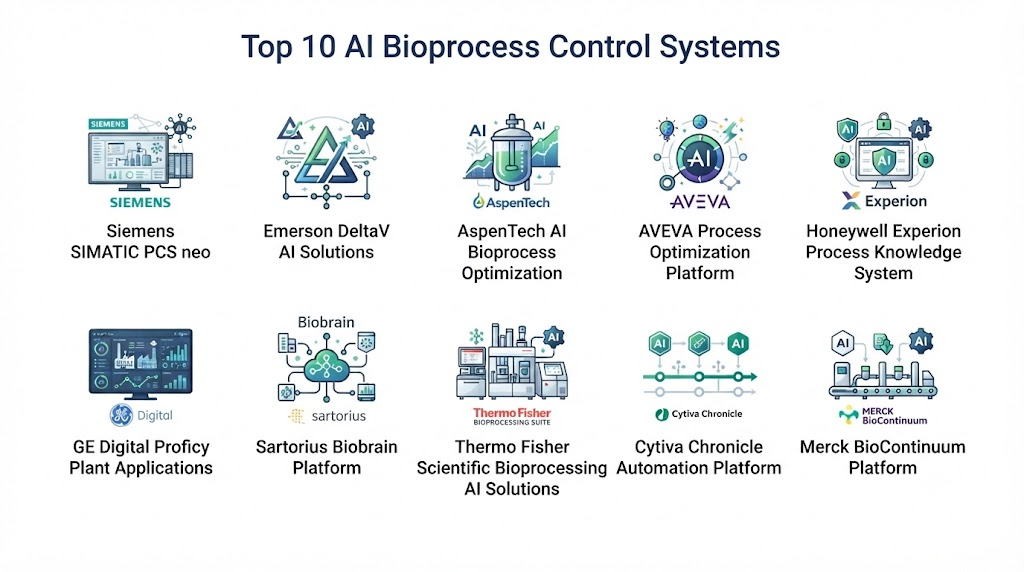
Top 10 AI Bioprocess Control Systems
1. Sartorius Biobrain
Verdict: Best overall AI-powered bioprocess intelligence platform.
Short Description: Sartorius Biobrain combines automation, analytics, and intelligent process control technologies to support advanced bioprocess development and manufacturing workflows.
Key Features
- Intelligent process monitoring
- Bioprocess analytics
- Automation support
- Data integration
- Process optimization
Pros
- Strong biopharmaceutical focus
- Supports complex workflows
- Advanced automation capabilities
Cons
- Enterprise implementation required
Deployment: Manufacturing and research environments
Security & Compliance: Industrial and pharmaceutical data controls
Integrations & Ecosystem: Bioreactors, sensors, MES, laboratory systems
Support & Community: Enterprise support
Pricing Model: Custom enterprise pricing
Best-Fit Scenarios: Biopharmaceutical manufacturing
2. Siemens SIMATIC PCS 7 + Industrial AI
Verdict: Industrial automation platform with AI process optimization capabilities.
Short Description: Siemens provides industrial control systems enhanced with AI analytics for monitoring, automation, and optimization of manufacturing processes.
Key Features
- Process automation
- Industrial control
- Predictive analytics
- Equipment monitoring
- Manufacturing integration
Pros
- Strong industrial ecosystem
- Enterprise scalability
Cons
- Requires automation expertise
3. Emerson DeltaV Advanced Analytics
Verdict: Advanced process control platform for pharmaceutical manufacturing.
Short Description: Emerson DeltaV provides process automation, analytics, and control capabilities for biopharmaceutical production environments.
Key Features
- Process control
- Real-time monitoring
- Predictive analytics
- Batch management
- Manufacturing automation
Pros
- Strong pharmaceutical adoption
- Reliable process control
Cons
- Complex deployment
4. Rockwell Automation FactoryTalk Analytics
Verdict: AI-supported industrial analytics platform.
Short Description: FactoryTalk Analytics uses industrial data and analytics technologies to improve manufacturing visibility, optimization, and operational performance.
Key Features
- Manufacturing analytics
- Predictive insights
- Equipment monitoring
- Data visualization
- Industrial integration
Pros
- Strong manufacturing ecosystem
- Scalable analytics
Cons
- Requires industrial infrastructure
5. GE Digital Proficy Smart Manufacturing
Verdict: Industrial intelligence platform for process optimization.
Short Description: GE Digital Proficy provides manufacturing analytics, workflow optimization, and operational intelligence for industrial environments.
Key Features
- Manufacturing analytics
- Process monitoring
- Data integration
- Quality optimization
- Production intelligence
Pros
- Enterprise manufacturing capabilities
- Strong analytics features
Cons
- Requires implementation expertise
6. Benchling Bioprocess Development Platform
Verdict: Digital research platform supporting biotechnology workflows.
Short Description: Benchling provides biotechnology data management and workflow capabilities that support research and development processes in biological manufacturing.
Key Features
- Research data management
- Experiment tracking
- Workflow automation
- Biological data organization
- Collaboration
Pros
- Strong biotech adoption
- Modern cloud platform
Cons
- More focused on R&D than production control
7. Genedata Bioprocess
Verdict: Data management and analytics platform for bioprocess development.
Short Description: Genedata provides software solutions for managing and analyzing complex biological process data across development workflows.
Key Features
- Bioprocess data analytics
- Process optimization
- Workflow management
- Data integration
- Research automation
Pros
- Strong life sciences focus
- Supports complex datasets
Cons
- Requires specialized knowledge
8. Honeywell Process Optimization Solutions
Verdict: Industrial automation platform with AI analytics capabilities.
Short Description: Honeywell provides process control and analytics solutions that help organizations optimize industrial and pharmaceutical manufacturing operations.
Key Features
- Process automation
- Predictive analytics
- Equipment monitoring
- Industrial control
- Data intelligence
Pros
- Strong industrial presence
- Enterprise reliability
Cons
- Broad industrial focus
9. AspenTech AI Process Optimization
Verdict: AI-powered process optimization platform.
Short Description: AspenTech provides industrial AI and optimization technologies that help manufacturers improve process efficiency, productivity, and decision-making.
Key Features
- AI process optimization
- Predictive modeling
- Digital twins
- Process simulation
- Operational analytics
Pros
- Strong optimization capabilities
- Advanced modeling tools
Cons
- Requires technical expertise
10. OpenAI-Based Custom AI Bioprocess Control Assistant
Verdict: Flexible AI assistant for customized bioprocess optimization workflows.
Short Description: Organizations can build custom AI bioprocess assistants using large language models integrated with manufacturing systems, sensor platforms, MES solutions, laboratory databases, and process analytics systems. These assistants can summarize process data, identify optimization opportunities, support troubleshooting, and assist engineers while requiring validation and expert review.
Key Features
- Process data analysis
- Manufacturing insights
- Troubleshooting assistance
- Report generation
- Knowledge management
Pros
- Highly customizable
- Flexible integrations
- Improves operational efficiency
Cons
- Requires process engineering expertise
- Validation required
Comparison Table
| Platform | AI Optimization | Process Control | Automation | Manufacturing Integration | Best Use |
|---|---|---|---|---|---|
| Sartorius Biobrain | Excellent | Excellent | Excellent | Excellent | Biopharma Production |
| Siemens SIMATIC PCS 7 | High | Excellent | Excellent | Excellent | Industrial Control |
| Emerson DeltaV | High | Excellent | Excellent | Excellent | Pharmaceutical Manufacturing |
| Rockwell FactoryTalk | High | High | Excellent | Excellent | Smart Manufacturing |
| GE Proficy | High | High | High | Excellent | Manufacturing Analytics |
| Benchling | High | Medium | High | Medium | Biotech Development |
| Genedata Bioprocess | High | High | High | High | Bioprocess Analytics |
| Honeywell Solutions | High | Excellent | Excellent | Excellent | Industrial Automation |
| AspenTech | Excellent | High | High | High | Process Optimization |
| OpenAI Custom | Custom | Custom | Custom | Custom | AI Bioprocess Assistant |
Evaluation & Scoring Table
| Platform | AI Capability 20% | Process Optimization 20% | Automation 15% | Integration 15% | Security 10% | Ease 10% | Value 10% | Total |
|---|---|---|---|---|---|---|---|---|
| Sartorius Biobrain | 20 | 20 | 15 | 15 | 10 | 8 | 8 | 96 |
| Emerson DeltaV | 18 | 20 | 15 | 15 | 10 | 8 | 8 | 94 |
| Siemens SIMATIC PCS 7 | 18 | 19 | 15 | 15 | 10 | 8 | 8 | 93 |
| AspenTech | 20 | 19 | 14 | 14 | 10 | 8 | 8 | 93 |
| Rockwell FactoryTalk | 18 | 18 | 15 | 14 | 10 | 8 | 8 | 91 |
| GE Proficy | 18 | 18 | 14 | 14 | 10 | 8 | 8 | 90 |
| Genedata Bioprocess | 17 | 18 | 14 | 13 | 10 | 8 | 8 | 88 |
| Honeywell Solutions | 17 | 18 | 14 | 14 | 10 | 8 | 7 | 88 |
| Benchling | 17 | 16 | 13 | 12 | 10 | 9 | 8 | 85 |
| OpenAI Custom | 20 | 16 | 12 | 15 | 8 | 7 | 9 | 87 |
Which AI Bioprocess Control System Is Right for You?
| If your priority is… | Recommended Platform |
|---|---|
| Biopharmaceutical production | Sartorius Biobrain |
| Industrial process control | Siemens SIMATIC PCS 7 |
| Pharmaceutical manufacturing | Emerson DeltaV |
| Smart manufacturing analytics | Rockwell FactoryTalk |
| Manufacturing intelligence | GE Proficy |
| Biotech development workflows | Benchling |
| Bioprocess data analytics | Genedata Bioprocess |
| Industrial automation | Honeywell |
| AI process optimization | AspenTech |
| Custom AI bioprocess assistant | OpenAI-Based AI Assistant |
Implementation Playbook
First 30 Days
- Define bioprocess optimization goals
- Identify process data sources
- Review automation requirements
- Map equipment integrations
Days 31–60
- Connect sensors and systems
- Configure AI analytics workflows
- Validate process models
- Train engineering teams
Days 61–90
- Optimize production workflows
- Automate monitoring processes
- Improve quality prediction
- Expand intelligent automation
Common Mistakes
- Poor sensor data quality
- Ignoring process validation
- Overrelying on AI recommendations
- Weak equipment integration
- Lack of operator training
- Ignoring regulatory requirements
- Poor data governance
- Insufficient monitoring
Frequently Asked Questions
1. What are AI Bioprocess Control Systems?
They are AI-powered platforms that optimize biological manufacturing processes using automation, analytics, and predictive models.
2. How does AI improve bioprocess control?
AI analyzes real-time process data to optimize conditions, detect issues, and improve production outcomes.
3. Can AI replace bioprocess engineers?
No. AI supports engineers but requires human expertise and validation.
4. Who uses AI bioprocess control systems?
Pharmaceutical companies, biotechnology manufacturers, and research organizations.
5. What processes can AI optimize?
AI can support fermentation, cell culture, purification, and manufacturing workflows.
6. Can AI improve product quality?
Yes. AI helps predict process behavior and improve consistency.
7. Are AI process recommendations reliable?
Reliability depends on data quality, model accuracy, and validation.
8. Do these systems integrate with manufacturing equipment?
Many integrate with sensors, automation systems, MES platforms, and laboratory systems.
9. How is manufacturing data protected?
Organizations use secure infrastructure, access controls, and compliance practices.
10. What should buyers evaluate before adoption?
Consider AI capabilities, integration support, scalability, security, validation requirements, and operational goals.
Conclusion
AI Bioprocess Control Systems are transforming biological manufacturing by enabling smarter automation, predictive optimization, and improved production efficiency. By combining artificial intelligence, industrial automation, real-time analytics, and process modeling, these platforms help organizations create more reliable and scalable bioprocessing environments.Organizations adopting AI bioprocess solutions should focus on process validation, data quality, equipment integration, and regulatory requirements. Platforms such as Sartorius Biobrain, Emerson DeltaV, Siemens SIMATIC PCS 7, AspenTech, and Rockwell FactoryTalk demonstrate how artificial intelligence is advancing biomanufacturing and supporting the future of intelligent production.
