Introduction
AI Capacity Forecasting for IT tools help organizations accurately predict future infrastructure, application, cloud, storage, network, and compute resource requirements using artificial intelligence (AI), machine learning (ML), predictive analytics, and historical operational data. These platforms analyze trends across CPU utilization, memory consumption, storage growth, network traffic, application workloads, cloud usage, and business demand to forecast future capacity needs before performance issues or resource shortages occur.
Traditional capacity planning often relies on manual spreadsheets, static thresholds, and periodic reviews that struggle to keep pace with rapidly changing cloud-native environments. AI-powered capacity forecasting continuously evaluates operational telemetry, seasonal patterns, workload behavior, infrastructure dependencies, and business growth to generate accurate forecasts and optimization recommendations. This enables IT operations teams to proactively scale infrastructure, reduce cloud costs, prevent service disruptions, and improve resource utilization.
Modern AI Capacity Forecasting platforms integrate with observability solutions, cloud platforms, virtualization infrastructure, Kubernetes clusters, Application Performance Monitoring (APM), IT Operations (ITOps), AIOps platforms, and FinOps solutions. They provide predictive dashboards, anomaly detection, automated capacity recommendations, and scenario modeling for hybrid and multi-cloud environments.
Organizations increasingly adopt AI Capacity Forecasting solutions to optimize infrastructure investments, improve service availability, reduce operational costs, and support digital transformation initiatives.
Real-world Use Cases
- Cloud capacity forecasting
- Server resource planning
- Storage growth prediction
- Network bandwidth forecasting
- Kubernetes capacity planning
- Virtual machine optimization
- Data center capacity management
- Cloud cost optimization
- Infrastructure scaling recommendations
- Business growth planning
Evaluation Criteria for Buyers
When evaluating AI Capacity Forecasting platforms, consider:
- Forecasting accuracy
- AI and machine learning capabilities
- Infrastructure visibility
- Cloud-native support
- Scenario modeling
- Automation features
- Integration with monitoring platforms
- Scalability
- Reporting and visualization
- Ease of deployment
Best For
- IT Operations teams
- Site Reliability Engineers (SREs)
- Cloud operations teams
- Infrastructure architects
- DevOps teams
- Enterprise IT organizations
Not Ideal For
Organizations with small static infrastructures or environments with minimal performance monitoring.
Key Trends
- AI-powered infrastructure forecasting
- Predictive AIOps
- Cloud capacity optimization
- Intelligent workload forecasting
- Kubernetes resource planning
- Hybrid cloud capacity analytics
- FinOps integration
- Autonomous infrastructure optimization
- Predictive resource scaling
- AI-driven infrastructure planning
Methodology
The platforms below were evaluated based on:
- AI forecasting capabilities
- Capacity planning accuracy
- Infrastructure coverage
- Cloud integrations
- Automation
- Enterprise scalability
- Reporting quality
- Overall operational value
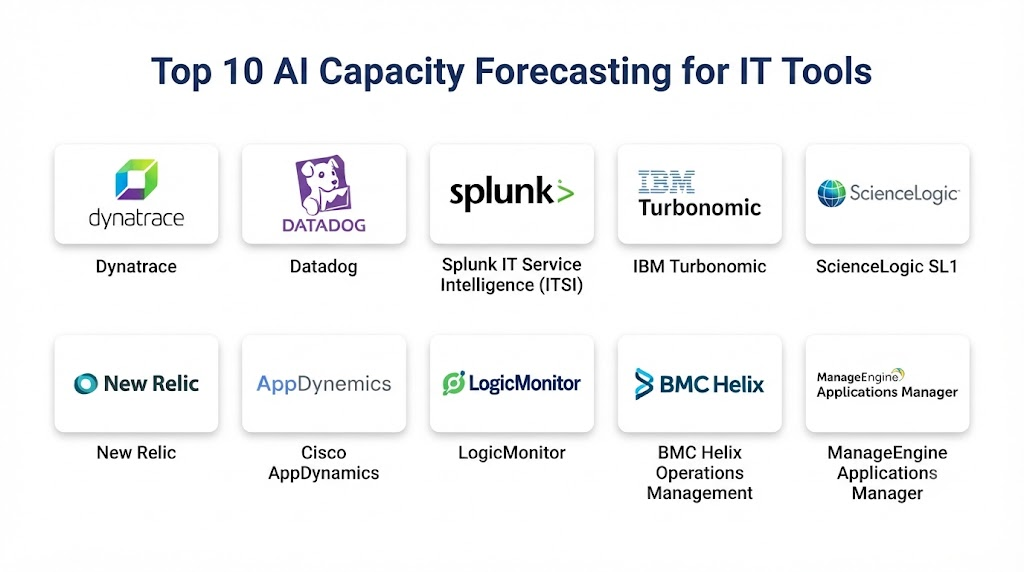
Top 10 AI Capacity Forecasting for IT Tools
1. Dynatrace Davis AI
Verdict: Best overall AI-powered platform for predictive infrastructure capacity forecasting.
Short Description: Dynatrace Davis AI continuously analyzes infrastructure, applications, cloud services, containers, and business workloads to forecast future capacity requirements, predict resource bottlenecks, and recommend optimization actions that improve performance while reducing operational costs.
Key Features
- AI capacity forecasting
- Predictive infrastructure analytics
- Cloud workload analysis
- Kubernetes monitoring
- Business impact forecasting
- Automatic dependency mapping
- Capacity optimization
- Intelligent recommendations
Pros
- Highly accurate forecasting
- Excellent cloud-native support
- Strong automation
- Enterprise scalability
Cons
- Premium enterprise pricing
- Advanced implementation
Deployment: SaaS & Managed
Security & Compliance: Enterprise-grade controls
Integrations & Ecosystem: AWS, Azure, Google Cloud, Kubernetes, VMware, ServiceNow
Support & Community: Enterprise support
Pricing Model: Subscription
Best-Fit Scenarios: Enterprise infrastructure operations
2. VMware Aria Operations
Verdict: Comprehensive AI platform for virtual infrastructure and cloud capacity planning.
Short Description: VMware Aria Operations uses predictive analytics and AI to forecast compute, storage, memory, and virtualization capacity requirements while optimizing hybrid cloud environments.
Key Features
- Predictive capacity analytics
- VM optimization
- Storage forecasting
- Resource rightsizing
- Hybrid cloud planning
- AI recommendations
Pros
- Excellent VMware integration
- Strong virtualization support
Cons
- Best for VMware environments
3. Datadog Cloud Cost & Capacity Management
Verdict: AI-powered cloud capacity forecasting platform.
Short Description: Datadog analyzes cloud infrastructure, applications, containers, and workloads to predict capacity trends, optimize cloud resources, and improve infrastructure efficiency.
Key Features
- AI forecasting
- Cloud analytics
- Kubernetes monitoring
- Capacity dashboards
- Cost optimization
Pros
- Excellent cloud observability
- Easy deployment
Cons
- Usage-based pricing
4. IBM Turbonomic
Verdict: AI-driven application resource management and capacity optimization platform.
Short Description: IBM Turbonomic continuously analyzes workload demand, predicts infrastructure needs, and automatically recommends or executes resource allocation decisions.
Key Features
- AI workload optimization
- Capacity forecasting
- Automated scaling
- Application resource management
- Hybrid cloud support
Pros
- Strong automation
- Excellent optimization
Cons
- Enterprise deployment
5. New Relic AI
Verdict: Intelligent observability platform with predictive capacity analytics.
Short Description: New Relic AI combines infrastructure monitoring, telemetry analysis, and predictive analytics to forecast capacity utilization and identify future infrastructure bottlenecks.
Key Features
- Capacity forecasting
- Predictive monitoring
- Infrastructure analytics
- Distributed tracing
- AI insights
Pros
- Unified observability
- Strong cloud support
Cons
- Usage-based licensing
6. LogicMonitor Edwin AI
Verdict: AI-powered hybrid infrastructure monitoring and forecasting platform.
Short Description: LogicMonitor Edwin AI predicts infrastructure capacity needs across on-premises, cloud, and hybrid environments using AI-driven monitoring and analytics.
Key Features
- Infrastructure forecasting
- AI recommendations
- Hybrid cloud monitoring
- Resource optimization
- Performance analytics
Pros
- Easy deployment
- Strong hybrid visibility
Cons
- Smaller ecosystem
7. SolarWinds Hybrid Cloud Observability
Verdict: Enterprise infrastructure monitoring with predictive capacity planning.
Short Description: SolarWinds provides AI-enhanced monitoring, capacity forecasting, storage planning, and infrastructure optimization across enterprise IT environments.
Key Features
- Capacity analytics
- Infrastructure monitoring
- Storage forecasting
- Network monitoring
- Performance optimization
Pros
- Mature monitoring platform
- Broad infrastructure support
Cons
- Limited AI capabilities compared to newer platforms
8. Splunk IT Service Intelligence (ITSI)
Verdict: AI-powered AIOps platform with predictive capacity intelligence.
Short Description: Splunk ITSI analyzes operational telemetry, predicts infrastructure demand, identifies capacity risks, and supports proactive service management through AI-driven analytics.
Key Features
- Predictive analytics
- Capacity intelligence
- Service health monitoring
- AI recommendations
- Event correlation
Pros
- Excellent enterprise analytics
- Strong AIOps integration
Cons
- Requires Splunk expertise
9. ScienceLogic SL1
Verdict: AI-driven infrastructure monitoring and capacity planning solution.
Short Description: ScienceLogic SL1 provides predictive capacity analysis, infrastructure monitoring, automation, and service dependency mapping for enterprise IT operations.
Key Features
- AI forecasting
- Capacity monitoring
- Automation
- Dependency mapping
- Hybrid infrastructure support
Pros
- Strong enterprise automation
- Broad infrastructure coverage
Cons
- Initial configuration complexity
10. OpenAI-Based Custom Capacity Forecasting Platform
Verdict: Flexible AI-powered forecasting solution for enterprise infrastructure planning.
Short Description: Organizations can build custom AI capacity forecasting solutions using large language models integrated with monitoring systems, cloud telemetry, observability platforms, Kubernetes, and ITSM tools to generate predictive capacity recommendations, infrastructure reports, and scenario analyses.
Key Features
- AI forecasting
- Infrastructure analysis
- Predictive reporting
- Capacity recommendations
- Workflow automation
Pros
- Highly customizable
- Flexible integrations
- Organization-specific insights
Cons
- Requires AI engineering expertise
- Governance and validation required
Comparison Table
| Platform | AI Forecasting | Cloud Support | Automation | Scalability | Best Use |
|---|---|---|---|---|---|
| Dynatrace Davis AI | Excellent | Excellent | Excellent | Excellent | Enterprise AIOps |
| VMware Aria Operations | Excellent | High | High | Excellent | VMware Infrastructure |
| Datadog | Excellent | Excellent | High | Excellent | Cloud Operations |
| IBM Turbonomic | Excellent | Excellent | Excellent | High | Resource Optimization |
| New Relic AI | High | Excellent | High | High | Observability |
| LogicMonitor Edwin AI | High | High | High | High | Hybrid Infrastructure |
| SolarWinds | High | Medium | Medium | High | Enterprise Monitoring |
| Splunk ITSI | High | High | High | Excellent | AIOps |
| ScienceLogic SL1 | High | High | High | High | IT Operations |
| OpenAI Custom | Custom | Custom | Custom | Custom | Custom Forecasting |
Evaluation & Scoring Table
| Platform | AI Features 20% | Forecasting 20% | Integrations 15% | Automation 15% | Performance 10% | Ease 10% | Value 10% | Total |
|---|---|---|---|---|---|---|---|---|
| Dynatrace Davis AI | 20 | 20 | 15 | 15 | 10 | 8 | 8 | 96 |
| IBM Turbonomic | 19 | 19 | 15 | 15 | 10 | 8 | 8 | 94 |
| Datadog | 19 | 19 | 14 | 14 | 10 | 9 | 8 | 93 |
| VMware Aria Operations | 18 | 19 | 15 | 13 | 10 | 8 | 8 | 91 |
| Splunk ITSI | 18 | 18 | 15 | 14 | 10 | 8 | 8 | 91 |
| New Relic AI | 18 | 18 | 14 | 13 | 10 | 9 | 8 | 90 |
| ScienceLogic SL1 | 17 | 18 | 14 | 13 | 9 | 8 | 8 | 87 |
| LogicMonitor Edwin AI | 17 | 17 | 13 | 13 | 9 | 9 | 8 | 86 |
| SolarWinds | 16 | 17 | 13 | 12 | 9 | 9 | 9 | 85 |
| OpenAI Custom | 20 | 19 | 12 | 15 | 8 | 7 | 9 | 90 |
Which AI Capacity Forecasting Tool Is Right for You?
| If your priority is… | Recommended Platform |
|---|---|
| Enterprise AIOps | Dynatrace Davis AI |
| VMware infrastructure | VMware Aria Operations |
| Cloud-native operations | Datadog |
| Automated resource optimization | IBM Turbonomic |
| Unified observability | New Relic AI |
| Hybrid infrastructure | LogicMonitor Edwin AI |
| Enterprise monitoring | SolarWinds Hybrid Cloud Observability |
| Service intelligence | Splunk ITSI |
| Infrastructure automation | ScienceLogic SL1 |
| Custom AI forecasting | OpenAI-Based Capacity Forecasting Platform |
Implementation Playbook
First 30 Days
- Inventory infrastructure assets
- Connect monitoring and observability platforms
- Collect historical performance data
- Define forecasting objectives
Days 31–60
- Train AI forecasting models
- Configure capacity dashboards
- Integrate cloud and virtualization platforms
- Validate prediction accuracy
Days 61–90
- Automate capacity recommendations
- Optimize infrastructure utilization
- Measure forecasting accuracy
- Continuously refine predictive models
Common Mistakes
- Relying only on historical averages
- Ignoring seasonal workload patterns
- Incomplete telemetry collection
- Weak cloud integration
- Not validating AI predictions
- Delaying infrastructure scaling
- Missing dependency relationships
- Failing to review forecast accuracy
Frequently Asked Questions
1. What are AI Capacity Forecasting for IT tools?
They use AI and machine learning to predict future infrastructure, cloud, storage, network, and application capacity requirements based on operational data.
2. How do these tools improve IT operations?
They help organizations proactively plan infrastructure growth, prevent resource shortages, optimize utilization, and reduce downtime.
3. Can they forecast cloud resource usage?
Yes. Most modern platforms support AWS, Microsoft Azure, Google Cloud, Kubernetes, and hybrid cloud environments.
4. Do these platforms integrate with observability tools?
Yes. They commonly integrate with APM, monitoring platforms, SIEM, ITSM, cloud services, and telemetry pipelines.
5. Can AI reduce cloud infrastructure costs?
Yes. AI identifies overprovisioned resources, recommends rightsizing, and forecasts demand to improve cost efficiency.
6. Are these solutions suitable for Kubernetes environments?
Yes. Many enterprise platforms provide predictive analytics for Kubernetes clusters and containerized workloads.
7. How accurate are AI capacity forecasts?
Accuracy depends on telemetry quality, historical data, workload stability, and model tuning, but AI generally outperforms manual forecasting methods.
8. Which teams benefit most from these platforms?
IT Operations, DevOps, SRE, cloud engineering, infrastructure architecture, and FinOps teams.
9. What metrics are commonly analyzed?
CPU, memory, storage, network bandwidth, application response times, cloud utilization, and workload performance.
10. What should organizations evaluate before selecting a solution?
Assess AI forecasting capabilities, cloud support, integrations, automation, scalability, reporting, deployment model, and total cost of ownership.
Conclusion
AI Capacity Forecasting for IT tools are enabling organizations to move from reactive infrastructure management to proactive, data-driven capacity planning. By combining predictive analytics, machine learning, and continuous monitoring, these platforms help optimize resource utilization, reduce operational costs, prevent performance bottlenecks, and improve overall service reliability across hybrid and multi-cloud environments.Organizations should select a solution based on infrastructure complexity, cloud strategy, observability maturity, integration requirements, and automation goals. Platforms such as Dynatrace Davis AI, IBM Turbonomic, Datadog, VMware Aria Operations, and Splunk ITSI deliver enterprise-grade capabilities that help IT teams forecast future demand accurately, optimize infrastructure investments, and strengthen long-term operational resilience
