Introduction
AI Clinical Documentation Summarization tools use artificial intelligence (AI), natural language processing (NLP), machine learning (ML), and large language models (LLMs) to automatically analyze, organize, and summarize complex healthcare documentation. These platforms transform large volumes of clinical information such as electronic health records (EHR), physician notes, laboratory results, imaging reports, discharge summaries, medication histories, and patient records into concise, structured summaries.
Healthcare professionals often spend significant time reviewing fragmented patient information across multiple systems before making clinical decisions. Long patient histories, repeated documentation, and increasing administrative requirements can slow workflows and reduce time available for direct patient care. AI-powered clinical summarization solutions help address these challenges by extracting relevant medical information, identifying key events, highlighting risks, and generating easy-to-understand summaries.
Modern AI Clinical Documentation Summarization platforms support physicians, nurses, care managers, researchers, and healthcare administrators by improving information accessibility and reducing manual review workload. These systems help with patient handoffs, emergency care, specialist consultations, discharge planning, utilization reviews, and population health management.
These tools integrate with EHR platforms, healthcare data warehouses, clinical workflows, telehealth systems, and analytics environments. AI summarization solutions are designed to assist healthcare professionals by improving efficiency and information availability while maintaining clinical oversight and validation.
Real-world Use Cases
- Patient history summarization
- Clinical note summarization
- Discharge summary generation
- Emergency department handoff support
- Specialist consultation preparation
- Medical record review
- Care coordination
- Insurance and utilization review
- Clinical research documentation
- Population health analysis
Evaluation Criteria for Buyers
When selecting an AI Clinical Documentation Summarization platform, consider:
- Summary accuracy
- Clinical context understanding
- EHR integration
- Natural language processing capabilities
- Data security and privacy
- Specialty support
- Workflow automation
- Explainability
- Scalability
- User experience
Best For
- Hospitals
- Healthcare systems
- Physicians
- Care management teams
- Research organizations
- Insurance healthcare programs
Not Ideal For
Organizations expecting AI-generated summaries to replace physician review or clinical judgment.
Key Trends
- Generative AI healthcare assistants
- Automated clinical summaries
- EHR intelligence platforms
- AI-powered medical record review
- Ambient healthcare documentation
- Healthcare workflow automation
- Clinical knowledge extraction
- Patient data intelligence
- Secure healthcare LLMs
- AI-assisted decision support
Methodology
The platforms below were evaluated based on:
- AI summarization capabilities
- Clinical accuracy
- Healthcare integration
- Workflow improvement
- Security capabilities
- Scalability
- Enterprise readiness
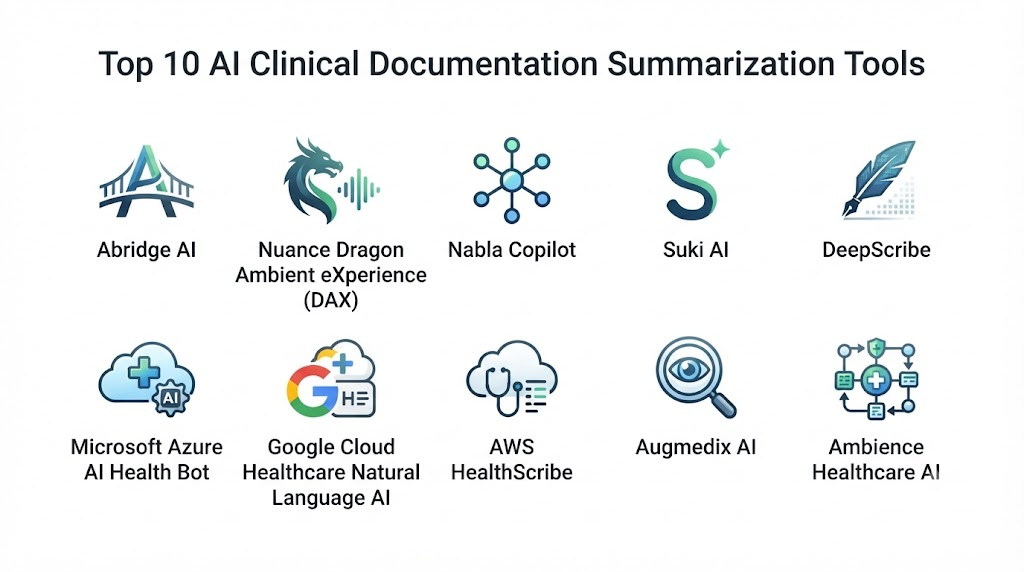
Top 10 AI Clinical Documentation Summarization Tools
1. Microsoft Dragon Ambient eXperience DAX Copilot
Verdict: Best overall AI clinical documentation summarization platform for healthcare organizations.
Short Description: Microsoft DAX Copilot uses ambient AI and advanced language models to capture clinical conversations, summarize encounters, and generate structured documentation that supports physician workflows.
Key Features
- Clinical conversation summarization
- AI-generated medical notes
- Patient encounter summaries
- EHR integration
- Specialty-specific workflows
- Documentation automation
Pros
- Strong healthcare AI capabilities
- High-quality summaries
- Enterprise scalability
Cons
- Enterprise deployment requirements
Deployment: Cloud-based
Security & Compliance: Healthcare-grade security controls
Integrations & Ecosystem: EHR systems and clinical workflows
Support & Community: Enterprise healthcare support
Pricing Model: Custom enterprise pricing
Best-Fit Scenarios: Hospitals and healthcare networks
2. Abridge
Verdict: Leading AI platform for summarizing patient-provider conversations.
Short Description: Abridge uses generative AI to capture healthcare conversations, summarize important clinical details, and create documentation that helps physicians review patient information efficiently.
Key Features
- Encounter summarization
- Clinical conversation analysis
- AI note generation
- Patient-friendly summaries
- EHR workflows
Pros
- Excellent conversational AI
- Strong physician usability
- Reduces documentation workload
Cons
- Requires healthcare workflow integration
3. Nuance PowerScribe One
Verdict: AI-powered clinical reporting and documentation intelligence platform.
Short Description: Nuance PowerScribe One supports radiology documentation by using AI-assisted reporting, structured summaries, speech recognition, and workflow automation.
Key Features
- AI reporting
- Medical speech recognition
- Structured documentation
- Clinical summaries
- Radiology workflow support
Pros
- Strong healthcare adoption
- Excellent reporting workflows
Cons
- Primarily focused on radiology
4. Epic AI Documentation Tools
Verdict: EHR-integrated AI summarization capabilities for healthcare organizations.
Short Description: Epic integrates AI capabilities into its healthcare ecosystem to help providers summarize patient records, improve documentation workflows, and access relevant clinical information.
Key Features
- Patient record summaries
- EHR intelligence
- Clinical documentation support
- Healthcare workflows
- Data organization
Pros
- Deep EHR integration
- Strong hospital adoption
Cons
- Best suited for Epic users
5. Google Cloud Healthcare AI
Verdict: AI infrastructure platform for building clinical summarization solutions.
Short Description: Google Cloud Healthcare AI provides machine learning and healthcare data tools that enable organizations to create AI-powered clinical summarization applications.
Key Features
- Healthcare data processing
- AI language models
- Clinical information extraction
- Data analytics
- Custom AI workflows
Pros
- Flexible AI capabilities
- Strong cloud infrastructure
Cons
- Requires AI expertise
6. Oracle Health Clinical AI
Verdict: Enterprise healthcare AI platform for clinical data summarization.
Short Description: Oracle Health provides AI-powered healthcare data solutions that help organizations analyze clinical information, improve documentation workflows, and generate healthcare insights.
Key Features
- Clinical data analysis
- Patient summaries
- Healthcare analytics
- EHR integration
- Workflow support
Pros
- Enterprise healthcare ecosystem
- Strong data capabilities
Cons
- Complex implementation
7. Suki AI
Verdict: AI clinical assistant supporting documentation and summarization.
Short Description: Suki AI uses voice technology and AI models to help physicians generate clinical notes, summarize encounters, and reduce documentation effort.
Key Features
- Voice documentation
- Clinical summaries
- AI assistant
- EHR integration
- Physician workflows
Pros
- Easy physician interaction
- Strong voice capabilities
Cons
- Primarily focused on provider workflows
8. Nabla Copilot
Verdict: AI clinical assistant for automated medical documentation.
Short Description: Nabla Copilot helps clinicians summarize patient interactions, create medical notes, and improve documentation workflows using conversational AI.
Key Features
- Visit summaries
- Clinical notes
- AI documentation
- Workflow automation
- Multi-specialty support
Pros
- User-friendly
- Strong summarization capabilities
Cons
- Availability varies by region
9. Pieces Technologies
Verdict: AI clinical intelligence platform for healthcare information summarization.
Short Description: Pieces uses AI to analyze healthcare information, summarize patient data, and provide clinicians with relevant insights during care delivery.
Key Features
- Patient summaries
- Clinical information extraction
- AI assistance
- Workflow support
- Healthcare intelligence
Pros
- Strong clinical AI approach
- Improves information access
Cons
- Requires healthcare integration
10. OpenAI-Based Custom Clinical Summarization Assistant
Verdict: Flexible AI solution for customized healthcare documentation workflows.
Short Description: Healthcare organizations can build custom AI clinical summarization assistants using large language models integrated with EHR systems, patient records, clinical databases, and healthcare workflows. These solutions can summarize medical histories, extract important events, support handoffs, and improve documentation processes while requiring privacy controls and clinical governance.
Key Features
- Patient record summaries
- Clinical timeline generation
- Medical information extraction
- Documentation assistance
- Workflow automation
Pros
- Highly customizable
- Flexible integrations
- Organization-specific workflows
Cons
- Requires healthcare AI expertise
- Clinical validation required
Comparison Table
| Platform | AI Summarization | EHR Integration | Clinical Understanding | Automation | Best Use |
|---|---|---|---|---|---|
| DAX Copilot | Excellent | Excellent | Excellent | Excellent | Clinical Documentation |
| Abridge | Excellent | High | Excellent | Excellent | Patient Conversations |
| PowerScribe One | Excellent | High | High | High | Radiology Reports |
| Epic AI Tools | High | Excellent | Excellent | High | Hospital Records |
| Google Healthcare AI | High | High | Custom | High | AI Development |
| Oracle Health AI | High | Excellent | High | High | Enterprise Healthcare |
| Suki AI | High | High | High | High | Physician Notes |
| Nabla Copilot | High | High | High | High | Clinical Documentation |
| Pieces Technologies | High | High | High | High | Clinical Intelligence |
| OpenAI Custom | Custom | Custom | Custom | Custom | Custom Solutions |
Evaluation & Scoring Table
| Platform | AI Features 20% | Summary Accuracy 20% | Integration 15% | Workflow 15% | Security 10% | Ease 10% | Value 10% | Total |
|---|---|---|---|---|---|---|---|---|
| DAX Copilot | 20 | 20 | 15 | 15 | 10 | 8 | 8 | 96 |
| Abridge | 20 | 19 | 14 | 15 | 10 | 9 | 8 | 95 |
| Epic AI Tools | 19 | 19 | 15 | 14 | 10 | 8 | 8 | 93 |
| Nabla Copilot | 18 | 18 | 14 | 14 | 10 | 9 | 8 | 91 |
| Suki AI | 18 | 18 | 14 | 14 | 10 | 9 | 8 | 91 |
| Oracle Health AI | 18 | 18 | 15 | 13 | 10 | 8 | 8 | 90 |
| Pieces Technologies | 18 | 18 | 13 | 14 | 10 | 8 | 8 | 89 |
| Google Healthcare AI | 19 | 17 | 14 | 13 | 10 | 7 | 8 | 88 |
| PowerScribe One | 17 | 18 | 13 | 13 | 10 | 9 | 8 | 88 |
| OpenAI Custom | 20 | 16 | 12 | 15 | 8 | 7 | 9 | 87 |
Which AI Clinical Documentation Summarization Tool Is Right for You?
| If your priority is… | Recommended Platform |
|---|---|
| Enterprise clinical documentation | DAX Copilot |
| Patient conversation summaries | Abridge |
| Radiology documentation | Nuance PowerScribe One |
| EHR-based summaries | Epic AI Tools |
| Healthcare AI development | Google Healthcare AI |
| Enterprise healthcare analytics | Oracle Health AI |
| Physician documentation assistant | Suki AI |
| Clinical workflow assistant | Nabla Copilot |
| Healthcare intelligence | Pieces Technologies |
| Custom AI summarization | OpenAI-Based Clinical Assistant |
Implementation Playbook
First 30 Days
- Identify documentation challenges
- Review clinical data sources
- Define summary requirements
- Assess EHR integration needs
Days 31–60
- Deploy AI summarization workflows
- Train healthcare users
- Validate generated summaries
- Establish review processes
Days 61–90
- Expand across departments
- Improve summary templates
- Monitor accuracy
- Optimize clinical workflows
Common Mistakes
- Using AI summaries without clinician review
- Poor data quality
- Weak EHR integration
- Ignoring privacy requirements
- Lack of workflow planning
- Over-relying on AI-generated content
- Insufficient user training
- Not monitoring accuracy
Frequently Asked Questions
1. What are AI Clinical Documentation Summarization tools?
They are AI-powered platforms that analyze healthcare records and create concise summaries of clinical information.
2. Can AI summarize complete patient histories?
Yes. AI can organize medical records, diagnoses, medications, procedures, and clinical events into structured summaries.
3. Can AI replace doctors reviewing records?
No. AI supports healthcare professionals by reducing review time while clinicians remain responsible for decisions.
4. What data can AI summarization tools analyze?
They can process clinical notes, EHR data, lab results, imaging reports, medications, and patient histories.
5. Do these platforms integrate with EHR systems?
Many enterprise solutions support EHR and healthcare workflow integration.
6. How do AI summaries improve healthcare workflows?
They reduce manual review time and help clinicians quickly understand important patient information.
7. Are AI-generated clinical summaries accurate?
Accuracy depends on AI models, data quality, and clinical review processes.
8. Which healthcare professionals use these tools?
Physicians, nurses, care managers, specialists, researchers, and administrators.
9. What security concerns should organizations consider?
Healthcare organizations should evaluate privacy protection, access controls, and compliance requirements.
10. What should buyers evaluate before selecting a solution?
Consider accuracy, integrations, security, workflow impact, scalability, and clinical validation.
Conclusion
AI Clinical Documentation Summarization tools are transforming healthcare information management by converting complex medical records into concise, actionable summaries. These platforms help clinicians save time, improve patient understanding, support care coordination, and make healthcare information more accessible.Healthcare organizations should choose solutions based on clinical accuracy, EHR compatibility, privacy requirements, workflow integration, and scalability. Platforms such as DAX Copilot, Abridge, Epic AI tools, Suki AI, and enterprise healthcare AI platforms demonstrate how artificial intelligence can improve documentation efficiency and support better healthcare delivery.
