Introduction
AI Endpoint Behavior Analytics tools use artificial intelligence (AI), machine learning (ML), behavioral analytics, and real-time telemetry to monitor endpoint devices and detect suspicious activities that may indicate malware, ransomware, insider threats, credential theft, privilege escalation, or advanced persistent threats. Instead of relying solely on signatures or predefined rules, these platforms continuously learn normal endpoint behavior and identify deviations that may represent malicious activity.
Modern organizations manage thousands of laptops, desktops, servers, virtual machines, cloud workloads, and mobile devices. As cyberattacks become increasingly sophisticated, attackers often exploit legitimate credentials, trusted applications, and normal administrative tools to evade traditional security controls. AI Endpoint Behavior Analytics platforms address these challenges by analyzing process execution, user behavior, system calls, file activity, registry modifications, network communications, memory usage, and endpoint telemetry to uncover hidden threats.
These platforms integrate with Endpoint Detection and Response (EDR), Extended Detection and Response (XDR), Security Information and Event Management (SIEM), Security Orchestration, Automation and Response (SOAR), identity security, and threat intelligence platforms to provide security teams with contextual insights, automated investigations, and faster incident response.
Organizations use AI Endpoint Behavior Analytics to improve endpoint visibility, reduce analyst workload, accelerate investigations, minimize false positives, and strengthen overall cyber resilience.
Real-world use cases:
- Ransomware detection
- Malware behavior analysis
- Insider threat detection
- Privilege escalation monitoring
- Credential theft detection
- Lateral movement detection
- Endpoint anomaly detection
- Threat hunting
- Incident investigation
- Endpoint risk scoring
Evaluation Criteria for Buyers:
- AI behavioral detection accuracy
- Real-time endpoint monitoring
- Threat intelligence integration
- Investigation capabilities
- Automated response
- Integration with SIEM, SOAR, EDR, and XDR
- Enterprise scalability
- Reporting and compliance
Best for
Enterprise SOC teams, endpoint security teams, MDR providers, incident responders, threat hunters, and organizations managing large endpoint environments.
Not ideal for
Organizations with limited endpoint infrastructure or those expecting AI to completely replace endpoint security analysts.
Key Trends
- AI-powered endpoint detection
- Behavioral malware detection
- Autonomous endpoint response
- Generative AI investigations
- AI-assisted threat hunting
- Continuous endpoint monitoring
- Zero Trust endpoint protection
- XDR integration
- Predictive endpoint analytics
- Automated incident summarization
Methodology
The platforms were evaluated based on:
- AI behavioral analytics
- Endpoint visibility
- Detection capabilities
- Threat intelligence integration
- Automation
- Incident investigation
- Enterprise deployment
- Security ecosystem integration
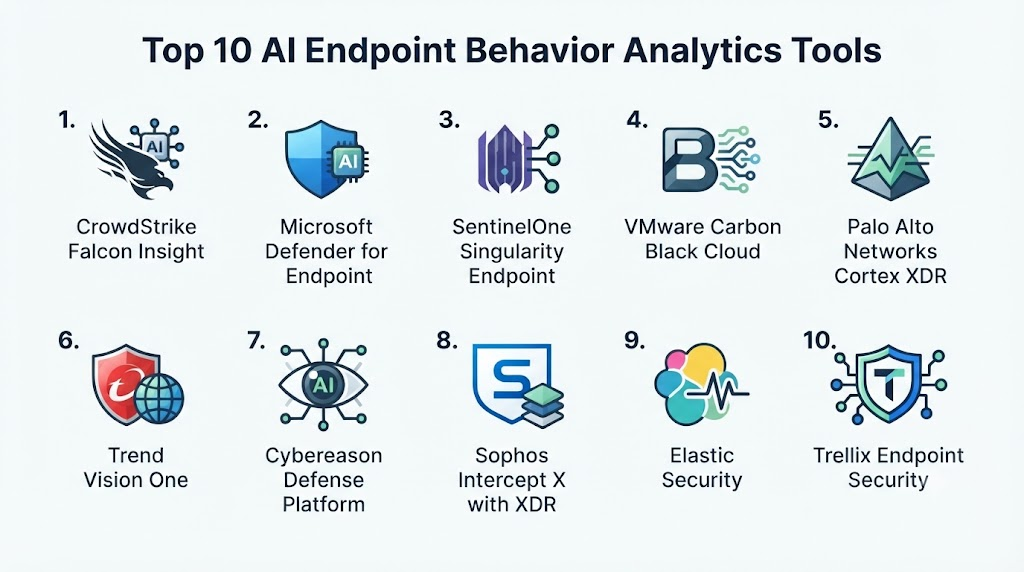
Top 10 AI Endpoint Behavior Analytics Tools
1. CrowdStrike Falcon Insight XDR
Verdict: One of the most advanced AI-powered endpoint behavior analytics platforms for enterprise security operations.
Short Description: CrowdStrike Falcon Insight XDR continuously analyzes endpoint behavior using AI and machine learning to detect ransomware, malware, credential abuse, suspicious processes, and attacker techniques. Its lightweight architecture and extensive threat intelligence enable rapid investigations, automated detections, and proactive threat hunting across enterprise environments.
Key Features
- Behavioral AI detection
- Real-time endpoint monitoring
- Threat hunting
- Incident investigation
- MITRE ATT&CK mapping
- AI-driven risk scoring
- Threat intelligence integration
- Automated response
Pros
- Industry-leading endpoint visibility
- Excellent threat intelligence
- Lightweight endpoint agent
- Fast investigations
Cons
- Premium enterprise pricing
- Advanced features require skilled analysts
Deployment: Cloud
Security & Compliance: Enterprise-grade security controls
Integrations & Ecosystem: SIEM, SOAR, XDR, identity platforms
Support & Community: Enterprise support
Pricing Model: Subscription
Best-Fit Scenarios: Enterprise SOCs and MDR providers
2. Microsoft Defender for Endpoint
Verdict: Comprehensive AI endpoint security platform for Microsoft environments.
Short Description: Microsoft Defender for Endpoint uses behavioral AI, cloud intelligence, and threat analytics to detect advanced endpoint attacks. It provides automated investigations, attack path visualization, vulnerability management, and endpoint behavior analysis integrated across the Microsoft security ecosystem.
Key Features
- Behavioral monitoring
- Automated investigations
- Threat intelligence
- Endpoint vulnerability management
- Attack path analysis
- AI-powered recommendations
- Endpoint risk scoring
Pros
- Excellent Microsoft integration
- Strong automation
- Enterprise scalability
Cons
- Best within Microsoft ecosystem
- Licensing complexity
Deployment: Cloud
Best-Fit Scenarios: Microsoft enterprise environments
3. SentinelOne Singularity XDR
Verdict: AI-first autonomous endpoint protection platform.
Short Description: SentinelOne Singularity XDR combines behavioral AI, machine learning, and autonomous response to detect malicious endpoint activities, investigate incidents, and automatically contain threats before they spread.
Key Features
- Autonomous detection
- Behavioral analytics
- Threat hunting
- Automated remediation
- Endpoint isolation
- AI investigations
Pros
- Excellent autonomous response
- Strong ransomware protection
Cons
- Enterprise deployment complexity
4. VMware Carbon Black Cloud
Verdict: Advanced endpoint behavior analytics with continuous monitoring.
Short Description: VMware Carbon Black continuously collects endpoint telemetry, analyzes behavioral patterns using AI, and identifies malicious activities such as fileless attacks, suspicious processes, and insider threats.
Key Features
- Continuous telemetry
- Behavioral detection
- Threat hunting
- Endpoint analytics
- Attack visualization
Pros
- Deep endpoint visibility
- Excellent threat hunting
Cons
- Requires tuning
- Learning curve
5. Sophos Intercept X
Verdict: AI-powered endpoint security platform with behavioral protection.
Short Description: Sophos Intercept X combines deep learning, behavioral analytics, anti-ransomware technology, and exploit prevention to detect advanced attacks before significant damage occurs.
Key Features
- Deep learning detection
- Behavioral monitoring
- Anti-ransomware
- Exploit prevention
- Threat intelligence
Pros
- Strong ransomware defense
- Easy deployment
Cons
- Advanced analytics less extensive than enterprise-focused competitors
6. Trellix Endpoint Security
Verdict: Enterprise endpoint behavior analytics with AI-powered detection.
Short Description: Trellix Endpoint Security combines behavioral monitoring, machine learning, and threat intelligence to identify suspicious endpoint activity, automate investigations, and improve incident response efficiency.
Key Features
- Behavioral analytics
- Threat intelligence
- AI investigations
- Automated response
- Endpoint protection
Pros
- Mature enterprise platform
- Strong automation
Cons
- Enterprise-oriented implementation
7. Cisco Secure Endpoint
Verdict: AI-powered endpoint protection integrated with Cisco security platforms.
Short Description: Cisco Secure Endpoint analyzes endpoint behavior using AI, correlates endpoint and network telemetry, and helps analysts identify threats through intelligent behavioral analytics and investigation workflows.
Key Features
- Behavioral analytics
- Endpoint telemetry
- Threat correlation
- Automated investigations
- Device isolation
Pros
- Strong Cisco ecosystem
- Excellent network correlation
Cons
- Best for Cisco customers
8. Elastic Security
Verdict: Flexible AI-powered endpoint behavior analytics for security operations.
Short Description: Elastic Security combines endpoint telemetry, behavioral analytics, and machine learning to detect endpoint anomalies, investigate incidents, and support proactive threat hunting using customizable workflows.
Key Features
- Endpoint analytics
- Behavioral detection
- Threat hunting
- Machine learning
- Detection engineering
Pros
- Highly customizable
- Strong analytics capabilities
Cons
- Requires Elastic expertise
9. Cortex XDR
Verdict: AI-driven endpoint and network behavior analytics platform.
Short Description: Cortex XDR correlates endpoint, network, cloud, and identity data to identify sophisticated attacks using behavioral analytics, AI, and automated investigation capabilities.
Key Features
- Behavioral analytics
- Multi-source correlation
- AI investigations
- Threat intelligence
- Automated detection
Pros
- Excellent XDR capabilities
- Strong AI correlation
Cons
- Best within Palo Alto ecosystem
10. OpenAI-Based Custom Endpoint Analytics
Verdict: Flexible AI-powered endpoint behavior analytics built for enterprise-specific workflows.
Short Description: Organizations can build customized endpoint behavior analytics solutions using large language models integrated with endpoint telemetry, SIEM platforms, EDR solutions, threat intelligence, and security automation tools to improve investigations, reporting, and analyst productivity.
Key Features
- Custom behavioral analysis
- AI investigations
- Endpoint summarization
- Threat intelligence enrichment
- Custom workflows
Pros
- Highly customizable
- Supports organization-specific requirements
Cons
- Requires AI and cybersecurity expertise
- Needs governance and validation
Comparison Table
| Platform | Behavioral Analytics | AI Investigation | Automation | Threat Intelligence | Best Use |
|---|---|---|---|---|---|
| CrowdStrike Falcon | Excellent | Excellent | Excellent | Excellent | Enterprise SOC |
| Microsoft Defender | Excellent | Excellent | Excellent | Excellent | Microsoft security |
| SentinelOne | Excellent | High | Excellent | High | Autonomous endpoint protection |
| VMware Carbon Black | High | High | High | High | Threat hunting |
| Sophos Intercept X | High | Medium | High | High | SMB & Enterprise |
| Trellix Endpoint | High | High | High | High | Enterprise endpoint security |
| Cisco Secure Endpoint | High | High | High | High | Cisco environments |
| Elastic Security | High | High | Medium | Medium | Security analytics |
| Cortex XDR | Excellent | Excellent | High | Excellent | XDR operations |
| OpenAI Custom | Custom | Excellent | Custom | Custom | Custom workflows |
Evaluation & Scoring Table
| Platform | AI Features 20% | Detection 20% | Integrations 15% | Automation 15% | Security 10% | Ease 10% | Value 10% | Total |
|---|---|---|---|---|---|---|---|---|
| CrowdStrike Falcon | 20 | 20 | 15 | 15 | 10 | 9 | 9 | 98 |
| Microsoft Defender | 19 | 20 | 15 | 15 | 10 | 9 | 9 | 97 |
| Cortex XDR | 19 | 19 | 15 | 14 | 10 | 8 | 8 | 93 |
| SentinelOne | 19 | 19 | 14 | 15 | 10 | 8 | 8 | 93 |
| VMware Carbon Black | 18 | 18 | 14 | 13 | 10 | 8 | 8 | 89 |
| Trellix Endpoint | 18 | 18 | 14 | 13 | 10 | 8 | 8 | 89 |
| Cisco Secure Endpoint | 18 | 17 | 14 | 13 | 10 | 8 | 8 | 88 |
| Sophos Intercept X | 17 | 17 | 13 | 13 | 10 | 9 | 9 | 88 |
| Elastic Security | 17 | 17 | 13 | 12 | 10 | 8 | 9 | 86 |
| OpenAI Custom | 20 | 19 | 12 | 15 | 8 | 7 | 9 | 90 |
Which AI Endpoint Behavior Analytics Tool Is Right for You?
| If your priority is… | Recommended Platform |
|---|---|
| Enterprise endpoint security | CrowdStrike Falcon |
| Microsoft infrastructure | Microsoft Defender |
| Autonomous response | SentinelOne |
| Threat hunting | VMware Carbon Black |
| XDR operations | Cortex XDR |
| Cisco environments | Cisco Secure Endpoint |
| Open analytics | Elastic Security |
| SMB endpoint protection | Sophos Intercept X |
| Enterprise endpoint security suite | Trellix Endpoint |
| Custom AI workflows | OpenAI-Based Endpoint Analytics |
Implementation Playbook
First 30 Days
- Inventory endpoint devices
- Deploy endpoint agents
- Connect SIEM and EDR
- Define behavioral baselines
Days 31–60
- Enable AI behavioral analytics
- Tune detection policies
- Integrate threat intelligence
- Train security analysts
Days 61–90
- Automate investigations
- Measure detection improvements
- Optimize behavioral models
- Expand response playbooks
Common Mistakes
- Relying only on signature-based detection
- Ignoring endpoint behavioral baselines
- Not integrating threat intelligence
- Poor alert prioritization
- Missing analyst validation
- Delayed response automation
- Inadequate endpoint coverage
- Lack of continuous tuning
Frequently Asked Questions
1. What is AI Endpoint Behavior Analytics?
AI Endpoint Behavior Analytics uses machine learning to monitor endpoint activities, identify abnormal behavior, and detect cyber threats before they cause significant damage.
2. How is it different from traditional antivirus?
Traditional antivirus relies mainly on known signatures, while AI Endpoint Behavior Analytics detects suspicious behaviors, including previously unseen attacks.
3. Can these tools detect ransomware?
Yes. Most leading platforms identify ransomware through behavioral indicators such as abnormal encryption activity, suspicious process execution, and privilege escalation.
4. Do these platforms integrate with SIEM and XDR?
Yes. Most enterprise solutions integrate with SIEM, SOAR, XDR, identity platforms, and threat intelligence feeds.
5. Can AI replace endpoint security analysts?
No. AI assists analysts by automating repetitive tasks and improving investigations, but human oversight remains essential.
6. Are these tools suitable for cloud workloads?
Yes. Many platforms support cloud workloads, virtual machines, containers, and hybrid environments.
7. What data do these platforms analyze?
They analyze endpoint telemetry, process execution, file activity, registry changes, memory usage, user behavior, and network communications.
8. How do they reduce false positives?
Machine learning models continuously learn normal endpoint behavior and prioritize alerts based on behavioral context and threat intelligence.
9. Which industries benefit the most?
Financial services, healthcare, government, manufacturing, retail, technology, and any organization managing large endpoint fleets.
10. What should organizations consider before deployment?
Organizations should evaluate endpoint coverage, integration capabilities, automation features, AI accuracy, compliance requirements, and analyst workflows.
Conclusion
AI Endpoint Behavior Analytics has become a foundational capability for modern endpoint security, enabling organizations to detect sophisticated attacks that traditional security tools often miss. By continuously monitoring endpoint behaviors, correlating security signals, and automating investigations, these platforms help security teams respond faster while reducing analyst fatigue and false positives.
Organizations should select an AI Endpoint Behavior Analytics platform based on endpoint scale, integration requirements, security ecosystem compatibility, automation capabilities, and operational maturity. Solutions such as CrowdStrike Falcon, Microsoft Defender for Endpoint, SentinelOne, and Cortex XDR offer enterprise-grade capabilities, while custom AI implementations provide flexibility for organizations with specialized security workflows.
