Introduction
AI Game NPC Behavior Generation Tools use artificial intelligence, machine learning, reinforcement learning, large language models (LLMs), natural language processing (NLP), procedural generation, and behavior simulation techniques to create more dynamic, intelligent, and responsive non-player characters (NPCs) in video games.
Traditional NPC systems often depend on manually created behavior trees, finite-state machines, scripted dialogue, and predefined reactions. While these approaches provide predictable gameplay, they can become repetitive and require significant development effort when creating large open worlds, complex simulations, or interactive storytelling experiences.
AI-powered NPC behavior systems help developers create characters that can adapt to player actions, generate contextual conversations, make decisions, learn from gameplay situations, and respond with more realistic behaviors.
These tools can assist with:
- NPC decision-making
- Adaptive combat behaviors
- Character personalities
- Procedural dialogue
- Social interactions
- Quest generation
- Companion AI
- Enemy strategy adaptation
- World simulation
- Dynamic storytelling
Modern AI NPC systems combine behavior modeling, game engines, AI agents, animation systems, voice technologies, knowledge bases, and simulation frameworks to create richer player experiences.
They are used across:
- Role-playing games (RPGs)
- Open-world games
- Strategy games
- Simulation games
- Multiplayer games
- Virtual worlds
- Educational games
- Training simulations
- Metaverse-style environments
Why AI NPC Behavior Generation Matters
NPCs strongly influence how players experience a game world. Static characters with limited responses can make environments feel artificial, while adaptive NPCs can create unpredictable and immersive gameplay.
AI-powered NPC behavior generation helps developers:
- Create believable characters
- Reduce manual scripting workload
- Generate dynamic conversations
- Improve replayability
- Build living game worlds
- Personalize player experiences
- Simulate complex social systems
- Support emergent gameplay
However, AI-generated behaviors still require careful design. Developers must control personality, fairness, safety, game balance, and narrative consistency.
Common Use Cases
- Intelligent enemy AI
- AI companions
- Dynamic quest systems
- Conversational NPCs
- Procedural storytelling
- Character personality simulation
- Strategy decision systems
- Open-world population simulation
- Training environments
- Virtual characters
Evaluation Criteria for Buyers
Behavior Intelligence
The system should generate believable decisions, reactions, and interactions based on game context.
Game Engine Integration
Strong integration with Unity, Unreal Engine, proprietary engines, and development pipelines is essential.
Developer Control
Developers need tools to define personality, boundaries, goals, emotions, memory, and gameplay rules.
Performance
AI behavior systems must operate efficiently without negatively affecting frame rates or server costs.
Scalability
Large games may require thousands of NPCs with different behaviors running simultaneously.
Safety and Consistency
Generated dialogue and actions should remain aligned with game ratings, story requirements, and gameplay rules.
Debugging Tools
Developers need visibility into why an NPC made a decision and how behavior can be adjusted.
Key Trends
LLM-Powered NPC Conversations
Large language models are enabling NPCs to generate contextual dialogue instead of relying only on manually written conversations.
Autonomous AI Agents
Game characters are increasingly modeled as autonomous agents with goals, memory, relationships, and decision-making abilities.
Procedural Character Personalities
AI systems can generate unique personalities, motivations, and behavior patterns for large populations of characters.
Adaptive Gameplay
NPCs can respond differently depending on player actions, creating personalized experiences.
AI Simulation Worlds
Developers are experimenting with simulated environments where NPCs interact with each other and create emergent events.
Hybrid AI Systems
The strongest implementations combine traditional game AI with generative AI to maintain control while increasing realism.
Methodology
The following platforms were evaluated using:
- Core features
- Ease of use
- Engine integration
- Performance
- Developer ecosystem
- Security and reliability
- Price and value
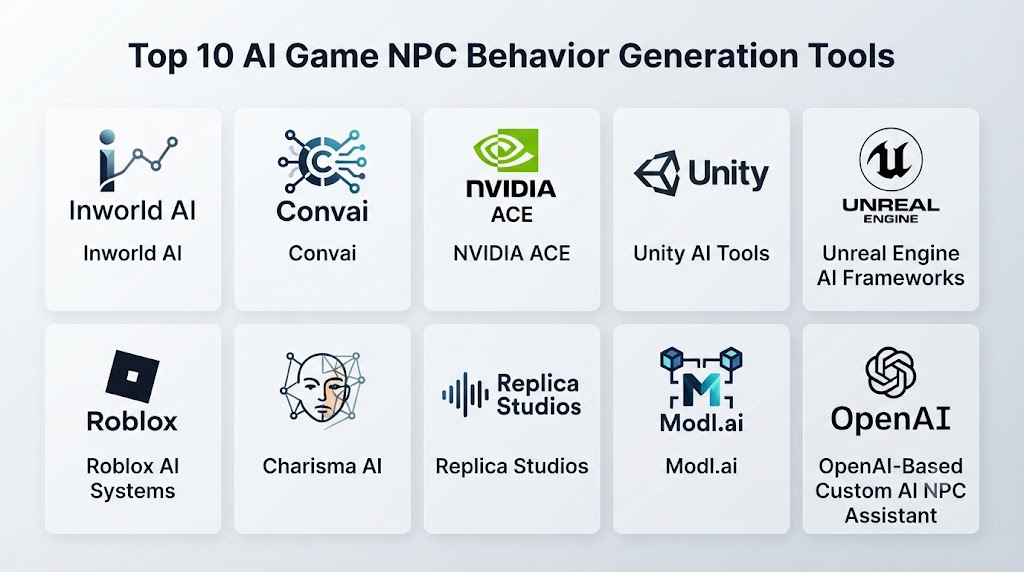
Top 10 AI Game NPC Behavior Generation Tools
1. Inworld AI
Inworld AI provides tools for creating intelligent game characters with personalities, memories, emotions, knowledge, and conversational abilities. It is designed specifically for interactive characters and game experiences.
Key Features
- AI character creation
- Personality modeling
- Memory systems
- Context-aware conversations
- Voice interaction
- Game engine integrations
- Character knowledge management
- Real-time responses
- Narrative control
- Developer tools
Pros
- Strong focus on game characters
- Supports realistic conversations
- Good personality customization
- Designed for interactive storytelling
- Useful for companion and dialogue systems
Cons
- Requires careful content control
- Complex games may need custom AI architecture
- Production costs vary based on scale
Platforms
Web tools, APIs, game-engine integrations, and developer SDKs.
Deployment or Support
Cloud-based AI services.
Security & Compliance
Enterprise controls depend on deployment requirements.
Integrations & Ecosystem
Game engines, character systems, voice technologies, narrative tools, and development pipelines.
Support & Community
Developer documentation, tutorials, and technical support.
2. Convai
Convai focuses on creating conversational AI characters that can understand speech, maintain context, and interact naturally within game environments.
Key Features
- Conversational NPCs
- Speech recognition
- Voice responses
- Character memory
- Knowledge bases
- Unreal Engine integration
- Unity integration
- Real-time interaction
- Character personalities
- AI dialogue systems
Pros
- Strong voice interaction
- Good game-engine integration
- Natural conversations
- Useful for immersive experiences
- Developer-friendly APIs
Cons
- Primarily focused on conversation
- Complex behavioral simulation requires additional systems
- Requires testing for narrative consistency
Platforms
Unity, Unreal Engine, APIs, and cloud services.
Deployment or Support
Cloud-based AI platform.
Security & Compliance
Not publicly stated for all deployments.
Integrations & Ecosystem
Game engines, voice systems, virtual characters, and interactive applications.
Support & Community
Developer documentation and community resources.
3. NVIDIA ACE
NVIDIA ACE provides AI technologies for creating digital characters with speech recognition, language understanding, animation, and realistic interactions.
Key Features
- AI character services
- Speech recognition
- Conversational AI
- Facial animation
- Digital human technology
- Real-time rendering
- AI inference optimization
- Game engine support
- Voice generation
- Character interaction
Pros
- High-quality digital human capabilities
- Strong hardware acceleration
- Enterprise-level technology
- Excellent graphics integration
Cons
- Requires advanced technical implementation
- Hardware requirements may be significant
- Best suited for large-scale productions
Platforms
NVIDIA technologies, APIs, SDKs, and game-engine integrations.
Deployment or Support
Cloud, enterprise, and local GPU environments.
Security & Compliance
Enterprise deployment controls vary by implementation.
Integrations & Ecosystem
Game engines, GPUs, rendering systems, animation pipelines, and AI infrastructure.
Support & Community
Developer resources, technical documentation, and enterprise support.
4. Unity AI Tools
Unity provides AI capabilities and development tools that help developers build intelligent behaviors, gameplay systems, and interactive experiences.
Key Features
- AI-assisted development
- NPC behavior systems
- Agent workflows
- Navigation systems
- Procedural content support
- Game simulation tools
- Developer APIs
- Editor integration
- Runtime systems
- Asset workflows
Pros
- Strong Unity ecosystem
- Familiar workflow for developers
- Flexible customization
- Large developer community
- Supports many game genres
Cons
- Requires game-development knowledge
- AI capabilities vary across tools
- Advanced NPC systems require custom development
Platforms
Unity Editor, game engines, APIs, and development environments.
Deployment or Support
Desktop development environment with cloud services.
Security & Compliance
Enterprise options vary by service.
Integrations & Ecosystem
Unity assets, game services, plugins, analytics, and development pipelines.
Support & Community
Large developer community, documentation, forums, and training resources.
5. Unreal Engine AI Frameworks
Unreal Engine provides behavior trees, AI perception, navigation, machine-learning-related tools, and gameplay frameworks for creating advanced NPC systems.
Key Features
- Behavior trees
- AI perception
- Navigation systems
- Decision logic
- Animation systems
- Simulation tools
- Blueprint scripting
- Gameplay framework
- Character controllers
- Environment awareness
Pros
- Industry-standard game engine
- Powerful AI frameworks
- Excellent visual capabilities
- Strong developer ecosystem
Cons
- Requires technical expertise
- Generative AI requires additional integration
- Complex projects need experienced teams
Platforms
Windows, macOS, consoles, and supported platforms.
Deployment or Support
Game-development environment.
Security & Compliance
Enterprise controls depend on deployment.
Integrations & Ecosystem
Game engines, animation tools, rendering systems, plugins, and development workflows.
Support & Community
Documentation, forums, marketplace assets, and developer communities.
6. Roblox AI Systems
Roblox provides AI tools and platform capabilities that allow creators to build interactive experiences, intelligent characters, and user-generated worlds.
Key Features
- AI-assisted creation
- Interactive characters
- Script assistance
- World simulation
- Creator tools
- Multiplayer experiences
- Procedural systems
- Developer APIs
- Community content
- Real-time environments
Pros
- Large creator ecosystem
- Accessible development platform
- Strong multiplayer environment
- Supports user-generated experiences
Cons
- Platform-specific limitations
- Less control than custom engines
- Complex AI behaviors require development skills
Platforms
Roblox Studio and Roblox platform.
Deployment or Support
Cloud gaming platform.
Security & Compliance
Platform-level safety systems and creator controls.
Integrations & Ecosystem
Roblox experiences, creator marketplace, developer tools, and community systems.
Support & Community
Large creator community and documentation.
7. Charisma AI
Charisma AI specializes in interactive storytelling using AI-driven dialogue, branching narratives, and character interactions.
Key Features
- Interactive storytelling
- AI dialogue
- Character relationships
- Narrative branching
- Voice support
- Story management
- Conversation systems
- Content control
- Character memory
- API integration
Pros
- Strong narrative focus
- Useful for story-driven games
- Good dialogue management
- Supports interactive experiences
Cons
- Less focused on combat AI
- Requires narrative planning
- Complex simulations need additional systems
Platforms
Cloud platform and APIs.
Deployment or Support
Cloud-based service.
Security & Compliance
Not publicly stated.
Integrations & Ecosystem
Games, interactive stories, education, entertainment applications.
Support & Community
Documentation and customer support.
8. Replica Studios
Replica Studios provides AI voice technology and character voice solutions for games and digital experiences.
Key Features
- AI voices
- Character dialogue
- Voice generation
- Voice customization
- Game integration
- Audio workflows
- Character creation
- Localization support
- Voice management
- Production tools
Pros
- Strong voice capabilities
- Useful for game dialogue production
- Speeds up voice workflows
- Supports character creation
Cons
- Primarily voice-focused
- Behavior generation requires additional AI systems
- Licensing considerations are important
Platforms
Web platform, APIs, and development integrations.
Deployment or Support
Cloud-based service.
Security & Compliance
Voice rights and usage policies should be reviewed.
Integrations & Ecosystem
Game engines, voice pipelines, character systems, and production workflows.
Support & Community
Documentation and customer support.
9. Modl.ai
Modl.ai provides AI agents for testing and simulation in games. It helps developers understand player experiences and automate gameplay testing.
Key Features
- AI game agents
- Automated testing
- Gameplay simulation
- Player behavior analysis
- Quality assurance
- Bug discovery
- Simulation environments
- Testing automation
- Analytics
- Developer tools
Pros
- Improves game testing
- Supports large-scale simulation
- Reduces manual QA effort
- Useful for complex games
Cons
- Focused more on testing than NPC storytelling
- Requires integration with development pipelines
- Not a complete NPC dialogue system
Platforms
Game engines, APIs, and developer environments.
Deployment or Support
Cloud-based testing services.
Security & Compliance
Enterprise requirements vary.
Integrations & Ecosystem
Game engines, QA workflows, analytics systems, and development pipelines.
Support & Community
Developer documentation and technical support.
10. OpenAI-Based Custom AI NPC Assistant
A custom AI NPC assistant built with large language models can provide developers with flexible systems for creating intelligent game characters. It can manage conversations, memories, personalities, goals, knowledge bases, and decision-support workflows while integrating with game engines and backend systems.
Key Features
- Dynamic dialogue generation
- NPC memory systems
- Personality modeling
- Quest assistance
- Character knowledge management
- Behavior recommendations
- Player-context analysis
- Multilingual conversations
- Game-engine integration
- Custom AI workflows
Pros
- Highly customizable
- Supports unique game requirements
- Flexible integration options
- Can combine multiple AI systems
- Useful for large narrative worlds
Cons
- Requires engineering expertise
- Needs strong gameplay constraints
- AI behavior requires testing and monitoring
- Infrastructure costs depend on scale
Platforms
Custom applications, APIs, cloud infrastructure, and game engines.
Deployment or Support
Cloud, hybrid, or private deployment.
Security & Compliance
Requires organization-defined security controls, access management, and content governance.
Integrations & Ecosystem
Unity, Unreal Engine, databases, knowledge systems, voice platforms, animation systems, and game backends.
Support & Community
Developer documentation, engineering support, and AI development resources.
Comparison Table
| Tool Name | Best For | Platform(s) Supported | Deployment | Standout Feature | Public Rating |
|---|---|---|---|---|---|
| Inworld AI | Intelligent NPC characters | APIs, Unity, Unreal | Cloud | Personality and memory systems | N/A |
| Convai | Conversational NPCs | Unity, Unreal, APIs | Cloud | Voice-based interaction | N/A |
| NVIDIA ACE | Digital humans | NVIDIA ecosystem | Cloud/local GPU | Realistic AI characters | N/A |
| Unity AI Tools | Unity games | Unity ecosystem | Desktop/cloud | Developer workflow integration | N/A |
| Unreal Engine AI Frameworks | AAA games | Unreal Engine | Development environment | Advanced behavior systems | N/A |
| Roblox AI Systems | Creator games | Roblox Studio | Cloud | User-generated worlds | N/A |
| Charisma AI | Narrative games | APIs | Cloud | Interactive storytelling | N/A |
| Replica Studios | AI character voices | APIs | Cloud | Voice generation | N/A |
| Modl.ai | AI game testing | APIs | Cloud | Autonomous testing agents | N/A |
| OpenAI Custom AI NPC Assistant | Enterprise game AI | Custom platforms | Cloud/hybrid/private | Fully customized NPC intelligence | N/A |
Weighted Evaluation
| Tool Name | Core Features 25% | Ease of Use 15% | Integrations & Ecosystem 15% | Security & Compliance 10% | Performance & Reliability 10% | Support & Community 10% | Price/Value 15% | Total |
|---|---|---|---|---|---|---|---|---|
| Inworld AI | 24 | 13 | 14 | 8 | 10 | 9 | 12 | 90 |
| Convai | 23 | 13 | 14 | 8 | 10 | 9 | 12 | 89 |
| NVIDIA ACE | 24 | 10 | 15 | 10 | 10 | 10 | 9 | 88 |
| Unity AI Tools | 22 | 12 | 15 | 9 | 10 | 10 | 12 | 90 |
| Unreal Engine AI Frameworks | 24 | 9 | 15 | 10 | 10 | 10 | 10 | 88 |
| Roblox AI Systems | 20 | 14 | 14 | 9 | 9 | 10 | 13 | 89 |
| Charisma AI | 21 | 13 | 12 | 8 | 9 | 8 | 12 | 83 |
| Replica Studios | 20 | 14 | 11 | 8 | 9 | 8 | 12 | 82 |
| Modl.ai | 21 | 11 | 13 | 9 | 10 | 8 | 11 | 83 |
| OpenAI Custom AI NPC Assistant | 25 | 10 | 15 | 8 | 10 | 9 | 12 | 89 |
Which AI NPC Behavior Generation Tool Is Right for You?
Choose Inworld AI when you need intelligent characters with personalities, memories, and conversations.
Choose Convai when voice-driven NPC interaction is your priority.
Choose NVIDIA ACE when building realistic digital humans and advanced character experiences.
Choose Unity AI Tools when developing games inside the Unity ecosystem.
Choose Unreal Engine AI Frameworks for large-scale professional game development.
Choose Roblox AI Systems for creator-focused multiplayer experiences.
Choose Charisma AI for interactive storytelling and branching narratives.
Choose Replica Studios when AI-generated character voices are the main requirement.
Choose Modl.ai when AI agents are needed for gameplay testing and simulation.
Choose OpenAI-Based Custom AI NPC Assistant when building a fully customized AI-driven game world.
Implementation Playbook
Phase 1: Define NPC Goals
- Identify character roles.
- Define personalities.
- Establish behavior boundaries.
- Determine memory requirements.
- Define player interaction goals.
Phase 2: Build Knowledge Systems
- Create character backgrounds.
- Define world rules.
- Add quest information.
- Connect game databases.
- Establish approved responses.
Phase 3: Integrate AI Behavior
- Connect AI systems with the game engine.
- Add decision layers.
- Configure dialogue systems.
- Implement memory handling.
- Test performance impact.
Phase 4: Validate Gameplay
- Test NPC consistency.
- Review unexpected behaviors.
- Check game balance.
- Measure player reactions.
- Improve behavior rules.
Common Mistakes
- Giving NPCs unlimited AI freedom
- Ignoring gameplay balance
- Poor character definition
- Lack of behavior testing
- Slow AI response times
- Weak memory management
- No content safety controls
- Ignoring player privacy
- Overusing AI-generated dialogue
- Failing to maintain narrative consistency
FAQs
1. What are AI Game NPC Behavior Generation Tools?
They are AI-powered systems that help developers create intelligent non-player characters capable of making decisions, generating dialogue, adapting behaviors, and responding dynamically to players.
2. Can AI create complete NPC personalities?
Yes. AI systems can generate personality traits, memories, motivations, dialogue styles, and behavioral patterns, but developers usually define the character boundaries.
3. Can AI NPCs learn from players?
Some systems support memory and adaptation features, allowing NPCs to respond differently based on previous interactions.
4. Will AI replace traditional game AI?
Most developers use AI alongside traditional systems. Behavior trees, rules, and scripted logic remain important for gameplay control and reliability.
5. Which game engines support AI NPC systems?
Unity and Unreal Engine are widely used, while specialized platforms provide integrations through APIs and SDKs.
6. Can AI NPCs generate dialogue in real time?
Yes. Large language model-based systems can create contextual conversations based on game state, character information, and player actions.
7. Are AI NPC behaviors expensive to run?
Costs depend on model usage, player count, response frequency, infrastructure, and deployment architecture.
8. How can developers prevent unwanted NPC behavior?
Developers should use content rules, knowledge restrictions, testing environments, monitoring, and human-designed gameplay constraints.
9. Can AI NPCs improve replayability?
Dynamic conversations, adaptive decisions, and changing relationships can create more varied experiences across multiple play sessions.
10. What should developers evaluate before adoption?
Consider game-engine compatibility, behavior quality, latency, scalability, safety controls, developer tools, customization options, and production requirements.
Conclusion
AI Game NPC Behavior Generation Tools are transforming interactive entertainment by enabling more responsive characters, dynamic conversations, adaptive gameplay, and richer virtual worlds.Inworld AI and Convai focus strongly on intelligent conversational characters, while NVIDIA ACE advances realistic digital humans. Unity and Unreal Engine provide powerful foundations for custom NPC systems. Roblox supports creator-driven experiences, Charisma AI strengthens interactive storytelling, Replica Studios improves character voices, and Modl.ai supports AI-driven testing.
