Introduction
AI Quiz & Assessment Generation Tools use artificial intelligence, natural language processing, machine learning, and educational analytics to help teachers, trainers, instructional designers, and organizations create assessments faster and more effectively.
Creating high-quality assessments traditionally requires educators to define learning objectives, prepare questions, design answer choices, create grading criteria, evaluate difficulty levels, and align questions with curriculum standards. AI-powered assessment tools automate many of these tasks by generating quizzes, tests, question banks, assignments, rubrics, and evaluation frameworks from topics, documents, lessons, or learning objectives.
These tools support different assessment formats, including:
- Multiple-choice questions
- True/false questions
- Short-answer questions
- Essay assessments
- Coding evaluations
- Scenario-based questions
- Knowledge checks
- Practice exams
- Skill assessments
- Certification preparation tests
AI assessment generators are used across:
- Schools
- Universities
- Corporate training programs
- Online learning platforms
- Certification providers
- Coaching programs
- Professional development organizations
Modern AI assessment platforms combine content generation, learning analytics, automated grading, question difficulty analysis, adaptive testing, and integration with learning management systems.
The goal of AI assessment generation is not only to create more questions but to create better learning experiences through meaningful evaluation, faster feedback, and personalized practice.
How AI Quiz & Assessment Generation Tools Work
Content Analysis
AI analyzes provided topics, documents, lessons, videos, or learning objectives to understand the subject matter.
Question Generation
The system creates questions based on selected formats, difficulty levels, and educational goals.
Answer Creation
AI generates answer keys, explanations, distractors, scoring guidelines, and feedback.
Difficulty Adjustment
Advanced platforms can modify question complexity according to learner level.
Assessment Analytics
AI analyzes learner responses to identify knowledge gaps and recommend improvement areas.
Common Use Cases
- Classroom quizzes
- Online course assessments
- Employee knowledge checks
- Certification preparation
- Compliance training
- Interview assessments
- Technical skill testing
- Language assessments
- Academic examinations
- Practice tests
- Learning reinforcement
- Automated grading support
Why AI Assessment Generation Matters
Faster Assessment Creation
Educators and trainers can create quizzes and exams in minutes instead of spending hours manually writing questions.
Better Learning Alignment
AI can generate assessments based on specific learning objectives, skills, and competency requirements.
Personalized Practice
Students can receive customized quizzes based on their performance and learning gaps.
Consistent Evaluation
Organizations can create standardized assessments across teams, locations, and learning programs.
Continuous Learning Support
AI enables frequent knowledge checks and instant feedback loops.
Evaluation Criteria for Buyers
Question Quality
Generated questions should be accurate, relevant, and aligned with learning goals.
Assessment Variety
Platforms should support multiple question formats and evaluation styles.
Customization
Users should control difficulty, audience level, subject area, and assessment structure.
Accuracy and Reliability
AI-generated assessments require expert review to prevent incorrect answers or ambiguous questions.
Analytics
Strong platforms provide insights into learner performance, knowledge gaps, and improvement areas.
Integration Capability
Important integrations include LMS platforms, HR systems, classroom tools, and content management systems.
Security and Privacy
Educational and corporate assessment data should be protected through access controls, encryption, and responsible data practices.
Key Trends
AI-Powered Adaptive Testing
Assessments are becoming dynamic, adjusting question difficulty based on learner responses.
Automated Question Banks
Organizations are building large reusable question libraries generated and maintained with AI assistance.
Skill-Based Assessment
Companies are moving toward measuring practical skills instead of only course completion.
Generative Assessment Content
AI is creating scenario-based questions, simulations, case studies, and application-focused assessments.
Real-Time Feedback
Learners increasingly receive instant explanations and improvement recommendations.
AI-Assisted Grading
Automated evaluation is expanding from multiple-choice tests toward written responses, coding tasks, and open-ended assignments.
Methodology
The following tools were evaluated using:
- Assessment generation capabilities
- Ease of use
- Integrations and ecosystem
- Security and compliance
- Performance and reliability
- Support and community
- Price and value
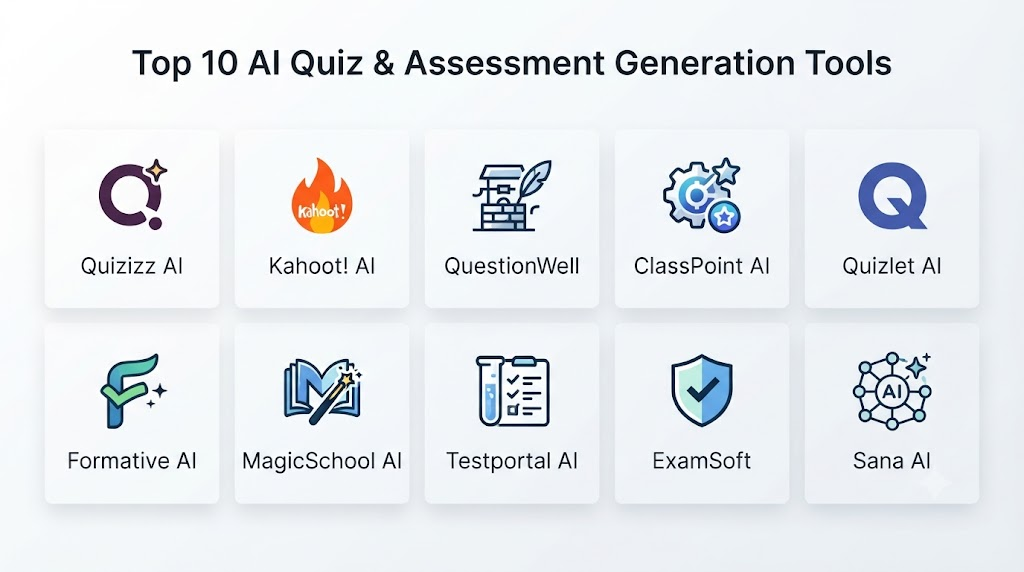
Top 10 AI Quiz & Assessment Generation Tools
1. Quizizz AI
Quizizz AI helps educators create quizzes, assessments, and learning activities using artificial intelligence. It supports automated question creation, customization, classroom engagement, and student performance tracking.
Key Features
- AI quiz generation
- Multiple question formats
- Lesson-based assessments
- Student analytics
- Live quizzes
- Homework assignments
- Question editing
- Performance reports
- Classroom activities
- Learning resources
Pros
- Easy for teachers and students
- Strong classroom engagement
- Fast quiz creation
- Good analytics features
- Supports multiple subjects
Cons
- Primarily focused on quizzes
- Requires teacher review
- Advanced features may depend on plans
Platforms
Web, iOS, and Android.
Deployment or Support
Cloud-based education platform.
Security & Compliance
Education privacy controls vary by plan.
Integrations & Ecosystem
Classroom workflows, educational platforms, and digital learning environments.
Support & Community
Teacher resources, tutorials, help center, and community support.
2. Kahoot! AI
Kahoot! uses AI features to help educators create quizzes, learning games, and interactive assessments from topics or existing resources.
Key Features
- AI question generation
- Interactive quizzes
- Classroom games
- Learning challenges
- Reports and analytics
- Question editing
- Team activities
- Student engagement
- Assessment sharing
- Learning resources
Pros
- Highly engaging learning experience
- Strong classroom adoption
- Easy quiz creation
- Good student participation
- Supports group learning
Cons
- Game-based approach may not fit every assessment
- Advanced analytics vary by plan
- Requires review of AI-generated questions
Platforms
Web, mobile applications.
Deployment or Support
Cloud-based platform.
Security & Compliance
Education security controls vary.
Integrations & Ecosystem
Schools, classrooms, presentations, and learning workflows.
Support & Community
Teacher community, documentation, and support resources.
3. QuestionWell
QuestionWell is an AI-powered question-generation platform designed to help educators create quizzes and assessments from learning content.
Key Features
- AI question generation
- Topic-based quizzes
- Document analysis
- Question export
- Multiple question formats
- Learning objectives
- Answer explanations
- Teacher workflows
- Resource conversion
- Assessment customization
Pros
- Focused specifically on question creation
- Saves teacher preparation time
- Supports educational content transformation
- Easy workflow
- Useful export options
Cons
- Limited broader LMS capabilities
- Requires question review
- Analytics features are limited compared with full platforms
Platforms
Web.
Deployment or Support
Cloud-based service.
Security & Compliance
Not publicly stated for all plans.
Integrations & Ecosystem
Educational platforms and quiz export workflows.
Support & Community
Documentation and educator resources.
4. ClassPoint AI
ClassPoint AI helps educators generate interactive questions and activities directly within presentation-based teaching workflows.
Key Features
- AI question generation
- Presentation integration
- Quiz creation
- Classroom interaction
- Multiple question types
- Lesson enhancement
- Student responses
- Teaching tools
- Presentation analytics
- Learning activities
Pros
- Strong classroom presentation integration
- Useful for teachers
- Quick question creation
- Improves engagement
- Easy adoption
Cons
- Best suited for presentation-based teaching
- Limited enterprise assessment features
- Requires compatible workflows
Platforms
Web and presentation environments.
Deployment or Support
Cloud-connected educational tool.
Security & Compliance
Not publicly stated.
Integrations & Ecosystem
Presentation software, classrooms, and educational workflows.
Support & Community
Teacher resources and support documentation.
5. Quizlet AI
Quizlet AI combines flashcards, study activities, AI-generated questions, practice tests, and learning tools for students and educators.
Key Features
- AI question generation
- Flashcards
- Practice tests
- Study guides
- Learning modes
- Adaptive practice
- Course materials
- Progress tracking
- Explanations
- Collaboration
Pros
- Strong student learning ecosystem
- Good exam preparation support
- Large study community
- Easy to use
- Supports self-paced learning
Cons
- Less focused on formal assessments
- Content quality depends on sources
- Some features require paid access
Platforms
Web, iOS, and Android.
Deployment or Support
Cloud-based learning platform.
Security & Compliance
Privacy controls vary by plan.
Integrations & Ecosystem
Student learning workflows and educational resources.
Support & Community
Help resources and learner community.
6. Formative AI
Formative provides digital assessment tools with AI assistance for creating questions, evaluating responses, and providing feedback.
Key Features
- AI assessment creation
- Real-time feedback
- Student responses
- Teacher dashboards
- Question banks
- Written response evaluation
- Progress analytics
- Classroom assessment
- Learning insights
- Collaboration
Pros
- Strong formative assessment workflow
- Real-time feedback
- Useful teacher analytics
- Supports different question formats
- Good classroom integration
Cons
- Primarily education-focused
- Requires teacher implementation
- Advanced capabilities depend on plans
Platforms
Web and mobile-supported workflows.
Deployment or Support
Cloud-based education platform.
Security & Compliance
Education privacy practices vary.
Integrations & Ecosystem
Schools, LMS platforms, classrooms, and educational systems.
Support & Community
Teacher resources and support.
7. MagicSchool AI
MagicSchool AI provides AI tools for educators, including quiz generation, assessments, rubrics, lesson planning, and instructional resources.
Key Features
- AI assessment creation
- Quiz generation
- Rubrics
- Lesson planning
- Teacher tools
- Educational resources
- Student feedback
- Differentiated instruction
- Classroom support
- Content adaptation
Pros
- Broad educator toolkit
- Saves teacher preparation time
- Supports multiple educational tasks
- Strong teacher-focused workflows
- Easy adoption
Cons
- Requires educator review
- Mainly focused on schools
- Not a dedicated assessment platform only
Platforms
Web.
Deployment or Support
Cloud-based education platform.
Security & Compliance
Education-focused security controls.
Integrations & Ecosystem
Schools, teachers, classroom platforms, and educational workflows.
Support & Community
Teacher community and documentation.
8. Testportal AI
Testportal provides online assessment creation, automated scoring, security features, and AI-assisted assessment workflows.
Key Features
- AI question generation
- Online exams
- Automated scoring
- Question banks
- Assessment security
- Reporting
- Randomized tests
- Candidate management
- Certificates
- Analytics
Pros
- Strong assessment management
- Suitable for organizations
- Supports secure testing
- Good reporting
- Useful for certification workflows
Cons
- More focused on formal assessments
- Requires setup
- Pricing varies by usage
Platforms
Web.
Deployment or Support
Cloud-based assessment platform.
Security & Compliance
Assessment security features vary by plan.
Integrations & Ecosystem
Training platforms, certification workflows, and organizational learning systems.
Support & Community
Documentation and customer support.
9. ExamSoft
ExamSoft provides secure assessment management solutions for institutions requiring controlled examinations, analytics, and performance insights.
Key Features
- Secure exams
- Assessment creation
- Automated scoring
- Exam analytics
- Question analysis
- Performance tracking
- Digital testing
- Institutional workflows
- Reporting
- Assessment security
Pros
- Strong high-stakes assessment capabilities
- Security-focused
- Useful analytics
- Supports institutions
- Professional testing workflows
Cons
- Designed mainly for formal examinations
- Higher education focus
- Requires institutional implementation
Platforms
Web and secure testing environments.
Deployment or Support
Cloud-based assessment system.
Security & Compliance
Strong assessment-security controls.
Integrations & Ecosystem
Universities, professional education, testing environments, and LMS platforms.
Support & Community
Institutional support and training.
10. Sana AI
Sana AI provides AI-powered learning and knowledge solutions for organizations, including assessment creation, training automation, and employee learning support.
Key Features
- AI-generated assessments
- Learning content creation
- Knowledge management
- Employee training
- AI assistants
- Learning analytics
- Enterprise search
- Personalized learning
- Content automation
- Collaboration
Pros
- Enterprise learning focus
- Combines knowledge and assessments
- Supports workplace training
- Modern AI capabilities
- Flexible workflows
Cons
- Enterprise-focused
- Requires implementation planning
- Pricing is not publicly stated
Platforms
Web and enterprise applications.
Deployment or Support
Cloud-based enterprise platform.
Security & Compliance
Enterprise controls vary by agreement.
Integrations & Ecosystem
LMS platforms, workplace tools, knowledge systems, and enterprise applications.
Support & Community
Enterprise onboarding and technical support.
Comparison Table
| Tool Name | Best For | Platform(s) Supported | Deployment | Standout Feature | Public Rating |
|---|---|---|---|---|---|
| Quizizz AI | Classroom quizzes | Web, mobile | Cloud | Interactive AI quizzes | N/A |
| Kahoot! AI | Gamified assessments | Web, mobile | Cloud | Learning games | N/A |
| QuestionWell | Question generation | Web | Cloud | AI question creation | N/A |
| ClassPoint AI | Presentation-based teaching | Web | Cloud | AI classroom questions | N/A |
| Quizlet AI | Study preparation | Web, mobile | Cloud | AI study activities | N/A |
| Formative AI | Classroom assessment | Web | Cloud | Real-time feedback | N/A |
| MagicSchool AI | Teacher workflows | Web | Cloud | Educator AI toolkit | N/A |
| Testportal AI | Online testing | Web | Cloud | Secure assessments | N/A |
| ExamSoft | High-stakes exams | Web | Cloud | Secure testing | N/A |
| Sana AI | Enterprise learning | Web | Cloud | AI workplace assessments | N/A |
Weighted Evaluation
| Tool Name | Core Features 25% | Ease of Use 15% | Integrations & Ecosystem 15% | Security & Compliance 10% | Performance & Reliability 10% | Support & Community 10% | Price/Value 15% | Total |
|---|---|---|---|---|---|---|---|---|
| Quizizz AI | 23 | 15 | 13 | 8 | 10 | 10 | 13 | 92 |
| Kahoot! AI | 22 | 15 | 14 | 8 | 10 | 10 | 13 | 92 |
| QuestionWell | 22 | 14 | 11 | 7 | 9 | 8 | 14 | 85 |
| ClassPoint AI | 21 | 14 | 12 | 8 | 9 | 9 | 13 | 86 |
| Quizlet AI | 22 | 15 | 14 | 8 | 9 | 10 | 13 | 91 |
| Formative AI | 22 | 14 | 13 | 9 | 9 | 9 | 12 | 88 |
| MagicSchool AI | 22 | 14 | 13 | 9 | 9 | 10 | 12 | 89 |
| Testportal AI | 21 | 12 | 12 | 10 | 9 | 8 | 11 | 83 |
| ExamSoft | 22 | 11 | 14 | 10 | 10 | 9 | 10 | 86 |
| Sana AI | 22 | 12 | 14 | 10 | 9 | 9 | 11 | 87 |
Which AI Quiz & Assessment Generation Tool Is Right for You?
Choose Quizizz AI when you need engaging classroom quizzes and student participation.
Choose Kahoot! AI when gamified learning and interactive assessments are priorities.
Choose QuestionWell when the primary requirement is quickly generating quality questions.
Choose ClassPoint AI when teachers create assessments during presentation-based lessons.
Choose Quizlet AI when students need practice tests, flashcards, and exam preparation.
Choose Formative AI when real-time classroom assessment and feedback matter.
Choose MagicSchool AI when educators need a complete AI teaching toolkit.
Choose Testportal AI when organizations require formal online assessments and testing workflows.
Choose ExamSoft when secure, high-stakes examinations are required.
Choose Sana AI when enterprises need AI-powered employee learning and assessment.
Implementation Playbook
Phase 1: Define Assessment Goals
- Identify learner groups
- Define competencies
- Select assessment types
- Establish scoring methods
- Align questions with objectives
Phase 2: Prepare Learning Content
- Collect course materials
- Identify key concepts
- Provide reference resources
- Define difficulty levels
- Establish evaluation criteria
Phase 3: Generate and Review Questions
- Create AI-generated assessments
- Verify accuracy
- Remove ambiguous questions
- Improve distractor options
- Validate scoring
Phase 4: Deploy Assessments
- Connect LMS platforms
- Assign learners
- Monitor completion
- Collect feedback
- Analyze results
Phase 5: Improve Continuously
- Update question banks
- Adjust difficulty
- Identify learning gaps
- Improve assessment quality
- Track learning outcomes
Common Mistakes
- Using AI-generated questions without review
- Measuring only memorization
- Ignoring learning objectives
- Creating ambiguous questions
- Failing to update question banks
- Ignoring accessibility requirements
- Not protecting assessment data
- Treating AI scores as the only measure of ability
FAQs
1. What are AI Quiz & Assessment Generation Tools?
They are AI-powered platforms that automatically create quizzes, tests, question banks, assignments, and evaluation materials from educational content.
2. Can AI create different types of questions?
Yes. Many tools generate multiple-choice, true/false, short-answer, essay, scenario-based, and practice questions.
3. Can AI-generated assessments replace teachers?
No. Teachers and subject experts should review assessments to ensure accuracy, fairness, and alignment with learning goals.
4. Which industries use AI assessment tools?
Schools, universities, businesses, certification providers, training companies, and online learning platforms use these tools.
5. Can AI adjust assessment difficulty?
Some platforms can adapt questions based on learner performance, skill level, and previous responses.
6. Are AI-generated quiz answers always correct?
No. AI-generated questions and answers should be reviewed before use.
7. Can AI help with employee assessments?
Yes. Organizations use AI assessment tools for onboarding, compliance training, certification, and skill evaluation.
8. How do AI assessment tools improve learning?
They provide faster feedback, personalized practice, targeted questions, and insights into learner knowledge gaps.
9. Are AI assessments secure?
Security depends on the platform. Organizations should review encryption, access controls, privacy policies, and assessment protection features.
10. What should organizations consider before choosing an AI assessment tool?
They should evaluate question quality, customization, integrations, analytics, security, scalability, pricing, and learning outcomes.
Conclusion
AI Quiz & Assessment Generation Tools are transforming evaluation by making it faster, more personalized, and more scalable. These platforms help educators and organizations create meaningful assessments, provide faster feedback, identify knowledge gaps, and support continuous learning.Quizizz AI and Kahoot! AI are strong choices for engaging classroom assessments, QuestionWell focuses on rapid question generation, Quizlet supports student practice, Formative provides classroom feedback, and ExamSoft supports secure examinations. Enterprise platforms such as Sana AI help organizations integrate assessments into workforce learning programs.The most effective assessment strategy combines AI efficiency with expert review, clear learning objectives, meaningful evaluation methods, and responsible use. AI should support educators and trainers by reducing repetitive work while improving the quality and accessibility of learning assessment.
