Introduction
AI Tutoring Platforms use artificial intelligence, machine learning, natural language processing (NLP), large language models (LLMs), adaptive learning algorithms, speech recognition, and personalized recommendation systems to provide interactive learning support for students, educators, and organizations.
Unlike traditional learning systems that deliver the same content to every learner, AI tutoring platforms analyze individual learning patterns, strengths, weaknesses, progress, and goals to provide personalized explanations, practice exercises, feedback, and guidance.
AI tutors can support multiple learning activities, including:
- Homework assistance
- Concept explanations
- Exam preparation
- Language learning
- Coding education
- Mathematics practice
- Science tutoring
- Writing improvement
- Skill development
- Professional training
The growth of AI tutoring has transformed digital education by making personalized support available beyond traditional classroom environments. Students can ask questions, receive explanations in different styles, practice concepts repeatedly, and get immediate feedback.
Modern AI tutoring platforms combine conversational AI, adaptive assessments, knowledge graphs, automated grading, content recommendations, virtual classrooms, and analytics dashboards to improve learning outcomes.
Educational institutions and businesses are increasingly adopting AI tutoring systems to provide scalable learning support while allowing teachers and trainers to focus on mentoring, creativity, and higher-level instruction.
Real-world Use Cases
AI tutoring platforms are used for:
- K-12 education
- Higher education
- Test preparation
- Language learning
- Coding education
- Corporate training
- Professional certifications
- STEM education
- Homework assistance
- Personalized learning paths
- Employee skill development
- Accessibility support
Evaluation Criteria for Buyers
When selecting an AI Tutoring Platform, consider:
- Personalization capabilities
- Accuracy of explanations
- Subject coverage
- Adaptive learning features
- Student engagement
- Teacher tools
- Analytics capabilities
- Integration options
- Security and privacy
- Ease of deployment
Best For
- Students
- Schools and universities
- Online education providers
- Training organizations
- Enterprise learning teams
Not Ideal For
Organizations that require only static learning content without interaction or personalization.
Key Trends
- Personalized AI learning assistants
- Adaptive education systems
- AI-powered homework support
- Conversational learning experiences
- Automated assessment feedback
- AI language tutors
- Coding education assistants
- Learning analytics
- Voice-based tutoring
- AI classroom assistants
Methodology
The platforms below were evaluated based on:
- AI tutoring quality
- Personalization
- Learning experience
- Integrations
- Scalability
- Security
- Support ecosystem
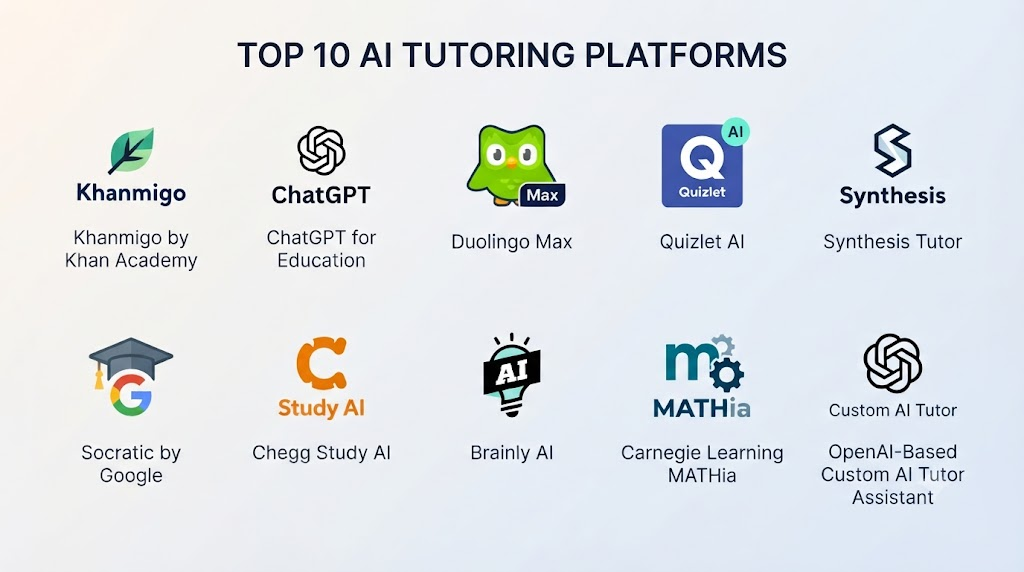
Top 10 AI Tutoring Platforms
1. Khanmigo by Khan Academy
Verdict: Best overall AI tutoring platform for students and educators.
Short Description: Khanmigo provides AI-powered tutoring experiences built around Khan Academy’s educational content, helping students learn concepts through guided conversations rather than simply providing answers.
Key Features
- AI tutoring conversations
- Mathematics assistance
- Writing feedback
- Coding support
- Teacher classroom tools
- Learning guidance
- Practice support
- Educational content integration
- Student progress assistance
- Socratic questioning
Pros
- Strong educational foundation
- Designed for learning rather than answer generation
- Supports teachers and students
- Encourages reasoning and understanding
- Integrated with learning resources
Cons
- Subject coverage depends on available content
- Access availability varies by region and program
- Not designed as a complete LMS replacement
Platforms
Web and supported educational environments.
Deployment or Support
Cloud-based learning platform.
Security & Compliance
Education-focused privacy controls and safeguards.
Integrations & Ecosystem
Learning resources, classroom tools, educational workflows, and teacher environments.
Support & Community
Educational resources, teacher communities, and support documentation.
2. ChatGPT for Education
Verdict: Best general-purpose AI learning assistant.
Short Description: ChatGPT can support personalized tutoring, explanations, brainstorming, writing improvement, coding assistance, language practice, and interactive learning through conversational AI.
Key Features
- Interactive tutoring
- Concept explanation
- Writing feedback
- Coding assistance
- Study planning
- Language practice
- Problem-solving guidance
- Custom learning assistants
- Multilingual support
- Educational workflows
Pros
- Broad subject coverage
- Highly flexible
- Strong conversational ability
- Supports personalized learning styles
- Useful for students and educators
Cons
- Requires responsible usage guidance
- Responses should be verified for academic accuracy
- Educational outcomes depend on implementation
3. Duolingo Max
Verdict: Best AI language learning platform.
Short Description: Duolingo Max combines language lessons with AI-powered conversation practice, roleplay experiences, and explanations to help learners improve communication skills.
Key Features
- AI conversation practice
- Roleplay scenarios
- Grammar explanations
- Language exercises
- Personalized lessons
- Speaking practice
- Vocabulary building
- Progress tracking
Pros
- Engaging learning experience
- Strong language-learning focus
- Mobile-friendly
- Gamified approach
Cons
- Limited outside language learning
- Advanced learners may need additional resources
4. Quizlet AI
Verdict: Best AI study and flashcard assistant.
Short Description: Quizlet AI helps students create study materials, generate practice questions, review concepts, and prepare for exams using adaptive learning techniques.
Key Features
- AI flashcards
- Practice tests
- Study guides
- Question generation
- Learning modes
- Progress tracking
- Subject libraries
- Personalized practice
Pros
- Excellent exam preparation
- Large learning community
- Easy student adoption
- Strong study workflows
Cons
- More focused on memorization than deep tutoring
- Quality depends on available study materials
5. Synthesis Tutor
Verdict: Best AI mathematics tutoring platform.
Short Description: Synthesis Tutor uses AI-guided learning experiences to help students develop mathematical reasoning and problem-solving skills.
Key Features
- Mathematics tutoring
- Problem-solving exercises
- Adaptive learning
- Interactive lessons
- Progress tracking
- Reasoning development
Pros
- Strong mathematics focus
- Encourages problem-solving
- Interactive learning approach
Cons
- Limited subject coverage
- Primarily focused on mathematics
6. Socratic by Google
Verdict: AI homework assistance platform.
Short Description: Socratic helps students understand academic concepts by providing explanations, resources, and learning guidance across different subjects.
Key Features
- Homework assistance
- Concept explanations
- Educational resources
- Image-based questions
- Subject support
- Learning guidance
Pros
- Easy student access
- Useful for homework support
- Supports multiple subjects
Cons
- Less personalized than advanced AI tutors
- Limited classroom management features
7. Chegg Study AI
Verdict: AI-powered academic support platform.
Short Description: Chegg Study AI provides step-by-step explanations, homework support, study resources, and academic guidance for students.
Key Features
- Homework help
- Step-by-step solutions
- Study resources
- Subject explanations
- Practice assistance
- Expert-supported learning
Pros
- Broad academic coverage
- Strong study resources
- Useful exam preparation support
Cons
- Subscription-based access
- Requires responsible academic use
8. Brainly AI
Verdict: Community-based AI learning assistant.
Short Description: Brainly combines AI assistance with a global student community to provide explanations, homework support, and peer-learning experiences.
Key Features
- AI explanations
- Homework support
- Community answers
- Subject assistance
- Learning discussions
- Study resources
Pros
- Large learning community
- Wide range of questions
- Peer-learning approach
Cons
- Answer quality can vary
- Requires moderation and verification
9. Carnegie Learning MATHia
Verdict: Enterprise AI mathematics tutoring platform.
Short Description: Carnegie Learning MATHia provides adaptive mathematics learning using AI-based personalization, assessment, and targeted instruction.
Key Features
- Adaptive mathematics learning
- Personalized pathways
- Skill assessment
- Student analytics
- Teacher dashboards
- Curriculum alignment
Pros
- Strong institutional focus
- Data-driven learning
- Teacher support tools
Cons
- Mainly focused on mathematics
- Enterprise implementation may require planning
10. OpenAI-Based Custom AI Tutor Assistant
Verdict: Best customizable AI tutoring solution for organizations.
Short Description: Organizations can build custom AI tutoring assistants using large language models integrated with Learning Management Systems (LMS), knowledge bases, digital textbooks, assessment platforms, student information systems, and educational workflows. These assistants can provide personalized explanations, generate practice exercises, answer questions, track learning progress, recommend resources, and support teachers while maintaining human oversight.
Key Features
- Personalized tutoring
- Course-specific knowledge
- AI explanations
- Practice generation
- Learning recommendations
- Assessment support
- Multilingual tutoring
- LMS integration
- Progress analytics
- Educational workflow automation
Pros
- Highly customizable
- Supports organization-specific curriculum
- Flexible integrations
- Scales across learners
- Enables personalized education experiences
Cons
- Requires implementation planning
- Needs quality controls
- Human educators remain essential
Comparison Table
| Tool Name | Best For | Platform(s) Supported | Deployment | Standout Feature | Public Rating |
|---|---|---|---|---|---|
| Khanmigo | Student learning | Web | Cloud | Guided AI tutoring | N/A |
| ChatGPT for Education | General AI tutoring | Web, mobile, APIs | Cloud | Broad subject assistance | N/A |
| Duolingo Max | Language learning | Mobile, web | Cloud | AI conversations | N/A |
| Quizlet AI | Exam preparation | Web, mobile | Cloud | AI study tools | N/A |
| Synthesis Tutor | Mathematics learning | Web | Cloud | Interactive math reasoning | N/A |
| Socratic | Homework help | Mobile | Cloud | Concept explanations | N/A |
| Chegg Study AI | Academic support | Web, mobile | Cloud | Step-by-step solutions | N/A |
| Brainly AI | Community learning | Web, mobile | Cloud | Student community support | N/A |
| Carnegie Learning MATHia | School mathematics | Educational platforms | Cloud | Adaptive learning | N/A |
| OpenAI Custom AI Tutor | Enterprise education | Custom platforms | Cloud/private | Personalized AI tutoring | N/A |
Weighted Evaluation
| Tool Name | Core Features 25% | Ease of Use 15% | Integrations & Ecosystem 15% | Security & Compliance 10% | Performance & Reliability 10% | Support & Community 10% | Price/Value 15% | Total |
|---|---|---|---|---|---|---|---|---|
| Khanmigo | 24 | 14 | 14 | 9 | 9 | 10 | 12 | 92 |
| ChatGPT for Education | 25 | 14 | 15 | 9 | 10 | 10 | 13 | 96 |
| Duolingo Max | 22 | 15 | 12 | 8 | 10 | 10 | 13 | 90 |
| Quizlet AI | 22 | 15 | 13 | 8 | 9 | 10 | 13 | 90 |
| Synthesis Tutor | 21 | 14 | 11 | 8 | 9 | 9 | 12 | 84 |
| Socratic | 20 | 15 | 11 | 8 | 9 | 9 | 13 | 85 |
| Chegg Study AI | 21 | 14 | 12 | 8 | 9 | 9 | 12 | 85 |
| Brainly AI | 20 | 15 | 12 | 7 | 9 | 10 | 12 | 85 |
| Carnegie Learning MATHia | 22 | 12 | 14 | 9 | 10 | 9 | 10 | 86 |
| OpenAI Custom AI Tutor | 25 | 12 | 15 | 9 | 10 | 9 | 12 | 92 |
Which AI Tutoring Platform Is Right for You?
| If your priority is… | Recommended Platform |
|---|---|
| General personalized tutoring | ChatGPT for Education |
| School learning support | Khanmigo |
| Language learning | Duolingo Max |
| Exam preparation | Quizlet AI |
| Mathematics tutoring | Synthesis Tutor |
| Homework assistance | Socratic |
| Academic study support | Chegg Study AI |
| Community learning | Brainly AI |
| Institutional mathematics programs | Carnegie Learning MATHia |
| Custom educational assistant | OpenAI-Based AI Tutor |
Implementation Playbook
First 30 Days
- Identify learning goals
- Define target learners
- Select subjects and curriculum
- Establish educational guidelines
Days 31–60
- Integrate LMS and learning resources
- Configure AI tutoring workflows
- Test explanations and assessments
- Train educators
Days 61–90
- Scale personalized learning
- Monitor student outcomes
- Improve recommendations
- Optimize learning experiences
Common Mistakes
- Using AI as a replacement for teachers
- Providing answers without explanations
- Ignoring accuracy verification
- Failing to protect student data
- Lack of curriculum alignment
- Poor assessment design
- Limited teacher involvement
- Ignoring accessibility needs
Frequently Asked Questions
1. What are AI Tutoring Platforms?
AI tutoring platforms are educational systems that use artificial intelligence to provide personalized explanations, practice, feedback, and learning support.
2. Can AI tutors replace teachers?
AI tutors can support learning but do not replace teachers. Human educators provide mentorship, emotional support, classroom management, and deeper instructional guidance.
3. Which subjects can AI tutors teach?
Many AI tutors support mathematics, science, languages, programming, writing, history, and professional skills.
4. How do AI tutors personalize learning?
They analyze learner interactions, progress, mistakes, and preferences to recommend explanations, exercises, and learning paths.
5. Are AI tutoring platforms suitable for schools?
Yes. Many platforms provide teacher dashboards, classroom tools, analytics, and curriculum-based learning support.
6. Can AI tutors help with exam preparation?
Yes. AI platforms can create practice questions, explain concepts, generate study plans, and provide revision support.
7. How accurate are AI tutoring responses?
Accuracy varies by platform and subject. Educational organizations should implement review processes and encourage critical thinking.
8. Can AI tutors support multiple languages?
Many platforms provide multilingual explanations and language-learning capabilities.
9. How is student data protected?
Organizations should evaluate privacy policies, access controls, encryption, data retention, and compliance requirements before adoption.
10. What should organizations evaluate before choosing an AI tutor?
Consider personalization, accuracy, curriculum alignment, integrations, security, analytics, scalability, and teacher support.
Conclusion
AI Tutoring Platforms are transforming education by providing personalized, interactive, and scalable learning experiences. They help students receive immediate explanations, practice difficult concepts, improve skills, and access learning support beyond traditional classroom hours.
Khanmigo and ChatGPT for Education provide broad tutoring capabilities, while Duolingo Max specializes in language learning and Quizlet AI supports study preparation. Synthesis Tutor and Carnegie Learning MATHia focus on mathematics education, while platforms such as Chegg, Brainly, and Socratic support everyday academic learning.Organizations building AI tutoring solutions should focus on educational quality, curriculum alignment, privacy protection, teacher collaboration, and responsible AI usage. The strongest implementations combine AI assistance with human teaching expertise to create more effective and inclusive learning environments.
