Introduction
AI Genomics Variant Calling Pipelines use artificial intelligence (AI), machine learning (ML), deep learning, and bioinformatics technologies to identify genetic variations from sequencing data. These platforms analyze DNA and RNA sequencing information to detect variants such as single nucleotide variants (SNVs), insertions and deletions (indels), structural variants, and other genomic alterations.
Variant calling is a critical step in genomics research, precision medicine, cancer genomics, inherited disease analysis, and population health studies. Traditional variant calling methods rely on statistical models and manually optimized algorithms, which can struggle with complex genomic regions, large-scale datasets, and noisy sequencing data.
AI-powered variant calling pipelines improve genomic analysis by learning complex patterns from sequencing data, reducing false positives, improving accuracy, and enabling faster interpretation of genetic information. These solutions combine deep learning models, neural networks, genome references, and advanced bioinformatics workflows to support researchers and clinicians.
Modern AI Genomics Variant Calling Pipelines integrate with next-generation sequencing (NGS) platforms, genomic databases, clinical interpretation systems, cloud computing environments, and precision medicine workflows. They support pharmaceutical companies, research institutions, clinical laboratories, and healthcare organizations in analyzing genomic data more efficiently.
These tools assist genomics professionals by improving variant detection and interpretation while requiring clinical validation, laboratory standards, and expert review.
Real-world Use Cases
- Germline variant detection
- Somatic mutation identification
- Cancer genomics analysis
- Rare disease research
- Whole genome sequencing analysis
- Whole exome sequencing analysis
- Precision medicine workflows
- Pharmacogenomics research
- Population genomics
- Clinical genetic testing
Evaluation Criteria for Buyers
When selecting an AI Genomics Variant Calling Pipeline, consider:
- Variant detection accuracy
- SNV and indel identification
- Structural variant support
- Sequencing data compatibility
- AI model performance
- Clinical workflow integration
- Scalability
- Cloud and infrastructure support
- Data security
- Reporting capabilities
Best For
- Genomics research organizations
- Clinical laboratories
- Hospitals
- Pharmaceutical companies
- Biotechnology companies
- Academic institutions
Not Ideal For
Organizations without sequencing infrastructure or expecting AI systems to replace clinical genetic interpretation.
Key Trends
- AI-powered genomic analysis
- Deep learning variant detection
- Precision medicine
- Cloud genomics platforms
- Single-cell sequencing analysis
- Long-read sequencing optimization
- Automated genomic interpretation
- Multi-omics integration
- Population-scale genomics
- Clinical genomics automation
Methodology
The platforms below were evaluated based on:
- AI variant calling capabilities
- Genomic data processing
- Accuracy and reliability
- Workflow integration
- Scalability
- Research and clinical adoption
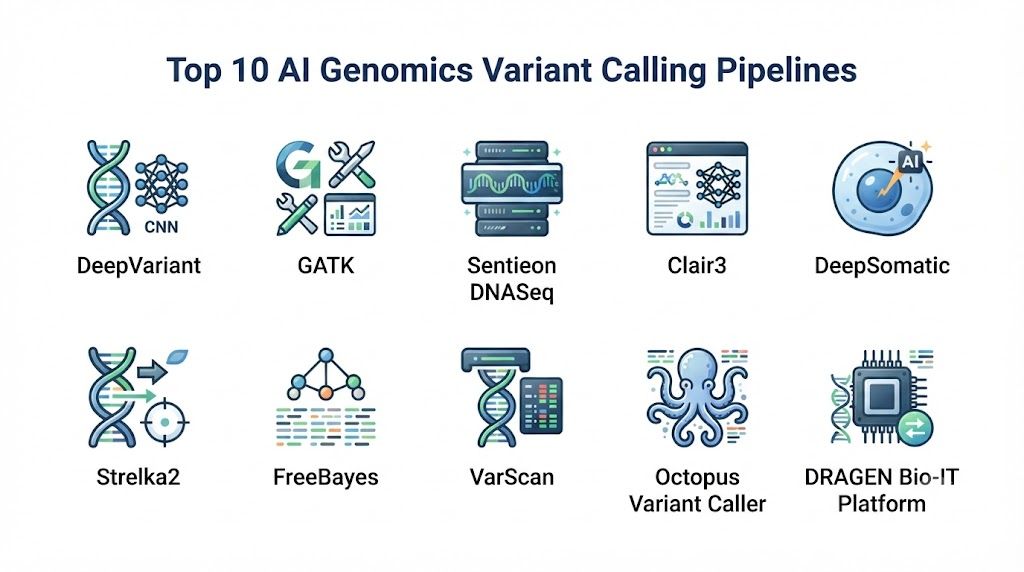
Top 10 AI Genomics Variant Calling Pipelines
1. DeepVariant
Verdict: Best overall AI-powered genomic variant calling pipeline.
Short Description: DeepVariant uses deep learning models to identify genetic variants from sequencing data and improve accuracy compared with traditional variant calling approaches.
Key Features
- Deep learning variant calling
- SNV and indel detection
- Whole genome sequencing support
- High accuracy predictions
- Genomic workflow integration
Pros
- Strong AI accuracy
- Widely adopted research pipeline
- Supports multiple sequencing technologies
Cons
- Requires computational resources
Deployment: Cloud and high-performance computing environments
Security & Compliance: Depends on deployment environment
Integrations & Ecosystem: Sequencing platforms, genomic workflows, bioinformatics tools
Support & Community: Research community support
Pricing Model: Availability varies by deployment
Best-Fit Scenarios: Genomics research and clinical pipelines
2. NVIDIA Parabricks
Verdict: High-performance AI-accelerated genomics analysis platform.
Short Description: NVIDIA Parabricks accelerates genomic workflows using GPU computing, enabling faster variant calling and large-scale sequencing analysis.
Key Features
- GPU-accelerated variant calling
- Genomic pipeline optimization
- Whole genome analysis
- Deep learning integration
- High-performance computing
Pros
- Extremely fast processing
- Enterprise scalability
- Supports large genomic datasets
Cons
- Requires compatible infrastructure
3. Illumina DRAGEN
Verdict: Enterprise genomic analysis platform with advanced variant calling capabilities.
Short Description: Illumina DRAGEN provides accelerated secondary genomic analysis including variant calling, alignment, and genomic interpretation workflows.
Key Features
- Variant detection
- Genome alignment
- Clinical genomics workflows
- Secondary analysis
- High-performance computing
Pros
- Strong sequencing ecosystem
- High accuracy and speed
Cons
- Best suited for Illumina environments
4. Sentieon DNASeq
Verdict: High-performance variant calling pipeline for genomic analysis.
Short Description: Sentieon provides optimized algorithms for genomic processing, including variant calling, alignment, and analysis workflows.
Key Features
- Germline variant calling
- Somatic variant analysis
- Genome processing
- Performance optimization
- Sequencing support
Pros
- Fast genomic processing
- Reliable analysis workflows
Cons
- Requires bioinformatics expertise
5. GATK (Genome Analysis Toolkit)
Verdict: Widely used genomic analysis framework.
Short Description: GATK provides tools and workflows for variant discovery, genomic analysis, and research applications across large-scale sequencing projects.
Key Features
- Variant discovery
- Germline analysis
- Somatic mutation calling
- Genomic workflows
- Research pipelines
Pros
- Strong scientific adoption
- Extensive ecosystem
Cons
- Complex configuration
6. VarScan
Verdict: Variant analysis tool supporting cancer and genomic research.
Short Description: VarScan helps researchers identify genetic variations from sequencing data, particularly in cancer genomics and somatic mutation analysis.
Key Features
- Somatic variant detection
- Mutation analysis
- Sequencing data processing
- Cancer genomics support
- Variant filtering
Pros
- Useful for research workflows
- Supports cancer studies
Cons
- Requires expert interpretation
7. Clair3
Verdict: AI-powered variant caller optimized for long-read sequencing.
Short Description: Clair3 uses deep learning approaches to detect variants from long-read sequencing data and improve genomic analysis accuracy.
Key Features
- Long-read variant calling
- Deep learning models
- SNV and indel detection
- Genome analysis
- Research workflows
Pros
- Strong long-read support
- AI-based accuracy improvements
Cons
- Requires technical expertise
8. Strelka
Verdict: Variant calling pipeline for germline and somatic analysis.
Short Description: Strelka provides variant calling capabilities for genomic research, including cancer genomics and inherited disease studies.
Key Features
- Germline variant detection
- Somatic mutation analysis
- Small variant calling
- Sequencing workflows
- Research support
Pros
- Reliable genomic analysis
- Research adoption
Cons
- Limited AI capabilities compared with newer approaches
9. Google DeepVariant Pipelines on Cloud
Verdict: Cloud-based genomic analysis workflow support.
Short Description: Google Cloud genomic solutions support scalable deployment of AI-based variant calling workflows using cloud infrastructure and genomic analysis tools.
Key Features
- Cloud genomics
- AI variant analysis
- Data processing
- Workflow automation
- Large-scale sequencing support
Pros
- Cloud scalability
- Supports large datasets
Cons
- Requires cloud expertise
10. OpenAI-Based Custom AI Genomics Variant Assistant
Verdict: Flexible AI assistant for genomic analysis workflows.
Short Description: Research organizations can build custom AI genomics assistants using large language models integrated with variant calling pipelines, genomic databases, sequencing systems, and interpretation platforms. These assistants can summarize variants, explain genomic reports, analyze research literature, and support bioinformatics workflows while requiring expert validation.
Key Features
- Variant report summaries
- Genomic literature analysis
- Research workflow assistance
- Data interpretation support
- Knowledge management
Pros
- Highly customizable
- Flexible integrations
- Improves researcher productivity
Cons
- Requires genomics expertise
- Clinical validation required
Comparison Table
| Platform | AI Variant Calling | Sequencing Support | Processing Speed | Clinical Integration | Best Use |
|---|---|---|---|---|---|
| DeepVariant | Excellent | Excellent | High | High | AI Variant Detection |
| NVIDIA Parabricks | Excellent | Excellent | Excellent | High | Large-Scale Genomics |
| Illumina DRAGEN | Excellent | Excellent | Excellent | Excellent | Clinical Genomics |
| Sentieon DNASeq | High | Excellent | Excellent | High | Genomic Processing |
| GATK | High | Excellent | High | Excellent | Research Genomics |
| VarScan | Medium | High | High | Medium | Cancer Genomics |
| Clair3 | Excellent | Excellent | High | High | Long-Read Sequencing |
| Strelka | Medium | High | High | Medium | Variant Analysis |
| Google Cloud DeepVariant | Excellent | Excellent | High | High | Cloud Genomics |
| OpenAI Custom | Custom | Custom | Custom | Custom | Genomic Assistant |
Evaluation & Scoring Table
| Platform | AI Capability 20% | Accuracy 20% | Scalability 15% | Integration 15% | Security 10% | Ease 10% | Value 10% | Total |
|---|---|---|---|---|---|---|---|---|
| DeepVariant | 20 | 20 | 14 | 15 | 10 | 8 | 8 | 95 |
| Illumina DRAGEN | 19 | 20 | 15 | 15 | 10 | 8 | 8 | 95 |
| NVIDIA Parabricks | 20 | 19 | 15 | 14 | 10 | 8 | 8 | 94 |
| Clair3 | 19 | 19 | 14 | 14 | 10 | 8 | 8 | 92 |
| Sentieon DNASeq | 18 | 19 | 15 | 14 | 10 | 8 | 8 | 92 |
| GATK | 17 | 19 | 14 | 15 | 10 | 8 | 8 | 91 |
| Google Cloud DeepVariant | 19 | 19 | 15 | 14 | 10 | 7 | 8 | 92 |
| Strelka | 16 | 17 | 13 | 13 | 10 | 9 | 8 | 86 |
| VarScan | 16 | 17 | 13 | 12 | 10 | 9 | 8 | 85 |
| OpenAI Custom | 20 | 16 | 12 | 15 | 8 | 7 | 9 | 87 |
Which AI Genomics Variant Calling Pipeline Is Right for You?
| If your priority is… | Recommended Platform |
|---|---|
| AI-powered variant detection | DeepVariant |
| Fast genomic processing | NVIDIA Parabricks |
| Clinical sequencing workflows | Illumina DRAGEN |
| High-performance genomics | Sentieon DNASeq |
| Research-standard pipelines | GATK |
| Cancer mutation analysis | VarScan |
| Long-read sequencing | Clair3 |
| Cloud genomic workflows | Google Cloud DeepVariant |
| Custom genomic assistant | OpenAI-Based AI Assistant |
Implementation Playbook
First 30 Days
- Define genomic analysis goals
- Identify sequencing data sources
- Select variant calling workflows
- Review infrastructure requirements
Days 31–60
- Configure genomic pipelines
- Integrate sequencing systems
- Validate variant detection
- Train bioinformatics teams
Days 61–90
- Automate genomic workflows
- Improve analysis performance
- Integrate interpretation systems
- Monitor pipeline accuracy
Common Mistakes
- Using poor-quality sequencing data
- Ignoring reference genome versions
- Treating AI predictions as final diagnoses
- Lack of validation workflows
- Poor computational planning
- Ignoring genomic data security
- Weak pipeline monitoring
- Poor integration with clinical systems
Frequently Asked Questions
1. What are AI Genomics Variant Calling Pipelines?
They are AI-powered systems that identify genetic variations from sequencing data.
2. How does AI improve variant calling?
AI models learn complex sequencing patterns to improve variant detection accuracy.
3. Can AI replace genetic specialists?
No. AI supports bioinformaticians and clinicians but requires expert interpretation.
4. Who uses variant calling pipelines?
Research institutions, hospitals, biotechnology companies, and clinical laboratories.
5. What types of variants can these tools detect?
They can detect SNVs, indels, and in some cases structural variants.
6. What sequencing technologies do they support?
Many support short-read and long-read sequencing platforms.
7. Are AI variant calls always accurate?
Accuracy depends on sequencing quality, model performance, and validation methods.
8. Can these pipelines support precision medicine?
Yes. They help identify genetic information used in personalized healthcare research.
9. How is genomic data protected?
Organizations should use secure infrastructure, access controls, and data governance practices.
10. What should buyers evaluate before adoption?
Consider accuracy, sequencing support, scalability, integration, security, and workflow requirements.
Conclusion
AI Genomics Variant Calling Pipelines are transforming genomic research by enabling faster, more accurate, and scalable analysis of sequencing data. By combining artificial intelligence, deep learning, and advanced bioinformatics methods, these platforms help researchers identify genetic variations and support discoveries in precision medicine, disease research, and biotechnology.Organizations adopting AI variant calling solutions should focus on accuracy, sequencing compatibility, computational performance, workflow integration, and data security. Platforms such as DeepVariant, NVIDIA Parabricks, Illumina DRAGEN, Clair3, and GATK demonstrate how artificial intelligence is improving genomic analysis and enabling more advanced healthcare and research applications.
