Introduction
AI Hospital Bed Demand Forecasting tools use artificial intelligence (AI), machine learning (ML), predictive analytics, and healthcare operational data to predict future hospital capacity requirements, including inpatient beds, ICU beds, emergency department demand, patient admissions, discharges, and resource utilization. These platforms help hospitals proactively manage capacity challenges by forecasting demand before shortages or overcrowding occur.
Hospital capacity management is one of the most complex operational challenges in healthcare. Unexpected patient surges, seasonal illnesses, emergency admissions, delayed discharges, and changing patient flow patterns can create pressure on available beds and clinical teams. Traditional forecasting methods often rely on spreadsheets, historical averages, and manual planning, which may not capture rapidly changing healthcare conditions.
AI-powered bed demand forecasting platforms analyze historical admissions, occupancy trends, emergency department activity, patient flow patterns, length of stay, seasonal factors, and operational data to generate predictive insights. These systems help hospitals improve bed allocation, optimize staffing decisions, reduce emergency department wait times, and improve patient experience. AI forecasting solutions are increasingly used in hospital command centers and healthcare operations teams to support proactive capacity planning. (DevOps School)
Modern AI capacity intelligence platforms can combine hospital data sources such as electronic medical records, patient administration systems, staffing systems, laboratory information, and operational dashboards to provide forward-looking capacity insights. (MyIQ Health)
Real-world Use Cases
- Inpatient bed demand prediction
- ICU capacity forecasting
- Emergency department volume prediction
- Patient admission forecasting
- Discharge planning optimization
- Hospital command center operations
- Staffing requirement planning
- Seasonal healthcare demand planning
- Surge capacity management
- Resource allocation optimization
Evaluation Criteria for Buyers
When selecting an AI Hospital Bed Demand Forecasting platform, consider:
- Forecasting accuracy
- Real-time hospital data integration
- Patient flow analytics
- Admission and discharge prediction
- ICU and ward-level forecasting
- Scenario modeling capabilities
- Dashboard and visualization quality
- Integration with hospital systems
- Scalability across multiple facilities
- Security and healthcare compliance
Best For
- Large hospitals
- Healthcare networks
- Hospital command centers
- Emergency departments
- Healthcare operations teams
- Government healthcare systems
Not Ideal For
Small healthcare facilities with limited historical data or organizations without digital hospital management systems.
Key Trends
- AI-powered hospital command centers
- Predictive patient flow management
- Real-time capacity intelligence
- Smart hospital operations
- AI-driven staffing optimization
- Predictive discharge planning
- Healthcare digital twins
- Multi-hospital capacity analytics
- Cloud-based healthcare intelligence
- Autonomous hospital operations
Methodology
The platforms below were evaluated based on:
- AI forecasting capabilities
- Healthcare workflow integration
- Capacity management features
- Operational automation
- Scalability
- Data intelligence
- Enterprise healthcare readiness
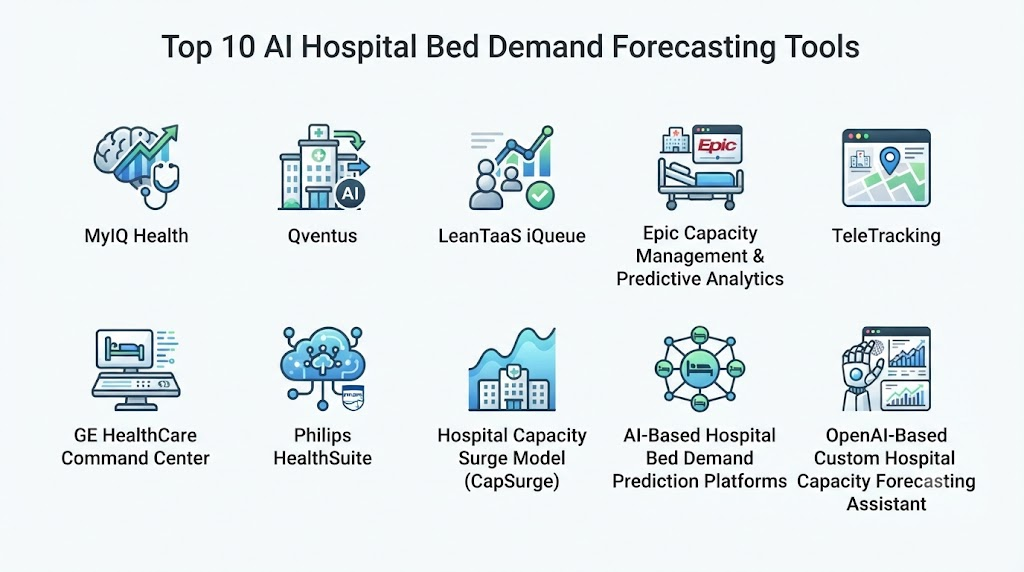
Top 10 AI Hospital Bed Demand Forecasting Tools
1. MyIQ Health
Verdict: Best AI-powered capacity intelligence platform for hospital demand forecasting.
Short Description: MyIQ Health uses AI-powered forecasting and healthcare analytics to predict patient volumes, capacity constraints, and resource requirements. The platform transforms hospital operational data into forward-looking insights for better bed planning and decision-making. (MyIQ Health)
Key Features
- AI capacity forecasting
- Patient volume prediction
- Hospital bottleneck prediction
- Scenario modeling
- Capacity dashboards
- Natural language analytics
- Healthcare data integration
Pros
- Strong forecasting capabilities
- Healthcare-focused analytics
- Supports operational decision-making
Cons
- Best suited for enterprise healthcare environments
Deployment: Cloud-based
Security & Compliance: Healthcare data protection requirements
Integrations & Ecosystem: Hospital operational systems, healthcare data platforms
Support & Community: Enterprise support
Pricing Model: Custom pricing
Best-Fit Scenarios: Hospital networks and capacity management teams
2. Qventus
Verdict: AI-driven hospital operations platform for improving patient flow and capacity management.
Short Description: Qventus applies AI and automation to help hospitals improve operational workflows, including patient flow, discharge coordination, and capacity utilization.
Key Features
- Patient flow optimization
- Bed management support
- Discharge prediction
- Operational automation
- Hospital workflow analytics
Pros
- Strong hospital operations focus
- Improves workflow coordination
Cons
- Requires operational process alignment
3. LeanTaaS iQueue
Verdict: AI-powered healthcare operations platform for capacity optimization.
Short Description: LeanTaaS iQueue uses predictive analytics to improve hospital resource utilization, patient flow, scheduling, and operational efficiency.
Key Features
- Bed utilization analytics
- Patient flow forecasting
- Capacity optimization
- Operational dashboards
- Healthcare analytics
Pros
- Strong healthcare operations expertise
- Enterprise scalability
Cons
- Primarily focused on healthcare operations
4. Epic Capacity Management & Predictive Analytics
Verdict: AI-supported capacity planning integrated with hospital information systems.
Short Description: Epic provides healthcare operational analytics and predictive capabilities through its healthcare platform ecosystem, helping organizations understand patient flow, admissions, discharge patterns, and resource requirements.
Key Features
- Hospital analytics
- Patient flow insights
- EHR-based forecasting
- Operational dashboards
- Healthcare data integration
Pros
- Strong EHR integration
- Large healthcare ecosystem
Cons
- Best suited for Epic environments
5. TeleTracking
Verdict: Patient flow management platform with predictive hospital capacity capabilities.
Short Description: TeleTracking provides healthcare operations technology that helps hospitals manage patient movement, bed availability, transfers, and capacity workflows.
Key Features
- Bed management
- Patient tracking
- Capacity visibility
- Transfer management
- Operational analytics
Pros
- Strong patient flow management
- Hospital-focused solution
Cons
- Requires workflow integration
6. GE HealthCare Command Center
Verdict: Enterprise healthcare operations platform for hospital capacity intelligence.
Short Description: GE HealthCare Command Center solutions help hospitals visualize operational data, improve patient flow, and support capacity decisions using analytics-driven insights.
Key Features
- Hospital command center analytics
- Capacity visibility
- Patient flow monitoring
- Operational intelligence
- Healthcare analytics
Pros
- Enterprise healthcare capabilities
- Strong operational visibility
Cons
- Large-scale implementation
7. Philips HealthSuite
Verdict: Digital healthcare platform supporting operational intelligence and hospital analytics.
Short Description: Philips HealthSuite enables healthcare organizations to connect data sources, analyze operational performance, and develop intelligent healthcare workflows.
Key Features
- Healthcare data analytics
- Operational insights
- Cloud healthcare platform
- Workflow optimization
- Data integration
Pros
- Broad healthcare ecosystem
- Strong data capabilities
Cons
- Requires healthcare technology maturity
8. Hospital Capacity Surge Model (CapSurge)
Verdict: Forecasting tool for hospital capacity planning during demand surges.
Short Description: CapSurge provides predictive modeling for hospital bed demand, staffing needs, and equipment requirements under routine and surge conditions. (episurge.hsye.org)
Key Features
- Bed demand prediction
- Surge forecasting
- Staffing forecasts
- Scenario modeling
- Capacity planning
Pros
- Useful for surge preparedness
- Forecasting-focused approach
Cons
- More specialized use cases
9. AI-Based Hospital Bed Demand Prediction Platforms
Verdict: Specialized AI solutions for real-time bed availability and demand prediction.
Short Description: AI-based hospital bed prediction systems analyze historical hospital data, admissions, transfers, and discharges to improve bed allocation and operational visibility. (SARU TECH)
Key Features
- Bed demand prediction
- Live bed tracking
- Admission forecasting
- Transfer management
- Capacity dashboards
Pros
- Practical operational use
- Improves bed coordination
Cons
- Capabilities vary by provider
10. OpenAI-Based Custom Hospital Capacity Forecasting Assistant
Verdict: Flexible AI solution for customized hospital capacity intelligence.
Short Description: Healthcare organizations can build custom AI forecasting assistants using large language models integrated with hospital data warehouses, EHR systems, operational dashboards, admission records, and staffing systems. These solutions can support capacity analysis, operational summaries, scenario planning, and decision support with appropriate healthcare governance.
Key Features
- AI capacity analysis
- Forecast summaries
- Scenario planning
- Operational reporting
- Workflow automation
Pros
- Highly customizable
- Flexible integrations
- Organization-specific insights
Cons
- Requires AI and healthcare data expertise
- Governance required
Comparison Table
| Platform | AI Forecasting | Bed Management | Hospital Integration | Automation | Best Use |
|---|---|---|---|---|---|
| MyIQ Health | Excellent | Excellent | Excellent | High | Capacity Intelligence |
| Qventus | Excellent | Excellent | High | Excellent | Patient Flow |
| LeanTaaS iQueue | Excellent | High | High | High | Hospital Operations |
| Epic Analytics | High | High | Excellent | High | EHR-Based Planning |
| TeleTracking | High | Excellent | High | High | Bed Management |
| GE HealthCare Command Center | High | High | Excellent | High | Enterprise Hospitals |
| Philips HealthSuite | High | Medium | High | High | Healthcare Analytics |
| CapSurge | High | High | Medium | Medium | Surge Planning |
| Bed Prediction Platforms | High | High | Medium | Medium | Bed Forecasting |
| OpenAI Custom | Custom | Custom | Custom | Custom | Custom Analytics |
Evaluation & Scoring Table
| Platform | AI Features 20% | Forecasting 20% | Integration 15% | Workflow 15% | Security 10% | Ease 10% | Value 10% | Total |
|---|---|---|---|---|---|---|---|---|
| MyIQ Health | 20 | 20 | 15 | 15 | 10 | 8 | 8 | 96 |
| Qventus | 19 | 19 | 15 | 15 | 10 | 8 | 8 | 94 |
| LeanTaaS iQueue | 19 | 19 | 14 | 14 | 10 | 8 | 8 | 92 |
| Epic Analytics | 18 | 18 | 15 | 14 | 10 | 8 | 8 | 91 |
| TeleTracking | 18 | 18 | 14 | 14 | 10 | 8 | 8 | 90 |
| GE Command Center | 18 | 18 | 15 | 13 | 10 | 8 | 8 | 90 |
| Philips HealthSuite | 17 | 17 | 14 | 13 | 10 | 8 | 8 | 87 |
| CapSurge | 17 | 18 | 12 | 13 | 9 | 9 | 8 | 86 |
| Bed Prediction Platforms | 17 | 17 | 12 | 13 | 9 | 9 | 8 | 85 |
| OpenAI Custom | 20 | 18 | 12 | 15 | 8 | 7 | 9 | 89 |
Which AI Hospital Bed Demand Forecasting Tool Is Right for You?
| If your priority is… | Recommended Platform |
|---|---|
| Enterprise capacity intelligence | MyIQ Health |
| Patient flow optimization | Qventus |
| Hospital operations analytics | LeanTaaS iQueue |
| EHR-based forecasting | Epic Analytics |
| Bed management | TeleTracking |
| Hospital command centers | GE HealthCare Command Center |
| Healthcare data platform | Philips HealthSuite |
| Surge planning | CapSurge |
| Custom hospital AI analytics | OpenAI-Based Capacity Assistant |
Implementation Playbook
First 30 Days
- Analyze current bed management challenges
- Identify hospital data sources
- Connect admission and discharge data
- Define forecasting goals
Days 31–60
- Deploy forecasting dashboards
- Configure capacity models
- Train operations teams
- Validate predictions
Days 61–90
- Expand across hospital units
- Automate capacity alerts
- Improve staffing decisions
- Continuously refine forecasting models
Common Mistakes
- Using incomplete hospital data
- Ignoring seasonal demand changes
- Lack of workflow integration
- Treating AI predictions as final decisions
- Poor staff adoption
- Missing operational governance
- Not validating forecast accuracy
- Ignoring patient flow bottlenecks
Frequently Asked Questions
1. What are AI Hospital Bed Demand Forecasting tools?
They are AI-powered systems that predict future hospital bed requirements using healthcare data, patient flow patterns, and operational analytics.
2. How do these tools help hospitals?
They help hospitals prepare for demand changes, improve bed allocation, reduce overcrowding, and optimize resources.
3. What data do these platforms analyze?
They analyze admissions, discharges, occupancy rates, emergency visits, length of stay, and operational trends.
4. Can AI predict ICU bed demand?
Yes. Many forecasting systems support ICU and specialized unit capacity planning.
5. Do these tools integrate with EHR systems?
Many enterprise solutions integrate with hospital information systems and healthcare data platforms.
6. Can AI reduce emergency department delays?
Yes. Better capacity forecasting helps hospitals prepare beds and resources before demand peaks.
7. Are AI forecasts always accurate?
Accuracy depends on data quality, hospital workflows, changing conditions, and model performance.
8. Who uses hospital bed forecasting tools?
Hospital executives, bed managers, operations teams, emergency departments, and command centers.
9. Can smaller hospitals use AI forecasting?
Yes, if they have sufficient operational data and suitable digital infrastructure.
10. What should hospitals evaluate before selecting a platform?
Consider forecasting accuracy, integration, scalability, security, workflow impact, and operational value.
Conclusion
AI Hospital Bed Demand Forecasting tools are helping healthcare organizations move from reactive capacity management to proactive hospital operations. By analyzing admissions, patient flow, discharge patterns, and operational data, these platforms provide early visibility into future capacity challenges and help healthcare teams make better resource decisions.Hospitals should select forecasting solutions based on their operational maturity, data availability, existing healthcare systems, and capacity management goals. Platforms such as MyIQ Health, Qventus, LeanTaaS iQueue, Epic analytics solutions, and TeleTracking demonstrate how AI can improve patient flow, optimize bed utilization, and support smarter healthcare delivery.
