Introduction
AI Incident Triage & Summarization tools help Security Operations Centers (SOCs), IT operations teams, Managed Detection and Response (MDR) providers, and incident response teams quickly understand, prioritize, and respond to security incidents. These platforms use artificial intelligence (AI), large language models (LLMs), machine learning (ML), and security analytics to automatically collect evidence, correlate alerts, classify incidents, summarize attack activity, recommend remediation steps, and reduce analyst workload.
Modern enterprises generate millions of alerts daily from Security Information and Event Management (SIEM), Extended Detection and Response (XDR), Endpoint Detection and Response (EDR), Network Detection and Response (NDR), cloud security platforms, identity systems, vulnerability scanners, and threat intelligence feeds. Manually reviewing each alert is time-consuming and often leads to alert fatigue, delayed investigations, and inconsistent incident documentation.
AI-powered incident triage platforms automatically analyze security events, remove duplicate alerts, correlate related activities, assign risk scores, generate concise incident summaries, and recommend next steps. Instead of replacing security analysts, these tools improve productivity by allowing analysts to focus on the highest-priority incidents while AI handles repetitive investigation and documentation tasks.
Organizations increasingly adopt AI Incident Triage & Summarization platforms to improve Mean Time to Detect (MTTD), reduce Mean Time to Respond (MTTR), standardize incident reporting, and enhance the overall efficiency of security operations.
Real-world Use Cases
- AI-powered alert triage
- Incident summarization
- Security event correlation
- Threat prioritization
- Automated incident documentation
- Malware investigation support
- Threat intelligence enrichment
- SOC analyst assistance
- Incident response recommendations
- Security operations reporting
Evaluation Criteria for Buyers
When selecting an AI Incident Triage & Summarization platform, evaluate:
- AI triage accuracy
- Incident summarization quality
- Threat correlation capabilities
- SIEM and SOAR integrations
- Threat intelligence enrichment
- Automation capabilities
- Reporting and documentation
- Enterprise scalability
- Governance and compliance
- Ease of deployment
Best For
- Enterprise SOC teams
- Incident response teams
- Managed Detection and Response providers
- Security analysts
- Security engineering teams
- Large security operations
Not Ideal For
Organizations with minimal security monitoring or teams expecting AI to replace incident responders.
Key Trends
- Generative AI incident summaries
- AI-assisted SOC investigations
- Automated alert prioritization
- Security event correlation
- AI-powered incident documentation
- Conversational SOC assistants
- Threat intelligence automation
- Human-in-the-loop investigations
- AI workflow orchestration
- Intelligent security reporting
Methodology
The tools were evaluated based on:
- AI investigation capabilities
- Alert triage effectiveness
- Summarization quality
- Automation
- Threat intelligence
- Enterprise integrations
- Security governance
- Operational scalability
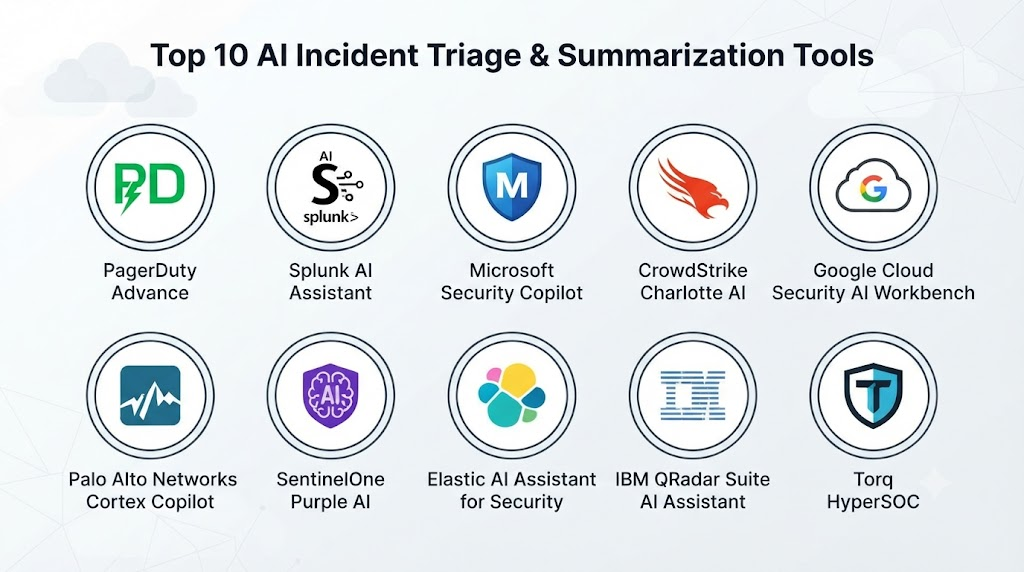
Top 10 AI Incident Triage & Summarization Tools
1. Microsoft Security Copilot
Verdict: Best overall AI platform for incident triage, investigation, and security summarization in Microsoft environments.
Short Description: Microsoft Security Copilot uses generative AI and Microsoft’s global threat intelligence to automatically summarize incidents, prioritize alerts, explain attack techniques, recommend remediation, generate investigation queries, and assist analysts throughout the incident lifecycle across Microsoft Defender, Sentinel, and related security services.
Key Features
- AI incident summaries
- Alert prioritization
- Investigation assistance
- Threat intelligence integration
- Natural language queries
- KQL generation
- Malware explanation
- Automated reporting
Pros
- Deep Microsoft integration
- Excellent summarization quality
- Enterprise-grade security
Cons
- Best within Microsoft ecosystem
Deployment: Cloud
Best-Fit: Enterprise Microsoft SOCs
2. CrowdStrike Charlotte AI
Verdict: AI-powered assistant for endpoint incident triage and investigation.
Short Description: Charlotte AI automatically correlates endpoint telemetry, summarizes incidents, prioritizes alerts, and guides analysts through investigations using CrowdStrike’s threat intelligence and AI capabilities.
Key Features
- Incident summaries
- Alert correlation
- Endpoint investigations
- Threat hunting
- AI recommendations
Pros
- Excellent endpoint visibility
- Strong threat intelligence
Cons
- Best within CrowdStrike ecosystem
3. SentinelOne Purple AI
Verdict: Conversational AI assistant for automated incident investigations.
Short Description: Purple AI helps analysts investigate alerts using natural language while automatically summarizing incidents, explaining threats, and recommending response actions.
Key Features
- Conversational investigations
- AI summaries
- Alert triage
- Incident recommendations
- Automated workflows
Pros
- Excellent analyst productivity
- Fast investigations
Cons
- Enterprise deployment
4. Google Security Gemini
Verdict: AI-powered incident investigation assistant for cloud security operations.
Short Description: Google Security Gemini assists analysts by summarizing incidents, analyzing alerts, explaining threats, and recommending security actions using Google’s AI capabilities and cloud security intelligence.
Key Features
- AI summaries
- Cloud investigations
- Threat intelligence
- Security recommendations
- Incident analysis
Pros
- Strong cloud security
- Excellent AI capabilities
Cons
- Best suited for Google Cloud environments
5. Palo Alto Networks Precision AI
Verdict: AI-enhanced security operations platform with intelligent incident triage.
Short Description: Precision AI automatically analyzes security alerts, prioritizes incidents, correlates telemetry, and generates investigation recommendations to improve SOC efficiency.
Key Features
- Alert prioritization
- AI investigations
- Threat intelligence
- Incident summaries
- Security automation
Pros
- Strong enterprise security platform
- Mature AI capabilities
Cons
- Platform-centric deployment
6. IBM QRadar Suite AI Assistant
Verdict: AI-powered investigation and incident summarization assistant.
Short Description: IBM QRadar AI Assistant summarizes incidents, explains alerts, recommends response actions, and improves SOC investigations using integrated AI capabilities.
Key Features
- Incident summaries
- AI investigations
- Threat intelligence
- Security analytics
- Workflow guidance
Pros
- Excellent SIEM integration
- Enterprise ready
Cons
- Best with QRadar deployments
7. Elastic AI Assistant
Verdict: Flexible AI assistant for security analytics and incident investigation.
Short Description: Elastic AI Assistant helps analysts summarize incidents, generate detection rules, investigate alerts, and accelerate threat hunting using conversational AI.
Key Features
- AI investigations
- Incident summaries
- Rule generation
- Security analytics
- Threat hunting
Pros
- Highly customizable
- Flexible platform
Cons
- Requires Elastic expertise
8. Cisco AI Assistant for Security
Verdict: AI-powered assistant for security investigations and alert prioritization.
Short Description: Cisco AI Assistant supports analysts by investigating incidents, explaining policies, summarizing security events, and recommending remediation across Cisco security products.
Key Features
- AI investigations
- Incident summaries
- Threat analysis
- Policy explanations
- Security recommendations
Pros
- Strong networking integration
- Good enterprise support
Cons
- Best for Cisco environments
9. Google Cloud Mandiant AI
Verdict: AI-powered threat intelligence and incident response assistant.
Short Description: Google Cloud Mandiant AI combines AI with global threat intelligence to summarize incidents, analyze attacker behavior, prioritize investigations, and improve incident response workflows.
Key Features
- Threat intelligence
- AI investigations
- Incident response
- Threat actor analysis
- Security reporting
Pros
- Excellent threat intelligence
- Strong incident response
Cons
- Enterprise-focused
10. OpenAI-Based Custom Incident Copilot
Verdict: Flexible AI incident investigation and summarization platform for enterprise SOCs.
Short Description: Organizations can build custom AI incident assistants using large language models integrated with SIEM, SOAR, XDR, EDR, ticketing platforms, and threat intelligence to automate alert triage, summarize investigations, generate reports, and improve analyst productivity.
Key Features
- Incident summaries
- AI investigations
- Alert prioritization
- Threat intelligence enrichment
- Workflow automation
Pros
- Highly customizable
- Flexible integrations
Cons
- Requires AI and security expertise
- Governance required
Comparison Table
| Platform | AI Triage | Incident Summaries | Threat Intelligence | Automation | Best Use |
|---|---|---|---|---|---|
| Microsoft Security Copilot | Excellent | Excellent | Excellent | Excellent | Enterprise SOC |
| CrowdStrike Charlotte AI | Excellent | Excellent | Excellent | High | Endpoint Security |
| SentinelOne Purple AI | Excellent | Excellent | High | Excellent | XDR Operations |
| Google Security Gemini | Excellent | Excellent | High | High | Cloud Security |
| Palo Alto Precision AI | Excellent | High | Excellent | High | Enterprise SOC |
| IBM QRadar AI | High | High | High | High | SIEM |
| Elastic AI Assistant | High | High | Medium | High | Analytics |
| Cisco AI Assistant | High | High | High | High | Cisco Security |
| Google Cloud Mandiant AI | High | High | Excellent | Medium | Incident Response |
| OpenAI Custom Copilot | Custom | Excellent | Custom | Custom | Custom SOC |
Evaluation & Scoring Table
| Platform | AI Features 20% | Triage 20% | Integrations 15% | Automation 15% | Security 10% | Ease 10% | Value 10% | Total |
|---|---|---|---|---|---|---|---|---|
| Microsoft Security Copilot | 20 | 20 | 15 | 15 | 10 | 9 | 9 | 98 |
| CrowdStrike Charlotte AI | 19 | 20 | 14 | 14 | 10 | 9 | 9 | 95 |
| SentinelOne Purple AI | 19 | 19 | 14 | 15 | 10 | 9 | 9 | 95 |
| Google Security Gemini | 19 | 18 | 14 | 14 | 10 | 9 | 8 | 92 |
| Palo Alto Precision AI | 19 | 18 | 15 | 14 | 10 | 8 | 8 | 92 |
| IBM QRadar AI | 18 | 18 | 15 | 13 | 10 | 8 | 8 | 90 |
| Elastic AI Assistant | 17 | 17 | 13 | 13 | 10 | 8 | 9 | 87 |
| Cisco AI Assistant | 18 | 17 | 14 | 13 | 10 | 8 | 8 | 88 |
| Google Cloud Mandiant AI | 18 | 19 | 13 | 12 | 10 | 8 | 8 | 88 |
| OpenAI Custom Copilot | 20 | 19 | 12 | 15 | 8 | 7 | 9 | 90 |
Which AI Incident Triage & Summarization Tool Is Right for You?
| If your priority is… | Recommended Platform |
|---|---|
| Microsoft security ecosystem | Microsoft Security Copilot |
| Endpoint investigations | CrowdStrike Charlotte AI |
| Autonomous investigations | SentinelOne Purple AI |
| Google Cloud security | Google Security Gemini |
| Enterprise firewall ecosystem | Palo Alto Precision AI |
| SIEM investigations | IBM QRadar Suite AI Assistant |
| Cisco infrastructure | Cisco AI Assistant |
| Flexible analytics | Elastic AI Assistant |
| Threat intelligence | Google Cloud Mandiant AI |
| Custom enterprise workflows | OpenAI-Based Incident Copilot |
Implementation Playbook
First 30 Days
- Connect SIEM and security data sources
- Define incident severity levels
- Enable AI triage workflows
- Validate AI-generated summaries
Days 31–60
- Automate incident documentation
- Integrate threat intelligence
- Train analysts on AI-assisted investigations
- Tune prioritization policies
Days 61–90
- Expand automation workflows
- Measure MTTR improvements
- Optimize AI recommendations
- Continuously evaluate investigation quality
Common Mistakes
- Trusting AI without analyst validation
- Poor integration with security tools
- Ignoring governance controls
- Limited analyst training
- Weak incident classification
- Missing threat intelligence integration
- Overlooking false-positive tuning
- Failing to monitor AI performance
Frequently Asked Questions
1. What is AI Incident Triage & Summarization?
It uses AI to prioritize security alerts, summarize incidents, correlate evidence, and assist analysts during investigations.
2. Can AI replace incident responders?
No. AI improves productivity but human analysts remain responsible for investigation and response decisions.
3. Do these platforms integrate with SIEM solutions?
Yes. Most enterprise platforms integrate with SIEM, SOAR, EDR, XDR, and cloud security tools.
4. Can AI summarize complex incidents?
Yes. Modern AI models generate concise summaries using multiple security data sources.
5. How do AI triage tools reduce alert fatigue?
They correlate related alerts, remove duplicates, prioritize high-risk incidents, and automate repetitive investigation tasks.
6. Are these tools suitable for MDR providers?
Yes. They significantly improve analyst productivity in Managed Detection and Response environments.
7. Can they generate incident reports?
Many platforms automatically generate investigation summaries and incident documentation.
8. What integrations are most important?
SIEM, SOAR, XDR, EDR, threat intelligence platforms, identity systems, and ticketing solutions.
9. Are AI-generated recommendations always accurate?
No. Security analysts should review AI-generated recommendations before taking action.
10. What should organizations evaluate before selecting a platform?
AI capabilities, integrations, automation, governance, scalability, reporting quality, and operational fit.
Conclusion
AI Incident Triage & Summarization tools are transforming modern Security Operations Centers by helping analysts investigate alerts faster, prioritize high-risk incidents, automate documentation, and improve response efficiency. By combining generative AI, machine learning, and threat intelligence, these platforms reduce manual effort while enabling security teams to focus on complex investigations and strategic security improvements.Organizations should select an AI Incident Triage & Summarization solution based on their existing security ecosystem, integration requirements, governance policies, and operational maturity. Platforms such as Microsoft Security Copilot, CrowdStrike Charlotte AI, SentinelOne Purple AI, and Google Security Gemini provide enterprise-grade capabilities that enhance SOC productivity, shorten response times, and improve overall cybersecurity operations.
