Introduction
AI Security Copilots for Analysts are transforming modern Security Operations Centers (SOCs) by helping cybersecurity professionals investigate threats faster, reduce alert fatigue, and automate repetitive security tasks. Powered by artificial intelligence (AI), large language models (LLMs), machine learning (ML), and security analytics, these platforms act as intelligent assistants that support analysts throughout the entire incident lifecycle—from alert triage and threat hunting to investigation, remediation, and reporting.
Today’s enterprise environments generate millions of security events from SIEM, XDR, EDR, NDR, cloud security platforms, identity systems, firewalls, email security, and endpoint protection tools. Security analysts often spend significant time correlating alerts, reviewing logs, researching Indicators of Compromise (IOCs), and documenting incidents. AI Security Copilots dramatically improve efficiency by summarizing incidents, explaining attack techniques, correlating telemetry across multiple security products, generating investigation queries, and recommending remediation steps.
Unlike traditional automation tools that rely on predefined workflows, AI Security Copilots understand natural language, learn from security context, analyze threat intelligence, and provide interactive guidance during investigations. They assist analysts without replacing human judgment, allowing security teams to respond faster while maintaining control over critical decisions.
As organizations face increasing cyber threats and growing security workloads, AI Security Copilots are becoming essential tools for improving analyst productivity, reducing Mean Time to Detect (MTTD), shortening Mean Time to Respond (MTTR), and strengthening enterprise cyber resilience.
Real-world Use Cases
- AI-assisted alert triage
- Security incident investigation
- Threat hunting
- Malware analysis
- Threat intelligence enrichment
- Security log analysis
- IOC investigation
- Security playbook generation
- Incident report automation
- Security knowledge assistance
Evaluation Criteria for Buyers
When evaluating AI Security Copilot platforms, consider:
- AI investigation capabilities
- Natural language understanding
- Threat intelligence integration
- SIEM, SOAR, EDR, and XDR integrations
- Automation capabilities
- Incident summarization quality
- Enterprise governance
- Security and compliance
- Ease of deployment
- Scalability
Best For
- Enterprise Security Operations Centers
- Managed Detection and Response providers
- Threat hunters
- Incident response teams
- Cybersecurity analysts
- Security engineering teams
Not Ideal For
Organizations without centralized security operations or teams expecting AI to replace experienced security professionals.
Key Trends
- Generative AI for SOC operations
- AI-assisted threat hunting
- Security copilots
- Autonomous investigations
- AI-driven incident summaries
- Conversational security analytics
- AI-powered threat intelligence
- Explainable AI for cybersecurity
- Human-in-the-loop investigations
- Security workflow automation
Methodology
The tools below were evaluated based on:
- AI capabilities
- Investigation assistance
- Security ecosystem integrations
- Automation features
- Threat intelligence
- Enterprise deployment
- Analyst productivity improvements
- Security governance
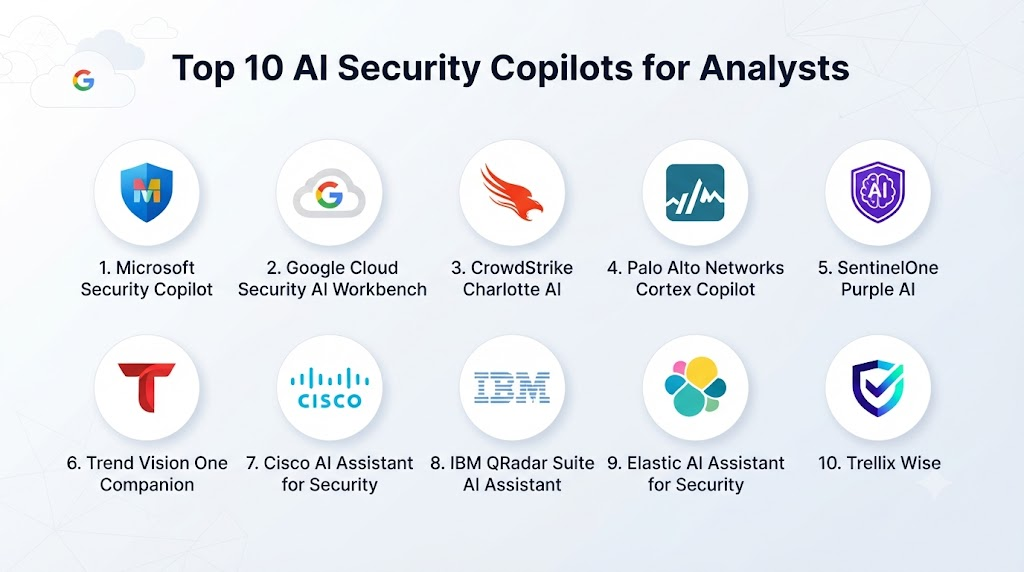
Top 10 AI Security Copilots for Analysts
1. Microsoft Security Copilot
Verdict: The most comprehensive enterprise AI Security Copilot for Microsoft security environments.
Short Description: Microsoft Security Copilot combines generative AI with Microsoft’s global threat intelligence to help analysts investigate incidents, summarize alerts, analyze scripts, explain vulnerabilities, perform threat hunting, and accelerate incident response. It integrates deeply across Microsoft Defender, Microsoft Sentinel, Microsoft Entra, Microsoft Intune, and Microsoft Purview to provide a unified AI-assisted security experience.
Key Features
- AI-powered incident investigation
- Natural language security search
- Alert summarization
- Threat intelligence integration
- Kusto Query Language (KQL) assistance
- Malware analysis
- Vulnerability explanations
- Security report generation
Pros
- Deep Microsoft ecosystem integration
- Excellent threat intelligence
- Strong natural language capabilities
- Enterprise-grade security
Cons
- Best suited for Microsoft environments
- Enterprise licensing required
Deployment: Cloud
Security & Compliance: Enterprise security controls
Integrations & Ecosystem: Microsoft Defender, Sentinel, Entra ID, Intune, Purview
Support & Community: Enterprise support
Pricing Model: Subscription
Best-Fit Scenarios: Microsoft-based enterprise SOCs
2. CrowdStrike Charlotte AI
Verdict: Advanced AI assistant for endpoint investigations and threat hunting.
Short Description: Charlotte AI enables analysts to investigate endpoint threats using conversational AI. It summarizes incidents, explains attacker behavior, assists with threat hunting, and provides recommendations using CrowdStrike’s extensive threat intelligence and endpoint telemetry.
Key Features
- AI investigations
- Endpoint analysis
- Threat hunting
- Incident summaries
- Threat intelligence
- Risk prioritization
Pros
- Excellent endpoint visibility
- Strong threat intelligence
- Fast investigations
Cons
- Best within CrowdStrike ecosystem
- Premium enterprise platform
Deployment: Cloud
Best-Fit: Endpoint security operations
3. SentinelOne Purple AI
Verdict: AI-powered security assistant designed for autonomous SOC operations.
Short Description: Purple AI combines conversational AI with endpoint telemetry, behavioral analytics, and autonomous investigation capabilities to improve analyst productivity and accelerate incident response.
Key Features
- Conversational investigations
- Threat hunting
- AI recommendations
- Security automation
- Alert analysis
- Incident summaries
Pros
- Excellent automation
- User-friendly interface
Cons
- Enterprise deployment
- Platform-focused capabilities
4. Google Security Gemini
Verdict: AI security assistant for Google Cloud security operations.
Short Description: Google Security Gemini assists analysts with investigations, cloud security monitoring, malware analysis, threat detection, and security recommendations using Google’s AI technologies and threat intelligence.
Key Features
- Cloud investigations
- AI recommendations
- Threat intelligence
- Malware analysis
- Natural language search
Pros
- Strong Google Cloud integration
- Excellent AI capabilities
Cons
- Best for Google Cloud environments
5. Palo Alto Networks Precision AI
Verdict: AI-powered security platform supporting enterprise SOC investigations.
Short Description: Precision AI improves threat detection, investigation, alert prioritization, and response across Palo Alto Networks’ security ecosystem using advanced AI and machine learning.
Key Features
- AI threat detection
- Incident investigations
- Threat intelligence
- Alert prioritization
- Security analytics
Pros
- Excellent enterprise security platform
- Mature AI capabilities
Cons
- Best within Palo Alto ecosystem
6. IBM QRadar Suite AI Assistant
Verdict: Intelligent investigation assistant integrated into QRadar security operations.
Short Description: IBM QRadar Suite AI Assistant helps analysts investigate alerts, summarize incidents, recommend response actions, and improve SOC productivity through AI-assisted workflows.
Key Features
- Incident summaries
- AI investigations
- Threat intelligence
- Security analytics
- Response recommendations
Pros
- Strong SIEM integration
- Enterprise-ready
Cons
- Best for QRadar customers
7. Cisco AI Assistant for Security
Verdict: AI-powered security assistant for Cisco security platforms.
Short Description: Cisco AI Assistant helps analysts investigate security events, explain policy issues, analyze threats, and automate security operations across Cisco’s security ecosystem.
Key Features
- Threat analysis
- AI investigations
- Policy assistance
- Security automation
- Incident guidance
Pros
- Strong networking expertise
- Good Cisco integration
Cons
- Cisco-focused platform
8. Elastic AI Assistant
Verdict: Flexible AI assistant for security analytics and threat investigations.
Short Description: Elastic AI Assistant supports natural language queries, investigation guidance, detection rule creation, and incident analysis for security analysts using Elastic Security.
Key Features
- AI query assistance
- Threat hunting
- Rule generation
- Incident summaries
- Security analytics
Pros
- Flexible analytics
- Excellent customization
Cons
- Requires Elastic expertise
9. Google Cloud Mandiant AI
Verdict: AI-powered threat intelligence and incident response assistant.
Short Description: Google Cloud Mandiant AI combines global threat intelligence with AI-assisted investigations to support security analysts during incident response and advanced threat hunting.
Key Features
- Threat intelligence
- AI investigations
- Threat actor analysis
- Incident response
- Threat hunting
Pros
- Industry-leading threat intelligence
- Excellent investigation support
Cons
- Enterprise-focused
10. OpenAI-Based Custom Security Copilot
Verdict: Highly customizable AI security assistant for enterprise SOC workflows.
Short Description: Organizations can build custom AI Security Copilots using large language models integrated with SIEM, SOAR, EDR, XDR, ticketing systems, security knowledge bases, and threat intelligence platforms to automate investigations, summarize incidents, and improve analyst efficiency.
Key Features
- Custom investigations
- Security knowledge assistant
- Incident summaries
- Threat intelligence enrichment
- Workflow automation
Pros
- Highly customizable
- Organization-specific workflows
- Flexible integrations
Cons
- Requires AI and security expertise
- Governance and validation required
Comparison Table
| Platform | AI Investigation | Threat Intelligence | Automation | Natural Language | Best Use |
|---|---|---|---|---|---|
| Microsoft Security Copilot | Excellent | Excellent | Excellent | Excellent | Enterprise SOC |
| CrowdStrike Charlotte AI | Excellent | Excellent | High | Excellent | Endpoint Security |
| SentinelOne Purple AI | Excellent | High | Excellent | Excellent | XDR Operations |
| Google Security Gemini | Excellent | High | High | Excellent | Cloud Security |
| Palo Alto Precision AI | Excellent | Excellent | High | High | Enterprise SOC |
| IBM QRadar AI | High | High | High | High | SIEM Operations |
| Cisco AI Assistant | High | High | High | High | Cisco Security |
| Elastic AI Assistant | High | Medium | High | Excellent | Security Analytics |
| Google Cloud Mandiant AI | High | Excellent | Medium | High | Incident Response |
| OpenAI Custom Copilot | Custom | Custom | Custom | Excellent | Custom SOC |
Evaluation & Scoring Table
| Platform | AI Features 20% | Investigation 20% | Integrations 15% | Automation 15% | Security 10% | Ease 10% | Value 10% | Total |
|---|---|---|---|---|---|---|---|---|
| Microsoft Security Copilot | 20 | 20 | 15 | 15 | 10 | 9 | 9 | 98 |
| CrowdStrike Charlotte AI | 19 | 20 | 14 | 14 | 10 | 9 | 9 | 95 |
| SentinelOne Purple AI | 19 | 19 | 14 | 15 | 10 | 9 | 9 | 95 |
| Palo Alto Precision AI | 19 | 19 | 15 | 14 | 10 | 8 | 8 | 93 |
| Google Security Gemini | 19 | 18 | 14 | 14 | 10 | 9 | 8 | 92 |
| IBM QRadar AI | 18 | 18 | 15 | 13 | 10 | 8 | 8 | 90 |
| Cisco AI Assistant | 18 | 17 | 14 | 13 | 10 | 8 | 8 | 88 |
| Elastic AI Assistant | 17 | 17 | 13 | 13 | 10 | 8 | 9 | 87 |
| Google Cloud Mandiant AI | 18 | 19 | 13 | 12 | 10 | 8 | 8 | 88 |
| OpenAI Custom Copilot | 20 | 19 | 12 | 15 | 8 | 7 | 9 | 90 |
Which AI Security Copilot Is Right for You?
| If your priority is… | Recommended Platform |
|---|---|
| Microsoft security ecosystem | Microsoft Security Copilot |
| Endpoint investigations | CrowdStrike Charlotte AI |
| Autonomous XDR | SentinelOne Purple AI |
| Google Cloud | Google Security Gemini |
| Enterprise firewall ecosystem | Palo Alto Precision AI |
| SIEM investigations | IBM QRadar Suite AI Assistant |
| Cisco environments | Cisco AI Assistant |
| Open analytics platform | Elastic AI Assistant |
| Threat intelligence | Google Cloud Mandiant AI |
| Custom enterprise workflows | OpenAI-Based Security Copilot |
Implementation Playbook
First 30 Days
- Identify repetitive SOC tasks
- Connect SIEM, EDR, and threat intelligence
- Define AI investigation workflows
- Validate AI responses
Days 31–60
- Enable AI-assisted investigations
- Train security analysts
- Build automated playbooks
- Optimize prompts and workflows
Days 61–90
- Expand AI automation
- Measure analyst productivity improvements
- Refine investigation processes
- Continuously monitor AI performance
Common Mistakes
- Expecting AI to replace analysts
- Deploying without governance
- Ignoring human validation
- Limited security integrations
- Poor prompt engineering
- Not securing AI access controls
- Failing to update security knowledge
- Skipping analyst training
Frequently Asked Questions
1. What is an AI Security Copilot?
An AI Security Copilot is an intelligent assistant that helps cybersecurity analysts investigate alerts, analyze threats, automate repetitive tasks, and improve incident response using AI.
2. Can AI Security Copilots replace SOC analysts?
No. They are designed to augment analysts by improving productivity and investigation speed while keeping humans responsible for critical security decisions.
3. Do these platforms integrate with SIEM solutions?
Yes. Most enterprise AI Security Copilots integrate with SIEM, SOAR, EDR, XDR, identity platforms, and threat intelligence sources.
4. Can they summarize security incidents?
Yes. AI can automatically generate concise incident summaries, recommended actions, and investigation reports.
5. Do they support threat hunting?
Yes. Many platforms enable analysts to perform threat hunting using natural language queries.
6. Can AI explain malware or attack techniques?
Yes. Leading solutions provide detailed explanations of malware behavior, vulnerabilities, and attack techniques.
7. Are AI Security Copilots suitable for MDR providers?
Yes. They help Managed Detection and Response providers investigate alerts faster and improve analyst efficiency.
8. How do they reduce alert fatigue?
By prioritizing high-risk alerts, correlating events, summarizing incidents, and automating repetitive investigation tasks.
9. What integrations are most important?
SIEM, SOAR, EDR, XDR, cloud security platforms, identity systems, ticketing tools, and threat intelligence feeds.
10. What should organizations evaluate before deployment?
Consider AI capabilities, security integrations, governance, automation, scalability, analyst workflows, and total cost of ownership.
Conclusion
AI Security Copilots for Analysts are reshaping modern security operations by helping analysts investigate incidents faster, automate repetitive work, and make better-informed security decisions. Rather than replacing cybersecurity professionals, these AI assistants enhance human expertise by providing contextual intelligence, accelerating investigations, and reducing operational workload.Organizations should choose an AI Security Copilot based on their existing security ecosystem, integration requirements, governance needs, and operational maturity. Platforms such as Microsoft Security Copilot, CrowdStrike Charlotte AI, SentinelOne Purple AI, and Palo Alto Networks Precision AI offer enterprise-grade capabilities that significantly improve SOC productivity, reduce response times, and strengthen overall cybersecurity resilience.
