Introduction
AI Threat Intelligence Enrichment Platforms use artificial intelligence, machine learning, natural language processing, and automated data analysis to enhance security intelligence with additional context about threats, indicators, vulnerabilities, and attack patterns. These platforms collect information from multiple sources, analyze threat signals, enrich security alerts, and provide actionable insights for security teams.
Traditional threat intelligence workflows often require analysts to manually research indicators, correlate data sources, and validate threat information. AI-powered threat intelligence enrichment solutions automate these tasks by connecting security data with threat databases, analyzing attacker behaviors, identifying relationships, and improving incident response decisions.
These platforms are widely used by security operations centers, threat intelligence teams, managed security providers, enterprises, and cybersecurity organizations to improve detection accuracy, reduce investigation time, and strengthen proactive defense strategies.
Real-world use cases:
- Automated IOC enrichment
- IP address and domain reputation analysis
- Malware intelligence enrichment
- Threat actor identification
- Vulnerability intelligence analysis
- Security alert context enhancement
- Threat hunting support
- Incident investigation assistance
- Attack pattern correlation
- Automated intelligence reporting
Evaluation Criteria for Buyers:
- AI enrichment accuracy
- Threat data coverage
- Intelligence correlation capabilities
- Automation workflows
- Integration with security platforms
- Threat actor analysis
- Real-time intelligence processing
- Reporting and visualization features
Best for
SOC teams, threat intelligence analysts, managed security providers, enterprises, and organizations managing large security data volumes.
Not ideal for
Small organizations with limited security monitoring needs or teams without dedicated security operations.
Key Trends
- AI-driven threat intelligence analysis
- Automated IOC enrichment
- Threat actor behavior modeling
- Machine learning security analytics
- Real-time threat intelligence processing
- Automated threat investigation
- Security copilot adoption
- Knowledge graph-based intelligence
- Predictive threat analysis
- Integration with SIEM and SOAR platforms
Methodology
- Selected platforms based on AI threat intelligence enrichment capabilities
- Evaluated intelligence collection, enrichment, automation, and integrations
- Considered enterprise cybersecurity requirements
- Prioritized platforms supporting security operations workflows
- Reviewed scalability, usability, and intelligence quality
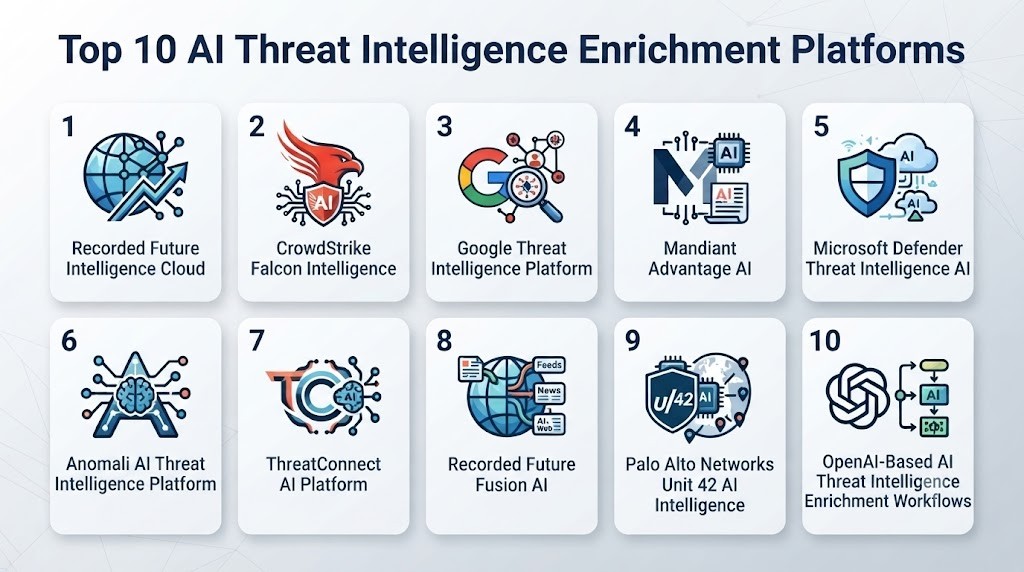
Top 10 AI Threat Intelligence Enrichment Platforms
1. Recorded Future Intelligence Cloud
Verdict: AI-powered threat intelligence platform for advanced security enrichment and risk analysis.
Short Description: Recorded Future uses AI and machine learning to analyze global intelligence sources, enrich security alerts, and provide threat context for organizations.
Key Features:
- Threat intelligence enrichment
- Risk scoring
- Threat actor analysis
- IOC intelligence
- Automated intelligence workflows
Pros:
- Extensive intelligence coverage
- Strong AI-driven analysis
Cons:
- Enterprise-focused
- Premium pricing model
Deployment: Cloud-based
Security & Compliance: Enterprise security controls
Integrations & Ecosystem: SIEM, SOAR, and security platforms
Support & Community: Enterprise support
Pricing Model: Subscription-based
Best-Fit Scenarios: Enterprise threat intelligence teams
2. CrowdStrike Falcon Intelligence
Verdict: AI-enhanced threat intelligence platform integrated with endpoint security.
Short Description: CrowdStrike Falcon Intelligence helps organizations analyze threats, enrich indicators, and understand attacker behavior.
Key Features:
- Threat intelligence
- Malware analysis
- Threat actor tracking
- IOC enrichment
- Automated investigation
Pros:
- Strong endpoint intelligence
- Real-time threat visibility
Cons:
- Best within CrowdStrike ecosystem
- Enterprise-oriented
Deployment: Cloud-based
Security & Compliance: Enterprise security controls
Integrations & Ecosystem: Security operations platforms
Support & Community: Enterprise support
Pricing Model: Subscription-based
Best-Fit Scenarios: Enterprise security teams
3. Google Threat Intelligence Platform
Verdict: AI-powered intelligence platform combining large-scale threat data analysis.
Short Description: Google Threat Intelligence helps security teams investigate threats, analyze indicators, and improve detection workflows.
Key Features:
- Threat intelligence analysis
- Malware intelligence
- IOC enrichment
- Threat research
- Security analytics
Pros:
- Strong data intelligence capabilities
- Advanced analytics
Cons:
- Requires security expertise
- Enterprise-focused
Deployment: Cloud-based
Security & Compliance: Enterprise cloud security
Integrations & Ecosystem: Security platforms
Support & Community: Enterprise support
Pricing Model: Subscription-based
Best-Fit Scenarios: Security operations teams
4. Mandiant Advantage AI
Verdict: AI-supported threat intelligence platform for incident response and threat analysis.
Short Description: Mandiant Advantage helps organizations understand threats, analyze attacker activity, and enrich security investigations.
Key Features:
- Threat actor intelligence
- Incident insights
- Malware analysis
- Threat reports
- Intelligence enrichment
Pros:
- Strong incident response expertise
- High-quality intelligence
Cons:
- Enterprise-focused
- Requires security knowledge
Deployment: Cloud-based
Security & Compliance: Enterprise security standards
Integrations & Ecosystem: Security operations tools
Support & Community: Enterprise support
Pricing Model: Subscription-based
Best-Fit Scenarios: Incident response teams
5. Microsoft Defender Threat Intelligence AI
Verdict: AI-enhanced threat intelligence platform integrated with Microsoft security solutions.
Short Description: Microsoft Defender Threat Intelligence helps organizations investigate threats, enrich indicators, and improve security visibility.
Key Features:
- Threat intelligence
- Domain analysis
- Attack surface insights
- IOC enrichment
- Security analytics
Pros:
- Strong Microsoft ecosystem
- Broad security integrations
Cons:
- Best with Microsoft tools
- Configuration required
Deployment: Cloud-based
Security & Compliance: Enterprise security framework
Integrations & Ecosystem: Microsoft security products
Support & Community: Enterprise support
Pricing Model: Subscription-based
Best-Fit Scenarios: Microsoft security environments
6. Anomali AI Threat Intelligence Platform
Verdict: AI-powered threat intelligence management and enrichment solution.
Short Description: Anomali helps security teams collect, analyze, and operationalize threat intelligence across security environments.
Key Features:
- Threat intelligence management
- IOC enrichment
- Threat correlation
- Intelligence automation
- Data analysis
Pros:
- Flexible intelligence workflows
- Strong integrations
Cons:
- Requires setup effort
- Advanced features need expertise
Deployment: Cloud and enterprise environments
Security & Compliance: Enterprise security controls
Integrations & Ecosystem: SIEM and security platforms
Support & Community: Customer support
Pricing Model: Subscription-based
Best-Fit Scenarios: Threat intelligence teams
7. ThreatConnect AI Platform
Verdict: AI-assisted threat intelligence platform for operational security teams.
Short Description: ThreatConnect helps organizations manage intelligence, analyze threats, and automate security decision workflows.
Key Features:
- Intelligence management
- Threat analysis
- Risk scoring
- Workflow automation
- Collaboration tools
Pros:
- Strong intelligence operations
- Good workflow capabilities
Cons:
- Requires configuration
- Enterprise-focused
Deployment: Cloud-based
Security & Compliance: Enterprise security controls
Integrations & Ecosystem: Security platforms
Support & Community: Enterprise support
Pricing Model: Subscription-based
Best-Fit Scenarios: Enterprise SOC teams
8. Recorded Future Fusion AI
Verdict: AI-driven intelligence automation platform for security enrichment.
Short Description: Recorded Future Fusion helps organizations integrate threat intelligence into security workflows and automate intelligence operations.
Key Features:
- Intelligence automation
- Threat scoring
- Data enrichment
- Risk analysis
- Security integrations
Pros:
- Strong automation capabilities
- Rich intelligence ecosystem
Cons:
- Enterprise pricing
- Requires skilled analysts
Deployment: Cloud-based
Security & Compliance: Enterprise security controls
Integrations & Ecosystem: Security platforms
Support & Community: Enterprise support
Pricing Model: Subscription-based
Best-Fit Scenarios: Security intelligence operations
9. Palo Alto Networks Unit 42 AI Intelligence
Verdict: AI-supported threat intelligence service for cybersecurity operations.
Short Description: Unit 42 intelligence helps organizations understand threats, analyze attacks, and enrich security investigations.
Key Features:
- Threat research
- Attack analysis
- Intelligence reports
- Threat actor tracking
- Incident insights
Pros:
- Strong research capabilities
- Enterprise security expertise
Cons:
- Best with Palo Alto ecosystem
- Requires expertise
Deployment: Cloud and enterprise environments
Security & Compliance: Enterprise security controls
Integrations & Ecosystem: Security platforms
Support & Community: Enterprise support
Pricing Model: Subscription-based
Best-Fit Scenarios: Enterprise security teams
10. OpenAI-Based AI Threat Intelligence Enrichment Workflows
Verdict: Custom AI approach for building organization-specific threat intelligence enrichment systems.
Short Description: AI workflows can analyze security alerts, threat reports, indicators, and security data sources to generate enriched intelligence insights.
Key Features:
- IOC analysis
- Threat report summarization
- Risk classification
- Intelligence correlation
- Custom automation workflows
Pros:
- Highly customizable
- Supports unique security requirements
Cons:
- Requires cybersecurity expertise
- Needs strong validation processes
Deployment: API and custom environments
Security & Compliance: Depends on implementation
Integrations & Ecosystem: SIEM, SOAR, EDR, threat databases
Support & Community: Developer ecosystem
Pricing Model: Usage-based
Best-Fit Scenarios: Custom security intelligence systems
Comparison Table
| Platform | AI Enrichment | Threat Intelligence | Automation | Integrations | Best Use |
|---|---|---|---|---|---|
| Recorded Future | Excellent | Excellent | Excellent | High | Enterprise intelligence |
| CrowdStrike Falcon Intelligence | Excellent | Excellent | High | Excellent | Endpoint security |
| Google Threat Intelligence | Excellent | Excellent | High | High | Security operations |
| Mandiant Advantage | Excellent | Excellent | High | High | Incident response |
| Microsoft Defender TI | Excellent | High | High | Excellent | Microsoft security |
| Anomali AI | High | Excellent | Excellent | High | Intelligence management |
| ThreatConnect AI | High | Excellent | High | High | SOC operations |
| Recorded Future Fusion | Excellent | Excellent | Excellent | High | Intelligence automation |
| Unit 42 Intelligence | Excellent | Excellent | Medium | High | Threat research |
| OpenAI Workflows | Excellent | Custom | Custom | Custom | Custom solutions |
Evaluation & Scoring Table
| Platform | AI Accuracy 25% | Intelligence Quality 15% | Automation 15% | Integrations 15% | Security 10% | Ease 10% | Value 10% | Total |
|---|---|---|---|---|---|---|---|---|
| Recorded Future | 25 | 15 | 15 | 14 | 10 | 8 | 9 | 96 |
| CrowdStrike Falcon Intelligence | 25 | 15 | 14 | 15 | 10 | 8 | 8 | 95 |
| Google Threat Intelligence | 25 | 15 | 14 | 14 | 10 | 8 | 8 | 94 |
| Mandiant Advantage | 25 | 15 | 14 | 14 | 10 | 8 | 8 | 94 |
| Microsoft Defender TI | 24 | 14 | 14 | 15 | 10 | 9 | 9 | 95 |
| Anomali AI | 23 | 14 | 15 | 14 | 10 | 9 | 9 | 94 |
| ThreatConnect AI | 23 | 14 | 14 | 14 | 10 | 9 | 8 | 92 |
| Recorded Future Fusion | 25 | 15 | 15 | 14 | 10 | 8 | 9 | 96 |
| Unit 42 Intelligence | 24 | 15 | 13 | 14 | 10 | 8 | 8 | 92 |
| OpenAI Workflows | 25 | 15 | 15 | 12 | 8 | 8 | 9 | 92 |
Which AI Threat Intelligence Enrichment Platform Is Right for You?
- Enterprise Threat Intelligence Teams: Recorded Future, CrowdStrike Falcon Intelligence
- Microsoft Security Environments: Microsoft Defender Threat Intelligence
- Incident Response Teams: Mandiant Advantage, Unit 42 Intelligence
- SOC Intelligence Operations: Anomali AI, ThreatConnect AI
- Custom Intelligence Automation: OpenAI-based workflows
Implementation Playbook
30 Days
- Identify intelligence sources
- Define enrichment requirements
- Review security workflows
60 Days
- Integrate SIEM and security tools
- Configure enrichment processes
- Validate intelligence quality
90 Days
- Automate threat workflows
- Improve investigation speed
- Continuously optimize intelligence models
Common Mistakes
- Using unreliable intelligence sources
- Ignoring false threat indicators
- Poor integration planning
- Lack of analyst validation
- Not updating intelligence workflows
Frequently Asked Questions
What are AI threat intelligence enrichment platforms?
They are AI-powered systems that add context and insights to security data and threat indicators.
How does AI improve threat intelligence?
AI analyzes large amounts of security data and identifies relevant threat patterns.
Can AI enrich security alerts automatically?
Yes. Many platforms automatically add reputation and threat context.
Do these platforms support SIEM integration?
Most enterprise solutions integrate with SIEM and security tools.
Can AI identify threat actors?
AI can analyze patterns and intelligence sources to support attribution.
Can AI improve threat hunting?
Yes. Enriched intelligence helps analysts investigate threats faster.
Are AI threat intelligence platforms secure?
Organizations should evaluate security controls and data handling practices.
Can small security teams use these platforms?
Some solutions support smaller teams through cloud-based models.
Do AI platforms reduce investigation time?
Yes. Automated enrichment reduces manual research effort.
Can AI analyze malware intelligence?
Many platforms support malware and indicator analysis.
Do these tools replace threat analysts?
No. They assist analysts with faster and richer intelligence.
How should organizations implement AI threat intelligence enrichment?
Start with reliable data sources, integrate security tools, validate outputs, and continuously improve workflows.
Conclusion
AI Threat Intelligence Enrichment Platforms are transforming cybersecurity operations by improving alert context, accelerating investigations, and enabling proactive threat detection. Platforms such as Recorded Future, CrowdStrike Falcon Intelligence, Microsoft Defender Threat Intelligence, and Mandiant Advantage provide advanced capabilities for modern security teams.Organizations should select solutions based on intelligence requirements, security infrastructure, integration needs, and operational maturity. Combining AI-powered enrichment with experienced analysts helps organizations improve threat visibility, reduce response time, and strengthen cybersecurity defenses.
