Introduction
AI Lab Automation Orchestration platforms use artificial intelligence (AI), machine learning (ML), robotics, workflow automation, and laboratory data intelligence to coordinate and optimize scientific experiments. These platforms connect laboratory instruments, robotic systems, software applications, researchers, and data pipelines to automate complex research workflows.
Modern laboratories generate large amounts of experimental data and operate across multiple instruments, protocols, and research teams. Managing these workflows manually can lead to delays, inconsistent results, operational complexity, and inefficient resource utilization. AI-powered lab orchestration solutions help researchers automate experiment planning, manage robotic workflows, analyze results, and improve laboratory productivity.
AI Lab Automation Orchestration platforms combine technologies such as laboratory information management systems (LIMS), robotic process automation, AI-driven experiment optimization, digital twins, machine learning models, and cloud-based scientific computing. They support pharmaceutical companies, biotechnology organizations, academic institutions, and research laboratories in accelerating scientific discovery.
These platforms integrate with laboratory robots, analytical instruments, ELN systems, LIMS platforms, cloud environments, and scientific data platforms. They help scientists create more efficient, repeatable, and scalable research workflows while maintaining human oversight and experimental validation.
Real-world Use Cases
- Automated laboratory workflows
- Robotic experiment coordination
- Drug discovery automation
- High-throughput screening
- Sample management
- Experiment scheduling
- Laboratory data analysis
- Synthetic biology workflows
- Biotechnology research automation
- Research process optimization
Evaluation Criteria for Buyers
When selecting an AI Lab Automation Orchestration platform, consider:
- AI workflow optimization capabilities
- Robotics integration
- Laboratory instrument compatibility
- Data management capabilities
- LIMS and ELN integration
- Experiment automation support
- Scalability
- Security and compliance
- Research collaboration features
- Ease of implementation
Best For
- Pharmaceutical companies
- Biotechnology organizations
- Research laboratories
- Academic institutions
- Synthetic biology companies
Not Ideal For
Organizations expecting complete laboratory autonomy without scientist supervision or experimental validation.
Key Trends
- Autonomous laboratories
- AI-driven experiment design
- Robotic research automation
- Digital laboratory twins
- Cloud-based scientific workflows
- Machine learning experiment optimization
- Automated drug discovery
- Synthetic biology automation
- Laboratory data platforms
- Self-driving research systems
Methodology
The platforms below were evaluated based on:
- AI orchestration capabilities
- Laboratory automation support
- Instrument integration
- Research workflow management
- Scalability
- Biotechnology adoption
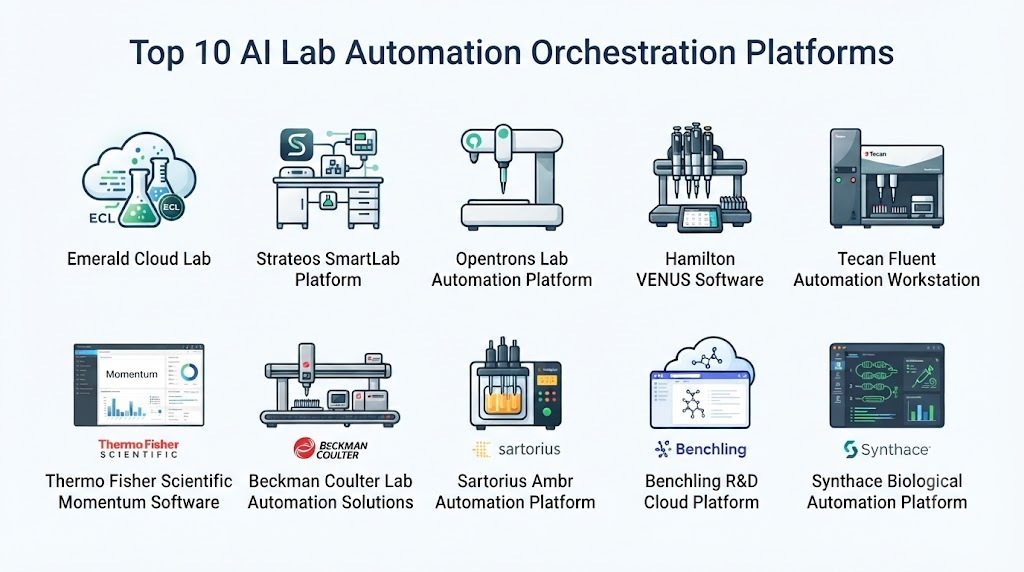
Top 10 AI Lab Automation Orchestration Platforms
1. Emerald Cloud Lab (ECL)
Verdict: Best overall cloud-based AI-enabled laboratory automation platform.
Short Description: Emerald Cloud Lab provides remotely accessible automated laboratory infrastructure that allows researchers to design, execute, and monitor experiments using advanced laboratory automation systems.
Key Features
- Cloud laboratory access
- Automated experiments
- Instrument orchestration
- Remote research workflows
- Scientific data management
Pros
- Highly automated laboratory environment
- Reduces infrastructure requirements
- Scalable research operations
Cons
- Requires adaptation to cloud laboratory workflows
Deployment: Cloud-based laboratory environment
Security & Compliance: Research data protection controls
Integrations & Ecosystem: Laboratory instruments, scientific workflows, research platforms
Support & Community: Research and enterprise support
Pricing Model: Custom research pricing
Best-Fit Scenarios: Biotechnology and pharmaceutical research
2. Strateos
Verdict: AI-powered robotic laboratory automation platform.
Short Description: Strateos provides automated laboratory infrastructure combining robotics, cloud software, and scientific workflows for scalable research operations.
Key Features
- Robotic automation
- Cloud laboratory workflows
- Experiment execution
- Sample management
- Research automation
Pros
- Strong automation capabilities
- Supports high-throughput research
Cons
- Designed for advanced laboratories
3. Opentrons
Verdict: Flexible robotic laboratory automation platform.
Short Description: Opentrons provides programmable laboratory robots and software tools that help researchers automate repetitive laboratory procedures.
Key Features
- Laboratory robotics
- Automated protocols
- Workflow programming
- Experiment automation
- Open software ecosystem
Pros
- Flexible automation
- Research-friendly platform
Cons
- Requires workflow configuration
4. Synthace
Verdict: AI-enabled biological workflow automation platform.
Short Description: Synthace provides a no-code laboratory automation platform that helps researchers design, execute, and analyze complex biological experiments.
Key Features
- Experiment design
- Workflow automation
- Laboratory integration
- Data management
- Biological process optimization
Pros
- Strong workflow flexibility
- Supports complex biology experiments
Cons
- Requires automation maturity
5. Benchling
Verdict: Scientific data platform supporting automated research workflows.
Short Description: Benchling provides cloud-based biotechnology software for managing research data, workflows, laboratory operations, and collaboration.
Key Features
- Electronic lab notebooks
- Research data management
- Workflow automation
- Collaboration tools
- Biotechnology data platform
Pros
- Strong biotech adoption
- Centralized research data
Cons
- More data-management focused than robotics
6. TetraScience
Verdict: Scientific data cloud platform for laboratory automation and connectivity.
Short Description: TetraScience helps organizations connect laboratory instruments, collect scientific data, and build automated research data workflows.
Key Features
- Laboratory data integration
- Instrument connectivity
- Scientific data pipelines
- Automation support
- Cloud research infrastructure
Pros
- Strong laboratory data capabilities
- Enterprise scalability
Cons
- Requires integration planning
7. Automata
Verdict: Laboratory automation platform for scalable scientific workflows.
Short Description: Automata provides robotic laboratory systems and automation software designed to improve research efficiency and laboratory operations.
Key Features
- Laboratory robotics
- Workflow automation
- Instrument coordination
- Research process management
- Automation software
Pros
- Improves laboratory productivity
- Flexible automation solutions
Cons
- Hardware integration required
8. Thermo Fisher Scientific SampleManager LIMS
Verdict: Enterprise laboratory management platform supporting automated workflows.
Short Description: Thermo Fisher SampleManager LIMS helps organizations manage laboratory processes, samples, workflows, and scientific data across research environments.
Key Features
- Laboratory information management
- Sample tracking
- Workflow automation
- Data management
- Compliance support
Pros
- Enterprise laboratory capabilities
- Strong industry adoption
Cons
- Complex implementation
9. LabVantage LIMS
Verdict: Comprehensive laboratory workflow management platform.
Short Description: LabVantage provides laboratory information management capabilities that help organizations automate workflows, manage scientific data, and improve laboratory operations.
Key Features
- LIMS workflows
- Sample management
- Laboratory automation
- Data analytics
- Research collaboration
Pros
- Highly configurable
- Supports multiple industries
Cons
- Requires customization
10. OpenAI-Based Custom AI Lab Automation Assistant
Verdict: Flexible AI assistant for customized laboratory orchestration workflows.
Short Description: Research organizations can build custom AI lab automation assistants using large language models integrated with LIMS, ELN systems, robotic platforms, laboratory instruments, and scientific databases. These assistants can support experiment planning, workflow documentation, data interpretation, and laboratory coordination while requiring scientific oversight.
Key Features
- Experiment planning assistance
- Workflow documentation
- Research data summaries
- Automation coordination
- Scientific knowledge support
Pros
- Highly customizable
- Flexible integrations
- Improves researcher productivity
Cons
- Requires AI and laboratory expertise
- Human validation required
Comparison Table
| Platform | AI Automation | Robotics Support | Data Management | Workflow Orchestration | Best Use |
|---|---|---|---|---|---|
| Emerald Cloud Lab | Excellent | Excellent | Excellent | Excellent | Cloud Laboratory |
| Strateos | Excellent | Excellent | High | Excellent | Robotic Research |
| Opentrons | High | Excellent | Medium | High | Laboratory Robotics |
| Synthace | Excellent | High | High | Excellent | Biological Automation |
| Benchling | High | Medium | Excellent | High | Research Management |
| TetraScience | High | High | Excellent | High | Scientific Data |
| Automata | High | Excellent | Medium | High | Lab Robotics |
| Thermo Fisher SampleManager | High | High | Excellent | High | Enterprise Labs |
| LabVantage | High | Medium | Excellent | High | LIMS Automation |
| OpenAI Custom | Custom | Custom | Custom | Custom | AI Lab Assistant |
Evaluation & Scoring Table
| Platform | AI Capability 20% | Automation 20% | Integration 15% | Data Management 15% | Security 10% | Ease 10% | Value 10% | Total |
|---|---|---|---|---|---|---|---|---|
| Emerald Cloud Lab | 20 | 20 | 15 | 15 | 10 | 8 | 8 | 96 |
| Strateos | 19 | 20 | 15 | 14 | 10 | 8 | 8 | 94 |
| Synthace | 19 | 19 | 14 | 15 | 10 | 8 | 8 | 93 |
| Opentrons | 18 | 19 | 14 | 13 | 10 | 9 | 8 | 91 |
| Benchling | 18 | 16 | 15 | 15 | 10 | 9 | 8 | 91 |
| TetraScience | 18 | 17 | 15 | 15 | 10 | 8 | 8 | 91 |
| Automata | 17 | 18 | 13 | 13 | 10 | 8 | 8 | 87 |
| Thermo Fisher SampleManager | 17 | 17 | 14 | 15 | 10 | 8 | 8 | 89 |
| LabVantage | 17 | 16 | 14 | 15 | 10 | 8 | 8 | 88 |
| OpenAI Custom | 20 | 16 | 12 | 15 | 8 | 7 | 9 | 87 |
Which AI Lab Automation Orchestration Platform Is Right for You?
| If your priority is… | Recommended Platform |
|---|---|
| Fully automated cloud laboratory | Emerald Cloud Lab |
| Robotic research automation | Strateos |
| Flexible lab robotics | Opentrons |
| Biological workflow automation | Synthace |
| Research data management | Benchling |
| Scientific data infrastructure | TetraScience |
| Laboratory robotics systems | Automata |
| Enterprise LIMS workflows | Thermo Fisher SampleManager |
| Laboratory information management | LabVantage |
| Custom AI laboratory assistant | OpenAI-Based AI Assistant |
Implementation Playbook
First 30 Days
- Identify laboratory automation goals
- Map existing workflows
- Review instrument compatibility
- Define automation requirements
Days 31–60
- Connect laboratory systems
- Configure workflows
- Integrate automation tools
- Train research teams
Days 61–90
- Expand automated experiments
- Monitor workflow performance
- Optimize laboratory operations
- Improve research efficiency
Common Mistakes
- Automating poorly designed workflows
- Ignoring instrument compatibility
- Lack of data standards
- Weak laboratory governance
- Overlooking validation requirements
- Poor integration planning
- Ignoring researcher adoption
- Treating AI outputs as final decisions
Frequently Asked Questions
1. What are AI Lab Automation Orchestration platforms?
They are AI-powered systems that coordinate laboratory instruments, workflows, robotics, and research data processes.
2. How does AI improve laboratory automation?
AI helps optimize experiments, coordinate workflows, analyze data, and improve research efficiency.
3. Can AI fully automate laboratories?
AI can automate many processes, but scientists remain responsible for validation and research decisions.
4. Who uses AI lab automation platforms?
Pharmaceutical companies, biotechnology organizations, research laboratories, and academic institutions.
5. What systems do these platforms integrate with?
They integrate with robotics, LIMS, ELN systems, instruments, and scientific databases.
6. Can AI improve drug discovery workflows?
Yes. AI automation can accelerate experiments, screening, and research analysis.
7. Are automated laboratory workflows reliable?
Reliability depends on system configuration, validation, and laboratory processes.
8. What challenges exist in lab automation adoption?
Common challenges include integration complexity, workflow redesign, and training requirements.
9. Are AI laboratory platforms secure?
Organizations should evaluate data protection, access controls, and research security practices.
10. What should buyers evaluate before adoption?
Consider automation capabilities, integrations, scalability, security, workflow compatibility, and research goals.
Conclusion
AI Lab Automation Orchestration platforms are transforming scientific research by enabling more efficient, scalable, and intelligent laboratory workflows. By combining artificial intelligence, robotics, automation software, and scientific data management, these solutions help researchers accelerate experiments, improve consistency, and optimize laboratory operations.Organizations adopting AI lab automation technologies should focus on workflow design, instrument integration, data management, and scientific validation. Platforms such as Emerald Cloud Lab, Strateos, Synthace, Opentrons, and Benchling demonstrate how artificial intelligence and automation are creating the foundation for next-generation laboratories and faster scientific discovery.
