Introduction
AI Medical Billing Coding Assistants use artificial intelligence (AI), machine learning (ML), natural language processing (NLP), and healthcare data analytics to help medical organizations automate and improve clinical coding, billing workflows, and revenue cycle operations. These platforms analyze physician notes, clinical documentation, procedures, diagnoses, and healthcare billing rules to recommend appropriate codes, identify documentation gaps, and reduce manual coding effort.
Medical billing and coding are essential healthcare processes, but they are also highly complex due to changing coding guidelines, payer requirements, documentation standards, and compliance regulations. Manual coding requires extensive expertise and can lead to errors, claim delays, denials, and revenue leakage when documentation does not accurately support submitted codes.
AI-powered coding assistants help medical coders, physicians, and revenue cycle teams by automatically extracting clinical information, suggesting ICD, CPT, HCPCS, and other relevant codes, detecting potential coding issues, and improving claim accuracy. These tools support faster documentation review, better compliance, and more efficient reimbursement workflows.
Modern AI Medical Billing Coding Assistants integrate with Electronic Health Records (EHR), Computer-Assisted Coding (CAC) systems, practice management software, revenue cycle platforms, and healthcare analytics solutions. They are used by hospitals, physician groups, specialty clinics, medical billing companies, and healthcare organizations to improve coding productivity while maintaining human review and compliance oversight.
Real-world Use Cases
- Automated medical code suggestions
- ICD and CPT code assistance
- Clinical documentation review
- Coding error detection
- Compliance checking
- Claim preparation support
- Revenue cycle optimization
- Documentation improvement
- Coding audit assistance
- Physician documentation support
Evaluation Criteria for Buyers
When selecting an AI Medical Billing Coding Assistant, consider:
- Coding accuracy
- ICD/CPT/HCPCS code support
- Clinical language understanding
- EHR integration
- Compliance capabilities
- Documentation analysis
- Workflow automation
- Coding audit features
- Security and privacy
- Scalability
Best For
- Hospitals
- Medical coding teams
- Physician practices
- Revenue cycle organizations
- Specialty clinics
- Healthcare billing companies
Not Ideal For
Organizations expecting AI to completely replace certified medical coders or perform final coding decisions without human review.
Key Trends
- AI-assisted medical coding
- Computer-assisted coding automation
- Generative AI healthcare assistants
- Automated documentation review
- Revenue cycle intelligence
- Real-time coding validation
- Clinical NLP advancement
- Healthcare workflow automation
- Coding compliance analytics
- AI-powered billing optimization
Methodology
The platforms below were evaluated based on:
- AI coding capabilities
- Clinical documentation understanding
- Revenue cycle integration
- Automation maturity
- Compliance support
- Enterprise scalability
- Healthcare workflow readiness
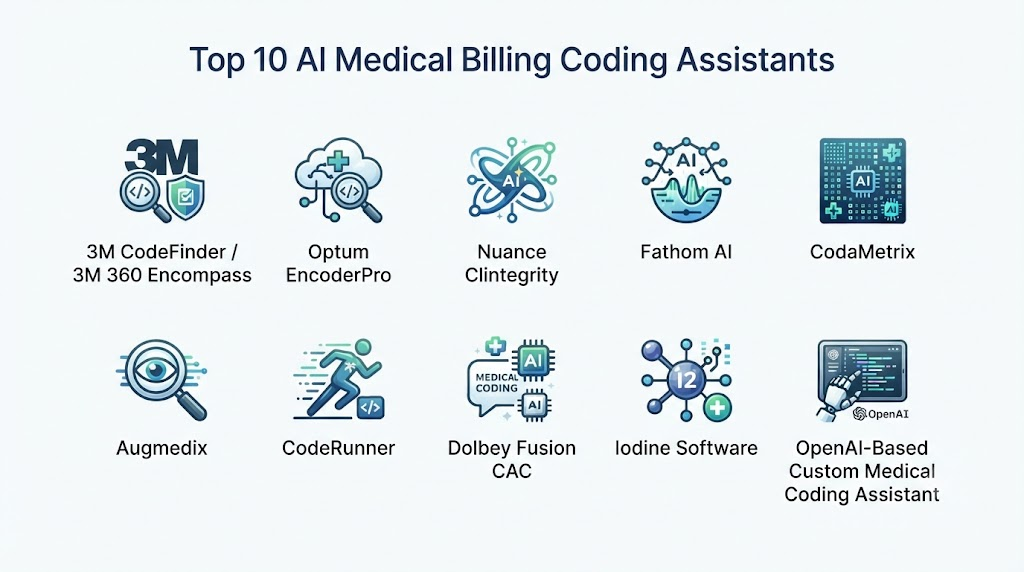
Top 10 AI Medical Billing Coding Assistants
1. 3M CodeFinder / 3M 360 Encompass
Verdict: Best overall AI-powered medical coding assistant for enterprise healthcare organizations.
Short Description: 3M healthcare coding solutions use AI, NLP, and clinical documentation analysis to assist medical coders with accurate code assignment, documentation improvement, and compliance-focused coding workflows.
Key Features
- AI-assisted coding
- Clinical NLP
- ICD and CPT support
- Documentation analysis
- Coding quality review
- Compliance workflows
Pros
- Strong healthcare coding expertise
- Enterprise adoption
- Advanced NLP capabilities
Cons
- Enterprise implementation complexity
Deployment: Enterprise healthcare platform
Security & Compliance: Healthcare-grade security controls
Integrations & Ecosystem: EHR, CAC systems, revenue cycle platforms
Support & Community: Enterprise healthcare support
Pricing Model: Custom enterprise pricing
Best-Fit Scenarios: Large hospitals and health systems
2. Optum EncoderPro
Verdict: AI-supported medical coding intelligence platform for healthcare professionals.
Short Description: Optum EncoderPro provides coding guidance, medical terminology intelligence, and healthcare coding resources to support accurate medical billing and reimbursement workflows.
Key Features
- Code lookup assistance
- Coding guidelines
- Clinical terminology support
- Compliance resources
- Coding workflow support
Pros
- Strong coding knowledge base
- Trusted healthcare resource
Cons
- More coding intelligence-focused than full automation
3. Nuance Clintegrity
Verdict: AI-enabled clinical documentation and coding improvement platform.
Short Description: Nuance Clintegrity uses clinical language understanding and healthcare AI technologies to improve documentation quality, coding accuracy, and compliance.
Key Features
- Clinical documentation improvement
- NLP-based analysis
- Coding support
- Documentation review
- Compliance assistance
Pros
- Strong healthcare AI capabilities
- Improves documentation quality
Cons
- Best suited for healthcare organizations
4. Fathom AI
Verdict: AI-native medical coding automation platform.
Short Description: Fathom uses artificial intelligence to automate medical coding processes by analyzing clinical documentation and assigning appropriate billing codes.
Key Features
- Autonomous coding support
- Clinical document analysis
- Code recommendations
- Coding workflow automation
- Audit support
Pros
- Strong AI automation
- Reduces manual coding workload
Cons
- Requires validation workflows
5. CodaMetrix
Verdict: AI-powered coding platform designed for healthcare coding automation.
Short Description: CodaMetrix uses machine learning and healthcare data analytics to automate coding workflows and improve coding consistency across healthcare organizations.
Key Features
- AI coding automation
- Physician note analysis
- Coding recommendations
- Specialty-specific workflows
- Revenue cycle support
Pros
- Strong healthcare AI focus
- Specialty coding capabilities
Cons
- Enterprise healthcare deployment
6. Augmedix
Verdict: AI clinical documentation assistant supporting coding efficiency.
Short Description: Augmedix uses AI-assisted documentation technology to capture clinical information and improve documentation quality, helping support downstream billing and coding processes.
Key Features
- Clinical documentation
- AI note generation
- Provider workflow support
- Medical information extraction
- Documentation improvement
Pros
- Improves documentation quality
- Reduces physician workload
Cons
- Primarily documentation-focused
7. CodeRunner
Verdict: Computer-assisted coding solution supporting healthcare coding teams.
Short Description: CodeRunner provides coding assistance capabilities that help healthcare organizations review documentation, identify codes, and improve coding workflows.
Key Features
- Coding assistance
- Documentation analysis
- Code suggestions
- Workflow support
- Audit preparation
Pros
- Supports coding productivity
- Useful for coding teams
Cons
- Capabilities vary by implementation
8. Dolbey Fusion CAC
Verdict: AI-assisted computer-assisted coding platform for healthcare organizations.
Short Description: Dolbey Fusion CAC uses automation and language processing technologies to support medical coding workflows, documentation review, and coding accuracy.
Key Features
- Computer-assisted coding
- NLP processing
- Documentation analysis
- Coding workflows
- Compliance support
Pros
- Healthcare coding expertise
- Strong workflow capabilities
Cons
- Requires integration planning
9. Iodine Software
Verdict: AI healthcare intelligence platform supporting coding and documentation improvement.
Short Description: Iodine Software uses AI to analyze clinical documentation, identify coding opportunities, and support revenue cycle improvement.
Key Features
- Clinical documentation analysis
- Coding insights
- Revenue intelligence
- AI workflow support
- Healthcare analytics
Pros
- Strong clinical AI capabilities
- Improves documentation accuracy
Cons
- Enterprise-focused solution
10. OpenAI-Based Custom Medical Coding Assistant
Verdict: Flexible AI solution for customized medical billing and coding workflows.
Short Description: Healthcare organizations can build custom AI coding assistants using large language models integrated with EHR systems, coding databases, clinical documentation platforms, and revenue cycle systems. These solutions can analyze notes, suggest codes, summarize coding rationale, and support documentation improvement while requiring certified coder review and compliance controls.
Key Features
- Clinical note analysis
- Code recommendation support
- Documentation summaries
- Coding explanations
- Workflow automation
Pros
- Highly customizable
- Flexible integrations
- Organization-specific workflows
Cons
- Requires healthcare AI expertise
- Human validation required
Comparison Table
| Platform | AI Coding | Documentation Analysis | EHR Integration | Automation | Best Use |
|---|---|---|---|---|---|
| 3M 360 Encompass | Excellent | Excellent | Excellent | High | Enterprise Coding |
| Optum EncoderPro | High | High | High | Medium | Coding Support |
| Nuance Clintegrity | Excellent | Excellent | Excellent | High | Documentation Improvement |
| Fathom AI | Excellent | Excellent | High | Excellent | Automated Coding |
| CodaMetrix | Excellent | Excellent | High | High | AI Coding Automation |
| Augmedix | High | Excellent | High | High | Clinical Documentation |
| CodeRunner | High | High | Medium | Medium | Coding Assistance |
| Dolbey Fusion CAC | High | High | High | High | CAC Workflows |
| Iodine Software | High | Excellent | High | High | Revenue Intelligence |
| OpenAI Custom | Custom | Custom | Custom | Custom | Custom Coding |
Evaluation & Scoring Table
| Platform | AI Features 20% | Coding Accuracy 20% | Integration 15% | Automation 15% | Security 10% | Ease 10% | Value 10% | Total |
|---|---|---|---|---|---|---|---|---|
| 3M 360 Encompass | 20 | 20 | 15 | 14 | 10 | 8 | 8 | 95 |
| Fathom AI | 20 | 19 | 14 | 15 | 10 | 8 | 8 | 94 |
| CodaMetrix | 19 | 19 | 14 | 15 | 10 | 8 | 8 | 93 |
| Nuance Clintegrity | 19 | 19 | 15 | 13 | 10 | 8 | 8 | 92 |
| Iodine Software | 18 | 18 | 14 | 14 | 10 | 8 | 8 | 90 |
| Dolbey Fusion CAC | 18 | 18 | 14 | 13 | 10 | 8 | 8 | 89 |
| Optum EncoderPro | 17 | 18 | 14 | 12 | 10 | 9 | 8 | 88 |
| Augmedix | 17 | 17 | 13 | 13 | 10 | 9 | 8 | 87 |
| CodeRunner | 17 | 17 | 12 | 12 | 10 | 8 | 8 | 84 |
| OpenAI Custom | 20 | 16 | 12 | 15 | 8 | 7 | 9 | 87 |
Which AI Medical Billing Coding Assistant Is Right for You?
| If your priority is… | Recommended Platform |
|---|---|
| Enterprise medical coding | 3M 360 Encompass |
| AI autonomous coding | Fathom AI |
| Healthcare documentation improvement | Nuance Clintegrity |
| Coding automation | CodaMetrix |
| Coding knowledge support | Optum EncoderPro |
| Clinical documentation workflows | Augmedix |
| CAC implementation | Dolbey Fusion CAC |
| Revenue cycle intelligence | Iodine Software |
| Custom coding workflows | OpenAI-Based Medical Coding Assistant |
Implementation Playbook
First 30 Days
- Review current coding workflows
- Identify documentation challenges
- Analyze coding error patterns
- Select integration requirements
Days 31–60
- Connect EHR and coding systems
- Configure AI coding workflows
- Train coding teams
- Validate recommendations
Days 61–90
- Expand automation coverage
- Monitor coding accuracy
- Improve documentation quality
- Optimize revenue cycle performance
Common Mistakes
- Expecting AI to replace certified coders
- Ignoring coding compliance requirements
- Poor documentation quality
- Lack of EHR integration
- Not validating AI recommendations
- Choosing tools without specialty support
- Ignoring audit requirements
- Over-automating sensitive workflows
Frequently Asked Questions
1. What are AI Medical Billing Coding Assistants?
They are AI-powered tools that help healthcare organizations analyze clinical documentation and recommend accurate billing codes.
2. Can AI replace medical coders?
No. AI assists coders by improving efficiency, but certified professionals remain responsible for final coding decisions.
3. What coding systems do AI assistants support?
Many platforms support ICD, CPT, HCPCS, and other healthcare coding standards.
4. How does AI improve medical coding accuracy?
AI analyzes clinical notes, identifies relevant information, and suggests codes based on healthcare coding rules.
5. Do AI coding tools integrate with EHR systems?
Yes. Many enterprise solutions connect with electronic health record and revenue cycle platforms.
6. Who uses AI coding assistants?
Hospitals, medical coders, physician practices, billing companies, and healthcare organizations.
7. Can AI reduce claim denials?
Yes. Better coding accuracy and documentation review can help reduce avoidable billing errors.
8. Are AI coding recommendations always accurate?
Accuracy depends on documentation quality, AI models, coding rules, and human review.
9. Are AI medical coding platforms secure?
Healthcare organizations should evaluate privacy controls, security practices, and compliance requirements.
10. What should buyers evaluate before adoption?
Consider coding accuracy, integrations, compliance, automation, scalability, and workflow impact.
Conclusion
AI Medical Billing Coding Assistants are transforming healthcare revenue cycle operations by improving coding accuracy, reducing manual workload, and helping organizations process claims more efficiently. By combining artificial intelligence, clinical language processing, and healthcare coding intelligence, these platforms support faster documentation review and more consistent billing workflows.Healthcare organizations should select AI coding solutions based on coding accuracy, compliance requirements, EHR integration, workflow compatibility, and scalability. Platforms such as 3M 360 Encompass, Fathom AI, CodaMetrix, Nuance Clintegrity, and Iodine Software demonstrate how AI can improve medical coding operations, reduce administrative burden, and strengthen healthcare financial performance.
