Introduction
AI Medical Imaging Diagnosis Support tools use artificial intelligence (AI), deep learning, computer vision, and machine learning (ML) to assist radiologists, clinicians, and healthcare providers in analyzing medical images with greater speed, accuracy, and consistency. These platforms help detect abnormalities, prioritize urgent cases, quantify findings, and provide clinical decision support across imaging modalities such as X-ray, CT, MRI, mammography, ultrasound, PET, and digital pathology.
Healthcare organizations generate millions of medical images every year, placing increasing pressure on radiology departments to deliver timely and accurate diagnoses. AI-powered imaging solutions augment—not replace—medical professionals by automatically identifying suspicious findings, highlighting regions of interest, measuring lesions, comparing historical studies, and generating structured reports. This helps reduce diagnostic variability, shorten reporting times, improve workflow efficiency, and support earlier disease detection.
Modern AI Medical Imaging Diagnosis Support platforms integrate with Picture Archiving and Communication Systems (PACS), Radiology Information Systems (RIS), Electronic Health Records (EHR), and hospital workflows. They support multiple clinical specialties including radiology, oncology, cardiology, neurology, pulmonology, orthopedics, and emergency medicine while helping organizations improve patient care and operational efficiency.
Healthcare providers increasingly adopt AI imaging solutions to improve diagnostic confidence, optimize radiology workflows, enhance clinical outcomes, and manage growing imaging volumes.
Real-world Use Cases
- Chest X-ray analysis
- CT scan interpretation
- Brain MRI analysis
- Stroke detection
- Lung nodule detection
- Breast cancer screening
- Fracture detection
- Cardiac imaging analysis
- Oncology imaging support
- Emergency radiology prioritization
Evaluation Criteria for Buyers
When evaluating AI Medical Imaging Diagnosis Support platforms, consider:
- Diagnostic accuracy
- Supported imaging modalities
- Clinical validation
- PACS and RIS integration
- Workflow automation
- Regulatory compliance
- Explainable AI capabilities
- Scalability
- Reporting features
- Deployment flexibility
Best For
- Hospitals
- Diagnostic imaging centers
- Radiology departments
- Oncology centers
- Cardiology practices
- Academic medical institutions
Not Ideal For
Organizations without digital imaging infrastructure or those seeking AI as a replacement for qualified medical professionals.
Key Trends
- AI-assisted radiology
- Computer vision in healthcare
- Automated image segmentation
- Explainable medical AI
- AI-powered triage
- Quantitative imaging
- Cloud-based imaging analytics
- Workflow automation
- Multi-modality AI
- Predictive diagnostic support
Methodology
The platforms below were evaluated based on:
- AI diagnostic capabilities
- Clinical validation
- Imaging modality coverage
- Workflow integration
- Automation
- Compliance
- Scalability
- Overall clinical value
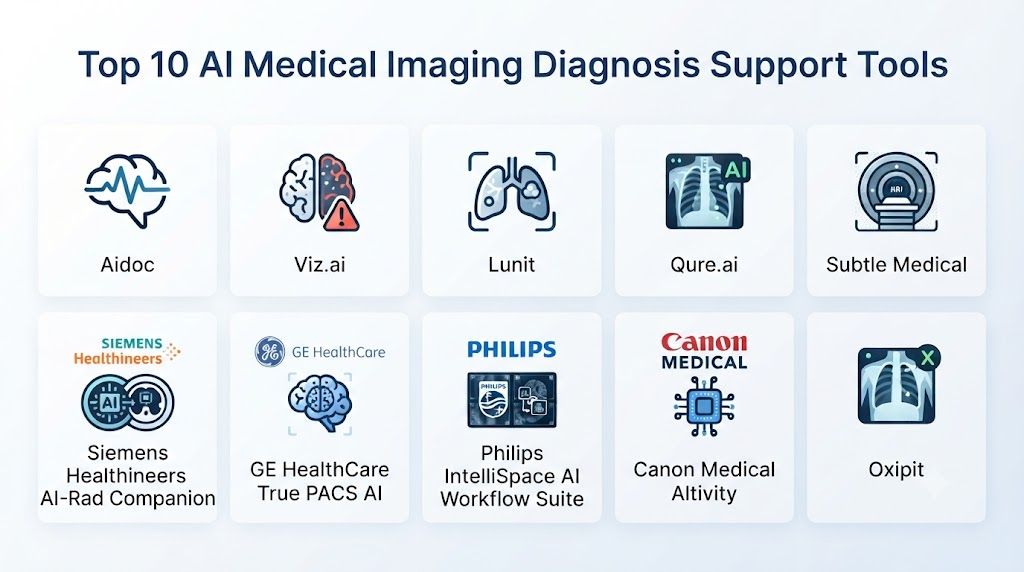
Top 10 AI Medical Imaging Diagnosis Support Tools
1. Aidoc
Verdict: Best overall AI platform for radiology workflow optimization and diagnostic support.
Short Description: Aidoc uses deep learning to analyze medical images in real time, identify critical findings, prioritize urgent cases, and assist radiologists across CT, X-ray, and other imaging modalities. The platform improves clinical workflows while supporting faster diagnosis and treatment.
Key Features
- AI image analysis
- Critical finding detection
- Case prioritization
- Workflow orchestration
- Multi-modality support
- Automated notifications
- Clinical dashboards
- PACS integration
Pros
- Broad clinical coverage
- Strong workflow integration
- High scalability
- Enterprise deployment
Cons
- Enterprise-focused pricing
- Implementation planning required
Deployment: Cloud & On-premises
Security & Compliance: Enterprise healthcare security
Integrations & Ecosystem: PACS, RIS, EHR, hospital systems
Support & Community: Enterprise support
Pricing Model: Custom enterprise pricing
Best-Fit Scenarios: Large hospitals and radiology networks
2. Viz.ai
Verdict: Leading AI platform for stroke detection and emergency imaging workflows.
Short Description: Viz.ai uses AI to analyze brain CT angiography and other imaging studies to rapidly detect suspected stroke and notify care teams, helping accelerate treatment decisions.
Key Features
- Stroke detection
- Emergency alerts
- Imaging prioritization
- Care coordination
- Workflow automation
- Mobile notifications
Pros
- Excellent stroke workflow
- Fast clinical notifications
Cons
- Specialized clinical focus
3. Qure.ai
Verdict: Comprehensive AI imaging platform for chest imaging and emergency care.
Short Description: Qure.ai provides AI-assisted interpretation of chest X-rays, CT scans, and head imaging to support detection of tuberculosis, lung abnormalities, brain injuries, and other critical conditions.
Key Features
- Chest X-ray AI
- CT analysis
- Tuberculosis screening
- Brain imaging
- Workflow integration
Pros
- Broad imaging portfolio
- Strong public health applications
Cons
- Some solutions are specialty-specific
4. Gleamer
Verdict: AI-powered radiology assistant for musculoskeletal and chest imaging.
Short Description: Gleamer assists radiologists by detecting fractures, chest abnormalities, and other findings while integrating seamlessly into existing radiology workflows.
Key Features
- Fracture detection
- Chest X-ray analysis
- AI assistance
- Workflow integration
- Clinical decision support
Pros
- Easy integration
- High diagnostic consistency
Cons
- Limited modality coverage compared to broader platforms
5. Lunit INSIGHT
Verdict: Advanced AI platform for cancer screening and chest imaging.
Short Description: Lunit INSIGHT supports radiologists by analyzing mammography, chest X-rays, and other imaging studies to improve early detection of cancer and pulmonary diseases.
Key Features
- Mammography AI
- Chest imaging
- Cancer detection
- Quantitative analysis
- AI reporting
Pros
- Strong oncology capabilities
- High diagnostic accuracy
Cons
- Focused clinical applications
6. Subtle Medical
Verdict: AI platform for enhancing medical image quality and workflow efficiency.
Short Description: Subtle Medical applies AI to improve image quality, accelerate MRI and PET imaging, and reduce scan times while maintaining diagnostic quality.
Key Features
- Image enhancement
- MRI acceleration
- PET optimization
- Workflow efficiency
- AI reconstruction
Pros
- Improves imaging efficiency
- Reduces scan duration
Cons
- Focuses on image enhancement rather than diagnosis
7. Arterys
Verdict: Cloud-native AI platform for advanced medical imaging analysis.
Short Description: Arterys provides AI-powered imaging analysis for radiology and cardiology using cloud computing, automated quantification, and workflow integration.
Key Features
- Cloud imaging
- Cardiac analysis
- Automated measurements
- AI segmentation
- Multi-modality support
Pros
- Cloud-native architecture
- Strong cardiology capabilities
Cons
- Enterprise deployment model
8. HeartFlow
Verdict: AI-powered cardiovascular imaging analysis platform.
Short Description: HeartFlow analyzes coronary CT angiography using AI to provide functional insights that support the diagnosis and management of coronary artery disease.
Key Features
- Coronary CT analysis
- Functional assessment
- AI modeling
- Clinical reporting
- Cardiology workflow
Pros
- Excellent cardiovascular focus
- Advanced analytics
Cons
- Specialized application
9. DeepHealth
Verdict: Enterprise AI platform for breast imaging and radiology workflows.
Short Description: DeepHealth combines AI with enterprise imaging solutions to improve breast cancer screening, workflow efficiency, and diagnostic consistency.
Key Features
- Mammography AI
- Breast imaging
- Workflow optimization
- AI prioritization
- Reporting tools
Pros
- Strong breast imaging expertise
- Enterprise integration
Cons
- Primary focus on breast imaging
10. OpenAI-Based Custom Imaging Decision Support
Verdict: Flexible AI-powered platform for clinical imaging workflow assistance.
Short Description: Healthcare organizations can build custom AI decision-support systems using large language models integrated with imaging platforms, PACS, EHR systems, reporting workflows, and clinical guidelines to assist radiologists with structured reporting, workflow optimization, and diagnostic documentation. These systems should complement validated medical imaging models rather than independently interpreting images.
Key Features
- Clinical reporting assistance
- Workflow automation
- Imaging documentation
- Decision support
- Custom AI workflows
Pros
- Highly customizable
- Flexible integrations
- Organization-specific workflows
Cons
- Requires AI engineering expertise
- Clinical validation and regulatory governance required
Comparison Table
| Platform | AI Diagnosis | Workflow Integration | Multi-Modality | Automation | Best Use |
|---|---|---|---|---|---|
| Aidoc | Excellent | Excellent | Excellent | Excellent | Enterprise Radiology |
| Viz.ai | Excellent | Excellent | High | Excellent | Stroke Care |
| Qure.ai | Excellent | High | High | High | Chest & Emergency Imaging |
| Gleamer | High | High | Medium | High | Fracture Detection |
| Lunit INSIGHT | Excellent | High | High | High | Cancer Screening |
| Subtle Medical | Medium | High | High | High | Image Enhancement |
| Arterys | High | High | Excellent | High | Cardiology & Radiology |
| HeartFlow | Excellent | High | Medium | Medium | Cardiovascular Imaging |
| DeepHealth | High | High | Medium | High | Breast Imaging |
| OpenAI Custom | Custom | Custom | Custom | Custom | Clinical Workflow Support |
Evaluation & Scoring Table
| Platform | AI Features 20% | Clinical Accuracy 20% | Integrations 15% | Workflow 15% | Performance 10% | Ease 10% | Value 10% | Total |
|---|---|---|---|---|---|---|---|---|
| Aidoc | 20 | 20 | 15 | 15 | 10 | 8 | 8 | 96 |
| Viz.ai | 19 | 20 | 14 | 15 | 10 | 8 | 8 | 94 |
| Lunit INSIGHT | 19 | 19 | 14 | 14 | 10 | 8 | 8 | 92 |
| Qure.ai | 18 | 19 | 14 | 14 | 10 | 9 | 8 | 92 |
| Arterys | 18 | 18 | 15 | 13 | 10 | 8 | 8 | 90 |
| HeartFlow | 18 | 19 | 13 | 13 | 10 | 8 | 8 | 89 |
| DeepHealth | 17 | 18 | 14 | 13 | 9 | 8 | 8 | 87 |
| Gleamer | 17 | 18 | 13 | 13 | 9 | 9 | 8 | 87 |
| Subtle Medical | 17 | 17 | 13 | 13 | 10 | 9 | 8 | 87 |
| OpenAI Custom | 18 | 16 | 12 | 15 | 8 | 7 | 9 | 85 |
Which AI Medical Imaging Diagnosis Support Tool Is Right for You?
| If your priority is… | Recommended Platform |
|---|---|
| Enterprise radiology | Aidoc |
| Stroke diagnosis | Viz.ai |
| Chest imaging | Qure.ai |
| Cancer screening | Lunit INSIGHT |
| Fracture detection | Gleamer |
| MRI and PET optimization | Subtle Medical |
| Cardiology imaging | Arterys |
| Coronary CT analysis | HeartFlow |
| Breast imaging | DeepHealth |
| Custom workflow assistance | OpenAI-Based Imaging Decision Support |
Implementation Playbook
First 30 Days
- Assess imaging infrastructure
- Integrate PACS and RIS
- Define clinical workflows
- Validate AI performance
Days 31–60
- Train clinical users
- Configure workflow automation
- Monitor diagnostic consistency
- Integrate reporting systems
Days 61–90
- Expand AI-supported studies
- Measure workflow improvements
- Optimize clinical processes
- Continuously evaluate AI performance
Common Mistakes
- Expecting AI to replace radiologists
- Poor workflow integration
- Inadequate clinical validation
- Ignoring regulatory requirements
- Limited staff training
- Missing quality assurance processes
- Insufficient monitoring of AI performance
- Failing to update AI models and workflows
Frequently Asked Questions
1. What are AI Medical Imaging Diagnosis Support tools?
They use AI to assist clinicians by analyzing medical images, identifying potential abnormalities, prioritizing urgent cases, and supporting diagnostic workflows.
2. Can AI replace radiologists?
No. These platforms are designed to support qualified healthcare professionals, not replace their clinical judgment.
3. Which imaging modalities are commonly supported?
Many solutions support X-ray, CT, MRI, ultrasound, mammography, PET, and other medical imaging modalities.
4. Do these tools integrate with hospital systems?
Yes. Most enterprise platforms integrate with PACS, RIS, EHR systems, and existing radiology workflows.
5. Can AI improve reporting speed?
Yes. AI can automate measurements, prioritize urgent cases, and assist with structured reporting to improve workflow efficiency.
6. Are these platforms suitable for cancer screening?
Several solutions specialize in breast, lung, and other cancer detection workflows.
7. How accurate are AI imaging systems?
Performance varies by clinical application and imaging modality. Organizations should review published clinical validation studies and ensure appropriate regulatory clearances for their region.
8. What healthcare teams benefit most?
Radiologists, emergency physicians, oncologists, cardiologists, neurologists, and imaging specialists.
9. What should organizations evaluate before selecting a platform?
Assess clinical validation, regulatory status, workflow integration, supported imaging modalities, AI explainability, scalability, and interoperability.
10. Are AI imaging platforms regulated?
Many commercial products are subject to medical device regulations in the regions where they are marketed. Organizations should verify the applicable approvals and compliance requirements before deployment.
Conclusion
AI Medical Imaging Diagnosis Support tools are helping healthcare organizations improve diagnostic workflows by assisting clinicians with image analysis, prioritizing critical findings, and streamlining reporting processes. By combining deep learning, computer vision, and workflow automation, these platforms can enhance efficiency and support earlier detection of conditions across a wide range of imaging specialties.Organizations should choose a platform based on clinical use cases, imaging modalities, workflow integration, regulatory requirements, and validation evidence. Solutions such as Aidoc, Viz.ai, Qure.ai, Lunit INSIGHT, and Arterys offer advanced capabilities for enterprise healthcare environments, while carefully governed custom AI workflow assistants can further improve reporting and operational efficiency when used alongside validated clinical imaging solutions.
