Introduction
AI Medication Adherence Prediction tools use artificial intelligence (AI), machine learning (ML), predictive analytics, behavioral modeling, and healthcare data intelligence to identify patients who may struggle with taking medications as prescribed. These platforms analyze clinical history, prescription data, refill patterns, patient behavior, social factors, engagement signals, and health outcomes to predict adherence risks and enable proactive interventions.
Medication non-adherence is a major healthcare challenge that can lead to worsening disease conditions, avoidable hospitalizations, increased healthcare costs, and reduced treatment effectiveness. Traditional approaches often rely on manual follow-ups, patient self-reporting, or retrospective pharmacy data analysis, making it difficult to identify adherence issues early.
AI-powered medication adherence solutions help healthcare providers, pharmacies, insurers, and care management teams detect high-risk patients before problems occur. These platforms generate predictive risk scores, recommend personalized interventions, send reminders, support medication management programs, and improve communication between patients and healthcare teams.
Modern AI Medication Adherence Prediction platforms integrate with Electronic Health Records (EHR), pharmacy management systems, prescription databases, patient engagement platforms, remote monitoring tools, and digital health applications. They support chronic disease management programs involving diabetes, cardiovascular conditions, hypertension, respiratory diseases, oncology, and mental health.
These tools are designed to assist healthcare professionals by improving medication management, increasing patient engagement, and supporting better health outcomes through proactive care strategies.
Real-world Use Cases
- Chronic disease medication management
- Prescription refill prediction
- High-risk patient identification
- Pharmacy adherence programs
- Patient reminder automation
- Care management interventions
- Remote patient support
- Specialty medication monitoring
- Population health improvement
- Insurance-based medication programs
Evaluation Criteria for Buyers
When selecting an AI Medication Adherence Prediction platform, consider:
- Prediction accuracy
- Patient behavior analytics
- Pharmacy integration
- EHR compatibility
- Risk scoring capabilities
- Intervention automation
- Patient engagement features
- Data security and privacy
- Scalability
- Reporting and analytics
Best For
- Healthcare providers
- Pharmacies
- Insurance organizations
- Population health teams
- Specialty medication programs
- Chronic care management organizations
Not Ideal For
Organizations without access to medication history data, patient engagement systems, or digital healthcare infrastructure.
Key Trends
- AI-driven patient engagement
- Predictive healthcare analytics
- Digital medication management
- Smart reminders
- Remote patient monitoring integration
- Behavioral health analytics
- Personalized medication support
- Pharmacy AI solutions
- Value-based healthcare programs
- Preventive care automation
Methodology
The platforms below were evaluated based on:
- AI prediction capabilities
- Medication management features
- Healthcare integration
- Patient engagement
- Automation capabilities
- Scalability
- Enterprise healthcare readiness
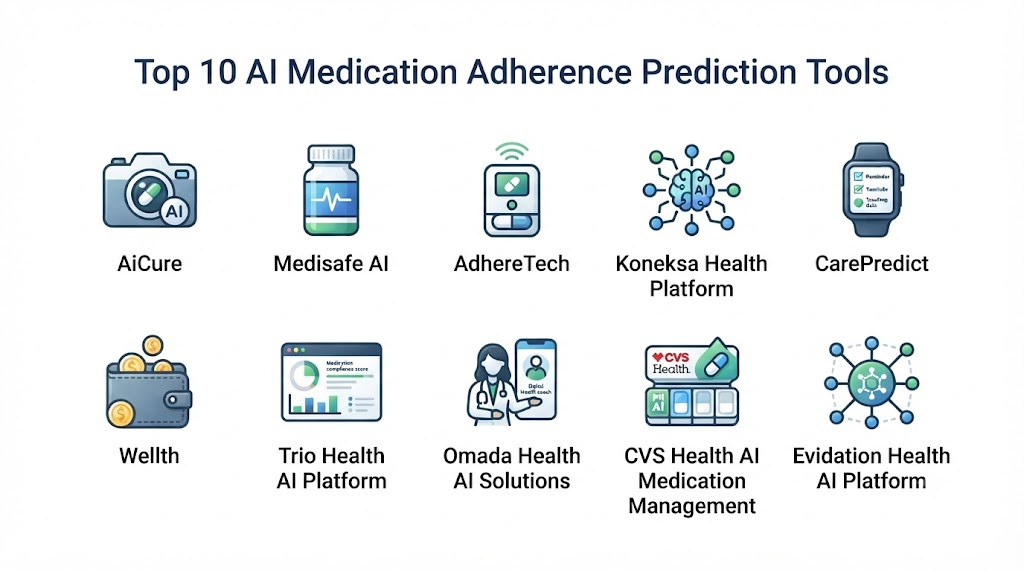
Top 10 AI Medication Adherence Prediction Tools
1. Medisafe
Verdict: Best overall AI-powered medication adherence platform for patient engagement.
Short Description: Medisafe uses AI-powered medication management capabilities to help patients track medications, receive reminders, monitor adherence behavior, and improve medication routines.
Key Features
- Medication reminders
- Adherence tracking
- Patient engagement
- Medication schedules
- Health insights
- Caregiver support
Pros
- Strong patient experience
- Easy mobile adoption
- Broad medication support
Cons
- Focused mainly on patient engagement
Deployment: Mobile & Cloud
Security & Compliance: Healthcare privacy controls
Integrations & Ecosystem: Healthcare applications and care programs
Support & Community: Digital health support
Pricing Model: Subscription and enterprise options vary
Best-Fit Scenarios: Consumer medication management
2. Omada Health
Verdict: AI-enabled digital health platform supporting medication and chronic care adherence.
Short Description: Omada Health combines digital coaching, behavioral analytics, and healthcare data insights to support patients managing chronic conditions and improving adherence behaviors.
Key Features
- Behavioral analytics
- Chronic care programs
- Patient engagement
- Digital coaching
- Health monitoring
Pros
- Strong behavioral healthcare approach
- Chronic disease expertise
Cons
- Broader digital health focus
3. Twistle by Health Catalyst
Verdict: AI-supported patient engagement platform for medication and care adherence workflows.
Short Description: Twistle helps healthcare organizations automate patient communication, reminders, and care pathways to improve adherence and follow-up.
Key Features
- Automated messaging
- Patient engagement
- Care pathways
- Reminders
- Healthcare workflows
Pros
- Strong healthcare integration
- Workflow automation
Cons
- Requires healthcare implementation planning
4. Wellth
Verdict: AI-driven behavioral platform focused on improving medication adherence.
Short Description: Wellth uses behavioral science and digital engagement tools to encourage patients to follow prescribed medication routines and improve chronic disease outcomes.
Key Features
- Behavioral AI
- Patient motivation
- Medication adherence programs
- Digital engagement
- Personalized interventions
Pros
- Strong adherence focus
- Behavioral science approach
Cons
- Program-based deployment model
5. Medisafe AI Medication Management
Verdict: Smart medication management platform with adherence insights.
Short Description: Medisafe provides medication tracking, reminders, and analytics capabilities that help patients and healthcare teams monitor medication routines.
Key Features
- Smart reminders
- Medication tracking
- Adherence reports
- Patient alerts
- Health integrations
Pros
- Strong usability
- Consumer-friendly platform
Cons
- Advanced prediction capabilities vary
6. DrFirst Medication Management
Verdict: Healthcare medication management platform supporting adherence workflows.
Short Description: DrFirst provides medication management solutions that improve prescribing workflows, medication history access, and patient medication communication.
Key Features
- Medication history
- Prescription management
- Patient communication
- Healthcare integration
- Medication safety
Pros
- Strong healthcare workflow integration
- Medication expertise
Cons
- Enterprise healthcare focus
7. Oracle Health Medication Management
Verdict: Enterprise healthcare platform supporting medication intelligence.
Short Description: Oracle Health provides healthcare data and medication management capabilities that support medication workflows, patient insights, and healthcare decision-making.
Key Features
- Medication data management
- Healthcare analytics
- Patient insights
- Clinical workflows
- Data integration
Pros
- Enterprise scalability
- Strong healthcare ecosystem
Cons
- Complex deployment
8. Epic Medication Management Analytics
Verdict: EHR-integrated medication intelligence platform.
Short Description: Epic provides medication management capabilities through its healthcare ecosystem, enabling providers to analyze medication history, patient information, and care workflows.
Key Features
- Medication records
- Patient data analysis
- Care workflows
- Clinical alerts
- EHR integration
Pros
- Deep healthcare integration
- Large healthcare adoption
Cons
- Best suited for Epic environments
9. AdhereHealth
Verdict: AI-enabled medication adherence analytics platform for healthcare organizations.
Short Description: AdhereHealth uses analytics, patient outreach, and medication management workflows to identify adherence risks and support interventions.
Key Features
- Adherence analytics
- Patient outreach
- Risk identification
- Pharmacy support
- Care management
Pros
- Strong medication adherence focus
- Healthcare-oriented solution
Cons
- Primarily enterprise-focused
10. OpenAI-Based Custom Medication Adherence Prediction Assistant
Verdict: Flexible AI solution for customized medication adherence workflows.
Short Description: Healthcare organizations can build custom AI medication adherence assistants using large language models integrated with pharmacy systems, EHR platforms, prescription histories, patient engagement tools, and healthcare analytics systems. These solutions can support adherence summaries, patient communication, risk explanations, and intervention planning while requiring clinical oversight.
Key Features
- AI adherence summaries
- Patient risk analysis
- Medication insights
- Automated communication
- Workflow integration
Pros
- Highly customizable
- Flexible integrations
- Organization-specific solutions
Cons
- Requires healthcare AI expertise
- Governance required
Comparison Table
| Platform | AI Prediction | Medication Management | Healthcare Integration | Patient Engagement | Best Use |
|---|---|---|---|---|---|
| Medisafe | High | Excellent | High | Excellent | Patient Medication Support |
| Omada Health | High | High | Excellent | Excellent | Chronic Care |
| Twistle | High | High | Excellent | High | Care Coordination |
| Wellth | Excellent | Excellent | High | Excellent | Adherence Programs |
| DrFirst | High | Excellent | Excellent | High | Medication Workflow |
| Oracle Health | High | High | Excellent | Medium | Enterprise Healthcare |
| Epic Analytics | High | High | Excellent | Medium | EHR-Based Programs |
| AdhereHealth | Excellent | Excellent | High | High | Medication Adherence |
| Medisafe Analytics | High | High | Medium | Excellent | Digital Medication |
| OpenAI Custom | Custom | Custom | Custom | Custom | Custom AI Solutions |
Evaluation & Scoring Table
| Platform | AI Features 20% | Prediction Accuracy 20% | Integration 15% | Engagement 15% | Security 10% | Ease 10% | Value 10% | Total |
|---|---|---|---|---|---|---|---|---|
| Wellth | 20 | 20 | 14 | 15 | 10 | 8 | 8 | 95 |
| AdhereHealth | 19 | 19 | 14 | 14 | 10 | 8 | 8 | 92 |
| Medisafe | 18 | 18 | 14 | 15 | 10 | 9 | 8 | 92 |
| Epic Medication Analytics | 18 | 18 | 15 | 13 | 10 | 8 | 8 | 90 |
| Oracle Health | 18 | 17 | 15 | 13 | 10 | 8 | 8 | 89 |
| DrFirst | 18 | 18 | 15 | 12 | 10 | 8 | 8 | 89 |
| Omada Health | 18 | 18 | 14 | 14 | 10 | 8 | 8 | 90 |
| Twistle | 17 | 17 | 15 | 14 | 10 | 8 | 8 | 89 |
| Adherence Platforms | 17 | 17 | 13 | 13 | 9 | 8 | 8 | 85 |
| OpenAI Custom | 20 | 16 | 12 | 15 | 8 | 7 | 9 | 87 |
Which AI Medication Adherence Prediction Tool Is Right for You?
| If your priority is… | Recommended Platform |
|---|---|
| Patient medication reminders | Medisafe |
| Behavioral adherence improvement | Wellth |
| Chronic disease management | Omada Health |
| Care communication workflows | Twistle |
| Medication workflow integration | DrFirst |
| Enterprise healthcare analytics | Oracle Health |
| EHR-based medication insights | Epic |
| Medication adherence programs | AdhereHealth |
| Custom AI medication workflows | OpenAI-Based Medication Assistant |
Implementation Playbook
First 30 Days
- Identify medication adherence challenges
- Review pharmacy and patient data sources
- Define target patient groups
- Establish intervention goals
Days 31–60
- Integrate medication data systems
- Deploy AI risk scoring
- Configure patient engagement workflows
- Train care teams
Days 61–90
- Expand adherence programs
- Monitor patient outcomes
- Optimize AI predictions
- Improve intervention strategies
Common Mistakes
- Using incomplete medication data
- Ignoring patient behavior factors
- Lack of patient engagement
- Poor integration with healthcare systems
- Treating AI scores as final decisions
- Ignoring privacy requirements
- Not measuring outcomes
- Overusing automated reminders
Frequently Asked Questions
1. What are AI Medication Adherence Prediction tools?
They are AI-powered platforms that predict medication adherence risks and help healthcare teams improve patient medication routines.
2. How does AI predict medication adherence?
AI analyzes prescription history, refill patterns, patient behavior, clinical data, and engagement signals.
3. Can AI improve medication adherence?
Yes. AI helps identify at-risk patients and enables personalized reminders, outreach, and support programs.
4. Who uses medication adherence prediction tools?
Hospitals, pharmacies, insurers, physicians, and care management organizations.
5. Do these platforms integrate with EHR systems?
Many enterprise solutions integrate with healthcare records, pharmacy systems, and patient platforms.
6. Which conditions benefit from medication adherence AI?
Chronic diseases such as diabetes, heart disease, hypertension, and respiratory conditions often benefit.
7. Can AI replace pharmacists or care managers?
No. AI supports healthcare professionals by providing insights and automation.
8. Are medication adherence predictions always accurate?
Accuracy depends on data quality, patient behavior, and model validation.
9. What privacy issues should organizations consider?
Organizations must protect patient health data and follow healthcare privacy requirements.
10. What should buyers evaluate before selecting a platform?
Consider AI accuracy, integrations, patient engagement, security, scalability, and workflow compatibility.
Conclusion
AI Medication Adherence Prediction tools are helping healthcare organizations move from reactive medication management to proactive patient support. By analyzing prescription behavior, clinical data, and patient engagement patterns, these platforms help identify adherence challenges early and enable personalized interventions.Healthcare providers, pharmacies, and health organizations should select solutions based on prediction accuracy, integration capabilities, patient engagement features, security requirements, and operational goals. Platforms such as Wellth, Medisafe, Epic medication analytics, AdhereHealth, and enterprise healthcare intelligence solutions demonstrate how artificial intelligence can improve medication management, strengthen chronic care programs, and support better patient outcomes.
