Introduction
AI No-Show Prediction tools use artificial intelligence (AI), machine learning (ML), predictive analytics, and healthcare behavior intelligence to identify patients who are likely to miss scheduled appointments. These platforms analyze historical appointment data, patient behavior patterns, communication responses, demographics, appointment history, travel factors, scheduling patterns, and healthcare engagement signals to predict no-show risks before they occur.
Patient no-shows create major operational challenges for healthcare organizations. Missed appointments reduce provider utilization, increase waiting times for other patients, create revenue losses, and make healthcare resources less efficient. Traditional approaches usually rely on generic reminder messages, which may not effectively identify high-risk appointments or personalize patient outreach.
AI-powered no-show prediction platforms help healthcare providers take proactive actions by identifying high-risk patients, optimizing reminder strategies, offering appointment rescheduling options, and improving patient engagement. These systems allow clinics and hospitals to prioritize outreach efforts and maximize appointment availability.
Modern AI No-Show Prediction solutions integrate with Electronic Health Records (EHR), practice management systems, patient engagement platforms, scheduling software, telehealth systems, and healthcare analytics environments. They support hospitals, outpatient clinics, specialty practices, and healthcare networks in improving attendance rates and operational efficiency.
These tools are designed to assist healthcare teams by providing predictive insights and automation while maintaining human oversight for patient communication and care decisions.
Real-world Use Cases
- Appointment no-show prediction
- Personalized patient reminders
- Appointment rescheduling automation
- Provider schedule optimization
- Patient engagement improvement
- Clinic capacity management
- Waitlist optimization
- Telehealth attendance improvement
- Resource utilization planning
- Revenue cycle improvement
Evaluation Criteria for Buyers
When selecting an AI No-Show Prediction platform, consider:
- Prediction accuracy
- Patient behavior analytics
- EHR integration
- Scheduling system compatibility
- Automated outreach capabilities
- Personalization features
- Reporting and analytics
- Data security
- Scalability
- Ease of implementation
Best For
- Hospitals
- Outpatient clinics
- Specialty practices
- Healthcare networks
- Telehealth providers
- Medical groups
Not Ideal For
Organizations without historical appointment data or digital patient communication systems.
Key Trends
- Predictive healthcare analytics
- AI-powered patient engagement
- Automated appointment management
- Digital healthcare access
- Personalized communication
- Smart scheduling optimization
- Healthcare workflow automation
- Patient behavior analytics
- Conversational AI reminders
- Value-based healthcare operations
Methodology
The platforms below were evaluated based on:
- AI prediction capabilities
- Scheduling integration
- Patient engagement features
- Automation maturity
- Healthcare workflow support
- Scalability
- Enterprise readiness
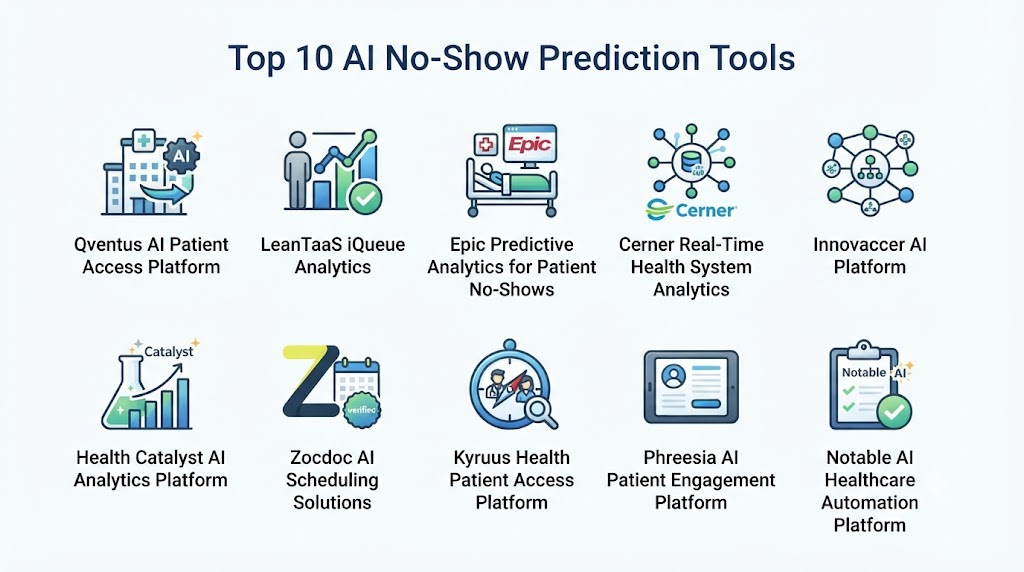
Top 10 AI No-Show Prediction Tools
1. Qventus
Verdict: Best overall AI platform for healthcare operational optimization and appointment attendance improvement.
Short Description: Qventus uses AI and automation to improve healthcare workflows, patient flow, scheduling efficiency, and operational decision-making. It helps organizations identify operational risks and optimize patient access processes.
Key Features
- Predictive analytics
- Healthcare workflow optimization
- Patient flow intelligence
- Scheduling insights
- Operational automation
- AI recommendations
Pros
- Strong healthcare operations focus
- Enterprise scalability
- Improves operational efficiency
Cons
- Best suited for larger healthcare organizations
Deployment: Cloud-based
Security & Compliance: Healthcare-grade security controls
Integrations & Ecosystem: EHR, scheduling systems, healthcare workflows
Support & Community: Enterprise support
Pricing Model: Custom enterprise pricing
Best-Fit Scenarios: Hospitals and healthcare networks
2. LeanTaaS iQueue
Verdict: AI-powered healthcare operations platform supporting appointment optimization.
Short Description: LeanTaaS uses predictive analytics to improve healthcare capacity management, scheduling efficiency, and resource utilization.
Key Features
- Predictive scheduling analytics
- Capacity optimization
- Appointment utilization insights
- Operational dashboards
- Healthcare analytics
Pros
- Strong healthcare analytics
- Improves resource planning
Cons
- Enterprise-focused solution
3. Phreesia
Verdict: Patient access platform with intelligent engagement and appointment management capabilities.
Short Description: Phreesia helps healthcare organizations improve patient engagement, digital intake, scheduling workflows, and communication processes that can reduce missed appointments.
Key Features
- Patient communication
- Appointment reminders
- Digital intake
- Patient engagement analytics
- Scheduling support
Pros
- Strong patient experience
- Healthcare-focused platform
Cons
- Broader patient access focus
4. Notable Health
Verdict: AI healthcare automation platform for patient communication and workflow improvement.
Short Description: Notable Health uses AI-powered automation to manage patient interactions, scheduling workflows, reminders, and administrative healthcare processes.
Key Features
- AI patient communication
- Automated reminders
- Scheduling workflows
- Digital assistants
- Healthcare automation
Pros
- Strong automation capabilities
- Reduces administrative workload
Cons
- Requires workflow configuration
5. Kyruus
Verdict: AI-powered healthcare access platform improving patient-provider matching and scheduling.
Short Description: Kyruus helps healthcare organizations improve patient access by connecting patients with appropriate providers and supporting efficient appointment workflows.
Key Features
- Provider matching
- Appointment scheduling
- Patient access optimization
- Healthcare directories
- Engagement workflows
Pros
- Improves patient access
- Strong healthcare integrations
Cons
- More focused on access optimization
6. Epic Healthy Planet Analytics
Verdict: EHR-based analytics platform supporting patient behavior insights.
Short Description: Epic healthcare analytics capabilities help organizations analyze patient patterns, care engagement, and operational trends that can support attendance improvement programs.
Key Features
- Patient analytics
- Healthcare data insights
- EHR integration
- Population health workflows
- Reporting
Pros
- Deep EHR integration
- Strong healthcare adoption
Cons
- Best suited for Epic environments
7. Salesforce Health Cloud
Verdict: Healthcare CRM platform supporting AI-powered patient engagement.
Short Description: Salesforce Health Cloud helps healthcare organizations manage patient relationships, communication workflows, and engagement strategies that can improve appointment attendance.
Key Features
- Patient engagement
- Automated communication
- Healthcare CRM
- Workflow automation
- Analytics
Pros
- Flexible platform
- Strong automation ecosystem
Cons
- Requires customization
8. Oracle Health Scheduling & Analytics
Verdict: Enterprise healthcare platform supporting appointment optimization.
Short Description: Oracle Health provides healthcare scheduling and analytics capabilities that help organizations improve patient access, appointment management, and operational workflows.
Key Features
- Appointment analytics
- Patient access management
- Healthcare workflows
- Data integration
- Reporting
Pros
- Enterprise scalability
- Strong healthcare ecosystem
Cons
- Complex implementation
9. Microsoft Cloud for Healthcare AI
Verdict: Flexible AI platform for building customized no-show prediction solutions.
Short Description: Microsoft Cloud for Healthcare provides AI, analytics, and automation capabilities that organizations can use to develop patient engagement and predictive scheduling solutions.
Key Features
- AI prediction models
- Patient analytics
- Healthcare data integration
- Automated communication
- Custom workflows
Pros
- Flexible AI infrastructure
- Strong cloud capabilities
Cons
- Requires technical expertise
10. OpenAI-Based Custom AI No-Show Prediction Assistant
Verdict: Customizable AI solution for healthcare attendance prediction workflows.
Short Description: Healthcare organizations can build custom AI no-show prediction assistants using large language models integrated with appointment systems, EHR platforms, patient communication tools, and analytics databases. These systems can analyze appointment history, generate risk summaries, personalize reminders, and support scheduling teams while requiring privacy controls and human oversight.
Key Features
- Appointment risk analysis
- Patient behavior summaries
- Personalized reminders
- Scheduling recommendations
- Workflow automation
Pros
- Highly customizable
- Flexible integrations
- Organization-specific solutions
Cons
- Requires AI expertise
- Governance required
Comparison Table
| Platform | AI Prediction | Scheduling Integration | Patient Engagement | Automation | Best Use |
|---|---|---|---|---|---|
| Qventus | Excellent | Excellent | High | Excellent | Healthcare Operations |
| LeanTaaS iQueue | Excellent | High | Medium | High | Capacity Optimization |
| Phreesia | High | Excellent | Excellent | High | Patient Access |
| Notable Health | Excellent | High | Excellent | Excellent | Patient Automation |
| Kyruus | High | Excellent | High | High | Provider Matching |
| Epic Analytics | High | Excellent | Medium | High | EHR Analytics |
| Salesforce Health Cloud | High | High | Excellent | High | Patient Engagement |
| Oracle Health | High | Excellent | Medium | High | Enterprise Healthcare |
| Microsoft Healthcare AI | High | High | High | High | Custom AI Solutions |
| OpenAI Custom | Custom | Custom | Custom | Custom | Custom Prediction |
Evaluation & Scoring Table
| Platform | AI Features 20% | Prediction Accuracy 20% | Integration 15% | Engagement 15% | Security 10% | Ease 10% | Value 10% | Total |
|---|---|---|---|---|---|---|---|---|
| Qventus | 20 | 20 | 15 | 15 | 10 | 8 | 8 | 96 |
| Notable Health | 19 | 19 | 14 | 15 | 10 | 8 | 8 | 93 |
| Phreesia | 18 | 18 | 15 | 15 | 10 | 9 | 8 | 93 |
| LeanTaaS iQueue | 19 | 19 | 14 | 13 | 10 | 8 | 8 | 91 |
| Kyruus | 18 | 18 | 14 | 14 | 10 | 9 | 8 | 91 |
| Epic Analytics | 18 | 18 | 15 | 13 | 10 | 8 | 8 | 90 |
| Salesforce Health Cloud | 18 | 17 | 14 | 14 | 10 | 8 | 8 | 89 |
| Oracle Health | 18 | 17 | 15 | 13 | 10 | 8 | 8 | 89 |
| Microsoft Healthcare AI | 18 | 17 | 14 | 13 | 10 | 8 | 8 | 88 |
| OpenAI Custom | 20 | 16 | 12 | 15 | 8 | 7 | 9 | 87 |
Which AI No-Show Prediction Tool Is Right for You?
| If your priority is… | Recommended Platform |
|---|---|
| Healthcare operations optimization | Qventus |
| Capacity and scheduling analytics | LeanTaaS iQueue |
| Patient communication | Phreesia |
| Automated patient workflows | Notable Health |
| Provider matching | Kyruus |
| EHR-based analytics | Epic Analytics |
| Patient relationship management | Salesforce Health Cloud |
| Enterprise scheduling analytics | Oracle Health |
| Custom AI prediction solutions | Microsoft Healthcare AI |
| Custom no-show prediction assistant | OpenAI-Based AI Assistant |
Implementation Playbook
First 30 Days
- Analyze appointment attendance patterns
- Identify major no-show causes
- Review patient communication workflows
- Define prediction goals
Days 31–60
- Integrate scheduling and patient data
- Deploy AI prediction models
- Configure reminder workflows
- Train administrative teams
Days 61–90
- Expand predictive outreach
- Monitor attendance improvements
- Optimize communication strategies
- Improve scheduling efficiency
Common Mistakes
- Using limited historical data
- Sending generic reminders to all patients
- Ignoring patient preferences
- Poor scheduling integration
- Lack of communication strategy
- Not measuring outcomes
- Over-automating patient interactions
- Ignoring privacy requirements
Frequently Asked Questions
1. What are AI No-Show Prediction tools?
They are AI-powered platforms that predict which patients are likely to miss appointments and help healthcare teams take preventive actions.
2. How does AI predict appointment no-shows?
AI analyzes appointment history, patient behavior, communication patterns, scheduling data, and engagement signals.
3. Can AI eliminate patient no-shows completely?
No. AI reduces risk by enabling targeted interventions but cannot guarantee attendance.
4. Do these tools integrate with scheduling systems?
Yes. Many healthcare platforms connect with EHR and appointment management systems.
5. Who uses AI no-show prediction platforms?
Hospitals, clinics, specialty practices, healthcare networks, and administrative teams.
6. How do AI tools reduce missed appointments?
They help identify high-risk patients and provide personalized reminders or rescheduling options.
7. Can AI improve provider utilization?
Yes. Better attendance prediction helps organizations optimize appointment availability.
8. Are patient predictions always accurate?
Accuracy depends on data quality, patient population, and model performance.
9. Are these platforms secure?
Healthcare organizations should evaluate privacy controls, access management, and compliance requirements.
10. What should buyers evaluate before selecting a solution?
Consider AI accuracy, integrations, patient engagement, security, scalability, and workflow impact.
Conclusion
AI No-Show Prediction tools are helping healthcare organizations improve appointment reliability, optimize provider schedules, and enhance patient access. By analyzing historical attendance patterns, patient behavior, and operational data, these platforms enable healthcare teams to proactively engage patients who may need additional support.Healthcare organizations should select no-show prediction solutions based on prediction accuracy, scheduling integration, patient communication capabilities, security requirements, and operational goals. Platforms such as Qventus, Phreesia, Notable Health, LeanTaaS iQueue, and healthcare AI analytics solutions demonstrate how artificial intelligence can reduce missed appointments, improve resource utilization, and create more efficient healthcare experiences.
