Introduction
AI Patient Recruitment Optimization Tools use artificial intelligence (AI), machine learning (ML), predictive analytics, natural language processing (NLP), and healthcare data intelligence to improve patient identification, matching, engagement, and enrollment for clinical trials.
Patient recruitment is one of the biggest challenges in clinical research. Many clinical trials experience delays because of difficulty finding eligible participants, ineffective outreach strategies, and limited visibility into patient populations. Traditional recruitment methods often depend on manual screening, physician referrals, advertisements, and fragmented healthcare data.
AI-powered patient recruitment platforms analyze clinical trial criteria, electronic health records (EHRs), real-world data (RWD), patient demographics, medical histories, and healthcare networks to identify suitable candidates more efficiently. These solutions help research teams predict enrollment opportunities, improve patient matching, and optimize recruitment strategies.
Modern AI patient recruitment solutions combine machine learning models, clinical data analytics, automated screening, conversational AI, digital engagement tools, and predictive modeling. They support pharmaceutical companies, biotechnology organizations, contract research organizations (CROs), hospitals, and clinical research teams.
These platforms integrate with clinical trial management systems (CTMS), electronic health records, recruitment platforms, patient engagement solutions, and healthcare databases. AI recruitment tools assist research teams while requiring ethical oversight, patient consent, and regulatory compliance.
Real-world Use Cases
- Clinical trial patient matching
- Eligibility screening automation
- Patient cohort identification
- Enrollment forecasting
- Recruitment campaign optimization
- Trial awareness improvement
- Patient engagement
- Clinical study feasibility
- Healthcare data analysis
- Decentralized clinical trial support
Evaluation Criteria for Buyers
When selecting an AI Patient Recruitment Optimization Tool, consider:
- AI matching accuracy
- Patient data integration
- Clinical trial compatibility
- Recruitment automation
- Engagement capabilities
- Healthcare network coverage
- Privacy and security controls
- CTMS integration
- Scalability
- Reporting capabilities
Best For
- Pharmaceutical companies
- Biotechnology organizations
- CROs
- Hospitals
- Clinical research teams
Not Ideal For
Organizations expecting AI to replace patient communication, clinical judgment, or informed consent processes.
Key Trends
- AI-driven patient matching
- Real-world data recruitment
- Predictive enrollment analytics
- Digital patient engagement
- Decentralized clinical trials
- Conversational AI assistants
- Automated eligibility screening
- Healthcare data intelligence
- Personalized recruitment strategies
- Clinical research automation
Methodology
The platforms below were evaluated based on:
- AI recruitment capabilities
- Patient matching functionality
- Clinical data integration
- Workflow automation
- Scalability
- Research adoption
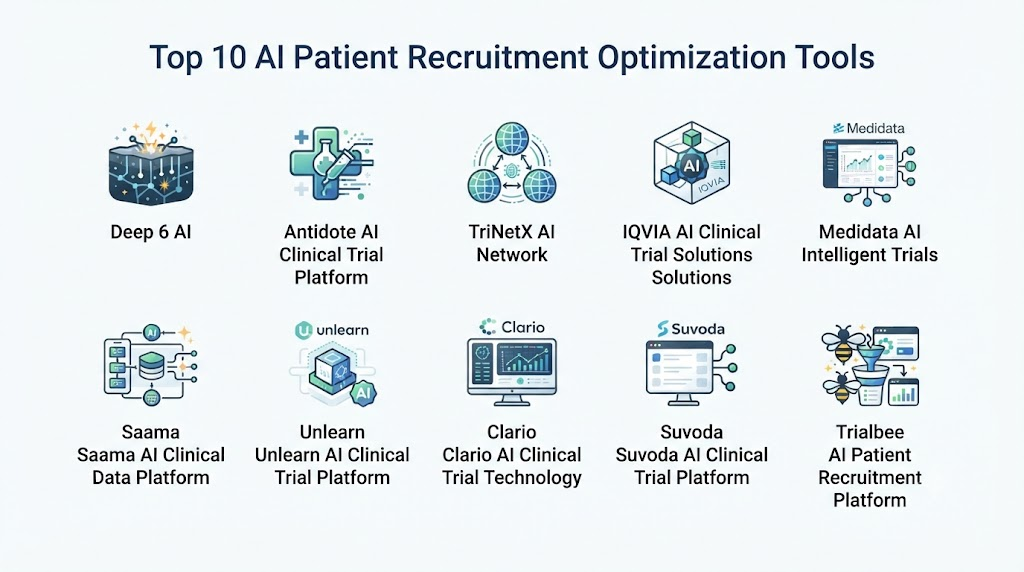
Top 10 AI Patient Recruitment Optimization Tools
1. Deep 6 AI
Verdict: Best overall AI-powered patient recruitment platform.
Short Description: Deep 6 AI uses artificial intelligence to analyze clinical data and identify eligible patients for clinical trials through advanced patient matching technology.
Key Features
- AI patient matching
- Clinical data analysis
- Trial eligibility screening
- Healthcare data integration
- Recruitment acceleration
Pros
- Advanced AI matching capabilities
- Reduces manual screening efforts
- Supports complex eligibility criteria
Cons
- Requires healthcare data access
Deployment: Healthcare and research environments
Security & Compliance: Healthcare data protection controls
Integrations & Ecosystem: EHR systems, clinical trial workflows, healthcare networks
Support & Community: Enterprise healthcare support
Pricing Model: Custom enterprise pricing
Best-Fit Scenarios: Clinical trial recruitment optimization
2. Antidote
Verdict: Patient engagement and clinical trial matching platform.
Short Description: Antidote helps connect patients with clinical trials using technology-driven matching and patient engagement workflows.
Key Features
- Trial matching
- Patient discovery
- Recruitment campaigns
- Digital engagement
- Clinical trial information
Pros
- Strong patient accessibility
- Improves trial awareness
Cons
- Depends on patient participation
3. IQVIA Clinical Trial Intelligence
Verdict: Enterprise clinical analytics platform supporting recruitment optimization.
Short Description: IQVIA uses healthcare data, analytics, and AI capabilities to help sponsors identify patient populations and improve clinical trial recruitment strategies.
Key Features
- Patient population analysis
- Recruitment forecasting
- Real-world data analytics
- Trial feasibility
- Clinical intelligence
Pros
- Large healthcare data ecosystem
- Global research capabilities
Cons
- Enterprise-focused solution
4. TriNetX
Verdict: Healthcare network analytics platform for patient identification.
Short Description: TriNetX enables researchers to analyze healthcare data networks and identify patient populations suitable for clinical studies.
Key Features
- Patient cohort discovery
- Healthcare data analysis
- Trial feasibility
- Population analytics
- Research collaboration
Pros
- Strong healthcare network access
- Data-driven recruitment insights
Cons
- Data availability varies by network
5. Tempus AI Platform
Verdict: AI healthcare platform supporting precision recruitment.
Short Description: Tempus uses clinical, molecular, and healthcare data to support patient identification, research insights, and precision medicine workflows.
Key Features
- Clinical data analysis
- Patient segmentation
- Molecular profiling
- Research analytics
- AI healthcare insights
Pros
- Combines clinical and molecular data
- Strong healthcare AI capabilities
Cons
- Primarily enterprise healthcare focused
6. Mendel AI
Verdict: AI healthcare data intelligence platform.
Short Description: Mendel uses AI and natural language processing to extract insights from complex healthcare data and support clinical research workflows.
Key Features
- Clinical data extraction
- Medical record analysis
- Patient identification support
- Healthcare intelligence
- AI search
Pros
- Strong NLP capabilities
- Handles complex medical information
Cons
- Requires healthcare data integration
7. ClinOne
Verdict: Digital patient engagement platform supporting clinical trial recruitment.
Short Description: ClinOne provides technology solutions for patient communication, enrollment support, and clinical trial engagement.
Key Features
- Patient communication
- Trial engagement
- Enrollment support
- Digital workflows
- Research collaboration
Pros
- Improves patient experience
- Supports decentralized trials
Cons
- More engagement-focused than pure AI matching
8. Trialbee
Verdict: AI-supported patient recruitment and enrollment platform.
Short Description: Trialbee helps clinical research teams improve recruitment through patient matching, enrollment analytics, and digital recruitment workflows.
Key Features
- Patient recruitment
- Enrollment optimization
- Trial matching
- Recruitment analytics
- Patient engagement
Pros
- Strong recruitment workflows
- Improves enrollment efficiency
Cons
- Requires integration with trial systems
9. SubjectWell
Verdict: Patient recruitment technology platform for clinical studies.
Short Description: SubjectWell uses technology-driven approaches to connect patients with clinical trials and improve recruitment outcomes.
Key Features
- Patient outreach
- Trial matching
- Recruitment campaigns
- Patient communication
- Enrollment support
Pros
- Focus on patient engagement
- Supports recruitment programs
Cons
- AI capabilities may vary by workflow
10. OpenAI-Based Custom AI Patient Recruitment Assistant
Verdict: Flexible AI assistant for customized clinical recruitment workflows.
Short Description: Organizations can build custom AI patient recruitment assistants using large language models integrated with clinical trial databases, EHR systems, patient engagement platforms, CTMS solutions, and healthcare datasets. These assistants can analyze eligibility criteria, summarize patient profiles, support trial matching, and improve recruitment workflows while requiring privacy controls and clinical oversight.
Key Features
- Trial eligibility analysis
- Patient profile summarization
- Recruitment workflow assistance
- Clinical data interpretation
- Communication support
Pros
- Highly customizable
- Flexible integrations
- Improves recruitment efficiency
Cons
- Requires healthcare expertise
- Privacy validation required
Comparison Table
| Platform | AI Recruitment | Patient Matching | Healthcare Data | Engagement | Best Use |
|---|---|---|---|---|---|
| Deep 6 AI | Excellent | Excellent | Excellent | High | Clinical Trial Matching |
| Antidote | High | High | Medium | Excellent | Patient Discovery |
| IQVIA Clinical Trial Intelligence | Excellent | Excellent | Excellent | High | Enterprise Trials |
| TriNetX | High | Excellent | Excellent | Medium | Patient Cohorts |
| Tempus AI | Excellent | High | Excellent | Medium | Precision Medicine |
| Mendel AI | Excellent | High | High | Medium | Medical Data Intelligence |
| ClinOne | High | Medium | Medium | Excellent | Patient Engagement |
| Trialbee | High | High | Medium | Excellent | Enrollment Optimization |
| SubjectWell | High | Medium | Medium | Excellent | Recruitment Campaigns |
| OpenAI Custom | Custom | Custom | Custom | Custom | AI Recruitment Assistant |
Evaluation & Scoring Table
| Platform | AI Features 20% | Matching Accuracy 20% | Data Integration 15% | Engagement 15% | Security 10% | Ease 10% | Value 10% | Total |
|---|---|---|---|---|---|---|---|---|
| Deep 6 AI | 20 | 20 | 15 | 14 | 10 | 8 | 8 | 95 |
| IQVIA Clinical Trial Intelligence | 20 | 20 | 15 | 14 | 10 | 8 | 8 | 95 |
| TriNetX | 18 | 19 | 15 | 13 | 10 | 9 | 8 | 92 |
| Tempus AI | 19 | 18 | 15 | 13 | 10 | 8 | 8 | 91 |
| Mendel AI | 19 | 18 | 14 | 13 | 10 | 8 | 8 | 90 |
| Antidote | 17 | 18 | 13 | 15 | 10 | 9 | 8 | 90 |
| Trialbee | 17 | 17 | 13 | 15 | 10 | 8 | 8 | 88 |
| ClinOne | 17 | 16 | 13 | 15 | 10 | 9 | 8 | 88 |
| SubjectWell | 16 | 16 | 12 | 15 | 10 | 9 | 8 | 86 |
| OpenAI Custom | 20 | 16 | 12 | 15 | 8 | 7 | 9 | 87 |
Which AI Patient Recruitment Optimization Tool Is Right for You?
| If your priority is… | Recommended Platform |
|---|---|
| AI patient matching | Deep 6 AI |
| Global clinical recruitment | IQVIA Clinical Trial Intelligence |
| Healthcare network analysis | TriNetX |
| Precision medicine recruitment | Tempus AI |
| Medical data intelligence | Mendel AI |
| Patient trial discovery | Antidote |
| Patient engagement | ClinOne |
| Enrollment optimization | Trialbee |
| Recruitment campaigns | SubjectWell |
| Custom AI recruitment assistant | OpenAI-Based AI Assistant |
Implementation Playbook
First 30 Days
- Define recruitment challenges
- Identify patient data sources
- Review trial eligibility criteria
- Select AI workflow requirements
Days 31–60
- Integrate healthcare datasets
- Configure AI matching models
- Test recruitment workflows
- Train clinical teams
Days 61–90
- Optimize patient identification
- Monitor enrollment performance
- Improve recruitment strategies
- Expand AI-driven workflows
Common Mistakes
- Ignoring patient privacy requirements
- Using incomplete healthcare data
- Overestimating AI matching accuracy
- Lack of patient engagement strategy
- Poor trial criteria configuration
- Weak data governance
- Ignoring regulatory requirements
- Not involving clinical experts
Frequently Asked Questions
1. What are AI Patient Recruitment Optimization Tools?
They are AI-powered platforms that help identify, match, and engage suitable participants for clinical trials.
2. How does AI improve patient recruitment?
AI analyzes healthcare data, trial criteria, and patient information to identify suitable candidates faster.
3. Can AI automatically enroll patients?
No. AI supports recruitment teams, but patient consent and clinical review are required.
4. Who uses AI patient recruitment platforms?
Pharmaceutical companies, CROs, hospitals, and clinical research organizations.
5. What data do these tools analyze?
They analyze healthcare records, trial criteria, demographics, and clinical information.
6. Can AI reduce clinical trial delays?
Yes. Better patient identification can improve enrollment efficiency.
7. Are AI patient matches accurate?
Accuracy depends on data quality, algorithms, and clinical validation.
8. How do these tools protect patient data?
Organizations should use privacy controls, secure systems, and regulatory-compliant workflows.
9. Can AI support decentralized clinical trials?
Yes. AI can help identify and engage patients digitally.
10. What should buyers evaluate before adoption?
Consider AI capabilities, data access, privacy, integrations, scalability, and clinical workflow needs.
Conclusion
AI Patient Recruitment Optimization Tools are transforming clinical research by helping organizations identify suitable participants faster, improve enrollment strategies, and reduce trial delays. By combining artificial intelligence, healthcare data analytics, predictive modeling, and patient engagement technologies, these platforms enable more efficient clinical trial operations.Organizations adopting AI recruitment solutions should focus on data quality, patient privacy, workflow integration, and ethical AI practices. Platforms such as Deep 6 AI, IQVIA Clinical Trial Intelligence, TriNetX, Tempus AI, and Trialbee demonstrate how artificial intelligence is improving patient recruitment and supporting faster clinical research outcomes.
