Introduction
AI Proteomics Pattern Mining Tools use artificial intelligence (AI), machine learning (ML), deep learning, and computational biology techniques to analyze large-scale proteomics datasets and discover meaningful biological patterns. These platforms help researchers identify protein expression changes, biomarker signatures, molecular relationships, disease mechanisms, and therapeutic opportunities.
Proteomics generates massive amounts of complex biological data through technologies such as mass spectrometry, protein arrays, and protein interaction studies. Analyzing these datasets manually is challenging because proteins interact through complex networks and their behavior can vary across diseases, tissues, and biological conditions.
AI-powered proteomics platforms apply advanced analytics, pattern recognition, neural networks, and predictive modeling to identify hidden relationships within protein data. They support researchers in biomarker discovery, precision medicine, drug development, clinical research, and biological pathway analysis.
Modern AI Proteomics Pattern Mining solutions integrate with mass spectrometry platforms, biological databases, multi-omics systems, laboratory workflows, and research analytics environments. These tools help pharmaceutical companies, biotechnology organizations, academic institutions, and healthcare researchers extract deeper insights from protein-level data.
AI proteomics platforms assist scientists by improving data interpretation while requiring biological expertise, experimental validation, and scientific review.
Real-world Use Cases
- Biomarker discovery
- Protein expression analysis
- Disease pathway identification
- Drug target discovery
- Clinical proteomics research
- Cancer proteomics
- Precision medicine
- Protein interaction analysis
- Multi-omics integration
- Biological pattern discovery
Evaluation Criteria for Buyers
When selecting an AI Proteomics Pattern Mining Tool, consider:
- AI analytics capabilities
- Protein data processing
- Mass spectrometry integration
- Biomarker discovery features
- Multi-omics support
- Machine learning capabilities
- Research workflow integration
- Scalability
- Data security
- Visualization capabilities
Best For
- Pharmaceutical companies
- Biotechnology organizations
- Proteomics researchers
- Academic laboratories
- Precision medicine teams
Not Ideal For
Organizations without proteomics datasets or expecting AI systems to replace laboratory experiments and biological interpretation.
Key Trends
- AI-driven proteomics analysis
- Multi-omics integration
- Precision medicine research
- Machine learning biomarker discovery
- Protein foundation models
- Clinical proteomics automation
- AI-powered mass spectrometry analysis
- Digital biology platforms
- Computational pathology integration
- Personalized healthcare research
Methodology
The platforms below were evaluated based on:
- AI proteomics capabilities
- Pattern recognition features
- Biological data support
- Research workflow integration
- Scalability
- Scientific adoption
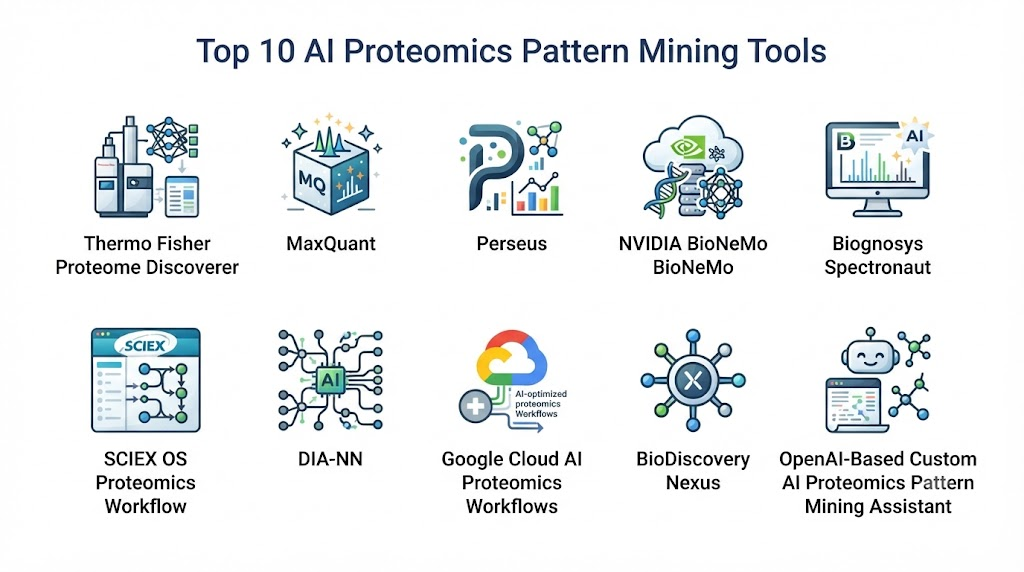
Top 10 AI Proteomics Pattern Mining Tools
1. Thermo Fisher Proteome Discoverer
Verdict: Best overall proteomics analysis platform for advanced research workflows.
Short Description: Thermo Fisher Proteome Discoverer provides proteomics data analysis capabilities for processing mass spectrometry data, identifying proteins, and supporting biological interpretation.
Key Features
- Mass spectrometry analysis
- Protein identification
- Quantitative proteomics
- Biological interpretation
- Research workflows
Pros
- Strong proteomics ecosystem
- Supports complex workflows
- Widely used in research
Cons
- Requires proteomics expertise
Deployment: Research and enterprise environments
Security & Compliance: Depends on deployment environment
Integrations & Ecosystem: Mass spectrometry platforms, biological databases, research workflows
Support & Community: Scientific support ecosystem
Pricing Model: Enterprise research pricing
Best-Fit Scenarios: Proteomics laboratories and research organizations
2. MaxQuant
Verdict: Widely adopted computational proteomics analysis platform.
Short Description: MaxQuant provides advanced computational methods for analyzing large-scale mass spectrometry proteomics datasets.
Key Features
- Protein identification
- Quantitative analysis
- Mass spectrometry processing
- Label-free quantification
- Proteomics workflows
Pros
- Strong scientific adoption
- Handles large datasets
Cons
- Requires bioinformatics knowledge
3. Perseus
Verdict: Statistical analysis platform for proteomics data interpretation.
Short Description: Perseus helps researchers analyze quantitative proteomics datasets and discover biological patterns using statistical and computational methods.
Key Features
- Proteomics statistics
- Pattern analysis
- Data visualization
- Cluster analysis
- Biological interpretation
Pros
- Research-friendly interface
- Strong academic adoption
Cons
- Limited automation compared with newer AI platforms
4. NVIDIA BioNeMo
Verdict: AI infrastructure platform for biological data analysis and protein intelligence.
Short Description: NVIDIA BioNeMo provides AI models and computational infrastructure that support protein analysis, biological modeling, and advanced life science research.
Key Features
- Protein AI models
- Biological data analysis
- Machine learning workflows
- Generative biology support
- GPU acceleration
Pros
- Powerful AI capabilities
- Supports large-scale research
Cons
- Requires AI expertise
5. Biognosys Spectronaut
Verdict: Advanced proteomics data analysis platform.
Short Description: Spectronaut provides AI-supported analysis capabilities for mass spectrometry-based proteomics workflows and biomarker research.
Key Features
- Proteomics analysis
- Data-independent acquisition workflows
- Protein quantification
- Biomarker discovery
- Data visualization
Pros
- Strong proteomics performance
- Supports advanced workflows
Cons
- Enterprise research focus
6. SCIEX OS Proteomics Workflow
Verdict: Integrated proteomics analysis environment.
Short Description: SCIEX provides analytical software solutions supporting mass spectrometry data processing and proteomics research workflows.
Key Features
- Mass spectrometry analysis
- Protein identification
- Data processing
- Quantitative analysis
- Research workflows
Pros
- Strong analytical capabilities
- Instrument integration
Cons
- Best suited for SCIEX ecosystems
7. DIA-NN
Verdict: AI-powered computational tool for large-scale proteomics analysis.
Short Description: DIA-NN uses advanced computational methods and machine learning approaches to analyze data-independent acquisition proteomics datasets.
Key Features
- Machine learning analysis
- Protein identification
- Quantitative proteomics
- Large dataset processing
- Data-independent acquisition
Pros
- Fast processing
- Strong AI-driven analysis
Cons
- Requires computational expertise
8. Google Cloud AI Proteomics Workflows
Verdict: Cloud infrastructure for building custom proteomics analytics solutions.
Short Description: Google Cloud AI services provide machine learning infrastructure and data processing capabilities for developing scalable proteomics analysis workflows.
Key Features
- AI model development
- Data analytics
- Cloud computing
- Research automation
- Large-scale processing
Pros
- Highly scalable
- Flexible AI development
Cons
- Requires cloud expertise
9. BioDiscovery Nexus
Verdict: Biological data analysis platform supporting genomic and proteomic research.
Short Description: BioDiscovery Nexus provides data analysis and visualization tools that help researchers interpret complex biological datasets.
Key Features
- Biological data analysis
- Pattern discovery
- Visualization
- Research reporting
- Multi-omics support
Pros
- Strong visualization capabilities
- Supports complex datasets
Cons
- Requires scientific interpretation
10. OpenAI-Based Custom AI Proteomics Pattern Mining Assistant
Verdict: Flexible AI assistant for customized proteomics analysis workflows.
Short Description: Research organizations can build custom AI proteomics assistants using large language models integrated with mass spectrometry data, protein databases, bioinformatics pipelines, and research platforms. These assistants can summarize protein datasets, identify research patterns, explain biological findings, and support scientific workflows while requiring expert validation.
Key Features
- Proteomics data interpretation
- Research summaries
- Literature analysis
- Pattern discovery support
- Scientific workflow assistance
Pros
- Highly customizable
- Flexible integrations
- Improves researcher productivity
Cons
- Requires proteomics expertise
- Validation required
Comparison Table
| Platform | AI Analysis | Proteomics Processing | Pattern Mining | Integration | Best Use |
|---|---|---|---|---|---|
| Thermo Fisher Proteome Discoverer | High | Excellent | High | Excellent | Proteomics Research |
| MaxQuant | High | Excellent | High | High | Mass Spectrometry Analysis |
| Perseus | Medium | High | Excellent | Medium | Statistical Proteomics |
| NVIDIA BioNeMo | Excellent | High | Excellent | High | AI Biology Research |
| Spectronaut | High | Excellent | High | Excellent | Quantitative Proteomics |
| SCIEX OS | Medium | High | Medium | Excellent | Instrument Workflows |
| DIA-NN | Excellent | Excellent | High | High | DIA Proteomics |
| Google Cloud AI | Excellent | Medium | Excellent | High | Custom AI Workflows |
| BioDiscovery Nexus | High | Medium | High | High | Biological Analytics |
| OpenAI Custom | Custom | Custom | Custom | Custom | AI Proteomics Assistant |
Evaluation & Scoring Table
| Platform | AI Capability 20% | Proteomics Analysis 20% | Pattern Discovery 15% | Integration 15% | Security 10% | Ease 10% | Value 10% | Total |
|---|---|---|---|---|---|---|---|---|
| NVIDIA BioNeMo | 20 | 19 | 15 | 15 | 10 | 8 | 8 | 95 |
| Thermo Fisher Proteome Discoverer | 18 | 20 | 14 | 15 | 10 | 8 | 8 | 93 |
| Spectronaut | 18 | 20 | 14 | 15 | 10 | 8 | 8 | 93 |
| DIA-NN | 19 | 19 | 14 | 14 | 10 | 8 | 8 | 92 |
| MaxQuant | 17 | 20 | 14 | 14 | 10 | 8 | 9 | 92 |
| Perseus | 16 | 18 | 15 | 12 | 10 | 9 | 9 | 89 |
| Google Cloud AI | 20 | 16 | 15 | 14 | 10 | 7 | 8 | 90 |
| BioDiscovery Nexus | 17 | 17 | 13 | 14 | 10 | 8 | 8 | 87 |
| SCIEX OS | 16 | 18 | 12 | 15 | 10 | 8 | 8 | 87 |
| OpenAI Custom | 20 | 16 | 12 | 15 | 8 | 7 | 9 | 87 |
Which AI Proteomics Pattern Mining Tool Is Right for You?
| If your priority is… | Recommended Platform |
|---|---|
| Advanced AI biology analysis | NVIDIA BioNeMo |
| Mass spectrometry workflows | Thermo Fisher Proteome Discoverer |
| Large-scale proteomics | MaxQuant |
| Statistical pattern discovery | Perseus |
| Quantitative proteomics | Spectronaut |
| DIA proteomics analysis | DIA-NN |
| Instrument-based workflows | SCIEX OS |
| Cloud AI development | Google Cloud AI |
| Biological visualization | BioDiscovery Nexus |
| Custom AI proteomics assistant | OpenAI-Based AI Assistant |
Implementation Playbook
First 30 Days
- Define proteomics research goals
- Identify protein datasets
- Review analysis workflows
- Select computational requirements
Days 31–60
- Process proteomics datasets
- Configure AI analysis workflows
- Train research teams
- Validate biological patterns
Days 61–90
- Integrate multi-omics analysis
- Automate reporting workflows
- Improve biomarker discovery
- Expand research applications
Common Mistakes
- Using poor-quality proteomics data
- Ignoring biological validation
- Overinterpreting AI patterns
- Lack of computational expertise
- Poor integration planning
- Ignoring data security
- Weak experimental design
- Not validating biomarkers
Frequently Asked Questions
1. What are AI Proteomics Pattern Mining Tools?
They are AI-powered platforms that analyze protein datasets to discover biological patterns, biomarkers, and molecular relationships.
2. How does AI help proteomics analysis?
AI identifies hidden patterns, predicts relationships, and analyzes complex protein datasets faster than traditional approaches.
3. What data do these tools analyze?
They analyze mass spectrometry data, protein expression data, protein interactions, and biological datasets.
4. Who uses AI proteomics platforms?
Pharmaceutical companies, biotechnology organizations, research laboratories, and academic institutions.
5. Can AI discover biomarkers?
Yes. AI can help identify potential biomarkers that require further experimental validation.
6. Does AI replace proteomics scientists?
No. AI supports researchers but requires biological expertise.
7. Are AI proteomics predictions accurate?
Accuracy depends on data quality, model performance, and validation processes.
8. Can proteomics AI support drug discovery?
Yes. It helps identify targets, biomarkers, and disease-related protein patterns.
9. What security concerns exist?
Organizations should protect biological datasets, research information, and intellectual property.
10. What should organizations evaluate before adoption?
Consider AI capabilities, data compatibility, workflow integration, scalability, security, and research goals.
Conclusion
AI Proteomics Pattern Mining Tools are transforming biological research by enabling deeper analysis of complex protein datasets and accelerating discoveries in medicine, biotechnology, and life sciences. By combining artificial intelligence, computational biology, and advanced analytics, these platforms help researchers identify biomarkers, understand disease mechanisms, and discover new therapeutic opportunities.Organizations adopting AI proteomics solutions should focus on analytical accuracy, data quality, workflow integration, and scientific validation. Platforms such as NVIDIA BioNeMo, Thermo Fisher Proteome Discoverer, Spectronaut, MaxQuant, and DIA-NN demonstrate how artificial intelligence is improving proteomics research and supporting the next generation of precision medicine.
