Introduction
AI Radiology Workflow Orchestration tools use artificial intelligence (AI), machine learning (ML), automation, and intelligent workflow management to optimize medical imaging operations across hospitals, diagnostic centers, and healthcare networks. These platforms coordinate the complete radiology workflow lifecycle, including image acquisition, study prioritization, interpretation, reporting, communication, quality management, and operational analytics.
Radiology departments handle large volumes of imaging studies every day across modalities such as X-ray, CT, MRI, ultrasound, mammography, and nuclear medicine. Traditional workflows often involve manual prioritization, fragmented communication, reporting delays, and inefficient resource allocation. AI-powered workflow orchestration platforms address these challenges by automatically prioritizing urgent cases, routing studies to appropriate specialists, optimizing radiologist workload, identifying workflow bottlenecks, and improving turnaround times.
Modern AI radiology workflow solutions integrate with Picture Archiving and Communication Systems (PACS), Radiology Information Systems (RIS), Electronic Health Records (EHR), Vendor Neutral Archives (VNA), AI imaging algorithms, and hospital communication platforms. They combine operational intelligence with clinical AI to improve diagnostic efficiency while allowing healthcare professionals to maintain control over final decisions.
Healthcare organizations increasingly adopt AI Radiology Workflow Orchestration platforms to improve patient care, reduce reporting delays, enhance collaboration between clinical teams, increase imaging department efficiency, and support scalable radiology operations.
Real-world Use Cases
- Automated imaging study prioritization
- Emergency case detection and routing
- Radiologist workload balancing
- AI algorithm orchestration
- Report workflow optimization
- Critical findings communication
- Turnaround time improvement
- Imaging quality monitoring
- Multi-site radiology coordination
- Clinical workflow analytics
Evaluation Criteria for Buyers
When selecting an AI Radiology Workflow Orchestration platform, consider:
- AI workflow automation capabilities
- PACS and RIS integration
- Imaging modality support
- Case prioritization accuracy
- Radiologist workload management
- Clinical communication features
- Reporting workflow optimization
- Security and compliance
- Scalability across healthcare networks
- Ease of deployment
Best For
- Hospitals
- Large radiology departments
- Diagnostic imaging centers
- Teleradiology providers
- Healthcare networks
- Academic medical centers
Not Ideal For
Small practices with low imaging volumes or organizations without digital radiology infrastructure.
Key Trends
- AI-assisted radiology operations
- Intelligent case prioritization
- Automated workflow routing
- Cloud-based radiology platforms
- Enterprise imaging orchestration
- AI marketplace integration
- Radiologist productivity optimization
- Multi-hospital imaging management
- Predictive workflow analytics
- Real-time clinical collaboration
Methodology
The platforms below were evaluated based on:
- AI workflow intelligence
- Imaging integration capabilities
- Automation maturity
- Clinical workflow optimization
- Scalability
- Interoperability
- Enterprise readiness
- Overall operational impact
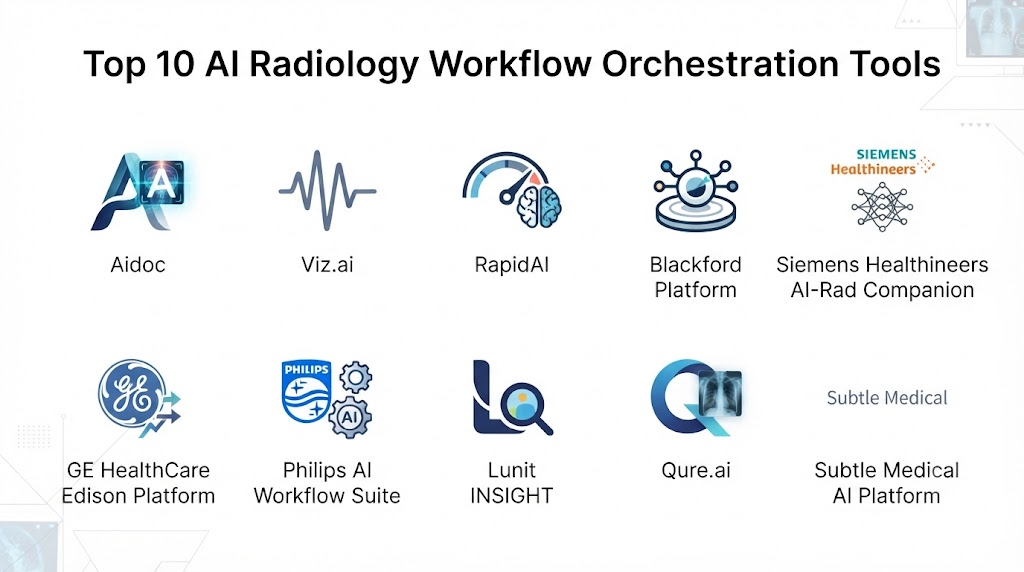
Top 10 AI Radiology Workflow Orchestration Tools
1. Aidoc AI Care Platform
Verdict: Best overall AI radiology workflow orchestration platform for enterprise imaging operations.
Short Description: Aidoc provides an AI-powered clinical workflow platform that analyzes medical images, prioritizes urgent findings, coordinates care teams, and integrates AI algorithms into existing radiology workflows. It helps radiologists focus on critical cases while improving communication and operational efficiency.
Key Features
- AI-powered case prioritization
- Critical finding alerts
- Workflow automation
- Multi-modality support
- AI algorithm management
- Clinical communication
- PACS integration
- Enterprise imaging analytics
Pros
- Strong clinical workflow automation
- Broad AI ecosystem
- Excellent hospital integration
- Improves turnaround time
Cons
- Enterprise-focused pricing
- Implementation requires workflow planning
Deployment: Cloud & Enterprise
Security & Compliance: Healthcare-grade security controls
Integrations & Ecosystem: PACS, RIS, EHR, VNA, imaging AI applications
Support & Community: Enterprise healthcare support
Pricing Model: Custom enterprise pricing
Best-Fit Scenarios: Large hospitals and radiology networks
2. Blackford Platform
Verdict: Leading AI orchestration platform for integrating multiple medical imaging AI applications.
Short Description: Blackford provides an AI orchestration layer that connects medical imaging AI applications with clinical workflows. It enables healthcare organizations to manage, deploy, and operate multiple AI algorithms through a unified platform.
Key Features
- AI application marketplace
- Workflow integration
- Algorithm management
- PACS connectivity
- Enterprise deployment
- Imaging analytics
Pros
- Excellent AI ecosystem management
- Vendor-neutral approach
- Strong interoperability
Cons
- Requires multiple AI solutions for maximum value
3. AidPACS / Enterprise Imaging Platforms
Verdict: Workflow-focused imaging management approach for enterprise radiology environments.
Short Description: Enterprise imaging workflow platforms combine AI automation, image routing, reporting workflows, and operational analytics to improve radiology efficiency across healthcare organizations.
Key Features
- Imaging workflow automation
- Study routing
- Worklist optimization
- Reporting support
- Enterprise imaging management
Pros
- Strong workflow capabilities
- Enterprise scalability
Cons
- Capabilities vary by implementation
4. Sectra Enterprise Imaging
Verdict: Comprehensive enterprise imaging workflow platform with intelligent radiology operations.
Short Description: Sectra Enterprise Imaging provides integrated radiology workflows, image management, reporting support, and collaboration tools designed to improve efficiency across healthcare organizations.
Key Features
- Enterprise imaging
- Radiology workflow management
- Worklist optimization
- Clinical collaboration
- Multi-site support
Pros
- Strong healthcare expertise
- Excellent interoperability
Cons
- Large enterprise deployment
5. GE HealthCare Edison Platform
Verdict: AI-enabled healthcare platform supporting imaging workflow optimization.
Short Description: GE HealthCare Edison integrates AI capabilities into healthcare workflows, supporting imaging operations, clinical decision support, and enterprise healthcare efficiency.
Key Features
- AI workflow support
- Imaging analytics
- Clinical integration
- Healthcare data management
- Operational optimization
Pros
- Strong healthcare ecosystem
- Enterprise capabilities
Cons
- Best within GE environments
6. Siemens Healthineers AI-Rad Companion
Verdict: AI-assisted imaging workflow platform for radiology productivity.
Short Description: AI-Rad Companion supports radiologists by automating measurements, assisting image analysis, and improving reporting workflows across multiple imaging specialties.
Key Features
- Automated measurements
- Image analysis
- Reporting assistance
- Workflow automation
- Multi-specialty support
Pros
- Strong imaging expertise
- High-quality clinical workflows
Cons
- Primarily Siemens ecosystem
7. Philips IntelliSpace AI Workflow
Verdict: Enterprise imaging workflow platform with AI integration capabilities.
Short Description: Philips IntelliSpace supports radiology workflow optimization by combining imaging management, AI integration, analytics, and clinical collaboration tools.
Key Features
- AI workflow integration
- Enterprise imaging
- Clinical collaboration
- Imaging analytics
- Workflow automation
Pros
- Strong healthcare infrastructure
- Broad imaging support
Cons
- Complex enterprise deployment
8. Nuance PowerScribe One
Verdict: AI-enhanced radiology reporting workflow platform.
Short Description: Nuance PowerScribe One improves radiology reporting efficiency using AI-assisted speech recognition, structured reporting, and workflow automation.
Key Features
- AI reporting assistance
- Speech recognition
- Structured reports
- Clinical documentation
- Workflow optimization
Pros
- Excellent reporting workflow
- Strong radiology adoption
Cons
- Focused mainly on reporting workflows
9. RapidAI
Verdict: AI-powered workflow orchestration platform for emergency imaging.
Short Description: RapidAI uses AI to analyze imaging studies, prioritize urgent cases, and coordinate clinical teams for time-sensitive conditions such as stroke and vascular emergencies.
Key Features
- Emergency imaging workflows
- AI case prioritization
- Clinical notifications
- Care coordination
- Imaging analytics
Pros
- Strong emergency workflow support
- Fast communication
Cons
- Specialty-focused platform
10. OpenAI-Based Custom Radiology Workflow Assistant
Verdict: Flexible AI workflow orchestration solution for customized healthcare operations.
Short Description: Healthcare organizations can build custom AI workflow assistants using large language models integrated with PACS, RIS, EHR, reporting systems, scheduling platforms, and validated medical AI applications to automate coordination, documentation, communication, and operational workflows.
Key Features
- Workflow automation
- Report assistance
- Case summarization
- Task coordination
- Custom integrations
Pros
- Highly customizable
- Organization-specific workflows
- Flexible automation
Cons
- Requires healthcare AI expertise
- Clinical governance required
Comparison Table
| Platform | AI Workflow | PACS/RIS Integration | Automation | Enterprise Scale | Best Use |
|---|---|---|---|---|---|
| Aidoc | Excellent | Excellent | Excellent | Excellent | Enterprise Radiology |
| Blackford | Excellent | Excellent | High | Excellent | AI Orchestration |
| Sectra | High | Excellent | High | Excellent | Enterprise Imaging |
| GE Edison | High | High | High | Excellent | Healthcare Networks |
| Siemens AI-Rad Companion | High | High | High | High | Imaging Workflows |
| Philips IntelliSpace | High | High | High | High | Enterprise Imaging |
| Nuance PowerScribe | High | High | High | High | Radiology Reporting |
| RapidAI | Excellent | High | Excellent | High | Emergency Imaging |
| Enterprise Imaging Platforms | High | High | High | High | Multi-site Healthcare |
| OpenAI Custom | Custom | Custom | Custom | Custom | Custom Workflow Automation |
Evaluation & Scoring Table
| Platform | AI Features 20% | Workflow 20% | Integration 15% | Automation 15% | Security 10% | Ease 10% | Value 10% | Total |
|---|---|---|---|---|---|---|---|---|
| Aidoc | 20 | 20 | 15 | 15 | 10 | 8 | 8 | 96 |
| Blackford | 19 | 20 | 15 | 14 | 10 | 8 | 8 | 94 |
| Sectra | 18 | 19 | 15 | 14 | 10 | 8 | 8 | 92 |
| RapidAI | 19 | 19 | 14 | 14 | 10 | 8 | 8 | 92 |
| Siemens AI-Rad Companion | 18 | 18 | 14 | 14 | 10 | 8 | 8 | 90 |
| Philips IntelliSpace | 18 | 18 | 14 | 13 | 10 | 8 | 8 | 89 |
| GE Edison | 18 | 18 | 13 | 13 | 10 | 8 | 8 | 88 |
| Nuance PowerScribe | 17 | 18 | 14 | 13 | 10 | 9 | 8 | 89 |
| Enterprise Imaging Platforms | 17 | 17 | 13 | 13 | 10 | 8 | 8 | 86 |
| OpenAI Custom | 20 | 18 | 12 | 15 | 8 | 7 | 9 | 89 |
Which AI Radiology Workflow Orchestration Tool Is Right for You?
| If your priority is… | Recommended Platform |
|---|---|
| Enterprise radiology workflow | Aidoc |
| AI algorithm orchestration | Blackford |
| Enterprise imaging | Sectra |
| Emergency imaging | RapidAI |
| Radiology reporting | Nuance PowerScribe One |
| Siemens imaging ecosystem | AI-Rad Companion |
| Philips healthcare ecosystem | IntelliSpace |
| GE healthcare environment | Edison Platform |
| Custom workflow automation | OpenAI-Based Radiology Assistant |
Implementation Playbook
First 30 Days
- Assess current radiology workflows
- Integrate PACS and RIS systems
- Identify AI use cases
- Define workflow improvement goals
Days 31–60
- Deploy AI workflow automation
- Configure case prioritization
- Train radiology teams
- Monitor turnaround improvements
Days 61–90
- Expand AI integrations
- Optimize operational workflows
- Measure reporting efficiency
- Continuously improve AI-assisted processes
Common Mistakes
- Deploying AI without workflow planning
- Ignoring PACS/RIS integration
- Expecting AI to replace radiologists
- Poor staff training
- Lack of clinical validation
- Ignoring regulatory requirements
- Limited monitoring of workflow performance
- Choosing tools without scalability planning
Frequently Asked Questions
1. What are AI Radiology Workflow Orchestration tools?
They use AI and automation to manage, prioritize, coordinate, and optimize radiology workflows from image acquisition to reporting.
2. Can AI workflow tools replace radiologists?
No. They support radiologists by improving efficiency, prioritizing cases, and reducing administrative workload.
3. Do these tools integrate with PACS and RIS?
Yes. Enterprise platforms are designed to integrate with existing imaging infrastructure.
4. How do these platforms improve radiology efficiency?
They automate routing, prioritize urgent studies, improve communication, and reduce reporting delays.
5. Can they manage multiple AI imaging algorithms?
Yes. Some platforms act as orchestration layers for multiple AI diagnostic applications.
6. Are these tools suitable for large hospital networks?
Yes. Many solutions support multi-site and enterprise imaging environments.
7. What imaging modalities are supported?
Support varies but may include CT, MRI, X-ray, ultrasound, mammography, and other modalities.
8. How important is workflow integration?
Integration is critical because AI value depends on fitting smoothly into existing clinical processes.
9. Are these platforms regulated?
Medical AI workflows may involve regulated software components, so healthcare organizations should verify applicable compliance requirements.
10. What should hospitals evaluate before choosing a platform?
Consider AI capabilities, interoperability, clinical validation, security, scalability, workflow impact, and total cost.
Conclusion
AI Radiology Workflow Orchestration platforms are transforming medical imaging operations by connecting AI technologies, clinical workflows, and healthcare systems into a more efficient diagnostic environment. These solutions help radiology teams prioritize critical cases, automate repetitive processes, improve communication, and optimize resource utilization while allowing clinicians to maintain control over final diagnostic decisions.Organizations should select a platform based on imaging volume, existing PACS/RIS infrastructure, AI requirements, clinical workflows, and scalability goals. Solutions such as Aidoc, Blackford, Sectra Enterprise Imaging, RapidAI, and major healthcare imaging platforms provide powerful capabilities for improving radiology operations, reducing turnaround times, and supporting better patient outcomes.
