Introduction
AI Readmission Risk Prediction tools use artificial intelligence (AI), machine learning (ML), predictive analytics, and healthcare data intelligence to identify patients who may have a higher risk of being readmitted to hospitals after discharge. These platforms analyze clinical history, electronic health records (EHR), medications, laboratory results, demographics, previous admissions, social factors, and patient behavior patterns to generate predictive risk insights.
Hospital readmissions create significant challenges for healthcare organizations because they increase operational costs, place additional pressure on clinical teams, and may indicate gaps in care coordination, discharge planning, or post-discharge support. Traditional readmission prediction methods often depend on manual assessments and historical indicators, which may not capture complex patient risk patterns.
AI-powered readmission prediction platforms help healthcare providers identify high-risk patients earlier and enable targeted interventions such as personalized discharge plans, medication management, follow-up scheduling, remote monitoring, and care coordination. These systems support clinicians, case managers, and population health teams by providing actionable insights that improve continuity of care.
Modern AI Readmission Risk Prediction solutions integrate with EHR platforms, hospital information systems, population health management tools, care management platforms, and analytics environments. They are commonly used in hospitals, health systems, accountable care organizations, and insurance programs to reduce avoidable readmissions and improve patient outcomes.
Real-world Use Cases
- 30-day readmission prediction
- High-risk patient identification
- Discharge planning optimization
- Chronic disease management
- Care coordination
- Post-discharge monitoring
- Medication adherence support
- Population health management
- Emergency readmission prevention
- Value-based care programs
Evaluation Criteria for Buyers
When selecting an AI Readmission Risk Prediction platform, consider:
- Predictive accuracy
- Clinical validation
- EHR integration
- Risk scoring capabilities
- Explainability of predictions
- Care workflow integration
- Patient population analytics
- Security and privacy controls
- Scalability
- Reporting capabilities
Best For
- Hospitals
- Health systems
- Population health teams
- Care management organizations
- Insurance providers
- Value-based care organizations
Not Ideal For
Organizations without sufficient patient data infrastructure or those expecting AI predictions to replace clinical decision-making.
Key Trends
- Predictive healthcare analytics
- AI-powered population health management
- Personalized care pathways
- Value-based healthcare optimization
- Remote patient monitoring
- Explainable healthcare AI
- AI-driven discharge planning
- Real-time patient risk scoring
- Healthcare data platforms
- Preventive care intelligence
Methodology
The platforms below were evaluated based on:
- AI prediction capabilities
- Healthcare data integration
- Clinical workflow support
- Risk scoring accuracy
- Automation capabilities
- Enterprise scalability
- Healthcare operational value
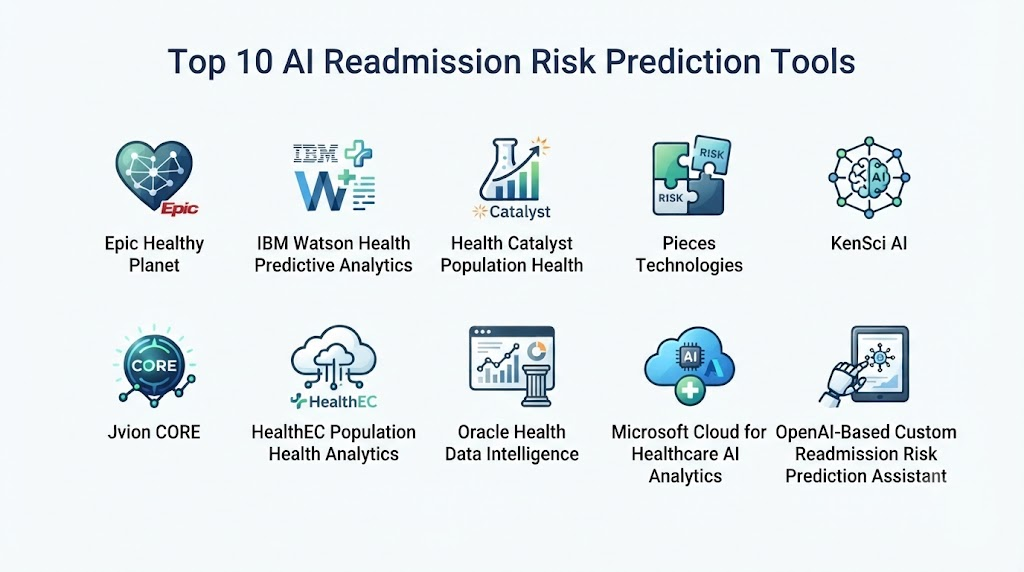
Top 10 AI Readmission Risk Prediction Tools
1. Epic Healthy Planet
Verdict: Best overall AI-powered platform for healthcare organizations using integrated EHR analytics.
Short Description: Epic Healthy Planet provides population health management capabilities that help healthcare organizations identify high-risk patients, manage care gaps, and support interventions designed to reduce avoidable hospital readmissions.
Key Features
- Patient risk stratification
- Population health analytics
- Care management workflows
- EHR-based insights
- Care gap identification
- Health outcome tracking
Pros
- Deep EHR integration
- Strong healthcare adoption
- Enterprise scalability
Cons
- Best suited for Epic environments
- Requires implementation resources
Deployment: Enterprise Healthcare Platform
Security & Compliance: Healthcare-grade security controls
Integrations & Ecosystem: EHR, healthcare workflows, analytics platforms
Support & Community: Enterprise healthcare support
Pricing Model: Custom enterprise pricing
Best-Fit Scenarios: Large healthcare systems
2. IBM Watson Health Predictive Analytics
Verdict: Enterprise AI analytics platform for patient risk prediction.
Short Description: IBM healthcare analytics solutions use AI and predictive modeling to analyze clinical data, identify patient risks, and support healthcare organizations with proactive care management strategies.
Key Features
- Predictive analytics
- Patient risk scoring
- Clinical data analysis
- Population health insights
- Decision support
Pros
- Strong AI capabilities
- Enterprise healthcare experience
Cons
- Complex deployment
3. Health Catalyst Population Health
Verdict: Data-driven healthcare analytics platform for risk identification and care improvement.
Short Description: Health Catalyst uses healthcare data analytics and predictive insights to help organizations identify high-risk patients, improve care coordination, and optimize population health programs.
Key Features
- Patient risk analytics
- Healthcare data platform
- Population health management
- Care improvement workflows
- Clinical analytics
Pros
- Strong healthcare data capabilities
- Enterprise-focused
Cons
- Requires analytics maturity
4. Pieces Technologies
Verdict: AI-powered clinical intelligence platform supporting patient risk assessment.
Short Description: Pieces uses AI to analyze clinical information, summarize patient data, and support healthcare teams with intelligent insights during patient care workflows.
Key Features
- Clinical AI assistance
- Patient information analysis
- Healthcare summaries
- Decision support
- Workflow automation
Pros
- Strong clinical AI capabilities
- Improves information accessibility
Cons
- Requires healthcare workflow integration
5. KenSci AI
Verdict: AI healthcare analytics platform focused on risk prediction and population health.
Short Description: KenSci applies machine learning to healthcare data to predict patient risks, identify high-cost populations, and support proactive healthcare interventions.
Key Features
- Predictive analytics
- Patient risk scoring
- Population health insights
- Healthcare data modeling
- Risk management
Pros
- Strong healthcare AI focus
- Predictive modeling capabilities
Cons
- Enterprise implementation required
6. Jvion CORE
Verdict: AI-powered healthcare risk prediction platform for identifying vulnerable patients.
Short Description: Jvion CORE uses machine learning to identify patients at risk for adverse outcomes, including preventable readmissions, and helps healthcare teams prioritize interventions.
Key Features
- Risk prediction
- Patient vulnerability analysis
- Care intervention recommendations
- Population health insights
- Clinical analytics
Pros
- Focused on healthcare outcomes
- Actionable risk insights
Cons
- Primarily enterprise healthcare focused
7. HealthEC Population Health Analytics
Verdict: Healthcare analytics platform supporting patient risk management.
Short Description: HealthEC provides population health management and predictive analytics capabilities that help healthcare organizations identify high-risk patients and improve care coordination.
Key Features
- Risk stratification
- Patient analytics
- Care management
- Healthcare reporting
- Data integration
Pros
- Strong population health workflows
- Broad healthcare analytics
Cons
- Requires data integration planning
8. Oracle Health Data Intelligence
Verdict: Enterprise healthcare data platform with predictive analytics capabilities.
Short Description: Oracle Health Data Intelligence uses healthcare data analytics and AI capabilities to support patient risk assessment, clinical insights, and operational decision-making.
Key Features
- Healthcare analytics
- Predictive insights
- Patient risk analysis
- Data integration
- Clinical intelligence
Pros
- Enterprise data capabilities
- Strong healthcare ecosystem
Cons
- Complex enterprise deployment
9. Microsoft Cloud for Healthcare AI Analytics
Verdict: Cloud-based healthcare analytics platform supporting predictive care solutions.
Short Description: Microsoft Cloud for Healthcare provides AI and data analytics capabilities that organizations can use to build patient risk prediction, care management, and healthcare intelligence solutions.
Key Features
- Healthcare data analytics
- AI model development
- Patient insights
- Cloud healthcare tools
- Workflow integration
Pros
- Flexible AI infrastructure
- Strong cloud ecosystem
Cons
- Requires customization
10. OpenAI-Based Custom Readmission Risk Prediction Assistant
Verdict: Flexible AI solution for customized patient risk intelligence workflows.
Short Description: Healthcare organizations can build custom AI readmission prediction assistants using AI models integrated with EHR data, patient records, analytics platforms, care management systems, and hospital workflows. These solutions can support risk summaries, care planning assistance, and operational insights while requiring appropriate clinical validation and governance.
Key Features
- AI patient summaries
- Risk analysis assistance
- Care coordination support
- Predictive reporting
- Workflow automation
Pros
- Highly customizable
- Flexible integrations
- Organization-specific models
Cons
- Requires AI and healthcare expertise
- Clinical governance required
Comparison Table
| Platform | AI Risk Prediction | EHR Integration | Population Health | Automation | Best Use |
|---|---|---|---|---|---|
| Epic Healthy Planet | Excellent | Excellent | Excellent | High | Hospital Systems |
| IBM Watson Health | Excellent | High | Excellent | High | Enterprise Analytics |
| Health Catalyst | Excellent | High | Excellent | High | Population Health |
| Pieces Technologies | High | High | Medium | High | Clinical Intelligence |
| KenSci AI | Excellent | High | Excellent | High | Risk Prediction |
| Jvion CORE | Excellent | High | High | High | Patient Vulnerability |
| HealthEC | High | High | Excellent | High | Care Management |
| Oracle Health Data Intelligence | High | Excellent | High | High | Healthcare Analytics |
| Microsoft Cloud Healthcare | High | High | High | High | AI Development |
| OpenAI Custom | Custom | Custom | Custom | Custom | Custom Healthcare AI |
Evaluation & Scoring Table
| Platform | AI Features 20% | Prediction Accuracy 20% | Integration 15% | Care Workflow 15% | Security 10% | Ease 10% | Value 10% | Total |
|---|---|---|---|---|---|---|---|---|
| Epic Healthy Planet | 20 | 20 | 15 | 15 | 10 | 8 | 8 | 96 |
| Health Catalyst | 19 | 19 | 15 | 15 | 10 | 8 | 8 | 94 |
| IBM Watson Health | 19 | 19 | 14 | 14 | 10 | 8 | 8 | 92 |
| KenSci AI | 19 | 18 | 14 | 14 | 10 | 8 | 8 | 91 |
| Jvion CORE | 18 | 18 | 14 | 14 | 10 | 8 | 8 | 90 |
| HealthEC | 18 | 18 | 14 | 14 | 10 | 8 | 8 | 90 |
| Oracle Health Data Intelligence | 18 | 17 | 15 | 13 | 10 | 8 | 8 | 89 |
| Pieces Technologies | 18 | 17 | 13 | 14 | 10 | 9 | 8 | 89 |
| Microsoft Cloud Healthcare | 17 | 17 | 14 | 13 | 10 | 8 | 8 | 87 |
| OpenAI Custom | 20 | 16 | 12 | 15 | 8 | 7 | 9 | 87 |
Which AI Readmission Risk Prediction Tool Is Right for You?
| If your priority is… | Recommended Platform |
|---|---|
| Enterprise hospital analytics | Epic Healthy Planet |
| Population health management | Health Catalyst |
| Healthcare predictive analytics | IBM Watson Health |
| Patient vulnerability prediction | Jvion CORE |
| Healthcare AI risk modeling | KenSci AI |
| Care coordination | HealthEC |
| Enterprise healthcare data | Oracle Health Data Intelligence |
| Custom healthcare AI | Microsoft Cloud Healthcare |
| Custom risk prediction workflows | OpenAI-Based Readmission Assistant |
Implementation Playbook
First 30 Days
- Identify readmission reduction goals
- Review available patient data sources
- Connect EHR and analytics systems
- Define risk scoring requirements
Days 31–60
- Deploy AI risk prediction models
- Validate patient risk scores
- Train care management teams
- Create intervention workflows
Days 61–90
- Expand across departments
- Automate risk monitoring
- Measure readmission improvements
- Continuously improve AI models
Common Mistakes
- Using incomplete patient data
- Treating AI predictions as final decisions
- Ignoring clinical workflows
- Poor EHR integration
- Lack of care intervention plans
- Weak privacy controls
- Not validating AI models
- Ignoring social health factors
Frequently Asked Questions
1. What are AI Readmission Risk Prediction tools?
They are AI-powered systems that analyze patient data to predict the likelihood of hospital readmission and support preventive care actions.
2. How do AI models predict readmission risk?
They analyze clinical history, previous admissions, medications, laboratory results, demographics, and healthcare patterns.
3. Can AI prevent hospital readmissions?
AI helps identify high-risk patients early so healthcare teams can provide targeted interventions and follow-up support.
4. Do these tools integrate with EHR systems?
Yes. Most enterprise platforms integrate with hospital information systems and healthcare data platforms.
5. Can AI replace care managers?
No. AI supports care teams by providing insights, but healthcare professionals make final decisions.
6. Which patients benefit most from these systems?
Patients with chronic diseases, complex medical histories, and previous hospital admissions often benefit from targeted monitoring.
7. Are AI risk predictions always accurate?
Accuracy depends on data quality, model design, patient population, and continuous validation.
8. What healthcare teams use these platforms?
Care managers, physicians, hospital administrators, population health teams, and insurers.
9. What privacy concerns should organizations consider?
Healthcare data protection, security controls, patient consent, and regulatory compliance are essential.
10. What should hospitals evaluate before selecting a solution?
Organizations should evaluate AI accuracy, integration capabilities, clinical validation, workflow impact, scalability, and security.
Conclusion
AI Readmission Risk Prediction tools are helping healthcare organizations move toward proactive and preventive patient care. By analyzing complex clinical data and identifying patients at higher risk of returning to the hospital, these platforms enable healthcare teams to deliver personalized interventions, improve discharge planning, and strengthen care coordination.Organizations should select solutions based on their healthcare data infrastructure, clinical workflows, population health goals, and integration requirements. Platforms such as Epic Healthy Planet, Health Catalyst, IBM Watson Health, Jvion CORE, and KenSci AI demonstrate how artificial intelligence can support better patient outcomes, reduce avoidable readmissions, and improve healthcare operational efficiency.
