Introduction
AI Remote Patient Monitoring Analytics tools use artificial intelligence (AI), machine learning (ML), predictive analytics, Internet of Medical Things (IoMT), and healthcare data intelligence to continuously analyze patient health information collected outside traditional healthcare facilities. These platforms process data from wearable devices, connected medical devices, mobile health applications, home monitoring equipment, and patient-generated health data to provide real-time insights into patient conditions.
Remote Patient Monitoring (RPM) has become increasingly important as healthcare organizations look for ways to improve chronic disease management, reduce hospital visits, support aging populations, and provide continuous care beyond hospital environments. Traditional monitoring methods often depend on periodic checkups, making it difficult to identify early warning signs between visits.
AI-powered RPM analytics platforms analyze vital signs, activity patterns, medication adherence, symptoms, and behavioral data to identify health risks, predict deterioration, generate alerts, and support proactive clinical interventions. These systems help healthcare providers monitor patients with chronic conditions such as heart failure, diabetes, hypertension, respiratory diseases, and post-surgical recovery needs.
Modern AI Remote Patient Monitoring solutions integrate with Electronic Health Records (EHR), telehealth platforms, healthcare analytics systems, wearable devices, and clinical workflows. They enable healthcare teams to deliver personalized care, reduce avoidable hospitalizations, improve patient engagement, and enhance population health management.
Real-world Use Cases
- Chronic disease monitoring
- Heart failure management
- Diabetes monitoring
- Blood pressure tracking
- Post-discharge patient monitoring
- Elderly care support
- Medication adherence monitoring
- Remote vital sign analysis
- Predictive health alerts
- Virtual care management
Evaluation Criteria for Buyers
When selecting an AI Remote Patient Monitoring Analytics platform, consider:
- AI predictive analytics capabilities
- Device connectivity
- Real-time monitoring
- Healthcare integration
- Alert accuracy
- Clinical workflow support
- Patient engagement features
- Data security and privacy
- Scalability
- Reporting and analytics
Best For
- Hospitals
- Healthcare networks
- Telehealth providers
- Chronic care management programs
- Insurance organizations
- Home healthcare providers
Not Ideal For
Organizations without digital health infrastructure or those expecting AI monitoring to replace clinical supervision.
Key Trends
- AI-powered virtual care
- Connected healthcare devices
- Predictive patient monitoring
- Hospital-at-home programs
- Wearable health analytics
- Personalized healthcare
- Remote chronic disease management
- Digital therapeutics
- AI healthcare dashboards
- Continuous patient engagement
Methodology
The platforms below were evaluated based on:
- AI analytics capabilities
- Remote monitoring features
- Device ecosystem
- Healthcare integrations
- Predictive insights
- Scalability
- Enterprise healthcare readiness
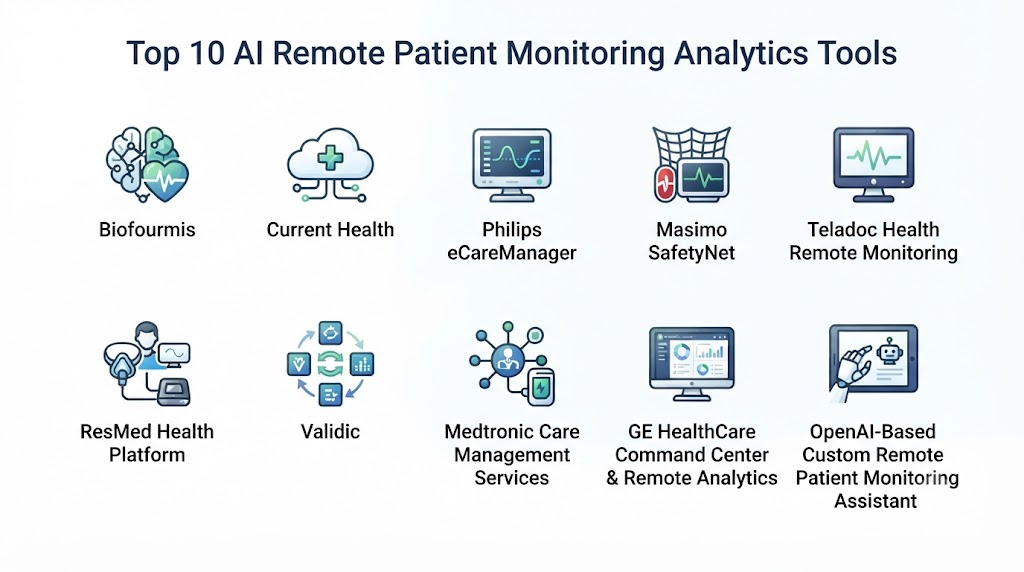
Top 10 AI Remote Patient Monitoring Analytics Tools
1. Biofourmis
Verdict: Best overall AI-powered remote patient monitoring analytics platform.
Short Description: Biofourmis uses AI-driven analytics, wearable sensors, and predictive algorithms to monitor patients remotely and identify early signs of health deterioration. The platform supports personalized care pathways across chronic disease management and hospital-at-home programs.
Key Features
- AI-powered patient monitoring
- Predictive health analytics
- Wearable device integration
- Vital sign analysis
- Clinical dashboards
- Personalized care pathways
Pros
- Strong AI analytics
- Advanced remote monitoring capabilities
- Healthcare-focused platform
Cons
- Enterprise healthcare deployment
- Requires connected devices
Deployment: Cloud-based
Security & Compliance: Healthcare-grade security controls
Integrations & Ecosystem: Wearables, healthcare systems, clinical workflows
Support & Community: Enterprise healthcare support
Pricing Model: Custom enterprise pricing
Best-Fit Scenarios: Hospitals and chronic care programs
2. Current Health
Verdict: AI-enabled remote care platform for hospital-at-home and chronic disease management.
Short Description: Current Health provides remote patient monitoring technology that combines connected devices, AI analytics, and clinical workflows to help healthcare providers monitor patients outside hospitals.
Key Features
- Remote vital monitoring
- AI risk detection
- Care management workflows
- Connected devices
- Virtual care support
Pros
- Strong healthcare operations
- Hospital-at-home support
Cons
- Enterprise-focused solution
3. Philips eCareManager
Verdict: Enterprise remote patient monitoring platform for healthcare organizations.
Short Description: Philips eCareManager supports remote monitoring and clinical decision-making by collecting patient data, analyzing health information, and helping care teams manage patients remotely.
Key Features
- Remote monitoring
- Clinical dashboards
- Patient analytics
- Care coordination
- Healthcare integration
Pros
- Strong healthcare ecosystem
- Enterprise scalability
Cons
- Complex deployment
4. Masimo SafetyNet
Verdict: Connected health monitoring platform for remote patient care.
Short Description: Masimo SafetyNet uses connected medical devices and healthcare analytics to monitor patients remotely and provide clinicians with visibility into patient conditions outside hospitals.
Key Features
- Remote monitoring
- Vital sign tracking
- Connected devices
- Patient alerts
- Clinical dashboards
Pros
- Strong medical device integration
- Reliable monitoring capabilities
Cons
- Device ecosystem focused
5. Teladoc Health Remote Monitoring
Verdict: Digital healthcare platform supporting remote monitoring and virtual care.
Short Description: Teladoc Health provides digital healthcare solutions that combine remote monitoring, telehealth services, patient engagement, and healthcare analytics.
Key Features
- Virtual care
- Patient monitoring
- Digital health programs
- Chronic condition support
- Healthcare analytics
Pros
- Broad telehealth ecosystem
- Strong patient engagement
Cons
- Large healthcare platform complexity
6. ResMed Health Platform
Verdict: Remote monitoring analytics platform for respiratory and chronic care management.
Short Description: ResMed uses connected healthcare technology and analytics to support remote monitoring of respiratory conditions and improve chronic disease management.
Key Features
- Connected devices
- Respiratory monitoring
- Patient analytics
- Care management
- Remote insights
Pros
- Strong respiratory healthcare expertise
- Device connectivity
Cons
- Specialty-focused
7. Validic
Verdict: Healthcare data connectivity platform enabling AI-driven remote monitoring.
Short Description: Validic connects healthcare organizations with patient-generated health data from devices and applications, enabling analytics and remote care workflows.
Key Features
- Device connectivity
- Health data integration
- Remote monitoring support
- Patient-generated data
- Analytics infrastructure
Pros
- Broad device ecosystem
- Strong interoperability
Cons
- Requires healthcare analytics layer
8. Medtronic Care Management Services
Verdict: Remote monitoring platform supporting chronic disease management.
Short Description: Medtronic provides connected healthcare solutions that collect patient data, support remote monitoring, and assist clinicians in managing chronic conditions.
Key Features
- Remote monitoring
- Medical device connectivity
- Patient analytics
- Clinical workflows
- Chronic care support
Pros
- Strong medical device expertise
- Healthcare reliability
Cons
- Device-specific applications
9. GE HealthCare Command Center & Remote Analytics
Verdict: Healthcare analytics platform supporting operational and patient monitoring insights.
Short Description: GE HealthCare provides healthcare analytics solutions that help organizations monitor patient information, optimize workflows, and improve healthcare decision-making.
Key Features
- Healthcare analytics
- Patient insights
- Operational dashboards
- Data integration
- Clinical intelligence
Pros
- Enterprise healthcare capabilities
- Strong infrastructure
Cons
- Large-scale implementation
10. OpenAI-Based Custom Remote Patient Monitoring Assistant
Verdict: Flexible AI analytics solution for customized remote healthcare workflows.
Short Description: Healthcare organizations can build custom AI RPM assistants using large language models integrated with wearable devices, patient monitoring platforms, EHR systems, and healthcare analytics environments. These solutions can support patient summaries, trend analysis, alert explanations, and care coordination while requiring clinical oversight and healthcare governance.
Key Features
- AI patient summaries
- Health trend analysis
- Alert interpretation
- Care workflow automation
- Custom healthcare integrations
Pros
- Highly customizable
- Flexible integrations
- Organization-specific analytics
Cons
- Requires healthcare AI expertise
- Strong governance required
Comparison Table
| Platform | AI Analytics | Device Support | Healthcare Integration | Remote Monitoring | Best Use |
|---|---|---|---|---|---|
| Biofourmis | Excellent | Excellent | Excellent | Excellent | Predictive RPM |
| Current Health | Excellent | Excellent | High | Excellent | Hospital-at-Home |
| Philips eCareManager | High | High | Excellent | Excellent | Enterprise Healthcare |
| Masimo SafetyNet | High | Excellent | High | High | Connected Monitoring |
| Teladoc Health | High | High | Excellent | High | Virtual Care |
| ResMed Health Platform | High | Excellent | High | High | Respiratory Care |
| Validic | High | Excellent | Excellent | High | Health Data Connectivity |
| Medtronic Care Management | High | Excellent | High | High | Chronic Care |
| GE HealthCare Analytics | High | Medium | Excellent | High | Healthcare Operations |
| OpenAI Custom | Custom | Custom | Custom | Custom | Custom RPM Analytics |
Evaluation & Scoring Table
| Platform | AI Features 20% | Analytics 20% | Integration 15% | Monitoring 15% | Security 10% | Ease 10% | Value 10% | Total |
|---|---|---|---|---|---|---|---|---|
| Biofourmis | 20 | 20 | 15 | 15 | 10 | 8 | 8 | 96 |
| Current Health | 19 | 19 | 15 | 15 | 10 | 8 | 8 | 94 |
| Philips eCareManager | 18 | 18 | 15 | 14 | 10 | 8 | 8 | 91 |
| Validic | 18 | 18 | 15 | 13 | 10 | 8 | 8 | 90 |
| Masimo SafetyNet | 18 | 18 | 14 | 14 | 10 | 8 | 8 | 90 |
| Teladoc Health | 18 | 17 | 15 | 13 | 10 | 8 | 8 | 89 |
| ResMed Health Platform | 17 | 18 | 14 | 13 | 10 | 8 | 8 | 88 |
| Medtronic Care Management | 17 | 17 | 14 | 13 | 10 | 8 | 8 | 87 |
| GE HealthCare Analytics | 17 | 17 | 15 | 12 | 10 | 8 | 8 | 87 |
| OpenAI Custom | 20 | 18 | 12 | 15 | 8 | 7 | 9 | 89 |
Which AI Remote Patient Monitoring Analytics Tool Is Right for You?
| If your priority is… | Recommended Platform |
|---|---|
| Predictive remote monitoring | Biofourmis |
| Hospital-at-home programs | Current Health |
| Enterprise healthcare monitoring | Philips eCareManager |
| Connected medical devices | Masimo SafetyNet |
| Virtual healthcare ecosystem | Teladoc Health |
| Respiratory monitoring | ResMed Health Platform |
| Healthcare data integration | Validic |
| Chronic care monitoring | Medtronic Care Management |
| Healthcare analytics | GE HealthCare |
| Custom AI monitoring workflows | OpenAI-Based RPM Assistant |
Implementation Playbook
First 30 Days
- Define remote monitoring goals
- Identify patient populations
- Select connected devices
- Review healthcare integrations
Days 31–60
- Deploy monitoring workflows
- Connect patient devices
- Train care teams
- Validate alerts and analytics
Days 61–90
- Expand patient programs
- Optimize AI predictions
- Measure clinical outcomes
- Improve care workflows
Common Mistakes
- Poor device connectivity planning
- Too many unnecessary alerts
- Lack of clinical workflows
- Ignoring patient engagement
- Weak privacy controls
- Poor data quality
- Missing escalation procedures
- Treating AI predictions as final decisions
Frequently Asked Questions
1. What are AI Remote Patient Monitoring Analytics tools?
They are AI-powered platforms that analyze patient health data collected remotely to provide insights, alerts, and predictive healthcare support.
2. How do AI RPM platforms work?
They collect data from connected devices, analyze health patterns, identify risks, and provide information to healthcare teams.
3. Which conditions benefit from remote monitoring?
Heart failure, diabetes, hypertension, respiratory diseases, and chronic conditions commonly benefit from RPM programs.
4. Can AI RPM reduce hospital visits?
Yes. Early detection of health changes can help providers intervene before conditions worsen.
5. Do these platforms integrate with wearable devices?
Many solutions support smart devices, medical equipment, and connected healthcare technologies.
6. Can AI replace healthcare monitoring teams?
No. AI supports clinicians by providing insights and alerts, while healthcare professionals make decisions.
7. Are AI RPM platforms secure?
Healthcare organizations should evaluate privacy controls, security practices, and compliance requirements.
8. Who uses AI remote monitoring platforms?
Hospitals, physicians, care managers, telehealth providers, and healthcare organizations.
9. What metrics do RPM platforms analyze?
They may analyze heart rate, blood pressure, oxygen levels, glucose, activity patterns, symptoms, and other health data.
10. What should organizations evaluate before selecting an RPM platform?
Consider AI accuracy, device support, integrations, security, scalability, patient engagement, and clinical workflow impact.
Conclusion
AI Remote Patient Monitoring Analytics tools are transforming healthcare by enabling continuous patient observation beyond traditional clinical settings. These platforms combine artificial intelligence, connected devices, and predictive analytics to identify health risks earlier, support chronic disease management, and improve care coordination.Healthcare organizations should choose RPM solutions based on patient needs, device ecosystem, clinical workflows, data security requirements, and scalability goals. Platforms such as Biofourmis, Current Health, Philips eCareManager, Masimo SafetyNet, and Teladoc Health demonstrate how AI can improve remote healthcare delivery, enhance patient engagement, and support more proactive healthcare models.
