Introduction
AI Symptom Checker Apps use artificial intelligence (AI), machine learning (ML), natural language processing (NLP), and healthcare knowledge databases to help users understand possible health conditions based on reported symptoms, personal health information, and medical history. These applications provide preliminary health guidance, suggest possible causes, recommend next steps, and help users decide when professional medical care may be appropriate.
Traditional healthcare access often involves uncertainty about whether symptoms require urgent attention, routine consultation, or self-care. AI-powered symptom checker applications help bridge this gap by allowing users to describe symptoms through conversational interfaces and receive structured health information. These tools analyze patterns across millions of medical cases, clinical knowledge resources, and health guidelines to provide personalized guidance.
Modern AI symptom checker platforms are designed as healthcare navigation tools rather than replacements for doctors. They help users prepare for medical consultations, understand potential health concerns, identify emergency warning signs, and improve access to healthcare information. Many platforms integrate with telemedicine services, electronic health records (EHR), appointment systems, and digital health ecosystems.
Healthcare providers, insurers, and consumers increasingly use AI symptom checker applications to improve healthcare accessibility, reduce unnecessary visits, support preventive care, and enable faster connections between patients and healthcare professionals.
Real-world Use Cases
- Initial symptom assessment
- Healthcare navigation
- Telemedicine support
- Patient education
- Emergency symptom guidance
- Preventive health screening
- Primary care assistance
- Appointment preparation
- Chronic condition support
- Digital health engagement
Evaluation Criteria for Buyers
When selecting an AI Symptom Checker App, consider:
- AI symptom analysis accuracy
- Medical knowledge quality
- User experience
- Clinical validation
- Healthcare provider integration
- Privacy and security
- Multilingual support
- Emergency guidance capability
- Personalization features
- Ease of use
Best For
- Consumers seeking health guidance
- Telehealth providers
- Healthcare organizations
- Insurance companies
- Digital health platforms
Not Ideal For
Users expecting AI to provide a final medical diagnosis or replace consultation with qualified healthcare professionals.
Key Trends
- Conversational healthcare AI
- Generative AI health assistants
- Personalized symptom analysis
- Telemedicine integration
- Preventive healthcare support
- AI health navigation
- Voice-based health assistants
- Digital health ecosystems
- Patient engagement platforms
- Remote healthcare access
Methodology
The platforms below were evaluated based on:
- AI capabilities
- Medical information quality
- User experience
- Healthcare integration
- Safety features
- Scalability
- Overall usefulness
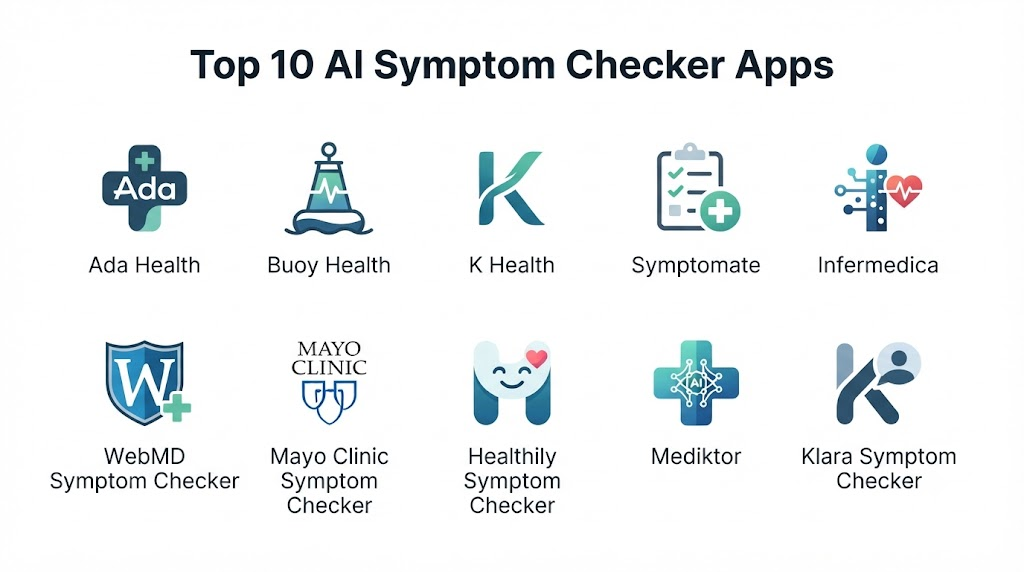
Top 10 AI Symptom Checker Apps
1. Ada Health
Verdict: Best overall AI symptom checker for personalized health assessments.
Short Description: Ada Health uses AI-powered medical reasoning to analyze user-reported symptoms, ask adaptive questions, and provide personalized health assessments. The platform combines medical knowledge with conversational AI to guide users toward appropriate healthcare actions.
Key Features
- AI symptom assessment
- Personalized health reports
- Adaptive questioning
- Medical knowledge database
- Healthcare navigation
- Mobile applications
Pros
- Strong medical reasoning
- User-friendly experience
- Personalized assessments
Cons
- Not a replacement for medical diagnosis
- Requires user input accuracy
Deployment: Mobile & Web
Security & Compliance: Healthcare privacy controls
Integrations & Ecosystem: Telehealth and healthcare partnerships
Support & Community: Digital health support
Pricing Model: Free and premium options vary
Best-Fit Scenarios: Consumer health guidance
2. Buoy Health
Verdict: AI-powered symptom checker focused on healthcare navigation.
Short Description: Buoy Health uses AI conversations to understand symptoms, provide possible explanations, recommend care options, and connect users with appropriate healthcare resources.
Key Features
- Conversational symptom analysis
- Care recommendations
- Health navigation
- Risk assessment
- Clinical pathways
Pros
- Simple user experience
- Strong healthcare navigation
Cons
- Not a diagnostic replacement
3. Infermedica Symptomate
Verdict: Enterprise AI symptom checker platform for healthcare organizations.
Short Description: Infermedica provides AI-driven symptom assessment technology used by healthcare providers, insurers, and digital health platforms to guide patients through symptom evaluation and care decisions.
Key Features
- AI symptom assessment
- Patient triage
- Healthcare integrations
- Clinical reasoning
- Digital health workflows
Pros
- Strong enterprise capabilities
- Healthcare-focused AI
Cons
- Mainly designed for organizations
4. WebMD Symptom Checker
Verdict: Popular consumer health information and symptom guidance platform.
Short Description: WebMD Symptom Checker helps users explore possible health conditions based on symptoms and provides medical information to support healthcare decisions.
Key Features
- Symptom search
- Health information
- Condition explanations
- Medical resources
- Consumer education
Pros
- Large health content library
- Widely recognized
Cons
- More information-focused than advanced AI reasoning
5. K Health AI
Verdict: AI-powered healthcare assistant combined with virtual care services.
Short Description: K Health uses AI technology and healthcare data analysis to provide symptom assessments, health guidance, and access to medical professionals through digital healthcare services.
Key Features
- AI symptom analysis
- Virtual care
- Health history analysis
- Personalized guidance
- Medical consultations
Pros
- Combines AI and healthcare access
- Personalized experience
Cons
- Availability depends on location
6. Healthily
Verdict: AI health assistant for symptom tracking and wellness guidance.
Short Description: Healthily provides AI-supported health information, symptom tracking, and wellness guidance to help users better understand their health conditions.
Key Features
- Symptom tracking
- Health education
- Wellness support
- Personalized insights
- Digital health tools
Pros
- User-friendly
- Strong wellness focus
Cons
- Limited clinical decision support
7. Sensely
Verdict: Conversational AI healthcare assistant for patient engagement.
Short Description: Sensely uses AI-powered virtual assistants to support symptom assessment, patient communication, healthcare navigation, and remote care programs.
Key Features
- Conversational AI
- Patient engagement
- Remote care support
- Symptom collection
- Healthcare workflows
Pros
- Strong healthcare integration
- Enterprise-ready
Cons
- Primarily healthcare organization focused
8. Your.MD
Verdict: AI health assistant providing symptom information and healthcare guidance.
Short Description: Your.MD uses AI and medical knowledge resources to help users understand symptoms, explore possible health conditions, and access healthcare information.
Key Features
- AI health assistant
- Symptom guidance
- Health articles
- Personalized recommendations
- Mobile support
Pros
- Easy to use
- Consumer-friendly
Cons
- Limited advanced clinical workflows
9. Mayo Clinic Symptom Checker
Verdict: Trusted healthcare information platform with symptom guidance.
Short Description: Mayo Clinic provides symptom information and health guidance resources designed to help users understand potential conditions and seek appropriate medical care.
Key Features
- Symptom information
- Condition guidance
- Medical education
- Healthcare resources
- Patient support
Pros
- Trusted medical source
- High-quality healthcare information
Cons
- Less focused on conversational AI
10. OpenAI-Based Custom AI Health Assistant
Verdict: Flexible conversational AI solution for healthcare guidance workflows.
Short Description: Healthcare organizations can build custom AI symptom assistance solutions using large language models integrated with healthcare knowledge bases, patient portals, telemedicine platforms, and clinical workflows. These systems can support symptom collection, health education, appointment preparation, and patient communication while requiring appropriate medical validation and safety controls.
Key Features
- Conversational symptom support
- Patient guidance
- Health information retrieval
- Workflow automation
- Healthcare integration
Pros
- Highly customizable
- Flexible integrations
- Organization-specific workflows
Cons
- Requires healthcare AI expertise
- Medical safety governance required
Comparison Table
| Platform | AI Symptom Analysis | Healthcare Integration | Personalization | User Experience | Best Use |
|---|---|---|---|---|---|
| Ada Health | Excellent | High | Excellent | Excellent | Consumer Health |
| Buoy Health | Excellent | High | High | Excellent | Health Navigation |
| Infermedica | Excellent | Excellent | High | High | Enterprise Healthcare |
| WebMD | Medium | Medium | Medium | High | Health Information |
| K Health | Excellent | High | Excellent | High | Virtual Care |
| Healthily | High | Medium | High | High | Wellness Support |
| Sensely | High | Excellent | High | High | Patient Engagement |
| Your.MD | High | Medium | Medium | High | Health Guidance |
| Mayo Clinic | Medium | Medium | Medium | High | Medical Education |
| OpenAI Custom | Custom | Custom | Custom | Custom | Custom Health Assistant |
Evaluation & Scoring Table
| Platform | AI Features 20% | Accuracy 20% | Integration 15% | Personalization 15% | Security 10% | Ease 10% | Value 10% | Total |
|---|---|---|---|---|---|---|---|---|
| Ada Health | 20 | 20 | 14 | 15 | 10 | 9 | 9 | 97 |
| Infermedica | 20 | 19 | 15 | 14 | 10 | 8 | 8 | 94 |
| Buoy Health | 19 | 19 | 14 | 14 | 10 | 9 | 8 | 93 |
| K Health | 19 | 18 | 14 | 15 | 10 | 9 | 8 | 93 |
| Sensely | 18 | 18 | 15 | 13 | 10 | 8 | 8 | 90 |
| Healthily | 17 | 17 | 13 | 13 | 10 | 9 | 8 | 87 |
| WebMD | 16 | 17 | 12 | 12 | 10 | 10 | 9 | 86 |
| Your.MD | 17 | 17 | 12 | 12 | 9 | 9 | 8 | 84 |
| Mayo Clinic | 16 | 18 | 12 | 11 | 10 | 9 | 8 | 84 |
| OpenAI Custom | 20 | 16 | 12 | 15 | 8 | 7 | 9 | 87 |
Which AI Symptom Checker App Is Right for You?
| If your priority is… | Recommended Platform |
|---|---|
| Personalized symptom assessment | Ada Health |
| Healthcare navigation | Buoy Health |
| Enterprise healthcare integration | Infermedica |
| Virtual healthcare support | K Health |
| Patient engagement | Sensely |
| Health education | Mayo Clinic |
| Consumer health information | WebMD |
| Wellness tracking | Healthily |
| Simple AI health guidance | Your.MD |
| Custom healthcare assistant | OpenAI-Based Health Assistant |
Implementation Playbook
First 30 Days
- Define symptom assessment goals
- Identify healthcare workflows
- Review safety requirements
- Select integration points
Days 31–60
- Deploy AI assistant workflows
- Connect healthcare systems
- Test user interactions
- Validate medical information quality
Days 61–90
- Expand healthcare use cases
- Monitor user engagement
- Improve AI responses
- Establish safety governance
Common Mistakes
- Treating AI as a medical replacement
- Ignoring clinical validation
- Poor symptom data collection
- Missing privacy controls
- Lack of emergency escalation guidance
- Overlooking user experience
- Limited healthcare integration
- Not monitoring AI safety
Frequently Asked Questions
1. What are AI Symptom Checker Apps?
They are AI-powered applications that analyze reported symptoms and provide health guidance, possible conditions, and recommended next steps.
2. Can AI symptom checkers diagnose diseases?
No. They provide informational guidance and healthcare navigation but do not replace professional medical diagnosis.
3. How do AI symptom checkers work?
They analyze user responses, medical knowledge databases, and symptom patterns using AI models to provide possible explanations and recommendations.
4. Are AI symptom checker apps safe?
They should be used as supportive health tools, and users should seek professional medical care for serious or persistent symptoms.
5. Can these apps connect users with doctors?
Many platforms integrate with telemedicine and healthcare services.
6. What information do these apps use?
They may analyze symptoms, age, gender, health history, medications, and user-provided information.
7. Do hospitals use AI symptom checkers?
Yes. Healthcare organizations use them for patient navigation, triage support, and digital engagement.
8. Can AI symptom checkers support chronic disease management?
Some platforms provide ongoing tracking and health guidance for chronic conditions.
9. What privacy considerations are important?
Organizations should evaluate healthcare data protection, security practices, and compliance requirements.
10. What should users consider before using an AI symptom checker?
Use them as guidance tools, verify important health concerns with healthcare professionals, and seek urgent care for emergency symptoms.
Conclusion
AI Symptom Checker Apps are improving access to healthcare information by helping users understand symptoms, navigate care options, and make informed decisions about seeking medical attention. These platforms combine artificial intelligence, medical knowledge, and conversational interfaces to provide personalized health guidance while supporting healthcare professionals and digital health ecosystems.Organizations and users should choose AI symptom checker solutions based on medical accuracy, safety features, privacy controls, healthcare integrations, and usability. Platforms such as Ada Health, Buoy Health, Infermedica, K Health, and healthcare-focused AI assistants demonstrate how artificial intelligence can improve patient engagement and create more accessible healthcare experiences.
