Introduction
AI Workforce Scheduling Tools for Public Services use artificial intelligence, machine learning, predictive analytics, optimization algorithms, and automation to help government agencies and public organizations manage employee schedules, staffing requirements, and workforce availability.
Public service organizations such as healthcare departments, emergency services, transportation agencies, municipal offices, and government service centers require efficient workforce planning to ensure essential services remain available. Managing shifts, employee availability, workload demands, compliance rules, and operational requirements manually can become complex.
Traditional workforce scheduling methods often depend on spreadsheets, fixed schedules, and manual adjustments. These approaches may create challenges such as staffing shortages, inefficient resource allocation, overtime costs, and difficulty responding to changing service demands.
AI-powered workforce scheduling platforms analyze historical workload patterns, employee skills, availability, service requirements, and operational constraints to create optimized schedules.
These tools help organizations:
- Automate workforce scheduling
- Improve staff utilization
- Reduce scheduling conflicts
- Balance workloads
- Manage shift changes
- Improve public service availability
- Support workforce planning
AI workforce scheduling solutions are used by:
- Government departments
- Healthcare and emergency services
- Transportation agencies
- Public safety organizations
- Municipal service centers
- Education departments
- Public utility organizations
Modern platforms combine AI forecasting, workforce optimization, employee management, scheduling automation, compliance tracking, and analytics.
The goal of these solutions is to ensure public services have the right people available at the right time while improving operational efficiency.
How AI Workforce Scheduling Works
Workforce Data Collection
AI analyzes:
- Employee availability
- Skills and certifications
- Historical schedules
- Service demand
- Workload patterns
Demand Forecasting
Machine learning predicts:
- Staffing requirements
- Peak service periods
- Resource needs
- Future workload changes
Schedule Optimization
AI considers:
- Employee preferences
- Labor rules
- Shift requirements
- Service coverage
Automated Scheduling
Platforms generate:
- Optimized shifts
- Assignments
- Rotation plans
- Coverage schedules
Continuous Adjustment
AI updates schedules based on:
- Absences
- Emergencies
- Demand changes
- Operational needs
Common Use Cases
- Emergency response staffing
- Public healthcare workforce planning
- Municipal employee scheduling
- Transportation workforce management
- Government call center staffing
- Police and fire department scheduling
- Public facility operations
- Utility workforce planning
- Education staffing
- Community service scheduling
Why AI Workforce Scheduling Tools Matter
Better Service Availability
AI helps ensure enough staff are available when citizens need services.
Reduced Administrative Work
Automation reduces manual scheduling effort.
Improved Resource Allocation
Organizations can assign employees more effectively.
Lower Operational Costs
Optimized scheduling helps reduce unnecessary overtime.
Faster Response to Changes
AI can adjust schedules when conditions change.
Evaluation Criteria for Buyers
Scheduling Optimization
Tools should create efficient schedules based on multiple constraints.
Demand Forecasting
Platforms should predict staffing requirements accurately.
Employee Management
Solutions should support:
- Availability tracking
- Skills management
- Leave management
- Shift preferences
Compliance Management
Systems should consider:
- Labor regulations
- Working hours
- Certifications
- Policies
Integration Capability
Important integrations include:
- HR systems
- Payroll platforms
- Time tracking systems
- Government applications
Scalability
Solutions should support large public organizations.
User Experience
Platforms should be easy for managers and employees.
Key Trends
AI-Based Workforce Optimization
Public organizations are adopting AI to improve staffing decisions.
Predictive Staffing Models
AI is helping agencies prepare for changing service demand.
Automated Shift Management
Organizations are reducing manual scheduling tasks.
Employee-Centered Scheduling
AI is considering workforce preferences and availability.
Real-Time Workforce Adjustments
Platforms are adapting schedules during emergencies.
Digital Public Service Transformation
Governments are modernizing workforce operations.
Methodology
The following platforms were evaluated using:
- AI scheduling capabilities
- Workforce optimization features
- Automation functionality
- Public service suitability
- Integration support
- Ease of use
- Security and privacy
- Performance and reliability
- Support and community
- Price and value
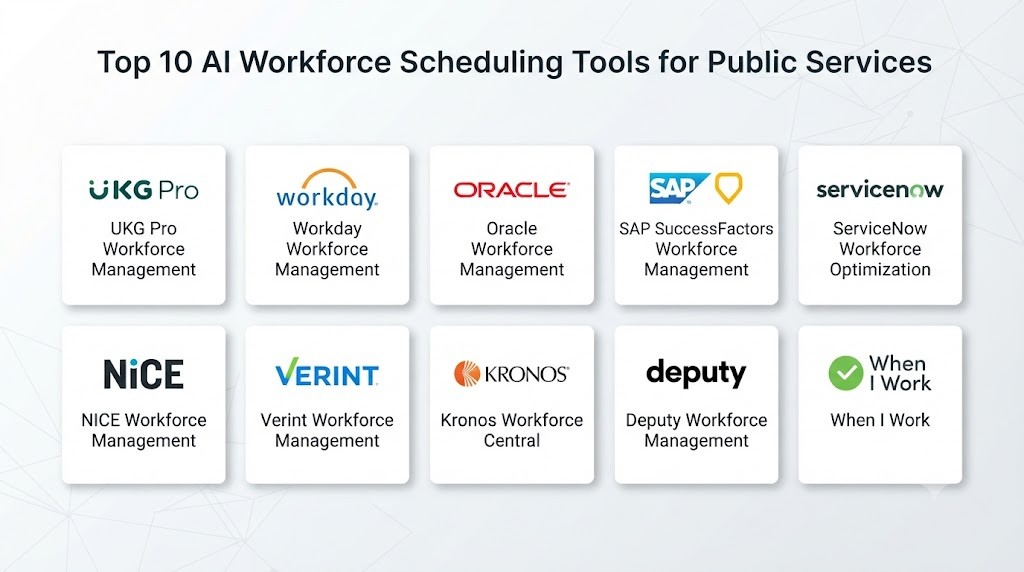
Top 10 AI Workforce Scheduling Tools for Public Services
1. UKG Pro Workforce Management
UKG provides workforce management solutions with scheduling automation and workforce optimization capabilities.
Key Features
- AI-assisted scheduling
- Workforce forecasting
- Shift management
- Time tracking
- Employee availability
- Labor analytics
- Compliance management
- Workforce insights
- Reporting
- Automation
Pros
- Strong workforce management capabilities
- Good scheduling optimization
- Enterprise scalability
- Useful analytics
- Supports complex organizations
Cons
- Enterprise-focused
- Requires implementation
- Configuration effort
Platforms
Cloud-based platform.
Deployment or Support
Cloud deployment.
Security & Compliance
Enterprise security controls.
Integrations & Ecosystem
HR systems, payroll platforms, and enterprise applications.
Support & Community
Enterprise support.
2. Workday Workforce Management
Workday provides cloud-based workforce planning and management capabilities.
Key Features
- Workforce planning
- Scheduling support
- Employee management
- Analytics
- Reporting
- Time tracking
- Workforce insights
- Automation
- HR integration
- Planning tools
Pros
- Strong HR ecosystem
- Cloud-based platform
- Good analytics
- Enterprise scalability
- Unified workforce data
Cons
- Requires implementation
- Enterprise pricing
- Advanced scheduling needs configuration
Platforms
Cloud platform.
Deployment or Support
Cloud deployment.
Security & Compliance
Enterprise cloud security controls.
Integrations & Ecosystem
HR systems, payroll, finance, and business applications.
Support & Community
Enterprise support.
3. Oracle Workforce Management
Oracle provides workforce scheduling and optimization solutions.
Key Features
- Workforce scheduling
- Labor forecasting
- Employee management
- Time and attendance
- Analytics
- Automation
- Compliance tracking
- Workforce planning
- Reporting
- Enterprise integration
Pros
- Enterprise-grade capabilities
- Strong analytics
- Good integration options
- Supports large organizations
- Comprehensive workforce tools
Cons
- Complex deployment
- Requires expertise
- Enterprise-oriented
Platforms
Cloud platform.
Deployment or Support
Cloud deployment.
Security & Compliance
Enterprise security controls.
Integrations & Ecosystem
Oracle applications, HR systems, and enterprise platforms.
Support & Community
Enterprise support.
4. SAP SuccessFactors Workforce Management
SAP provides workforce management and employee scheduling capabilities.
Key Features
- Workforce planning
- Scheduling
- Time management
- Employee data management
- Analytics
- Automation
- Compliance tracking
- Reporting
- HR integration
- Workforce insights
Pros
- Strong enterprise HR integration
- Global workforce support
- Good analytics
- Scalable
- Flexible configuration
Cons
- Implementation complexity
- Requires training
- Enterprise-focused
Platforms
Cloud platform.
Deployment or Support
Cloud deployment.
Security & Compliance
Enterprise security controls.
Integrations & Ecosystem
SAP systems, HR platforms, and enterprise applications.
Support & Community
Enterprise support.
5. ServiceNow Workforce Optimization
ServiceNow provides workflow automation and workforce management capabilities.
Key Features
- Workforce planning
- Scheduling workflows
- Task management
- Automation
- Analytics
- Service operations
- Employee workflows
- Reporting
- Integration tools
- AI assistance
Pros
- Strong workflow automation
- Good enterprise integration
- Flexible platform
- Supports service operations
- Scalable
Cons
- Requires configuration
- Enterprise-focused
- Implementation effort
Platforms
Cloud platform.
Deployment or Support
Cloud deployment.
Security & Compliance
Enterprise security controls.
Integrations & Ecosystem
Enterprise applications, HR systems, and workflow platforms.
Support & Community
Enterprise support.
6. NICE Workforce Management
NICE provides AI-powered workforce optimization solutions.
Key Features
- Workforce forecasting
- Schedule optimization
- Shift planning
- Employee management
- Analytics
- Automation
- Real-time adjustments
- Performance tracking
- Reporting
- Workforce insights
Pros
- Strong AI scheduling
- Good forecasting
- Contact center expertise
- Real-time optimization
- Analytics capabilities
Cons
- Specialized focus
- Requires configuration
- Enterprise deployment
Platforms
Cloud platform.
Deployment or Support
Cloud deployment.
Security & Compliance
Enterprise security controls.
Integrations & Ecosystem
Contact centers, workforce systems, and enterprise applications.
Support & Community
Enterprise support.
7. Verint Workforce Management
Verint provides workforce optimization and scheduling solutions.
Key Features
- Workforce forecasting
- Scheduling automation
- Employee engagement
- Analytics
- Quality management
- Reporting
- Resource planning
- Automation
- Performance insights
- Workflow management
Pros
- Strong workforce analytics
- Good optimization tools
- Enterprise capabilities
- Supports service organizations
- Flexible workflows
Cons
- Requires setup
- Enterprise-focused
- Learning curve
Platforms
Cloud platform.
Deployment or Support
Cloud deployment.
Security & Compliance
Enterprise security controls.
Integrations & Ecosystem
Communication platforms, workforce systems, and enterprise tools.
Support & Community
Enterprise support.
8. Kronos Workforce Central
Kronos provides workforce management and scheduling solutions.
Key Features
- Employee scheduling
- Time tracking
- Workforce analytics
- Attendance management
- Shift planning
- Reporting
- Compliance management
- Workforce insights
- Automation
- Resource planning
Pros
- Established workforce platform
- Strong scheduling features
- Good workforce tracking
- Supports large organizations
- Broad adoption
Cons
- Legacy deployments exist
- Migration may require planning
- Configuration effort
Platforms
Enterprise platform.
Deployment or Support
Cloud and enterprise deployment.
Security & Compliance
Enterprise security controls.
Integrations & Ecosystem
HR systems, payroll platforms, and enterprise applications.
Support & Community
Enterprise support.
9. Deputy Workforce Management
Deputy provides scheduling and workforce management tools.
Key Features
- Employee scheduling
- Shift planning
- Availability management
- Time tracking
- Communication tools
- Reporting
- Workforce analytics
- Mobile access
- Automation
- Leave management
Pros
- Easy scheduling
- User-friendly interface
- Mobile support
- Good for smaller organizations
- Quick implementation
Cons
- Limited enterprise complexity
- Advanced AI features vary
- Less suitable for very large agencies
Platforms
Cloud platform.
Deployment or Support
Cloud deployment.
Security & Compliance
Security controls vary.
Integrations & Ecosystem
HR systems, payroll platforms, and business tools.
Support & Community
Customer support.
10. When I Work
When I Work provides employee scheduling and workforce management capabilities.
Key Features
- Shift scheduling
- Employee availability
- Time tracking
- Team communication
- Mobile scheduling
- Notifications
- Reporting
- Attendance management
- Automation
- Workforce coordination
Pros
- Simple scheduling
- Easy adoption
- Good mobile experience
- Affordable option
- Useful communication tools
Cons
- Limited advanced optimization
- Better for smaller teams
- Enterprise features vary
Platforms
Cloud platform.
Deployment or Support
Cloud deployment.
Security & Compliance
Security controls vary.
Integrations & Ecosystem
HR tools, payroll systems, and workforce applications.
Support & Community
Customer support.
Comparison Table
| Tool Name | Best For | Platform(s) Supported | Deployment | Standout Feature | Public Rating |
|---|---|---|---|---|---|
| UKG Pro Workforce Management | Enterprise workforce scheduling | Cloud | Cloud | AI scheduling | N/A |
| Workday Workforce Management | HR-connected workforce planning | Cloud | Cloud | Workforce analytics | N/A |
| Oracle Workforce Management | Large organizations | Cloud | Cloud | Enterprise optimization | N/A |
| SAP SuccessFactors | Global workforce management | Cloud | Cloud | HR integration | N/A |
| ServiceNow Workforce Optimization | Service operations | Cloud | Cloud | Workflow automation | N/A |
| NICE Workforce Management | Contact center staffing | Cloud | Cloud | Forecasting | N/A |
| Verint Workforce Management | Workforce optimization | Cloud | Cloud | Analytics | N/A |
| Kronos Workforce Central | Workforce tracking | Enterprise | Hybrid | Scheduling management | N/A |
| Deputy | Small and medium teams | Cloud | Cloud | Easy scheduling | N/A |
| When I Work | Simple workforce scheduling | Cloud | Cloud | Team scheduling | N/A |
Weighted Evaluation
| Tool Name | Core Features 25% | Ease of Use 15% | Integrations & Ecosystem 15% | Security & Compliance 10% | Performance & Reliability 10% | Support & Community 10% | Price/Value 15% | Total |
|---|---|---|---|---|---|---|---|---|
| UKG Pro | 25 | 13 | 15 | 10 | 10 | 10 | 11 | 94 |
| Workday | 24 | 13 | 15 | 10 | 10 | 10 | 11 | 93 |
| Oracle Workforce Management | 25 | 12 | 15 | 10 | 10 | 10 | 10 | 92 |
| SAP SuccessFactors | 24 | 12 | 15 | 10 | 10 | 10 | 10 | 91 |
| ServiceNow Workforce Optimization | 24 | 13 | 15 | 10 | 10 | 10 | 11 | 93 |
| NICE Workforce Management | 24 | 14 | 14 | 10 | 10 | 10 | 11 | 93 |
| Verint Workforce Management | 23 | 13 | 14 | 10 | 10 | 10 | 11 | 91 |
| Kronos Workforce Central | 23 | 13 | 14 | 10 | 10 | 10 | 11 | 91 |
| Deputy | 21 | 15 | 12 | 10 | 10 | 10 | 13 | 91 |
| When I Work | 20 | 15 | 12 | 10 | 10 | 10 | 14 | 91 |
Which AI Workforce Scheduling Tool Is Right for You?
Choose UKG Pro Workforce Management when large public organizations need advanced scheduling.
Choose Workday Workforce Management when workforce planning must connect with HR operations.
Choose Oracle Workforce Management when enterprise optimization is required.
Choose SAP SuccessFactors when global workforce management is needed.
Choose ServiceNow Workforce Optimization when workflow automation is important.
Choose NICE Workforce Management when predictive staffing is a priority.
Choose Verint Workforce Management when workforce analytics are needed.
Choose Kronos Workforce Central when established workforce scheduling capabilities are required.
Choose Deputy when simple and flexible scheduling is preferred.
Choose When I Work when smaller public teams need easy scheduling.
Implementation Playbook
Phase 1: Define Workforce Goals
- Identify scheduling challenges
- Review staffing requirements
- Define service coverage needs
- Analyze workforce data
- Establish success metrics
Phase 2: Prepare Workforce Data
- Collect employee information
- Review availability
- Connect HR systems
- Define scheduling rules
- Establish compliance requirements
Phase 3: Deploy AI Scheduling
- Configure optimization models
- Create schedules
- Enable notifications
- Connect workflows
- Test operations
Phase 4: Measure Results
- Reduce scheduling conflicts
- Improve workforce utilization
- Monitor service coverage
- Analyze staffing efficiency
- Improve employee experience
Phase 5: Maintain Scheduling Intelligence
- Update workforce rules
- Monitor demand changes
- Improve AI recommendations
- Review performance
- Maintain governance
Common Mistakes
- Ignoring employee preferences
- Poor workforce data quality
- Not defining scheduling rules
- Over-automating decisions
- Weak system integration
- Ignoring compliance requirements
- Not training managers
- Failing to monitor results
FAQs
1. What are AI Workforce Scheduling Tools for Public Services?
These tools use artificial intelligence to optimize employee schedules and improve workforce planning for government and public organizations.
2. How does AI improve workforce scheduling?
AI analyzes staffing needs, availability, and operational requirements to create optimized schedules.
3. Can AI replace workforce managers?
No. AI supports managers by providing recommendations and automation.
4. Which public services use AI scheduling?
Healthcare, emergency services, transportation, municipalities, and government departments use these solutions.
5. Can AI handle emergency staffing changes?
Many platforms can adjust schedules based on changing workforce conditions.
6. Are AI scheduling tools secure?
Organizations should evaluate security, privacy, and access controls.
7. Can these tools integrate with HR systems?
Many platforms connect with HR, payroll, and workforce management systems.
8. How does AI reduce operational costs?
AI helps optimize staffing levels and reduce unnecessary overtime.
9. What challenges exist with AI scheduling?
Challenges include data quality, employee acceptance, and maintaining fair scheduling practices.
10. What should organizations consider before selecting an AI workforce scheduling tool?
They should evaluate scheduling accuracy, integrations, scalability, security, usability, and cost.
Conclusion
AI Workforce Scheduling Tools for Public Services are helping government organizations improve staffing efficiency, service availability, and workforce planning.UKG Pro, Workday, Oracle, SAP SuccessFactors, ServiceNow, and NICE provide strong workforce optimization capabilities, while simpler platforms support smaller public teams with flexible scheduling needs.The most effective AI workforce scheduling strategy combines automation with human decision-making, accurate workforce data, employee considerations, and clear operational goals. AI helps public service organizations ensure the right workforce is available at the right time to deliver better services.
