Introduction
Data Pipeline Orchestration Tools are software platforms that automate the movement, transformation, and processing of data across multiple systems. These tools provide a centralized way to design, schedule, and monitor complex data workflows, ensuring that data flows reliably from sources to destinations while maintaining integrity and quality.
In , as organizations manage exponentially growing datasets from multiple cloud services, SaaS applications, and on-prem systems, pipeline orchestration is critical for ensuring efficient, error-free, and timely data delivery. Modern orchestration platforms often incorporate AI/ML capabilities to detect anomalies, optimize pipeline performance, and predict potential failures, making data operations more intelligent and resilient.
Real-world use cases include:
- Automating ETL/ELT pipelines for analytics and reporting.
- Orchestrating AI/ML training and inference workflows across cloud and on-prem clusters.
- Integrating multi-source data for real-time business intelligence dashboards.
- Coordinating cross-cloud data synchronization and replication.
- Enforcing data quality checks and regulatory compliance across pipelines.
Evaluation Criteria for Buyers:
- Support for batch, streaming, and hybrid pipelines
- Task dependency and scheduling management
- Real-time monitoring and alerting
- Integration with cloud, SaaS, and on-prem systems
- Scalability across large and distributed datasets
- AI-driven pipeline optimization
- Deployment flexibility (cloud, on-prem, hybrid)
- Security, RBAC, and audit logging
- Ease of use and visualization dashboards
- Vendor support and community resources
Best for: Data engineers, DevOps teams, AI/ML teams, and enterprises managing complex, multi-source data pipelines across cloud and on-prem environments.
Not ideal for: Organizations with minimal data complexity or single-source workflows; simpler ETL tools may suffice.
Key Trends in Data Pipeline Orchestration Tools
- AI-driven anomaly detection for pipeline failures and bottlenecks.
- Automation of multi-cloud, hybrid, and on-premise data workflows.
- Event-driven orchestration triggered by real-time data changes.
- Integration of observability, logging, and telemetry into pipelines.
- Enhanced security and compliance with RBAC, encryption, and audit trails.
- Serverless and container-native orchestration for dynamic scaling.
- Low-code and no-code interfaces for business users.
- Integration with AI/ML model training pipelines.
- Support for streaming, batch, and hybrid workloads.
- Flexible subscription and consumption-based pricing models.
How We Selected These Tools (Methodology)
- Evaluated market adoption and brand presence in enterprises and tech communities.
- Assessed feature completeness for scheduling, dependency management, monitoring, and data handling.
- Reviewed performance and reliability signals in large-scale deployments.
- Verified security posture, including encryption, RBAC, and compliance.
- Considered integration ecosystem with cloud platforms, SaaS, and data warehouses.
- Analyzed customer fit across SMB, mid-market, and enterprise organizations.
- Prioritized platforms with AI/ML optimization and failure prediction.
- Examined support and community engagement for onboarding and troubleshooting.
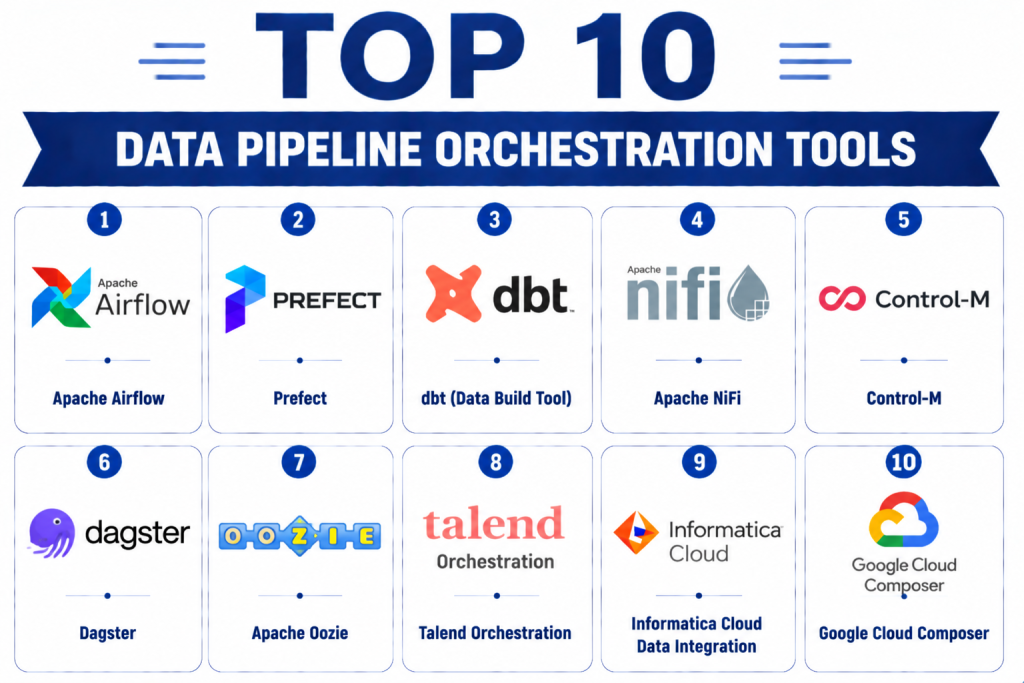
Top 10 Data Pipeline Orchestration Tools
1- Apache Airflow
Short description: Apache Airflow is an open-source platform that allows organizations to programmatically author, schedule, and monitor workflows. It is widely used for ETL pipelines, data analytics, and AI/ML workflows in enterprises.
Key Features
- DAG-based workflow design
- Scheduling and task dependency management
- Extensive integrations via operators and hooks
- Real-time monitoring and logging
- Scalable execution frameworks
- Customizable web UI dashboards
Pros
- Open-source with a large community
- Highly extensible with Python APIs
- Proven in enterprise-scale deployments
Cons
- Requires Python expertise
- Limited low-code/no-code options
Platforms / Deployment
- Linux / Cloud / On-prem
Security & Compliance
- RBAC, audit logs
- Not publicly stated for certifications
Integrations & Ecosystem
- Cloud platforms: AWS, GCP, Azure
- Databases: PostgreSQL, MySQL
- Big data frameworks: Spark, Hadoop
Support & Community
Extensive documentation, active open-source community, commercial support available.
2- Prefect
Short description: Prefect is a workflow orchestration platform for data pipelines, offering Python-native APIs, cloud orchestration, and hybrid deployment for enterprises and developers.
Key Features
- Cloud and on-prem execution
- Task orchestration and DAG management
- Failure handling, retries, and alerts
- Observability dashboards
- API-first workflow definitions
Pros
- Developer-friendly and Python-native
- Hybrid and cloud support
- Strong monitoring and logging
Cons
- Advanced enterprise features require cloud subscription
- Limited low-code interface
Platforms / Deployment
- Linux / Web / Cloud / Hybrid
Security & Compliance
- RBAC, SSO/SAML, audit logs
- SOC 2 compliance for cloud service
Integrations & Ecosystem
- SaaS and cloud integration
- Data warehouses: Snowflake, BigQuery
- Collaboration: Slack, Jira
Support & Community
Active community, commercial support plans, thorough documentation.
3- dbt (Data Build Tool)
Short description: dbt enables analytics engineers to transform, test, and document data directly in the warehouse, integrating well with orchestration tools for pipeline management.
Key Features
- SQL-based data transformation
- Version control integration
- Testing and validation framework
- Documentation generation
- Modular workflow and dependency management
Pros
- Simplifies data transformation and testing
- Strong version control and CI/CD integration
- Cloud and warehouse-native
Cons
- Focused on transformation; requires orchestration integration
- Limited streaming support
Platforms / Deployment
- Linux / Cloud / On-prem
Security & Compliance
- RBAC via connected data warehouse
- Not publicly stated
Integrations & Ecosystem
- Snowflake, BigQuery, Redshift
- Git, CI/CD pipelines
- Workflow orchestrators: Airflow, Prefect
Support & Community
Open-source community, enterprise support via dbt Labs.
4- Apache NiFi
Short description: Apache NiFi automates the flow of data between systems with visual pipelines, supporting streaming and batch data orchestration.
Key Features
- Visual data flow creation
- Real-time monitoring and metrics
- Data provenance and lineage tracking
- Flow versioning and rollback
- Multi-source integration
Pros
- Open-source and scalable
- Strong for ETL and streaming pipelines
- Visual interface for workflow design
Cons
- Primarily data-centric, not full business workflow automation
- Requires technical expertise
Platforms / Deployment
- Linux / Cloud / On-prem
Security & Compliance
- RBAC, encryption, audit logs
- Not publicly stated
Integrations & Ecosystem
- Kafka, MQTT, REST APIs
- Databases: PostgreSQL, MySQL
- Cloud storage: AWS S3, Azure Blob
Support & Community
Open-source community, active documentation and forums.
5- Control-M
Short description: Control-M provides enterprise workflow orchestration with robust scheduling, monitoring, and automation for complex IT and data pipelines.
Key Features
- Centralized job scheduling
- SLA monitoring and exception handling
- Multi-platform and cloud support
- Event-driven workflows
- Prebuilt integrations for enterprise systems
Pros
- Enterprise-grade reliability
- Strong monitoring and alerting
- Compliance-ready
Cons
- Commercial license required
- Higher cost for smaller teams
Platforms / Deployment
- Linux, Windows / Cloud / On-prem
Security & Compliance
- RBAC, SSO/SAML, encryption
- SOC 2, ISO 27001
Integrations & Ecosystem
- ERP, databases, cloud platforms
- AWS, Azure
- ServiceNow, Slack
Support & Community
Vendor support, comprehensive documentation, user forums.
6- Dagster
Short description: Dagster provides a modern orchestration platform for data pipelines, combining orchestration, testing, and observability in a Python-native framework.
Key Features
- DAG-based pipeline definition
- Python-native APIs
- Observability and monitoring
- Type system for data validation
- Cloud and on-prem execution
Pros
- Strong developer experience
- Observability and validation built-in
- Cloud and hybrid support
Cons
- Requires Python knowledge
- Learning curve for enterprise deployment
Platforms / Deployment
- Linux / Cloud / On-prem
Security & Compliance
- RBAC via deployment
- Not publicly stated
Integrations & Ecosystem
- Data warehouses: Snowflake, BigQuery
- AI/ML pipelines: TensorFlow, PyTorch
- CI/CD integration
Support & Community
Open-source community, commercial support via Elementl.
7- Apache Oozie
Short description: Oozie is an open-source workflow scheduler for Hadoop jobs, supporting data pipeline orchestration in big data environments.
Key Features
- DAG-based job orchestration
- Time and data-triggered workflows
- Hadoop ecosystem integration
- Error handling and retries
- Multi-job dependency management
Pros
- Native Hadoop integration
- Open-source and stable
- Scalable for large clusters
Cons
- Limited cloud-native capabilities
- Complex XML-based configuration
Platforms / Deployment
- Linux / On-prem / Cloud
Security & Compliance
- Hadoop RBAC
- Not publicly stated
Integrations & Ecosystem
- Hadoop, Hive, Spark
- HDFS, Kafka
- REST APIs
Support & Community
Active Apache community, documentation, and tutorials.
8- Talend Orchestration
Short description: Talend provides cloud and on-prem orchestration for data integration, transformation, and pipeline management with low-code options.
Key Features
- Visual workflow builder
- Cloud and hybrid deployment
- Data quality validation
- Scheduling and dependency management
- Prebuilt SaaS connectors
Pros
- Low-code interface
- Supports batch and streaming pipelines
- Enterprise-ready monitoring
Cons
- Commercial license required
- Limited flexibility for custom workflows
Platforms / Deployment
- Linux, Windows / Cloud / Hybrid
Security & Compliance
- RBAC, encryption
- SOC 2, ISO 27001
Integrations & Ecosystem
- Cloud: AWS, Azure, GCP
- Databases: Snowflake, Redshift
- SaaS: Salesforce, Google Analytics
Support & Community
Enterprise support, documentation, community forums.
9- Informatica Cloud Data Integration
Short description: Informatica orchestrates ETL/ELT pipelines across cloud and on-premise systems, offering enterprise data pipeline management with monitoring and automation.
Key Features
- Drag-and-drop workflow design
- Real-time monitoring and alerting
- Data quality and transformation tools
- Cloud and on-prem orchestration
- API-based integration
Pros
- Enterprise-grade reliability
- Supports hybrid cloud data pipelines
- Strong monitoring and logging
Cons
- Commercial licensing
- Complexity for small teams
Platforms / Deployment
- Web / Cloud / On-prem
Security & Compliance
- RBAC, encryption
- SOC 2, ISO 27001
Integrations & Ecosystem
- Databases, SaaS, cloud platforms
- APIs for custom integration
- BI tools and warehouses
Support & Community
Enterprise support, detailed documentation, user community.
10- Google Cloud Composer
Short description: Cloud Composer is a managed workflow orchestration service built on Apache Airflow, providing cloud-native orchestration for data pipelines and analytics workloads.
Key Features
- Managed Airflow orchestration
- Cloud-native scaling
- Integration with GCP services
- DAG-based workflows
- Monitoring and logging dashboards
Pros
- Fully managed service
- Cloud-native for scalability
- Seamless GCP integration
Cons
- Limited to Google Cloud ecosystem
- Cost scales with pipelines and usage
Platforms / Deployment
- Linux / Cloud
Security & Compliance
- RBAC, SSO/SAML
- SOC 2, ISO 27001, GDPR
Integrations & Ecosystem
- BigQuery, Dataflow, Cloud Storage
- APIs and GCP services
- Third-party connectors
Support & Community
Google enterprise support, documentation, community forums.
Comparison Table (Top 10)
| Tool Name | Best For | Platform(s) Supported | Deployment | Standout Feature | Public Rating |
|---|---|---|---|---|---|
| Apache Airflow | Data pipelines | Linux | Cloud / On-prem | DAG-based orchestration | N/A |
| Prefect | Hybrid workflows | Linux / Web | Cloud / Hybrid | Python-native APIs | N/A |
| dbt | Data transformation | Linux | Cloud / On-prem | SQL-based modular pipelines | N/A |
| Apache NiFi | Streaming & batch | Linux | Cloud / On-prem | Visual data flow orchestration | N/A |
| Control-M | Enterprise IT | Linux, Windows | Cloud / On-prem | Centralized monitoring | N/A |
| Dagster | Developer pipelines | Linux | Cloud / On-prem | Observability & Python-native | N/A |
| Apache Oozie | Hadoop ecosystems | Linux | Cloud / On-prem | Hadoop-native orchestration | N/A |
| Talend | Cloud & hybrid ETL | Linux, Windows | Cloud / Hybrid | Low-code visual builder | N/A |
| Informatica | Enterprise ETL | Web | Cloud / On-prem | End-to-end pipeline orchestration | N/A |
| Google Cloud Composer | GCP-native workflows | Linux | Cloud | Managed Airflow orchestration | N/A |
Evaluation & Scoring of Data Pipeline Orchestration Tools
| Tool Name | Core (25%) | Ease (15%) | Integrations (15%) | Security (10%) | Performance (10%) | Support (10%) | Value (15%) | Weighted Total |
|---|---|---|---|---|---|---|---|---|
| Apache Airflow | 9 | 7 | 8 | 7 | 8 | 7 | 8 | 7.9 |
| Prefect | 8 | 8 | 8 | 7 | 8 | 7 | 8 | 7.9 |
| dbt | 8 | 7 | 7 | 7 | 8 | 7 | 8 | 7.7 |
| Apache NiFi | 8 | 7 | 8 | 7 | 8 | 7 | 7 | 7.5 |
| Control-M | 9 | 7 | 8 | 8 | 9 | 8 | 7 | 8.1 |
| Dagster | 8 | 8 | 8 | 7 | 8 | 7 | 8 | 7.9 |
| Apache Oozie | 7 | 7 | 7 | 7 | 7 | 7 | 7 | 7.0 |
| Talend | 8 | 8 | 8 | 8 | 8 | 7 | 7 | 7.8 |
| Informatica | 8 | 7 | 8 | 8 | 8 | 7 | 7 | 7.8 |
| Cloud Composer | 8 | 8 | 8 | 8 | 8 | 7 | 7 | 7.8 |
Interpretation: Weighted totals indicate comparative platform strength. Higher scores suggest stronger core features, integrations, and usability. Category scores reveal specific areas of advantage for enterprise, developer, or cloud workflows.
Which Data Pipeline Orchestration Tool Is Right for You?
Solo / Freelancer
- Zapier or Prefect for lightweight automation and pipeline experimentation.
SMB
- Apache Airflow or Dagster for medium-scale workflows with developer-friendly interfaces.
Mid-Market
- Apache NiFi, Talend, or dbt for multi-source orchestration and transformation.
Enterprise
- Control-M, Informatica, or Cloud Composer for robust, monitored, and scalable enterprise pipelines.
Budget vs Premium
- Open-source tools provide cost efficiency; commercial platforms provide enterprise-grade support and monitoring.
Feature Depth vs Ease of Use
- Dagster and Prefect offer developer-centric depth; Talend and Control-M balance low-code interfaces with advanced features.
Integrations & Scalability
- Cloud Composer, Airflow, and NiFi scale across cloud, hybrid, and on-prem environments.
Security & Compliance Needs
- Enterprises requiring audit trails, encryption, and SOC 2/ISO compliance should prefer Control-M, Informatica, or Cloud Composer.
Frequently Asked Questions (FAQs)
1- What pricing models are used for these tools?
Open-source tools are free; commercial platforms use subscription, usage, or enterprise licensing.
2- How long does implementation take?
Small pipelines deploy within days; enterprise-grade solutions require weeks of configuration.
3- Can these tools handle streaming and batch pipelines?
Yes, most top tools support batch, streaming, and hybrid data workflows.
4- Are AI/ML features included?
Some platforms, like Dagster and Cloud Composer, include AI-driven monitoring and anomaly detection.
5- Do these tools integrate with cloud and on-prem data?
Yes, they integrate with AWS, Azure, GCP, SaaS apps, and on-prem databases.
6- Can business users adopt low-code/no-code workflows?
Platforms like Talend and Cloud Composer offer visual workflow design for non-developers.
7- What are common mistakes when adopting these tools?
Neglecting monitoring, ignoring dependency management, or choosing tools misaligned with existing tech stack.
8- How is security handled?
Enterprise platforms support RBAC, SSO/SAML, encryption, and audit logging; open-source tools require configuration.
9- Are multi-cloud workflows supported?
Yes, platforms like Prefect, Airflow, and Cloud Composer can orchestrate cross-cloud pipelines.
10- What are alternatives for small teams?
Lightweight ETL tools, SaaS connectors, or simple cron-based automation may suffice.
Conclusion
Data Pipeline Orchestration Tools streamline multi-source workflows, automate complex ETL/ELT processes, and provide visibility into data pipelines. The “best” tool depends on scale, technical expertise, cloud strategy, and workflow complexity. Open-source platforms like Airflow, Dagster, and dbt provide flexibility, while commercial tools like Control-M, Informatica, and Cloud Composer offer enterprise-grade monitoring, security, and support.
