Introduction
Hospital Information Systems (HIS) are comprehensive software platforms designed to manage clinical, administrative, financial, and operational functions in hospitals and healthcare networks.
They integrate patient records, scheduling, billing, pharmacy, lab systems, and reporting into unified workflows that improve efficiency and reduce errors.
Modern HIS platforms also support interoperability with external systems, decision‑making analytics, and regulatory compliance to enhance patient care and operational visibility.
Choosing the right HIS ensures streamlined processes across departments, better clinical outcomes, and scalable support for multi‑facility operations.
Real‑world use cases:
- Centralized patient record, appointment, and billing management
- Automated pharmacy, laboratory, and radiology integration
- Operational dashboards and quality reporting
- Resource scheduling and bed management
- Regulatory compliance and analytics
Key buyer evaluation criteria:
- Comprehensive clinical and administrative coverage
- Interoperability and standards (FHIR, HL7)
- Billing, claims, and revenue cycle support
- Analytics, dashboarding, and reporting
- Scalability for hospitals and multi‑site networks
- Security, auditing, and regulatory compliance
- Deployment flexibility (Cloud vs On‑premises)
- Mobile and patient engagement modules
- Integration with external healthcare systems
Best for: Hospitals, multi‑specialty clinics, healthcare networks, and integrated delivery systems.
Not ideal for: Small standalone clinics that only require basic EMR/EHR features.
Key Trends in Hospital Information Systems
- Cloud‑native HIS with scalable multi‑site architecture
- Interoperability via FHIR, HL7, and open APIs
- AI‑assisted decision support and predictive analytics
- Integrated revenue cycle and billing automation
- Patient portals and mobile applications
- Real‑time operational dashboards
- Telehealth and remote care modules
- Data security, encryption, audit logging
- Modular solutions with specialty‑specific workflows
- Flexible subscription and licensing models
How We Selected These Tools (Methodology)
- Adoption and usage in large hospitals and healthcare networks
- Breadth of clinical, administrative, and financial modules
- Interoperability and standards compliance
- Integration with labs, pharmacy, radiology, and billing systems
- Deployment flexibility (Cloud, On‑premises, Hybrid)
- Security, encryption, and audit capabilities
- Analytics and quality reporting features
- Vendor support, training, and documentation
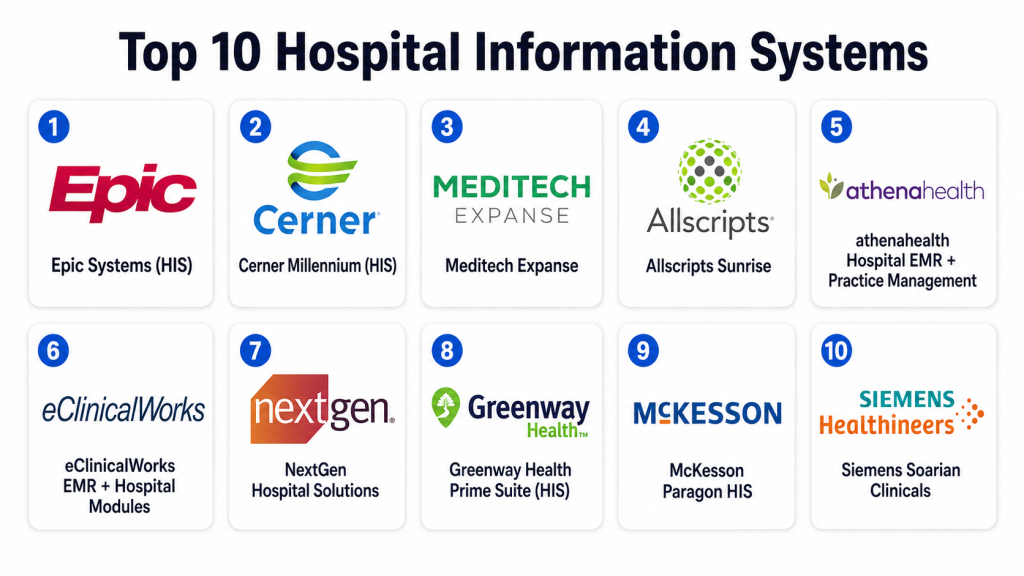
Top 10 Hospital Information Systems
#1 — Epic Systems (HIS)
Short description:
Epic Systems provides a comprehensive HIS suite for large hospitals and integrated delivery networks.
Supports clinical, financial, and operational workflows under one platform.
Includes analytics, interoperability, and patient engagement tools.
Ideal for enterprise hospitals and multi‑facility networks.
Key Features
- Integrated clinical and administrative modules
- Revenue cycle and billing automation
- Population health and analytics
- Interoperability via FHIR/HL7
- Patient portals and telehealth
Pros
- End‑to‑end hospital coverage
- Strong interoperability and scalability
- Powerful analytics and reporting
Cons
- High implementation cost
- Complex deployment and training
Platforms / Deployment
- Web / Windows / iOS
- Cloud / On‑premises
Security & Compliance
- Encryption, role‑based access
- HIPAA & HITECH compliance
Integrations & Ecosystem
- HL7/FHIR APIs
- Third‑party app marketplace
- Telehealth, labs, pharmacy connectors
Support & Community
- Extensive vendor training
- Large user community
#2 — Cerner Millennium (HIS)
Short description:
Cerner Millennium HIS supports clinical workflow, administrative operations, and financial revenue cycle.
Offers interoperability, analytics, and decision support.
Suitable for mid‑to‑large healthcare systems.
Provides multiple deployment options.
Key Features
- Clinical documentation and CPOE
- Billing and claims management
- Interoperability standards support
- Operational dashboards and analytics
- Lab, pharmacy, and imaging integration
Pros
- Scalable for multi‑facility operations
- Strong data integration
- Cloud and hybrid options
Cons
- Customization complexity
- Higher cost structure
Platforms / Deployment
- Web / Windows / iOS
- Cloud / On‑premises
Security & Compliance
- Encryption, SSO/MFA
- HIPAA compliance
Integrations & Ecosystem
- FHIR/HL7 standards
- Third‑party connectors
Support & Community
- Vendor support programs
- User forums
#3 — Meditech Expanse
Short description:
Meditech Expanse is a modular HIS designed for hospitals and health systems.
Supports clinical, billing, and administrative workflows.
Cloud and on‑premises deployment with mobile access.
Ideal for mid‑to‑large healthcare organizations.
Key Features
- Clinical and administrative modules
- Patient engagement and portals
- Lab, radiology,/pharmacy integration
- Analytics and reporting
Pros
- Mobile‑friendly and modern interface
- Scales across facilities
- Cloud and local options
Cons
- Training required for full utilization
- Premium cost
Platforms / Deployment
- Web / iOS / Windows
- Cloud / On‑premises
Security & Compliance
- Audit logging and encryption
- HIPAA & HITECH compliance
Integrations & Ecosystem
- FHIR/HL7 interfaces
- Third‑party apps and extensions
Support & Community
- Vendor support
- Documentation
#4 — Allscripts Sunrise
Short description:
Allscripts Sunrise HIS provides clinical and financial workflows for hospitals.
Includes interoperability, analytics, and patient engagement.
Ideal for specialty and general hospitals.
Supports cross‑departmental integration.
Key Features
- Clinical documentation & order entry
- Revenue cycle management
- Patient portal and telehealth
- Analytics dashboards, quality reporting
Pros
- Flexible and modular
- Cloud‑enabled options
- Multi‑specialty support
Cons
- Implementation complexity
- Premium pricing
Platforms / Deployment
- Web / Windows / iOS
- Cloud / On‑premises
Security & Compliance
- Encryption, audit trails
- HIPAA compliance
Integrations & Ecosystem
- HL7/FHIR support
- Third‑party tools
Support & Community
- Vendor support
- Community forums
#5 — athenahealth Hospital EMR + Practice Management
Short description:
athenahealth offers cloud‑based EMR and practice management integrated with hospital workflows.
Supports billing, scheduling, and patient engagement.
Ideal for ambulatory and smaller hospitals.
Includes analytics and interoperability.
Key Features
- Cloud EMR and scheduling
- Billing and claims integration
- Patient portals and telehealth
- Analytics & reporting
Pros
- Cloud‑native with fast deployment
- Cost‑effective for smaller networks
- Strong patient engagement focus
Cons
- Limited enterprise and inpatient features
- Dependent on internet connectivity
Platforms / Deployment
- Web / iOS
- Cloud
Security & Compliance
- Encryption, access control
- HIPAA compliant
Integrations & Ecosystem
- FHIR/HL7 APIs
- Telehealth connectors
Support & Community
- Vendor support
- Guides and documentation
#6 — eClinicalWorks EMR + Hospital Modules
Short description:
eClinicalWorks combines EMR with hospital administrative and clinical features.
Supports documentation, scheduling, and population health.
Ideal for community hospitals and integrated health networks.
Includes patient engagement and allowing interoperability.
Key Features
- Clinical documentation & order sets
- Scheduling & workflow management
- Analytics dashboards
- Lab/pharmacy integration
Pros
- Cloud‑centric platform
- Comprehensive documentation tools
Cons
- Smaller ecosystem vs larger HIS
- Training recommended
Platforms / Deployment
- Web / iOS
- Cloud
Security & Compliance
- Encryption
- HIPAA compliant
Integrations & Ecosystem
- FHIR/HL7 support
- Third‑party connectors
Support & Community
- Vendor support
- Tutorials
#7 — NextGen Hospital Solutions
Short description:
NextGen Healthcare provides hospital modules integrated with EMR and practice management.
Supports documentation, billing, and clinical workflows.
Ideal for smaller hospitals and multi‑provider practices.
Includes analytics and reporting tools.
Key Features
- Clinical documentation & CPOE
- Billing, scheduling, claims support
- Analytics and quality reporting
- Interoperability
Pros
- Flexible deployment
- Cloud or on‑premises
- User‑friendly modules
Cons
- Limited enterprise functionality
- Building advanced workflows may require support
Platforms / Deployment
- Web / Windows / iOS
- Cloud / On‑premises
Security & Compliance
- Encryption, access control
- HIPAA compliant
Integrations & Ecosystem
- FHIR/HL7 support
Support & Community
- Vendor support
- Documentation
#8 — Greenway Health Prime Suite (HIS)
Short description:
Greenway Prime Suite HIS integrates clinical, billing, and operational workflows.
Ideal for ambulatory surgery centers and community hospitals.
Supports patient engagement and reporting.
Includes interoperability features.
Key Features
- Clinical documentation & scheduling
- Billing & claims management
- Patient portal & telehealth
- Analytics dashboards
Pros
- Integrated hospital workflows
- Scalable for community practices
- Cloud or local deployment
Cons
- Complex implementation
- Subscription cost
Platforms / Deployment
- Web / Windows / iOS
- Cloud / On‑premises
Security & Compliance
- Encryption & audit logs
- HIPAA compliant
Integrations & Ecosystem
- FHIR/HL7 connectivity
Support & Community
- Vendor support
- Tutorials
#9 — McKesson Paragon HIS
Short description:
McKesson Paragon HIS provides integrated clinical and administrative hospital systems.
Supports patient records, pharmacy, billing, and analytics.
Ideal for community and mid‑sized hospitals.
Includes quality reporting tools.
Key Features
- Clinical documentation & CPOE
- Pharmacy & lab integration
- Billing & revenue cycle
- Analytics and reporting
Pros
- Strong integration across hospital functions
- Scalable for mid‑sized health systems
Cons
- Premium pricing
- Implementation and customization effort
Platforms / Deployment
- Web / Windows
- Cloud / On‑premises
Security & Compliance
- Encryption, RBAC
- HIPAA & HITECH compliant
Integrations & Ecosystem
- HL7/FHIR support
- Third‑party extensions
Support & Community
- Vendor support
- Documentation
#10 — Siemens Soarian Clinicals
Short description:
Siemens Soarian Clinicals HIS focuses on clinical workflows and administrative operations.
Supports documentation, orders, and resource scheduling.
Ideal for large community hospitals and specialty care centers.
Includes reporting and decision support tools.
Key Features
- Clinical documentation & case management
- Scheduling & resource optimization
- Billing and claims support
- Analytics and quality reporting
Pros
- Comprehensive clinical modules
- Scalable for larger networks
Cons
- Aging user interface
- Training needed
Platforms / Deployment
- Web / Windows
- Cloud / On‑premises
Security & Compliance
- Encryption, audit trails
- HIPAA compliant
Integrations & Ecosystem
- FHIR/HL7 support
- Third‑party systems
Support & Community
- Vendor support
- Documentation
Comparison Table (Top 10)
| Tool Name | Best For | Platform(s) | Deployment | Standout Feature | Public Rating |
|---|---|---|---|---|---|
| Epic Systems | Enterprise hospitals | Web/Windows/iOS | Cloud/On‑prem | Complete HIS suite | N/A |
| Cerner Millennium | Health networks | Web/Windows/iOS | Cloud/On‑prem | Interoperability & analytics | N/A |
| Meditech Expanse | Multi‑facility systems | Web/Windows/iOS | Cloud/On‑prem | Cloud & mobile integration | N/A |
| Allscripts Sunrise | Mid‑large hospitals | Web/Windows/iOS | Cloud/On‑prem | Modular workflows | N/A |
| athenahealth | Ambulatory hospitals | Web/iOS | Cloud | Cloud EMR + practice integration | N/A |
| eClinicalWorks | Community hospitals | Web/iOS | Cloud | Documentation & engagement | N/A |
| NextGen Hospital | Small/medium hospitals | Web/Windows/iOS | Cloud/On‑prem | Flexible modules | N/A |
| Greenway Prime Suite | Ambulatory & community | Web/Windows/iOS | Cloud/On‑prem | Integrated clinical & billing | N/A |
| McKesson Paragon | Community hospitals | Web/Windows | Cloud/On‑prem | Integrated hospital functions | N/A |
| Siemens Soarian | Specialty and general hospitals | Web/Windows | Cloud/On‑prem | Clinical & admin workflows | N/A |
Evaluation & Scoring
| Tool | Core (25%) | Ease (15%) | Integrations (15%) | Security (10%) | Performance (10%) | Support (10%) | Value (15%) | Weighted Total |
|---|---|---|---|---|---|---|---|---|
| Epic Systems | 10 | 7 | 8 | 8 | 9 | 8 | 6 | 8.3 |
| Cerner | 9 | 7 | 8 | 8 | 8 | 7 | 6 | 7.8 |
| Meditech Expanse | 9 | 7 | 8 | 8 | 8 | 7 | 6 | 7.7 |
| Allscripts Sunrise | 8 | 8 | 7 | 7 | 8 | 7 | 6 | 7.5 |
| athenahealth | 8 | 9 | 7 | 7 | 7 | 7 | 7 | 7.6 |
| eClinicalWorks | 8 | 8 | 7 | 7 | 7 | 7 | 7 | 7.5 |
| NextGen Hospital | 8 | 8 | 7 | 7 | 7 | 7 | 6 | 7.3 |
| Greenway Prime Suite | 8 | 7 | 7 | 7 | 7 | 7 | 6 | 7.1 |
| McKesson Paragon | 9 | 7 | 8 | 8 | 8 | 7 | 6 | 7.8 |
| Siemens Soarian | 8 | 7 | 7 | 7 | 8 | 7 | 6 | 7.3 |
Decision Guide
Enterprise Systems
Epic Systems and Cerner Millennium offer complete hospital information workflows and integration for large health networks.
Cloud‑Centric HIS
athenahealth and Meditech Expanse provide cloud apps and mobile access, ideal for modern multi‑site systems.
Mid‑Sized Hospitals
Allscripts Sunrise and McKesson Paragon balance modularity and comprehensive features.
Community & Ambulatory
eClinicalWorks and Greenway Prime Suite support community hospital workflows with clinical and billing modules.
Flexible & Integrated
NextGen Hospital solutions adapt to small/medium hospitals needing flexible deployment.
Frequently Asked Questions (FAQs)
1. What’s the difference between HIS and EMR?
HIS covers the entire hospital ecosystem including administrative and financial workflows, while EMR focuses on clinical patient records.
2. Are HIS systems HIPAA compliant?
Yes, top HIS platforms include encryption, role‑based access, and audit logging to ensure HIPAA compliance.
3. Do HIS platforms support FHIR and HL7?
Yes, modern HIS systems support FHIR/HL7 interoperability for seamless data exchange.
4. Can HIS integrate with telehealth?
Many provide integrated telehealth modules or APIs for third‑party telehealth solutions.
5. Are analytics and dashboards included?
Yes, HIS platforms offer operational, clinical, and financial analytics for decision‑making.
6. Do HIS systems handle billing and revenue cycle?
All major HIS provide revenue cycle modules including billing, claims management, and reporting.
7. Is cloud deployment available?
Yes, many HIS platforms offer cloud‑native and hybrid deployment models.
8. What training is required?
Enterprise HIS typically require vendor‑led training due to configuration complexity.
9. Can multi‑site hospitals share one HIS?
Yes, modern systems support centralized administration for distributed networks.
10. Are mobile apps supported for clinicians?
Yes, mobile access and clinician portals are available in leading HIS systems.
Conclusion
Choosing the right Hospital Information System depends on hospital size, clinical and administrative needs, and scalability requirements. Enterprise hospitals benefit from all‑in‑one platforms like Epic Systems and Cerner Millennium that provide deep clinical, financial, and interoperability features. Cloud‑centric systems like athenahealth and Meditech Expanse offer fast deployment and mobile access for modern healthcare environments. Community and mid‑sized hospitals can leverage Allscripts Sunrise, McKesson Paragon, or eClinicalWorks for balanced workflows across clinical and billing domains. Prioritizing interoperability, analytics, and vendor support ensures improved operational efficiency, compliance, and patient care outcomes.
