Introduction
Large Language Models (LLMs) have transformed AI by powering applications like chatbots, content generation, summarization, and advanced analytics. Hosting these models efficiently requires specialized platforms that manage infrastructure, scaling, and latency, allowing teams to focus on building applications rather than managing servers. The right platform ensures high performance, security, and cost efficiency while offering developer-friendly APIs and tools. Real-world use cases include enterprise customer support automation, large-scale content personalization, AI research, and conversational AI deployment in SaaS products. Buyers evaluating these platforms should consider model availability, API flexibility, scalability, latency, security compliance, and pricing.
Best for
Enterprises, AI startups, and developers who need scalable, secure, and production-ready LLM hosting with minimal infrastructure management.
Not ideal for
Organizations that require fully on-premises hosting of experimental models, or have strict budget constraints for occasional usage.
Key Trends
- Multi-cloud hosting for redundancy and flexibility
- Demand for low-latency inference at scale
- Built-in fine-tuning and prompt management capabilities
- Hybrid on-prem/cloud solutions emerging
- Enterprise-grade security and compliance (SOC 2, ISO 27001, GDPR)
- Pay-as-you-go and usage-based pricing gaining popularity
- Pre-built integrations with popular AI frameworks and pipelines
- Real-time monitoring and observability becoming standard
- Focus on energy-efficient inference and model optimization
- Managed services for specialized LLMs like GPT and LLaMA
Methodology
- Selected platforms based on adoption, capabilities, and community feedback
- Evaluated scalability, ease of integration, performance, security, support, and pricing
- Prioritized platforms with API access, fine-tuning, and multi-model hosting
- Considered cloud-native and hybrid deployment options
- Benchmarked documentation, SDKs, and developer tools
- Targeted developers, researchers, and enterprises
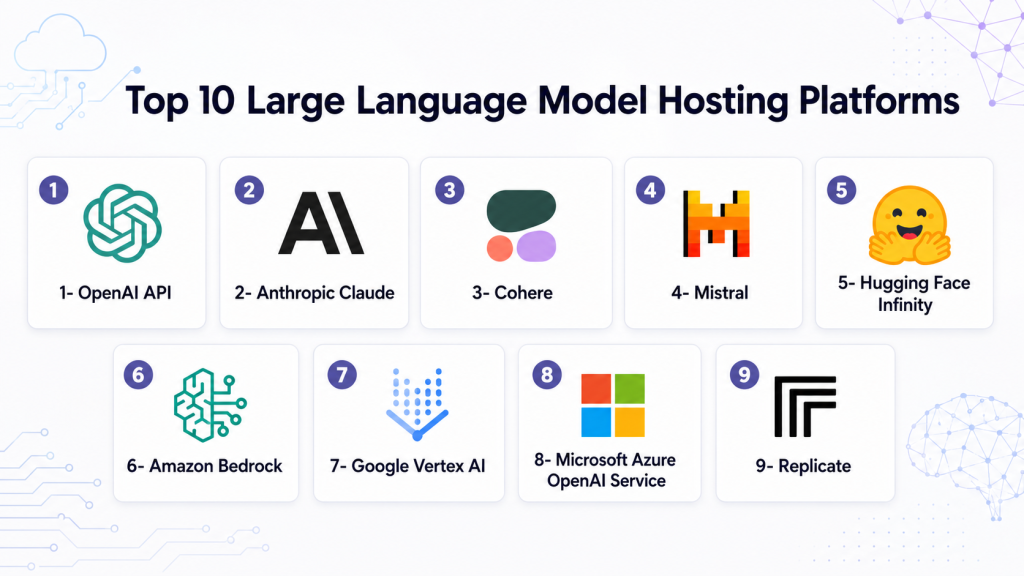
Top 10 Large Language Model Hosting Platforms
1- OpenAI API
Verdict: Highly reliable LLM hosting with wide model access.
Short Description: OpenAI API provides cloud-hosted GPT models with scalable endpoints and managed fine-tuning.
Standout Capabilities / Key Features:
- GPT family models and embeddings
- Managed fine-tuning
- Real-time API endpoints
- Rate limits and usage controls
- SDKs for multiple languages
Pros: Reliable uptime, extensive documentation, high-quality models
Cons: Cost escalates with heavy usage, limited on-prem flexibility
Platforms / Deployment: Cloud-native, fully managed
Security & Compliance: SOC 2, ISO 27001, GDPR
Integrations & Ecosystem: Works with major pipelines, Python/Node.js SDKs
Support & Community: Developer forums, Slack community
Pricing Model: Usage-based, tiered API pricing
Best-Fit Scenarios: Enterprises and developers needing production-ready GPT models
2- Anthropic Claude
Verdict: AI-first hosting with strong safety and alignment focus.
Short Description: Claude API provides cloud-hosted LLMs emphasizing controllability, alignment, and safety for conversational AI.
Standout Capabilities / Key Features:
- Safe, aligned AI models
- Multi-turn conversation handling
- Fine-tuning and prompt optimization
- Usage analytics
- Rate-limited API
Pros: Safety and ethical AI focus
Cons: Smaller ecosystem, less flexible pricing
Platforms / Deployment: Cloud API
Security & Compliance: SOC 2, GDPR
Integrations & Ecosystem: Python SDK, enterprise integrations
Support & Community: Documentation and developer portal
Pricing Model: Subscription + usage-based
Best-Fit Scenarios: Enterprises prioritizing safety and alignment
3- Cohere
Verdict: Flexible LLM hosting for embeddings and text generation.
Short Description: Cohere offers scalable APIs for text generation, semantic embeddings, and NLP tasks.
Standout Capabilities / Key Features:
- Text generation and embeddings
- Fine-tuning support
- SDKs for Python and JavaScript
- Managed infrastructure
- High-traffic scaling
Pros: Strong embedding support, developer-friendly
Cons: Limited model variety
Platforms / Deployment: Cloud-managed
Security & Compliance: SOC 2, GDPR
Integrations & Ecosystem: Python/JS SDKs, cloud apps
Support & Community: Docs and forums
Pricing Model: Usage-based or subscription
Best-Fit Scenarios: Semantic search, NLP applications, recommendations
4- Mistral
Verdict: Cutting-edge open-weight LLM hosting for experimentation.
Short Description: Mistral provides open-weight models with high-performance inference for research and experimentation.
Standout Capabilities / Key Features:
- Open-weight, high-efficiency models
- Optimized inference endpoints
- Multi-model support
- Customizable pipelines
- API access
Pros: High flexibility, research-friendly
Cons: Limited production support, smaller ecosystem
Platforms / Deployment: Cloud-hosted
Security & Compliance: Varies / N/A
Integrations & Ecosystem: Python API
Support & Community: Community-driven
Pricing Model: Usage-based
Best-Fit Scenarios: AI researchers and experimental deployments
5- Hugging Face Infinity
Verdict: Managed LLM hosting with multi-framework support.
Short Description: Hugging Face Infinity provides fast, scalable inference for multiple model frameworks with managed deployment.
Standout Capabilities / Key Features:
- Low-latency inference
- Multi-framework support (PyTorch, TensorFlow, JAX)
- Managed scaling and deployment
- API and SDK access
- Model repository integration
Pros: Strong community, low-latency endpoints
Cons: Paid plans required for production
Platforms / Deployment: Cloud-managed
Security & Compliance: SOC 2, GDPR
Integrations & Ecosystem: Hugging Face Hub, Python SDKs
Support & Community: Docs, community models
Pricing Model: Subscription + usage tiers
Best-Fit Scenarios: Developers using Hugging Face models in production
6- Amazon Bedrock
Verdict: Enterprise-grade LLM hosting integrated with AWS.
Short Description: Bedrock hosts multiple foundation models with API access, leveraging AWS security and scalability.
Standout Capabilities / Key Features:
- Multi-model support (AI21, Anthropic, Stability AI)
- Managed infrastructure
- Fine-tuning endpoints
- API + SDK access
- AWS ecosystem integration
Pros: Enterprise-ready, scalable
Cons: AWS vendor lock-in
Platforms / Deployment: Cloud-native AWS
Security & Compliance: SOC 2, ISO, HIPAA, GDPR
Integrations & Ecosystem: AWS SDKs, Lambda, SageMaker
Support & Community: AWS support tiers, forums
Pricing Model: Pay-as-you-go
Best-Fit Scenarios: Enterprises leveraging AWS
7- Google Vertex AI
Verdict: Fully managed hosting integrated with Google Cloud.
Short Description: Vertex AI hosts foundation models with fine-tuning, batch and real-time inference, and integrated monitoring.
Standout Capabilities / Key Features:
- Multi-model support
- Fine-tuning and training
- Real-time and batch inference
- Monitoring and logging
- Secure APIs
Pros: GCP integration, enterprise-ready
Cons: Learning curve for non-GCP users
Platforms / Deployment: Cloud-managed
Security & Compliance: SOC 2, ISO, GDPR
Integrations & Ecosystem: GCP tools, BigQuery, Dataflow
Support & Community: Docs and GCP support
Pricing Model: Usage-based
Best-Fit Scenarios: Enterprises on Google Cloud
8- Microsoft Azure OpenAI Service
Verdict: LLM hosting with enterprise-grade compliance.
Short Description: Azure OpenAI Service provides GPT model hosting with enterprise-grade security, API access, and managed scaling.
Standout Capabilities / Key Features:
- GPT-3.5 and GPT-4 models
- Managed endpoints and scaling
- Enterprise security
- Monitoring tools
- SDK support
Pros: Strong compliance, Azure integration
Cons: Limited fine-tuning options
Platforms / Deployment: Cloud-managed on Azure
Security & Compliance: SOC 2, ISO, HIPAA, GDPR
Integrations & Ecosystem: Azure SDKs, Power Platform
Support & Community: Microsoft support and docs
Pricing Model: Usage-based
Best-Fit Scenarios: Enterprises in Microsoft ecosystem
9- Replicate
Verdict: Simple LLM hosting for developers and enthusiasts.
Short Description: Replicate hosts open-source LLMs via simple API access, focusing on quick deployment.
Standout Capabilities / Key Features:
- Open-source model hosting
- API for real-time inference
- Model versioning
- Developer dashboard
- Web app integration
Pros: Easy setup, fast experimentation
Cons: Limited scalability, less enterprise support
Platforms / Deployment: Cloud-managed
Security & Compliance: Varies / N/A
Integrations & Ecosystem: Python SDK, API
Support & Community: Community forums
Pricing Model: Usage-based
Best-Fit Scenarios: Startups, individual developers
10- Aleph Alpha
Verdict: European LLM hosting with privacy focus.
Short Description: Aleph Alpha hosts multi-lingual LLMs with enterprise-grade compliance and strong privacy standards.
Standout Capabilities / Key Features:
- Multi-lingual LLMs
- Fine-tuning and embeddings API
- EU privacy and compliance focus
- Secure deployment
- Python SDK
Pros: Privacy-focused, multi-lingual
Cons: Smaller model ecosystem
Platforms / Deployment: Cloud-hosted
Security & Compliance: GDPR, SOC 2, ISO 27001
Integrations & Ecosystem: API and enterprise connectors
Support & Community: Enterprise support, documentation
Pricing Model: Subscription / usage-based
Best-Fit Scenarios: EU enterprises, privacy-sensitive applications
Comparison Table
| Platform | Model Support | Fine-tuning | Latency | Security | API | Ecosystem |
|---|---|---|---|---|---|---|
| OpenAI API | GPT family | Yes | Low | SOC2, ISO | REST | SDKs |
| Anthropic Claude | Claude | Yes | Medium | SOC2, GDPR | REST | SDK |
| Cohere | Text, Embeddings | Yes | Low | SOC2, GDPR | REST | SDKs |
| Mistral | Open-weight | Yes | Low | Varies | REST | Python SDK |
| Hugging Face Infinity | HF models | Yes | Very low | SOC2, GDPR | REST | Hub + SDKs |
| Amazon Bedrock | Multi-model | Yes | Low | SOC2, ISO, HIPAA | REST | AWS |
| Vertex AI | GCP models | Yes | Low | SOC2, ISO, GDPR | REST | GCP tools |
| Azure OpenAI | GPT models | Limited | Low | SOC2, ISO, HIPAA | REST | Azure tools |
| Replicate | Open-source | Limited | Medium | Varies | REST | API |
| Aleph Alpha | Multi-lingual | Yes | Medium | GDPR, SOC2 | REST | Enterprise SDKs |
Evaluation & Scoring Table
| Platform | Core 25% | Ease 15% | Integrations 15% | Security 10% | Performance 10% | Support 10% | Value 15% | Total |
|---|---|---|---|---|---|---|---|---|
| OpenAI API | 25 | 14 | 13 | 9 | 9 | 9 | 12 | 91 |
| Anthropic Claude | 23 | 12 | 12 | 9 | 8 | 8 | 11 | 83 |
| Cohere | 22 | 14 | 12 | 9 | 9 | 8 | 12 | 86 |
| Mistral | 21 | 12 | 11 | 8 | 9 | 7 | 12 | 80 |
| Hugging Face Infinity | 24 | 14 | 13 | 9 | 10 | 9 | 12 | 91 |
| Amazon Bedrock | 25 | 13 | 14 | 10 | 10 | 9 | 11 | 92 |
| Vertex AI | 24 | 13 | 13 | 10 | 10 | 9 | 11 | 90 |
| Azure OpenAI | 24 | 13 | 13 | 10 | 10 | 9 | 11 | 90 |
| Replicate | 19 | 14 | 10 | 7 | 8 | 7 | 12 | 77 |
| Aleph Alpha | 22 | 12 | 11 | 10 | 9 | 8 | 11 | 83 |
Which Large Language Model Hosting Platform Is Right for You?
- Solo / Developers: Replicate, Hugging Face Infinity, Cohere
- SMB: OpenAI API, Cohere, Hugging Face Infinity
- Mid-Market: Vertex AI, Amazon Bedrock, Azure OpenAI
- Enterprise: OpenAI API, Amazon Bedrock, Azure OpenAI, Aleph Alpha
- Budget vs Premium: Replicate for low-cost experimentation; OpenAI, Vertex AI, Bedrock for full-featured production
- Feature Depth vs Ease: Hugging Face Infinity and OpenAI API balance ease and features
- Integrations & Scalability: Amazon Bedrock and Vertex AI excel
- Security & Compliance Needs: Aleph Alpha, Azure OpenAI, Amazon Bedrock
Implementation Playbook (30/60/90 Days)
- 30 Days: Test endpoints, validate model selection, run small pilot
- 60 Days: Integrate into production, monitor performance, optimize prompts/fine-tuning
- 90 Days: Scale usage, manage costs, expand workflows
Common Mistakes
- Ignoring latency requirements
- Underestimating inference cost at scale
- Weak API key and data security
- Choosing a platform without needed models/language support
- Skipping fine-tuning or prompt optimization
Frequently Asked Questions
What is an LLM hosting platform?
An LLM hosting platform provides infrastructure to deploy, scale, and manage large language models without requiring in-house server management.
Do all platforms support fine-tuning?
Not all. Platforms like OpenAI API, Cohere, and Hugging Face Infinity support fine-tuning, while some like Replicate have limited options.
Which platform is best for low latency?
Hugging Face Infinity, Amazon Bedrock, and OpenAI API provide low-latency endpoints suitable for production.
Are these platforms secure for enterprise use?
Yes. Many platforms comply with SOC 2, ISO 27001, GDPR, and in some cases HIPAA for healthcare workloads.
Can I host custom models?
Platforms like Mistral and Replicate allow open-weight or custom models, while others focus on pre-trained foundation models.
Is cloud dependency a concern?
Yes. Most platforms are cloud-hosted; on-prem options are limited, so organizations must plan around cloud reliance.
How is pricing structured?
Typically usage-based, sometimes with subscription tiers. Heavy inference workloads can increase costs significantly.
Do platforms provide SDKs?
Most provide SDKs for Python, JavaScript, and REST API endpoints to simplify integration.
Which platform is beginner-friendly?
Replicate and OpenAI API are straightforward for developers to start experimenting.
Can I integrate these with my existing AI pipelines?
Yes. APIs, SDKs, and cloud integration tools allow connection to data pipelines, SaaS apps, and workflow tools.
Are multi-lingual models available?
Aleph Alpha and some OpenAI models provide multi-lingual capabilities, while others focus mainly on English.
Can I monitor performance and usage?
Yes. Most platforms include dashboards, logging, and analytics for usage, latency, and error monitoring.
Conclusion
Choosing the right LLM hosting platform is critical for scaling AI applications efficiently. Developers and enterprises can leverage OpenAI API, Hugging Face Infinity, Amazon Bedrock, and other platforms based on workload, cost, and compliance needs. A structured evaluation considering latency, fine-tuning, model variety, and security ensures production-ready deployment. Next steps include shortlisting platforms for your use case, piloting workloads, and validating scalability and cost efficiency before full rollout. This approach ensures reliable LLM deployment while maximizing the latest AI capabilities.
