Introduction
Pharmacovigilance software helps healthcare organizations collect, track, and analyze adverse event (AE) and drug safety data.
It ensures regulatory compliance by supporting case management, signal detection, and safety reporting.
These systems automate workflows, reduce manual errors, and enable rapid response to safety concerns.
Choosing the right pharmacovigilance platform improves patient safety, speeds regulatory submissions, and streamlines global safety operations.
Real‑world use cases:
- Life sciences companies monitoring post‑market drug safety
- Contract research organizations (CROs) managing safety data for sponsors
- Regulatory affairs teams preparing periodic safety reports
- Hospitals and clinical research sites tracking adverse events
- Public health agencies analyzing safety trends
Key buyer evaluation criteria:
- Case intake and data capture
- Standardization and coding (MedDRA, WHO‑DRL)
- Signal detection and analytics
- Regulatory reporting (e.g., CIOMS, FDA, EudraVigilance)
- Workflow automation
- Integration with EDC, CTMS, and safety databases
- Security and audit trails
- Multi‑region regulatory compliance
- Scalability and support
Best for: Pharmaceutical companies, biotech firms, CROs, regulatory affairs teams, and safety reporting units.
Not ideal for: Organizations without safety reporting obligations or minimal adverse event tracking.
Key Trends in Pharmacovigilance Software
- Cloud‑based safety databases with global access
- AI‑assisted signal detection and data mining
- Automated regulatory reporting workflows
- Integration with EDC, trial systems, and safety registries
- Real‑time dashboards and KPI tracking
- Mobile access for field safety reporting
- Standardized coding (MedDRA, WHO‑ART) integration
- Enhanced security, audit trails, and compliance logging
- Flexible pricing models
- Scalable architectures for multi‑region operations
How We Selected These Tools (Methodology)
- Adoption and regulatory credibility in pharmacovigilance
- Feature completeness (case management, signal detection, reporting)
- Security and compliance capabilities
- Integration with clinical trial and safety systems
- Scalability for global safety operations
- Ease of use and adoption
- Vendor support and documentation
- Analytics and alerting capabilities
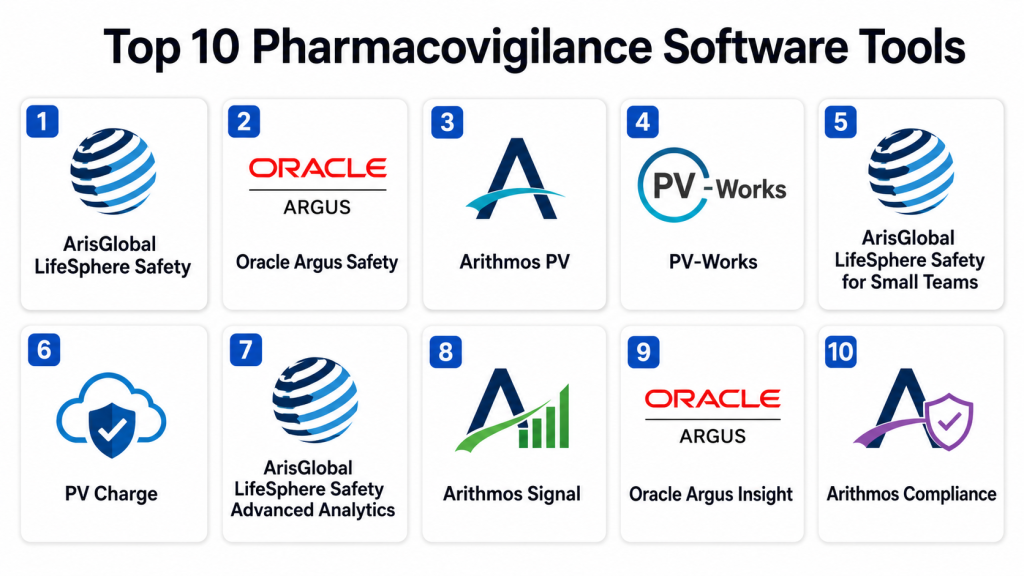
Top 10 Pharmacovigilance Software Tools
#1 — ArisGlobal LifeSphere Safety
Short description:
ArisGlobal LifeSphere Safety is a comprehensive drug safety and pharmacovigilance platform.
Supports case intake, coding, signal detection, and periodic reporting.
Cloud‑enabled with global regulatory coverage.
Ideal for large pharma and global safety teams.
Key Features
- Case management and workflow automation
- MedDRA and WHO‑ART coding
- Signal detection and dashboards
- Regulatory submission generation
- Audit trails and access control
Pros
- Enterprise‑scale capability
- Strong regulatory compliance support
- Workflow automation
Cons
- Higher cost for small teams
- Complex implementation
Platforms / Deployment
- Web
- Cloud
Security & Compliance
- Encryption, role‑based access
- Regulatory compliance: MedDRA, CIOMS, FDA, EudraVigilance
Integrations & Ecosystem
- EDC and safety database connectors
- APIs for analytics and reporting
- CTMS & clinical system integration
Support & Community
- Vendor support and training
- Documentation and tutorials
- Active safety user community
#2 — Oracle Argus Safety
Short description:
Oracle Argus Safety is a leading solution for adverse event tracking.
It handles case processing, reporting, and compliance workflows.
Designed for global pharmacovigilance operations.
Ideal for enterprise safety and regulatory teams.
Key Features
- Adverse event case intake
- Coding and data standardization
- Signal detection tools
- Regulatory reporting workflows
- Analytics dashboards
Pros
- Scalable for global operations
- Strong regulatory compliance
- Integration with enterprise systems
Cons
- Setup complexity
- Premium pricing
Platforms / Deployment
- Web
- Cloud / On‑premises
Security & Compliance
- Encryption, SSO
- CIOMS, FDA, EMA, ICH‑E2B compliance
Integrations & Ecosystem
- APIs for EDC & safety systems
- Clinical trial system connectivity
- Analytics integration
Support & Community
- Vendor training
- Documentation
- User forums
#3 — Arithmos PV
Short description:
Arithmos PV is a cloud pharmacovigilance platform focused on automation.
Supports end‑to‑end safety case management workflows.
Includes coding, reporting, and signal detection.
Ideal for small to mid‑sized safety teams.
Key Features
- Case intake and routing
- Automatic coding (MedDRA)
- Analytics and signal detection
- Regulatory reporting templates
Pros
- Cloud‑native and scalable
- Good automation features
- Friendly UI
Cons
- Less robust for extreme enterprise scale
- Fewer connectors than legacy systems
Platforms / Deployment
- Web
- Cloud
Security & Compliance
- Encryption and access control
- Regulatory frameworks supported: MedDRA, CIOMS
Integrations & Ecosystem
- API access
- EDC & safety system integration
- Reporting connectors
Support & Community
- Vendor support
- Documentation
- Training webinars
#4 — PV‑Works
Short description:
PV‑Works is a pharmacovigilance system designed for safety teams.
Handles case management, coding, and reporting workflows.
Includes audit trails and compliance tracking.
Ideal for mid‑sized and growing safety operations.
Key Features
- Case management
- Coding and standardization
- Regulatory report generation
- Analytics and dashboards
Pros
- User‑friendly interface
- Quick deployment
- Cost‑effective for mid‑sized teams
Cons
- Limited enterprise integrations
- Analytics less advanced than premium tools
Platforms / Deployment
- Web
- Cloud
Security & Compliance
- Encryption
- Compliance: MedDRA, CIOMS
Integrations & Ecosystem
- API for safety database export
- Reporting connectors
Support & Community
- Vendor support
- Documentation
#5 — ArisGlobal LifeSphere Safety for Small Teams
Short description:
Scaled version of LifeSphere for smaller safety teams and biotechs.
Offers case management, coding, and basic signal detection.
Cloud‑based with regulatory templates.
Ideal for emerging biopharma and small safety operations.
Key Features
- Adverse event tracking
- MedDRA coding
- Reporting templates
- Regulatory compliance basics
Pros
- Cost‑effective for smaller teams
- Cloud deployment
- Regulatory foundations covered
Cons
- Less advanced analytics
- Not for global enterprise
Platforms / Deployment
- Web
- Cloud
Security & Compliance
- Encryption, access control
- MedDRA, CIOMS support
Integrations & Ecosystem
- API access
- Safety database connectors
Support & Community
- Vendor support
- Documentation
#6 — PV Charge
Short description:
PV Charge offers streamlined adverse event case management and workflows.
Supports standard coding and regulatory reporting.
Cloud‑based with compliance tracking.
Ideal for mid‑sized pharma and CRO safety teams.
Key Features
- Case intake and workflow templates
- MedDRA standardization
- Regulatory reporting modules
- Audit trails
Pros
- Simple case management
- Scales moderately
- Cloud access
Cons
- Limited advanced analytics
- Fewer global reporting features
Platforms / Deployment
- Web
- Cloud
Security & Compliance
- Encryption
- Supports MedDRA, CIOMS
Integrations & Ecosystem
- API access
- Reporting connectors
Support & Community
- Vendor support
- Documentation
#7 — ArisGlobal LifeSphere Safety Advanced Analytics
Short description:
Advanced analytics add‑on for LifeSphere Safety platforms.
Provides trend analysis, signal detection, and visualization tools.
Enhances global safety insight capabilities.
Ideal for safety teams needing deeper analytics.
Key Features
- Signal detection engines
- Analytics dashboards
- Trend reporting
- Visualization tools
Pros
- Adds powerful analytics to existing systems
- Improves safety signal insight
- Scalable visualization
Cons
- Requires primary PV platform
- Added cost
Platforms / Deployment
- Web
- Cloud
Security & Compliance
- Inherits underlying platform compliance
Integrations & Ecosystem
- Works with core LifeSphere modules
Support & Community
- Vendor support
- Documentation
#8 — Arithmos Signal
Short description:
Signal detection and analytics extension for Arithmos PV systems.
Focuses on advanced trend analysis and alerting.
Ideal for safety signal teams and data scientists.
Enhances proactive safety monitoring.
Key Features
- Advanced signal detection
- Data visualization
- Custom alert rules
- Trend dashboards
Pros
- Boosts signal management capabilities
- Custom visualization
- Cloud delivery
Cons
- Requires base PV system
- Not standalone
Platforms / Deployment
- Web
- Cloud
Security & Compliance
- Inherits platform security
Integrations & Ecosystem
- Works with Arithmos PV
Support & Community
- Documentation
- Vendor support
#9 — Oracle Argus Insight
Short description:
Oracle Argus Insight offers advanced analytics for pharmacovigilance.
Provides dashboards, signal detection, and risk metrics.
Works with core Argus Safety systems.
Ideal for teams needing deep safety intelligence.
Key Features
- Analytics dashboards
- Signal metrics and KPIs
- Risk profiling
- Visualization tools
Pros
- Enhances Argus Safety analytics
- Deep signal insights
- Enterprise scalability
Cons
- Requires Argus Safety core
- Added cost
Platforms / Deployment
- Web
- Cloud / On‑premises
Security & Compliance
- Inherits Argus Safety compliance
Integrations & Ecosystem
- Argus ecosystem
- Reporting and analytics
Support & Community
- Vendor support
- Training
#10 — Arithmos Compliance
Short description:
Compliance monitoring extension for Arithmos PV platforms.
Tracks regulatory timelines, audit preparedness, and quality metrics.
Ideal for safety quality and regulatory teams.
Boosts compliance visibility.
Key Features
- Regulatory timeline tracking
- Quality metrics dashboards
- Audit readiness tools
- Alerting
Pros
- Improves compliance workflows
- Cloud delivery
- Works with Arithmos PV tools
Cons
- Requires base PV platform
- Not standalone
Platforms / Deployment
- Web
- Cloud
Security & Compliance
- Inherits underlying platform compliance
Integrations & Ecosystem
- Works within Arithmos ecosystem
Support & Community
- Documentation
- Vendor support
Comparison Table (Top 10)
| Tool Name | Best For | Platform(s) | Deployment | Standout Feature | Public Rating |
|---|---|---|---|---|---|
| ArisGlobal LifeSphere Safety | Large safety teams | Web | Cloud | Enterprise PV workflows | N/A |
| Oracle Argus Safety | Global pharma | Web | Cloud/On‑prem | Regulatory compliance | N/A |
| Arithmos PV | Mid‑sized pharmacovigilance | Web | Cloud | Automation workflows | N/A |
| PV‑Works | Mid‑sized safety ops | Web | Cloud | Cost‑effective workflows | N/A |
| LifeSphere Safety Small Teams | Small safety teams | Web | Cloud | Scaled core PV | N/A |
| PV Charge | Mid‑sized teams | Web | Cloud | Simple case mgmt | N/A |
| ArisGlobal Analytics | Analytics add‑on | Web | Cloud | Advanced visualization | N/A |
| Arithmos Signal | Signal analytics | Web | Cloud | Trend detection | N/A |
| Oracle Argus Insight | Analytics extension | Web | Cloud/On‑prem | Deep signal insights | N/A |
| Arithmos Compliance | Compliance extension | Web | Cloud | Regulation tracking | N/A |
Evaluation & Scoring
| Tool Name | Core (25%) | Ease (15%) | Integrations (15%) | Security (10%) | Performance (10%) | Support (10%) | Value (15%) | Weighted Total |
|---|---|---|---|---|---|---|---|---|
| LifeSphere Safety | 10 | 7 | 8 | 8 | 9 | 8 | 6 | 8.3 |
| Oracle Argus | 10 | 7 | 8 | 8 | 9 | 7 | 6 | 8.1 |
| Arithmos PV | 8 | 8 | 7 | 7 | 8 | 7 | 8 | 7.8 |
| PV‑Works | 7 | 8 | 7 | 7 | 7 | 7 | 8 | 7.5 |
| LifeSphere Small | 8 | 8 | 6 | 7 | 7 | 7 | 8 | 7.6 |
| PV Charge | 7 | 8 | 7 | 7 | 7 | 7 | 8 | 7.4 |
| Aris Analytics | 6 | 7 | 6 | 7 | 7 | 6 | 7 | 6.6 |
| Arithmos Signal | 6 | 7 | 6 | 7 | 7 | 6 | 7 | 6.6 |
| Argus Insight | 7 | 7 | 7 | 8 | 8 | 7 | 6 | 7.4 |
| Arithmos Compliance | 6 | 7 | 6 | 7 | 7 | 6 | 7 | 6.6 |
Interpretation: Scores consider core pharmacovigilance features, integrations, compliance, and practical value. Higher totals indicate stronger overall capability.
Which Pharmacovigilance Software Is Right for You?
Large Pharmaceutical & Global Safety Teams
Choose ArisGlobal LifeSphere Safety or Oracle Argus Safety for enterprise workflows, global compliance, and regulatory reporting.
Mid‑sized Safety Operations
Arithmos PV or PV‑Works offers scalable case management with lower cost and faster deployment.
Small Teams & Biotech
LifeSphere Small Teams edition or PV Charge provide core safety workflows without enterprise complexity.
Analytics & Signal Detection Focus
Use ArisGlobal Analytics or Oracle Argus Insight with core platforms for advanced trend analysis.
Compliance‑Centric Operations
Add Arithmos Compliance for regulatory timeline tracking and audit readiness.
Frequently Asked Questions (FAQs)
1. What pricing models do pharmacovigilance systems use?
Most commercial PV platforms use subscription pricing. Smaller teams can choose scaled versions or cloud deployments to manage costs.
2. How difficult is implementation?
Enterprise tools require planning, data mapping, and training. Cloud options simplify deployment and reduce setup time.
3. Can these systems integrate with trial and safety systems?
Yes. Modern PV tools integrate with EDC, CTMS, safety registries, and analytics systems via APIs.
4. Are regulatory reports automated?
Yes. Many platforms generate CIOMS, FDA, EudraVigilance, and other regulatory study reports automatically.
5. Do these systems support global safety operations?
Enterprise tools provide multi‑region compliance, coding standards, and distributed workflows for global teams.
6. How is security handled?
Enterprise PV systems include encryption, audit trails, role‑based access, and compliance logging for safety data.
7. What standards are important for PV tools?
MedDRA, WHO‑ART, CIOMS, and ICH‑E2B standards improve data consistency and reporting compliance.
8. Can small biotechs use pharmacovigilance software?
Yes. Scaled editions and cloud solutions are cost‑effective for smaller safety teams.
9. What common mistakes should organizations avoid?
Avoid underestimating integration complexity, overlooking regulatory reporting needs, or choosing tools without analytics capabilities.
10. Are there open‑source pharmacovigilance tools?
Open‑source PV tools are rare; most organizations rely on commercial solutions due to compliance and audit requirements.
Conclusion
Selecting the right pharmacovigilance software depends on safety team size, regulatory requirements, and integration needs. Enterprise organizations require robust systems with global compliance, analytics, and reporting automation. Mid‑sized teams benefit from cloud‑native, scalable tools that balance capability with usability. Smaller safety operations can deploy scaled versions that cover core case management and coding workflows. Pilots, workflow validation, and integration checks help ensure a smooth implementation. A well‑chosen PV system improves safety data quality, compliance readiness, and operational efficiency across global safety programs.
