Introduction
Pharmacy Management Systems (PMS) are software platforms designed to support the entire pharmacy workflow, from prescription intake and dispensing to inventory control, billing, reporting, and regulatory compliance.
These systems help retail, hospital, and specialty pharmacies streamline operations, reduce errors, improve patient safety, and maintain compliance with healthcare and pharmacy regulations such as HIPAA, DEA, and state board requirements.
Modern pharmacy systems often integrate with Electronic Health Records (EHR), prescribing systems, payment processors, and clinical decision support tools to improve accuracy and efficiency.
Real‑world use cases:
- Receiving and processing electronic prescriptions
- Managing drug inventory, expiration dates, and reorders
- Dispensing medications and generating labels
- Billing insurance claims (Medicaid/Medicare/Commercial)
- Capturing clinical alerts, drug interactions, and allergy warnings
Key buyer evaluation criteria:
- Prescription processing and e‑prescribing support
- Inventory and stock control
- Billing and insurance claims management
- Clinical decision support (drug interaction checking)
- Reporting and analytics
- Integration with EHR and third‑party systems
- Regulatory compliance (DEA, HIPAA, state boards)
- User interface and ease of use
- Cloud vs on‑premises deployment
Best for: Retail pharmacies, hospital pharmacies, long‑term care pharmacies, specialty pharmacies, and clinic‑affiliated pharmacies.
Not ideal for: Practices with minimal prescription volume or those relying solely on manual processes without integration needs.
Key Trends in Pharmacy Management Systems
- Cloud‑first PMS for real‑time updates and multi‑site synchronization
- E‑prescribing and standards compliance (NCPDP SCRIPT)
- AI‑assisted clinical decision support for drug interactions and dose checking
- Mobile and tablet interfaces for point‑of‑care access
- Integrated billing with payer rule validation
- Real‑time inventory tracking and automated reordering
- Analytics dashboards for revenue, stock levels, and compliance metrics
- Telepharmacy and remote consultation support
- Barcode scanning and RFID tracking for accuracy
- Interoperability with EHR/EMR and lab systems
How We Selected These Tools (Methodology)
- Market adoption across retail, hospital, and specialty pharmacy segments
- Feature completeness for prescription processing, inventory, billing, and reporting
- Integration capabilities with EHR/EMR, e‑prescribing, and third‑party systems
- Security, compliance, and data protection posture
- Support for multi‑location and multi‑channel pharmacy operations
- Ease of use and workflow optimization
- Analytics, dashboards, and quality reporting
- Cloud and on‑premises deployment options
- Vendor support, documentation, and training resources
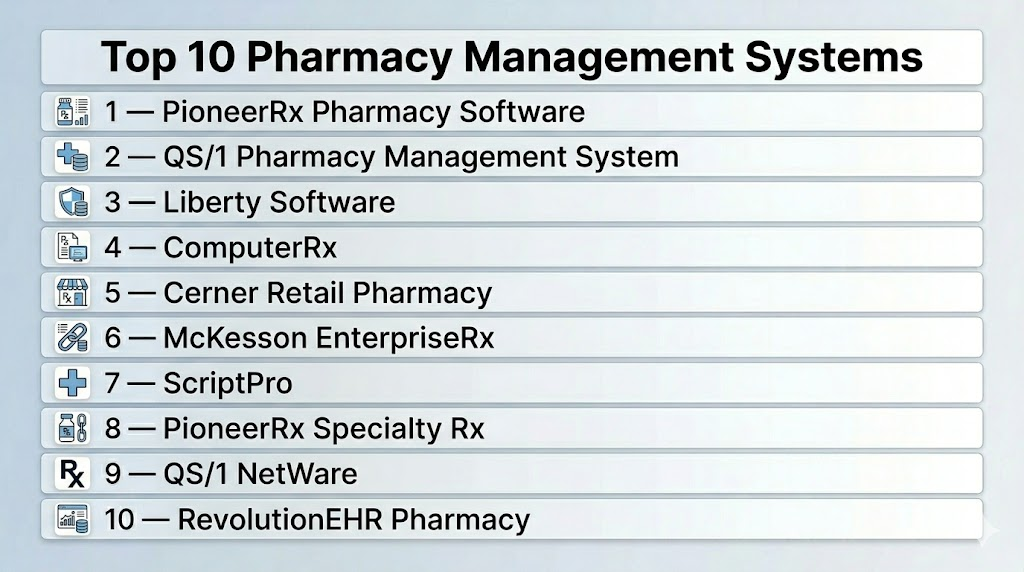
Top 10 Pharmacy Management Systems
#1 — PioneerRx Pharmacy Software
Short description:
PioneerRx is a comprehensive pharmacy management solution widely adopted by independent and community pharmacies.
It supports e‑prescribing, inventory control, billing, reporting, and clinical services.
Ideal for retail and specialty pharmacies seeking robust workflows.
Key Features
- E‑prescribing and prescription management
- Inventory and expiration tracking
- Billing, claims, and reconciliation
- Clinical alerts and drug interaction checking
- Reporting and analytics
Pros
- Strong support for independent pharmacies
- Clinical decision support tools
- Flexible reporting and workflow automation
Cons
- Premium pricing for full feature sets
- Learning curve for new users
Platforms / Deployment
- Windows / Web
- Cloud / On‑premises
Security & Compliance
- HIPAA‑compliant encryption
- DEA and regulatory compliance tools
Integrations & Ecosystem
- EHR/EMR and e‑prescribing systems
- Payment processors and third‑party connectors
Support & Community
- Vendor support and onboarding
- Extensive documentation and training
#2 — QS/1 Pharmacy Management System
Short description:
QS/1 delivers robust PMS solutions for retail, outpatient, and long‑term care pharmacies.
Includes prescription processing, inventory, billing, and reporting modules.
Ideal for multi‑location pharmacy operations.
Key Features
- Prescription processing and e‑prescribing
- Inventory tracking and reorder alerts
- Billing, adjudication, and claims
- Reporting and compliance tools
- Multi‑store management
Pros
- Strong multi‑site and enterprise features
- Comprehensive prescription lifecycle support
- Advanced reporting
Cons
- Complex customization for smaller pharmacies
- Training required for advanced modules
Platforms / Deployment
- Windows / Web
- Cloud / On‑premises
Security & Compliance
- HIPAA‑compliant controls
- Regulatory reporting support
Integrations & Ecosystem
- EHR/EMR and e‑prescribing connectors
- PBM interfaces
Support & Community
- Vendor support plans
- Documentation and training
#3 — Liberty Software
Short description:
Liberty Software provides pharmacy management tools for retail, long‑term care, and outpatient pharmacies.
Offers prescription processing, billing, inventory, and clinical tools.
Ideal for mid‑sized chains and independent pharmacies.
Key Features
- Prescription entry and refill management
- Inventory and supply controls
- Billing and PBM adjudication
- Clinical alerts and patient profiles
- Reporting
Pros
- Flexible and scalable
- Strong inventory support
- Clinical decision support
Cons
- Limited mobile features
- Reporting dashboards are basic
Platforms / Deployment
- Windows
- Cloud / On‑premises
Security & Compliance
- HIPAA‑compliant encryption
Integrations & Ecosystem
- EHR interfaces
- PBM and billing systems
Support & Community
- Vendor support
- Training resources
#4 — ComputerRx
Short description:
ComputerRx is an established pharmacy management system with modules for prescription processing, billing, inventory, and point‑of‑sale.
Suited for independent pharmacies and small to mid‑sized chains.
Key Features
- E‑prescribing support
- Inventory and reorder tools
- Billing and claims management
- POS integration
- Reporting
Pros
- Affordable for small and independent pharmacies
- Reliable core prescription workflows
- Integrates with POS systems
Cons
- UI feels dated
- Limited advanced clinical tools
Platforms / Deployment
- Windows / Web
- Cloud / On‑premises
Security & Compliance
- HIPAA‑compliant encryption
Integrations & Ecosystem
- E‑prescribing interfaces
- POS and billing systems
Support & Community
- Vendor support
- Documentation
#5 — Cerner Retail Pharmacy
Short description:
Cerner’s Retail Pharmacy System integrates with Cerner EMR to provide comprehensive pharmacy management.
Supports dispensing, inventory, billing, and interoperability with clinical records.
Key Features
- E‑prescribing and medication dispensing
- Inventory management
- Billing and reimbursement workflows
- Integration with clinical EHR data
- Reporting and analytics
Pros
- Deep EMR integration
- Strong interoperability
- Supports clinical decision support
Cons
- Best suited for Cerner EMR customers
- Premium pricing
Platforms / Deployment
- Web / Desktop
- Cloud / On‑premises
Security & Compliance
- HIPAA‑compliant encryption
- ADE reporting support
Integrations & Ecosystem
- Cerner EMR ecosystem
- PBM connectors
Support & Community
- Vendor support
- Documentation
#6 — McKesson EnterpriseRx
Short description:
EnterpriseRx by McKesson is designed for large pharmacy operations, including hospital, retail chains, and specialty pharmacies.
Supports prescription lifecycle, inventory, billing, and compliance.
Key Features
- Enterprise prescription management
- Inventory and lot tracking
- Billing and PBM adjudication
- Reporting and compliance
- Multi‑location support
Pros
- Enterprise scalability
- Strong inventory and billing support
- Compliance tools
Cons
- High cost for small pharmacies
- Complex setup
Platforms / Deployment
- Web / Desktop
- Cloud / On‑premises
Security & Compliance
- HIPAA‑compliant encryption
- Audit logs and regulatory support
Integrations & Ecosystem
- EHR interfaces
- PBM and billing systems
Support & Community
- Vendor support
- Training programs
#7 — ScriptPro
Short description:
ScriptPro offers a pharmacy management and automation platform that integrates with robotic dispensing, inventory control, and prescription processing.
Best suited for retail pharmacies with automation needs.
Key Features
- E‑prescribing and refill management
- Automated dispensing integration
- Inventory and reorder tools
- Billing and claims
- Reporting
Pros
- Automation support
- Strong prescription accuracy tools
- Good inventory controls
Cons
- Best with hardware investment
- Costly implementation
Platforms / Deployment
- Windows / Web
- Cloud / On‑premises
Security & Compliance
- HIPAA‑compliant encryption
Integrations & Ecosystem
- Robotic dispensing hardware
- EHR/EMR systems
Support & Community
- Vendor support
- Documentation
#8 — PioneerRx Specialty Rx
Short description:
PioneerRx Specialty Rx expands core PioneerRx functionality to support specialty pharmacy workflows including patient care plans, compliance tracking, and advanced billing.
Key Features
- Specialty prescription management
- Care plan documentation
- Claims and reimbursement tools
- Inventory and lot tracking
- Reporting and analytics
Pros
- Tailored to specialty pharmacies
- Advanced billing support
- Care plan tracking
Cons
- Premium pricing
- Specialized training needed
Platforms / Deployment
- Web / Desktop
- Cloud / On‑premises
Security & Compliance
- HIPAA‑compliant encryption
Integrations & Ecosystem
- Clinical EHR systems
- Billing and PBM interfaces
Support & Community
- Vendor support
- Training
#9 — QS/1 NetWare
Short description:
QS/1 NetWare is a flexible, scalable pharmacy management system suited for independent, specialty, and institutional pharmacy environments.
Key Features
- Prescription and e‑prescribing support
- Inventory management
- Billing and claims adjudication
- Reporting
- Multi‑store support
Pros
- Scalable modules
- Supports multi‑site pharmacies
- Strong reporting tools
Cons
- UI less modern
- Custom setup required
Platforms / Deployment
- Windows / Web
- Cloud / On‑premises
Security & Compliance
- HIPAA‑compliant encryption
Integrations & Ecosystem
- EHR/EMR connectors
- PBM and billing systems
Support & Community
- Vendor support
- Documentation
#10 — RevolutionEHR Pharmacy
Short description:
RevolutionEHR Pharmacy offers cloud pharmacy management integrated with point‑of‑care tools, e‑prescribing, inventory, billing, and reporting.
Suited for modern retail and compounding pharmacies.
Key Features
- E‑prescribing and refill workflows
- Inventory and supply management
- Billing and claims handling
- Reporting and analytics
- Cloud deployment
Pros
- Cloud‑native and modern UI
- Easy to deploy
- Good reporting
Cons
- Limited specialty pharmacy features
- Smaller ecosystem
Platforms / Deployment
- Web / iOS / Android
- Cloud
Security & Compliance
- HIPAA‑compliant encryption
- Audit trails
Integrations & Ecosystem
- EHR/EMR connections
- Third‑party billing
Support & Community
- Vendor support
- Documentation
Comparison Table (Top 10)
| Tool Name | Best For | Platform(s) | Deployment | Standout Feature | Public Rating |
|---|---|---|---|---|---|
| PioneerRx | Retail & independent | Windows/Web | Cloud/On‑prem | Comprehensive clinical + billing | N/A |
| QS/1 Pharmacy | Multi‑location pharmacies | Windows/Web | Cloud/On‑prem | Multi‑site support | N/A |
| Liberty Software | Mid‑sized chains | Windows | Cloud/On‑prem | Inventory control | N/A |
| ComputerRx | Small & independent | Windows/Web | Cloud/On‑prem | Affordable core workflows | N/A |
| Cerner Retail Pharmacy | EMR ecosystem users | Web/Desktop | Cloud/On‑prem | Deep EHR integration | N/A |
| McKesson EnterpriseRx | Large pharmacy chains | Web/Desktop | Cloud/On‑prem | Enterprise scalability | N/A |
| ScriptPro | Automation‑ready retail | Windows/Web | Cloud/On‑prem | Robotic dispensing support | N/A |
| PioneerRx Specialty Rx | Specialty pharmacies | Windows/Web | Cloud/On‑prem | Specialty care plans | N/A |
| QS/1 NetWare | Flexible, scalable PMS | Windows/Web | Cloud/On‑prem | Modular scalability | N/A |
| RevolutionEHR Pharmacy | Modern cloud PMS | Web/iOS/Android | Cloud | Cloud‑first platform | N/A |
Evaluation & Scoring
| Tool | Core (25%) | Ease (15%) | Integrations (15%) | Security (10%) | Performance (10%) | Support (10%) | Value (15%) | Weighted Total |
|---|---|---|---|---|---|---|---|---|
| PioneerRx | 10 | 8 | 9 | 9 | 9 | 8 | 7 | 8.8 |
| QS/1 Pharmacy | 9 | 7 | 8 | 9 | 8 | 8 | 7 | 8.0 |
| Liberty Software | 8 | 8 | 7 | 9 | 8 | 7 | 7 | 7.7 |
| ComputerRx | 7 | 8 | 7 | 9 | 8 | 7 | 8 | 7.8 |
| Cerner Retail Pharmacy | 9 | 7 | 9 | 9 | 8 | 8 | 7 | 8.1 |
| McKesson EnterpriseRx | 9 | 7 | 8 | 9 | 9 | 8 | 6 | 8.0 |
| ScriptPro | 8 | 7 | 8 | 9 | 8 | 7 | 6 | 7.7 |
| PioneerRx Specialty Rx | 10 | 7 | 8 | 9 | 9 | 8 | 6 | 8.1 |
| QS/1 NetWare | 9 | 7 | 8 | 9 | 8 | 8 | 7 | 8.0 |
| RevolutionEHR Pharmacy | 8 | 9 | 7 | 9 | 8 | 8 | 7 | 7.9 |
Decision Guide
Independent & Retail Pharmacies
PioneerRx, ComputerRx, and RevolutionEHR Pharmacy provide user‑friendly systems with strong prescription workflows and inventory controls.
Multi‑Location & Chain Pharmacies
QS/1 Pharmacy and McKesson EnterpriseRx deliver multi‑site scalability, advanced billing, and PBM support.
Specialty Pharmacy Focus
PioneerRx Specialty Rx is tailored for complex billing, care plan tracking, and specialty workflows.
EMR‑Connected Pharmacies
Cerner Retail Pharmacy integrates deeply with clinical EHR to support medication reconciliation and clinical decision alerts.
Automation & Accuracy
ScriptPro stands out for integration with robotic dispensing and automation.
Frequently Asked Questions (FAQs)
1. Do these systems support e‑prescribing?
Yes — all top pharmacy management systems support electronic prescriptions with industry‑standard interfaces.
2. Can they handle insurance claims processing?
Yes — PMS platforms automate adjudication and billing for Medicaid, Medicare, and commercial payers.
3. Are inventory controls included?
Yes — inventory tracking, expiration alerts, and reorder tools are standard in most systems.
4. Do they integrate with EHR/EMR?
Many (like Cerner Retail Pharmacy and QS/1) support EHR/EMR interoperability for clinical context.
5. Is HIPAA compliance ensured?
Top tools enforce encryption, access control, and audit logging to meet HIPAA standards.
6. Are specialty pharmacy workflows supported?
Yes — solutions like PioneerRx Specialty Rx address care planning, compliance, and advanced billing.
7. Is mobile access available?
Some cloud platforms such as RevolutionEHR Pharmacy and PioneerRx offer mobile or web access.
8. Can these systems scale for large chains?
Yes — platforms like McKesson EnterpriseRx and QS/1 are designed for multi‑location scalability.
9. Is training required?
Yes — vendor‑provided onboarding and documentation help maximize feature adoption.
10. Do they support reporting and analytics?
Yes — dashboards and reporting tools help monitor revenue, compliance, and inventory trends.
Conclusion
Pharmacy Management Systems are critical tools for streamlining prescription workflows, ensuring patient safety, and optimizing revenue cycles in modern pharmacy operations. Independent and retail pharmacies gain immediate value from PioneerRx, ComputerRx, and RevolutionEHR Pharmacy for user‑friendly prescription management and inventory control. Larger pharmacy chains and multi‑location operations benefit from scalable solutions like QS/1 Pharmacy and McKesson EnterpriseRx with strong billing and PBM support. Specialty pharmacies can leverage PioneerRx Specialty Rx for advanced care plan tracking and reimbursement workflows. Pharmacies embedded in clinical settings with EHR integration may prefer Cerner Retail Pharmacy for seamless clinical workflows. Choosing a system that balances ease of use, compliance, scalability, and integration ensures better operational efficiency, improved patient safety, and sustainable growth.
