Introduction
Search Indexing Pipelines are systems that automate the ingestion, processing, and indexing of structured and unstructured data to make it discoverable for search engines or internal search solutions. They are critical for enterprises and digital platforms that need fast, accurate, and scalable search experiences.
Real-world use cases include:
- Indexing large volumes of website or product data for e-commerce search.
- Processing enterprise documents for internal knowledge management.
- Enabling AI-powered semantic search for customer support platforms.
- Supporting real-time indexing for dynamic applications and IoT data.
- Enhancing search relevance through metadata enrichment and NLP.
What buyers should evaluate: ingestion speed, transformation capabilities, scalability, search engine compatibility, AI/ML integration, security and compliance, deployment flexibility, API ecosystem, monitoring & analytics, and cost-effectiveness.
Best for: IT teams, search engineers, large enterprises, SaaS providers, and content-heavy organizations.
Not ideal for: small businesses with limited data or those relying on simple database search functionality.
Key Trends in Container OrchestrationSearch Indexing Pipelines
- AI-powered indexing and semantic enrichment for better relevance.
- Real-time stream processing for dynamic datasets.
- Integration with cloud-native and hybrid architectures.
- Automation of data cleansing and transformation workflows.
- Compliance support for GDPR, CCPA, and data security.
- Enhanced observability with monitoring dashboards and analytics.
- Multi-language and multi-domain indexing capabilities.
- Scalable microservices-based deployment patterns.
- Open-source ecosystem integration and API extensibility.
How We Selected These Tools (Methodology)
- Evaluated market adoption and enterprise mindshare.
- Assessed feature richness for ingestion, transformation, and indexing.
- Analyzed performance and reliability metrics.
- Reviewed security posture and compliance support.
- Examined integration capabilities with search engines, databases, and AI.
- Considered fit for small, mid-market, and enterprise organizations.
- Verified support, documentation, and community strength.
- Prioritized platforms supporting AI/ML, real-time pipelines, and observability.
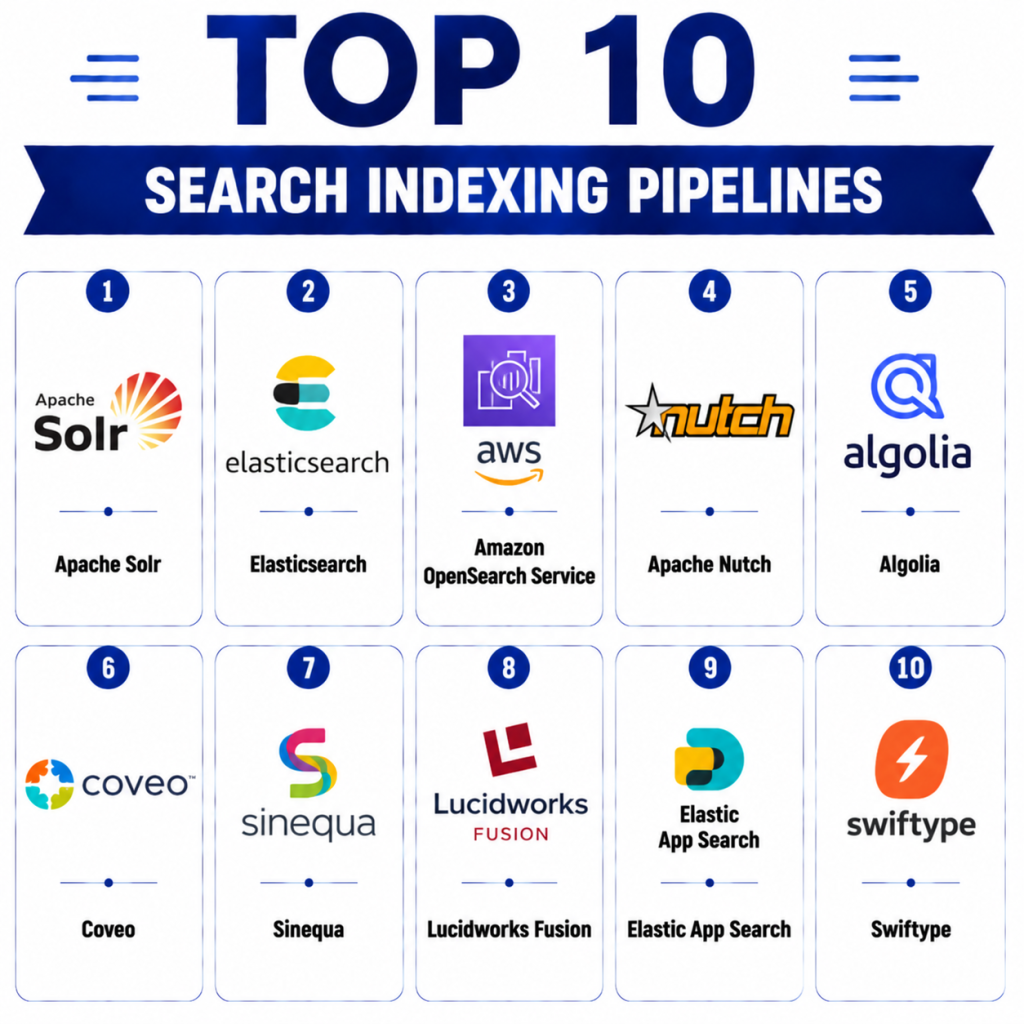
Top 10 Search Indexing Pipelines
#1 — Apache Solr
Short description: Open-source search platform that indexes structured and unstructured data for fast, reliable search. Widely used by enterprises and developers.
Key Features
- Full-text search, faceting, and filtering
- Real-time indexing and updates
- Distributed architecture for scalability
- Integration with Hadoop and Spark
- REST APIs and client libraries
- Advanced analytics and relevancy tuning
Pros
- Open-source with a strong community
- Highly customizable and scalable
Cons
- Requires configuration expertise
- Resource-intensive for large deployments
Platforms / Deployment
- Linux / Windows / macOS
- Self-hosted / Cloud
Security & Compliance
- Supports basic authentication and encryption
- Not publicly stated
Integrations & Ecosystem
- Hadoop, Spark, Elasticsearch connectors
- REST API, client libraries
- BI and analytics tool integration
Support & Community
- Active community and documentation
- Professional support via third-party vendors
#2 — Elasticsearch
Short description: Popular distributed search engine for indexing and querying large volumes of data. Ideal for analytics, logging, and real-time search applications.
Key Features
- Full-text search and relevance scoring
- JSON-based query DSL
- Real-time analytics
- Horizontal scaling with clusters
- Integration with Kibana for visualization
- Snapshot and restore capabilities
Pros
- High-performance and scalable
- Extensive ecosystem with Beats and Logstash
Cons
- Commercial licensing for advanced features
- Can be complex to tune
Platforms / Deployment
- Linux / Windows / macOS
- Cloud / Self-hosted / Hybrid
Security & Compliance
- SSO, RBAC, TLS encryption in commercial versions
Integrations & Ecosystem
- Kibana, Logstash, Beats
- REST API and plugins
- Machine learning modules
Support & Community
- Elastic support tiers available
- Large global developer community
#3 — Amazon OpenSearch Service
Short description: Fully managed search and analytics service built on OpenSearch and Elasticsearch, providing scalable indexing and real-time search capabilities.
Key Features
- Fully managed clusters with auto-scaling
- Security with IAM and encryption
- Integration with AWS ecosystem
- Real-time indexing and query support
- Automated snapshots and backups
- Multi-AZ deployment for high availability
Pros
- Fully managed service reduces operational overhead
- Easy integration with AWS services
Cons
- Tied to AWS ecosystem
- Can be costly at scale
Platforms / Deployment
- Web / Cloud
- Managed SaaS
Security & Compliance
- IAM, encryption, VPC support
- Not publicly stated
Integrations & Ecosystem
- AWS Lambda, S3, Kinesis
- REST APIs and SDKs
- Data pipelines for ETL
Support & Community
- AWS support tiers
- Documentation and forums
#4 — Apache Nutch
Short description: Open-source web crawler and search platform used to index web content. Suitable for large-scale web search projects.
Key Features
- Distributed crawling and indexing
- Plugin-based architecture
- Integration with Solr and Elasticsearch
- Support for structured and unstructured data
- Flexible scheduling and batch processing
Pros
- Highly customizable
- Free and open-source
Cons
- Requires technical expertise
- Limited out-of-the-box analytics
Platforms / Deployment
- Linux / Windows / macOS
- Self-hosted
Security & Compliance
- Not publicly stated
Integrations & Ecosystem
- Solr, Elasticsearch connectors
- Custom plugins for data extraction
Support & Community
- Community-driven support
- Active developer forums
#5 — Algolia
Short description: Hosted search API platform for fast, scalable, and relevance-tuned search across websites and applications.
Key Features
- Instant search and typo tolerance
- Analytics and relevance tuning
- Multi-language support
- API-first integration
- Dashboard for monitoring search metrics
- Custom ranking and filters
Pros
- Fast, hosted solution
- Easy to integrate
Cons
- SaaS pricing can be high
- Less flexible for complex data models
Platforms / Deployment
- Web / Cloud
- Managed SaaS
Security & Compliance
- SSL/TLS and API key-based access
- GDPR support
Integrations & Ecosystem
- REST API
- Frontend SDKs for JS, React, Android, iOS
Support & Community
- Vendor support available
- Documentation and tutorials
#6 — Coveo
Short description: Enterprise search and indexing platform with AI-powered relevance for e-commerce and support portals.
Key Features
- AI-powered search ranking
- Real-time indexing from multiple sources
- Analytics and reporting
- Multi-language and multi-domain support
- REST APIs and connectors
Pros
- AI-driven relevance
- Easy integration with CRM/ERP systems
Cons
- Expensive for smaller teams
- Proprietary SaaS
Platforms / Deployment
- Web / Cloud
- Managed SaaS
Security & Compliance
- SSO, encryption, role-based access
Integrations & Ecosystem
- Salesforce, Dynamics, CMS connectors
- REST API and webhooks
Support & Community
- Enterprise support plans
- Documentation and knowledge base
#7 — Sinequa
Short description: Cognitive search and analytics platform for enterprises, providing indexing pipelines with AI capabilities for structured and unstructured content.
Key Features
- AI and NLP for content analysis
- Real-time indexing
- Multi-source connectors
- Dashboard and analytics
- Security and compliance features
Pros
- Strong cognitive search
- Integrates multiple data sources
Cons
- Complexity for setup
- Premium pricing
Platforms / Deployment
- Web / Cloud / Hybrid
Security & Compliance
- SSO, RBAC, encryption
Integrations & Ecosystem
- BI tools, NLP engines, CMS connectors
Support & Community
- Professional enterprise support
#8 — Lucidworks Fusion
Short description: AI-powered search platform combining indexing pipelines, analytics, and search relevance tuning for enterprise data.
Key Features
- Real-time indexing and query
- Machine learning relevance
- Data connectors and pipelines
- Analytics dashboards
- Security and compliance features
Pros
- Flexible AI and ML integration
- Scalable for enterprise use
Cons
- High cost
- Requires expertise to configure
Platforms / Deployment
- Web / Cloud / Hybrid
Security & Compliance
- RBAC, encryption, audit logs
Integrations & Ecosystem
- Connectors for DBs, Hadoop, Elasticsearch
- REST API, SDKs
Support & Community
- Enterprise support available
#9 — Elastic App Search
Short description: API-first search solution for building search experiences with easy indexing pipelines and relevance tuning.
Key Features
- Simple API for indexing
- Relevance tuning and analytics
- Multi-language support
- Real-time updates
- Dashboard for search performance
Pros
- Easy API-based integration
- Fast deployment
Cons
- Limited AI capabilities
- Smaller community than full Elastic Stack
Platforms / Deployment
- Web / Cloud
- Managed SaaS
Security & Compliance
- API key authentication
- Not publicly stated
Integrations & Ecosystem
- Elasticsearch ecosystem
- REST API
Support & Community
- Documentation and vendor support
#10 — Swiftype
Short description: Hosted search platform providing indexing pipelines, analytics, and customizable search for websites and applications.
Key Features
- Real-time indexing
- Analytics and relevance tuning
- Multi-language support
- API-based integration
- Dashboard and monitoring
Pros
- Hosted, no maintenance required
- Easy to integrate
Cons
- Less flexible for complex datasets
- SaaS pricing
Platforms / Deployment
- Web / Cloud
- Managed SaaS
Security & Compliance
- SSL encryption
- Not publicly stated
Integrations & Ecosystem
- REST API
- CMS and application connectors
Support & Community
- Vendor support with documentation
Comparison Table (Top 10)
| Tool Name | Best For | Platform(s) Supported | Deployment | Standout Feature | Public Rating |
|---|---|---|---|---|---|
| Apache Solr | Enterprise / Dev | Linux / Windows / macOS | Self-hosted / Cloud | Open-source full-text search | N/A |
| Elasticsearch | Analytics / Logging | Linux / Windows / macOS | Cloud / Self-hosted / Hybrid | Distributed search engine | N/A |
| Amazon OpenSearch | Cloud-native | Web | Managed SaaS | Fully managed service | N/A |
| Apache Nutch | Web crawling | Linux / Windows / macOS | Self-hosted | Large-scale web indexing | N/A |
| Algolia | E-commerce | Web | Cloud | API-first hosted search | N/A |
| Coveo | Enterprise portals | Web | Cloud | AI-powered relevance | N/A |
| Sinequa | Enterprise search | Web / Cloud / Hybrid | Cloud / Hybrid | Cognitive search & NLP | N/A |
| Lucidworks Fusion | Enterprise | Web / Cloud / Hybrid | Cloud / Hybrid | AI relevance tuning | N/A |
| Elastic App Search | Developers | Web / Cloud | Managed SaaS | API-first search | N/A |
| Swiftype | Websites & apps | Web / Cloud | Managed SaaS | Hosted search + analytics | N/A |
Evaluation & Scoring of Survey Tools
| Tool Name | Core (25%) | Ease (15%) | Integrations (15%) | Security (10%) | Performance (10%) | Support (10%) | Value (15%) | Weighted Total (0–10) |
|---|---|---|---|---|---|---|---|---|
| Apache Solr | 9 | 7 | 8 | 7 | 8 | 7 | 9 | 7.9 |
| Elasticsearch | 9 | 7 | 9 | 8 | 9 | 8 | 8 | 8.3 |
| Amazon OpenSearch | 8 | 8 | 8 | 8 | 8 | 8 | 8 | 8.0 |
| Apache Nutch | 7 | 6 | 7 | 6 | 7 | 6 | 7 | 6.7 |
| Algolia | 8 | 9 | 8 | 7 | 8 | 8 | 7 | 7.9 |
| Coveo | 8 | 7 | 8 | 7 | 8 | 7 | 7 | 7.6 |
| Sinequa | 9 | 7 | 8 | 7 | 8 | 7 | 7 | 7.8 |
| Lucidworks Fusion | 9 | 7 | 8 | 7 | 8 | 7 | 7 | 7.8 |
| Elastic App Search | 8 | 8 | 7 | 7 | 7 | 7 | 7 | 7.4 |
| Swiftype | 8 | 8 | 7 | 7 | 7 | 7 | 7 | 7.4 |
Scores are comparative; higher weighted total indicates stronger overall capability for search and indexing pipelines.
Which Search Indexing Pipeline Tool Is Right for You?
Solo / Freelancer
Elastic App Search or Algolia provide simple API-based integration for small-scale projects.
SMB
Algolia or Swiftype balance ease of use and real-time indexing for growing businesses.
Mid-Market
Coveo, Lucidworks Fusion, or Sinequa suit mid-market teams requiring AI-enhanced search pipelines.
Enterprise
Elasticsearch, Amazon OpenSearch, and Solr scale for large datasets and AI/analytics integration.
Budget vs Premium
Open-source tools like Solr and Elasticsearch offer cost efficiency; managed services provide ease of maintenance.
Feature Depth vs Ease of Use
Enterprise platforms have advanced analytics and AI, while Algolia and Swiftype focus on speed and simplicity.
Integrations & Scalability
Lucidworks Fusion, Sinequa, and OpenSearch enable robust pipeline integration and multi-system scaling.
Security & Compliance Needs
Enterprise tools offer encryption, RBAC, and SSO; open-source solutions require configuration for compliance.
Frequently Asked Questions (FAQs)
1- What is a search indexing pipeline?
It is a system for ingesting, transforming, and indexing data to make it quickly searchable by users or applications.
2- How do indexing pipelines improve search?
They structure data, optimize relevance, and allow real-time updates for accurate and fast search results.
3- Are there free options?
Yes, open-source platforms like Apache Solr and Elasticsearch provide robust free search indexing.
4- Can these tools handle unstructured data?
Yes, most support structured, semi-structured, and unstructured content including logs, documents, and web pages.
5- Are these solutions scalable?
Yes, enterprise solutions like OpenSearch, Elasticsearch, and Lucidworks scale horizontally for large datasets.
6- Do they integrate with AI and analytics?
Yes, many provide ML-powered ranking, NLP capabilities, and integration with analytics platforms.
7- How complex is setup?
Managed SaaS is easy; self-hosted open-source solutions require configuration and tuning expertise.
8- Do they support real-time indexing?
Yes, tools like Algolia, OpenSearch, and Coveo allow near real-time updates for dynamic content.
9- Can they integrate with existing BI tools?
Yes, REST APIs, connectors, and data pipelines enable integration with dashboards and analytics systems.
10- How to choose the right platform?
Consider scale, real-time needs, AI capabilities, budget, ease of integration, and maintenance requirements.
Conclusion
Search Indexing Pipelines streamline data ingestion, transformation, and search across enterprises and applications. Selection depends on scale, AI needs, and maintenance preferences. Start with 2–3 shortlisted tools, run a pilot, and validate integration and compliance for best results.
