Introduction
Semantic Search Platforms enable organizations to retrieve information based on meaning and context rather than exact keyword matches. These platforms use AI, NLP, and knowledge graphs to understand queries, intent, and content relationships, delivering more relevant results across documents, databases, and digital assets.
Semantic search is critical for enterprises handling large volumes of unstructured data, improving customer experience, knowledge discovery, and decision-making. It powers applications in e-commerce search, internal knowledge management, chatbots, and AI-driven analytics.
Real-world use cases include:
- Improving e-commerce search with intent-based product recommendations.
- Enhancing enterprise knowledge management across documents and repositories.
- Powering AI chatbots and virtual assistants with contextual understanding.
- Enabling advanced analytics by connecting related content and entities.
- Supporting research and content discovery in media and publishing.
Evaluation Criteria for Buyers:
- NLP and AI capabilities
- Query understanding and intent recognition
- Integration with content repositories and BI tools
- Scalability and performance for large datasets
- Security, encryption, and access control
- Multi-language support and customization
- Deployment flexibility: cloud, on-prem, hybrid
- Analytics and insights on search behavior
- Ease of use for analysts and developers
- Vendor support and community engagement
Best for: Enterprises, e-commerce platforms, content-driven organizations, and teams managing large unstructured datasets requiring contextual search.
Not ideal for: Small datasets with simple keyword queries; traditional search engines may suffice.
Key Trends in Semantic Search Platforms
- AI and NLP-driven intent understanding and query refinement
- Integration with multi-cloud and hybrid content repositories
- Real-time search indexing and updates
- Knowledge graph integration for entity-aware search
- Multi-language and domain-specific model support
- Analytics dashboards for user behavior and search performance
- Personalization and recommendation integration
- Low-code/no-code interfaces for content teams
- Enhanced security, access control, and compliance
- Cloud-native, scalable deployment models
How We Selected These Tools (Methodology)
- Evaluated market adoption and industry recognition
- Assessed feature completeness for AI/NLP, knowledge graphs, and search analytics
- Reviewed performance, latency, and scalability
- Verified security and compliance features (RBAC, encryption, audit logs)
- Checked integration with BI, ML, and content management systems
- Considered suitability for SMB, mid-market, and enterprise users
- Prioritized tools with AI-enhanced semantic search and personalization
- Examined support, documentation, and community engagement
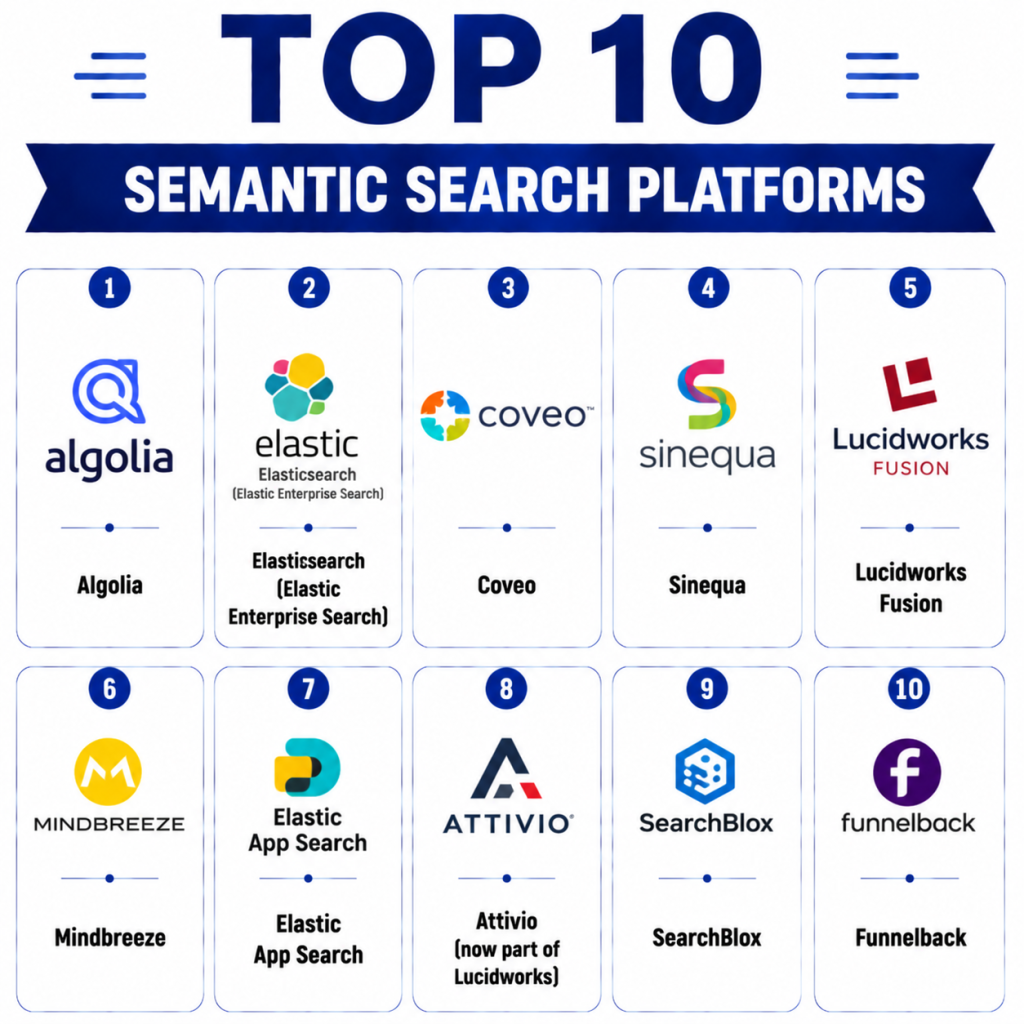
Top 10 Semantic Search Platforms
1- Algolia
Short description: Algolia provides AI-powered search APIs for websites and applications, delivering instant, context-aware results and personalized recommendations.
Key Features
- AI-powered relevance and ranking
- Instant search results
- Multi-language support
- Analytics dashboards
- Personalization and recommendations
- REST API integration
Pros
- Fast and scalable
- Excellent developer experience
- Strong documentation and support
Cons
- Cost scales with usage
- Some advanced AI features require premium plans
Platforms / Deployment
- Web, Cloud
Security & Compliance
- Encryption in transit and at rest
- RBAC and SSO
- SOC 2, GDPR
Integrations & Ecosystem
- CMS, e-commerce platforms
- BI dashboards
- APIs for custom applications
Support & Community
- 24/7 support, extensive docs, active developer forums
2- Elasticsearch (Elastic Enterprise Search)
Short description: Elasticsearch enables scalable, distributed semantic search with natural language processing and full-text indexing for enterprise content.
Key Features
- Distributed full-text search engine
- NLP and semantic query support
- Real-time indexing and search
- Analytics and visualization
- Integration with Kibana
- Multi-cloud deployment
Pros
- High performance and scalability
- Open-source and enterprise versions
- Flexible query language
Cons
- Requires setup and tuning expertise
- Complex configuration for large deployments
Platforms / Deployment
- Linux, Windows / Cloud / On-prem / Hybrid
Security & Compliance
- RBAC, encryption, SSO/SAML
- SOC 2, ISO 27001
Integrations & Ecosystem
- BI tools, custom apps, ML pipelines
- Kibana visualizations
- REST APIs
Support & Community
- Commercial support, large open-source community, extensive docs
3- Coveo
Short description: Coveo delivers AI-powered semantic search and personalization for websites, e-commerce, and enterprise knowledge systems.
Key Features
- Machine learning ranking
- Personalized recommendations
- Multi-source indexing
- Analytics dashboards
- Cloud-based search API
Pros
- Strong AI and ML capabilities
- Easy integration with enterprise apps
- Rich analytics
Cons
- Premium pricing
- May require developer support for advanced features
Platforms / Deployment
- Cloud
Security & Compliance
- RBAC, encryption, SSO
- SOC 2, ISO 27001
Integrations & Ecosystem
- Salesforce, ServiceNow
- BI platforms
- APIs for custom applications
Support & Community
- Enterprise support, documentation, active community
4- Sinequa
Short description: Sinequa offers a cognitive search platform with semantic and natural language understanding for large-scale enterprise data and document repositories.
Key Features
- Semantic search with NLP
- Knowledge graph integration
- Multi-language support
- Analytics and reporting
- AI-driven relevance scoring
Pros
- Enterprise-scale search
- Strong AI and NLP capabilities
- Integrates across multiple content repositories
Cons
- Requires configuration expertise
- Higher cost for full feature set
Platforms / Deployment
- Linux, Windows / Cloud / On-prem / Hybrid
Security & Compliance
- RBAC, SSO, encryption
- SOC 2, ISO 27001
Integrations & Ecosystem
- CMS and document systems
- BI dashboards
- REST APIs
Support & Community
- Enterprise support, documentation, training resources
5- Lucidworks Fusion
Short description: Fusion combines AI-driven semantic search, analytics, and machine learning to deliver context-aware search for enterprises.
Key Features
- Machine learning ranking and query suggestions
- Semantic and NLP search
- Real-time indexing
- Analytics dashboards
- Multi-source integration
Pros
- High customization
- Strong AI relevance
- Scalable for enterprise
Cons
- Steep learning curve
- Licensing cost
Platforms / Deployment
- Cloud / On-prem / Hybrid
Security & Compliance
- RBAC, encryption, SSO
- SOC 2, ISO 27001
Integrations & Ecosystem
- CMS, CRM, BI tools
- REST APIs
- Machine learning frameworks
Support & Community
- Enterprise support, documentation, user community
6- Mindbreeze
Short description: Mindbreeze provides enterprise search with AI, NLP, and semantic search to connect structured and unstructured content across systems.
Key Features
- AI-driven semantic search
- Multi-source indexing
- Knowledge extraction and enrichment
- Analytics and reporting
- Role-based access
Pros
- Effective knowledge discovery
- Multi-source integration
- Strong analytics
Cons
- Commercial licensing
- Customization may require consulting
Platforms / Deployment
- Linux, Windows / Cloud / On-prem / Hybrid
Security & Compliance
- RBAC, SSO, encryption
- SOC 2, ISO 27001
Integrations & Ecosystem
- CMS, ERP, CRM systems
- APIs for custom pipelines
- Analytics and visualization tools
Support & Community
- Vendor support, documentation, training
7- Elastic App Search
Short description: Elastic App Search simplifies search deployment with semantic query understanding, relevance tuning, and analytics for web and app content.
Key Features
- Semantic relevance tuning
- Analytics dashboards
- Multi-language search
- REST APIs
- Cloud and on-prem deployment
Pros
- Quick setup
- Flexible and scalable
- Analytics-enabled
Cons
- Limited advanced AI features
- Cloud license may be needed
Platforms / Deployment
- Linux, Windows / Cloud / On-prem
Security & Compliance
- RBAC, encryption
- SOC 2, ISO 27001
Integrations & Ecosystem
- CMS, BI tools, ML pipelines
- APIs for custom applications
Support & Community
- Enterprise support, documentation, forums
8- Attivio (now part of Lucidworks)
Short description: Attivio provides semantic search and AI-powered analytics to enhance enterprise knowledge discovery and decision-making.
Key Features
- NLP-based semantic search
- Knowledge graph integration
- Analytics dashboards
- Multi-source indexing
- Machine learning relevance
Pros
- Strong AI-driven insights
- Enterprise-scale indexing
- Integrates across multiple repositories
Cons
- Requires enterprise licensing
- Setup complexity
Platforms / Deployment
- Linux, Windows / Cloud / On-prem / Hybrid
Security & Compliance
- RBAC, SSO, encryption
- SOC 2, ISO 27001
Integrations & Ecosystem
- ERP, CRM, CMS systems
- BI and analytics platforms
- APIs for ML pipelines
Support & Community
- Enterprise support, documentation, active user base
9- SearchBlox
Short description: SearchBlox is a semantic search and text analytics platform that provides AI-powered search, NLP, and analytics for enterprises and websites.
Key Features
- NLP and semantic search
- AI-powered ranking
- Analytics dashboards
- Multi-source indexing
- Cloud and on-prem deployment
Pros
- Easy deployment
- Supports multiple languages
- Scalable for mid-market
Cons
- Less advanced AI than enterprise platforms
- Limited customization for large datasets
Platforms / Deployment
- Linux, Windows / Cloud / On-prem
Security & Compliance
- RBAC, encryption
- Not publicly stated
Integrations & Ecosystem
- CMS, BI, document repositories
- REST APIs
- Machine learning frameworks
Support & Community
- Vendor support, documentation, community forums
10- Funnelback
Short description: Funnelback provides enterprise semantic search with AI and NLP to connect digital content, internal data, and customer-facing knowledge bases.
Key Features
- Semantic and NLP search
- Multi-source indexing
- Analytics and insights dashboards
- Cloud and on-prem deployment
- Personalization and recommendations
Pros
- Strong enterprise search
- AI-enhanced relevance
- Easy integration
Cons
- Commercial licensing
- Limited open-source support
Platforms / Deployment
- Linux, Windows / Cloud / On-prem / Hybrid
Security & Compliance
- RBAC, encryption
- Not publicly stated
Integrations & Ecosystem
- CMS, BI tools, CRM systems
- REST APIs
- AI/ML pipelines
Support & Community
- Vendor support, documentation, active forums
Comparison Table (Top 10)
| Tool Name | Best For | Platform(s) Supported | Deployment | Standout Feature | Public Rating |
|---|---|---|---|---|---|
| Algolia | Instant AI search | Web | Cloud | Personalized recommendations | N/A |
| Elasticsearch | Enterprise search | Linux, Windows | Cloud / On-prem / Hybrid | Distributed full-text search | N/A |
| Coveo | Personalized search | Cloud | Cloud | AI-powered relevance | N/A |
| Sinequa | Enterprise analytics | Linux, Windows | Cloud / On-prem / Hybrid | NLP + semantic reasoning | N/A |
| Lucidworks Fusion | AI-driven enterprise | Cloud / On-prem / Hybrid | AI ranking & semantic search | N/A | |
| Mindbreeze | Knowledge discovery | Linux, Windows | Cloud / On-prem / Hybrid | Multi-source indexing | N/A |
| Elastic App Search | App/web search | Linux, Windows | Cloud / On-prem | Easy setup & analytics | N/A |
| Attivio | Enterprise knowledge | Linux, Windows | Cloud / On-prem / Hybrid | Semantic search & AI insights | N/A |
| SearchBlox | Mid-market semantic | Linux, Windows | Cloud / On-prem | NLP and AI search | N/A |
| Funnelback | Enterprise content search | Linux, Windows | Cloud / On-prem / Hybrid | AI-enhanced relevance | N/A |
Evaluation & Scoring of Semantic Search Platforms
| Tool Name | Core (25%) | Ease (15%) | Integrations (15%) | Security (10%) | Performance (10%) | Support (10%) | Value (15%) | Weighted Total |
|---|---|---|---|---|---|---|---|---|
| Algolia | 9 | 9 | 8 | 8 | 9 | 8 | 7 | 8.5 |
| Elasticsearch | 8 | 7 | 8 | 8 | 9 | 7 | 7 | 7.9 |
| Coveo | 9 | 7 | 8 | 8 | 8 | 7 | 7 | 8.0 |
| Sinequa | 8 | 7 | 8 | 8 | 8 | 7 | 7 | 7.8 |
| Lucidworks Fusion | 9 | 7 | 8 | 8 | 8 | 7 | 7 | 8.0 |
| Mindbreeze | 8 | 7 | 8 | 8 | 8 | 7 | 7 | 7.8 |
| Elastic App Search | 8 | 8 | 8 | 7 | 8 | 7 | 7 | 7.8 |
| Attivio | 8 | 7 | 8 | 8 | 8 | 7 | 7 | 7.8 |
| SearchBlox | 7 | 8 | 7 | 7 | 7 | 7 | 7 | 7.2 |
| Funnelback | 8 | 7 | 8 | 7 | 8 | 7 | 7 | 7.7 |
Interpretation: Weighted scores compare platforms across search relevance, AI/NLP capabilities, ease of use, integrations, and enterprise readiness. Higher totals indicate stronger semantic search capabilities.
Which Semantic Search Tool Is Right for You?
Solo / Freelancer
- Algolia or Elastic App Search for quick deployment and experimentation with semantic search.
SMB
- SearchBlox or Coveo for multi-source content search with AI relevance.
Mid-Market
- Lucidworks Fusion or Mindbreeze for enterprise-level multi-source semantic search.
Enterprise
- Sinequa, Attivio, or Funnelback for scalable AI-powered enterprise knowledge search.
Budget vs Premium
- Open-source or SaaS options reduce cost; enterprise platforms provide scalability and advanced analytics.
Feature Depth vs Ease of Use
- Algolia and Elastic App Search prioritize simplicity; Lucidworks and Sinequa provide advanced AI and NLP capabilities.
Integrations & Scalability
- Enterprise platforms scale across hybrid and multi-cloud environments and integrate with BI, CRM, and ML pipelines.
Security & Compliance Needs
- SSO, RBAC, encryption, and regulatory compliance (SOC 2, ISO 27001) are available on enterprise-grade platforms.
Frequently Asked Questions (FAQs)
1- What pricing models are typical?
Platforms offer subscription, pay-per-query, or enterprise licensing. SaaS platforms scale costs with usage, while on-premises options have upfront licenses.
2- How long does deployment take?
SaaS platforms can deploy in hours; enterprise-grade systems may require weeks to integrate multiple data sources.
3- Do these platforms support AI/NLP integration?
Yes, most support NLP, semantic understanding, and AI-driven query ranking for connected content and knowledge bases.
4- Can they handle multi-source data?
Yes, they can index and query multiple content repositories, databases, and cloud storage systems in a unified view.
5- Are semantic queries faster than keyword searches?
Advanced platforms use caching, indexing, and AI optimizations to provide fast, context-aware results even on large datasets.
6- Can business users leverage these tools?
Low-code interfaces, dashboards, and visual query builders allow non-technical users to run semantic queries and analyze results.
7- What are common adoption challenges?
Complex source integration, model tuning for NLP, and managing relevance ranking are common hurdles during implementation.
8- How is security enforced?
Enterprise-grade platforms use RBAC, encryption, SSO/SAML, and audit logging to secure access and meet compliance requirements.
9- Can they integrate with BI and analytics tools?
Yes, all top platforms integrate with tools like Tableau, Power BI, and other dashboards for reporting and analytics.
10- What are alternatives for small datasets?
For smaller, simple datasets, traditional keyword search engines may be sufficient, avoiding the complexity of semantic search platforms.
Conclusion
Semantic Search Platforms deliver contextual, AI-driven search across complex datasets, improving discovery, relevance, and user experience. Open-source and SaaS platforms are suitable for small teams and experimentation, while enterprise solutions like Sinequa, Lucidworks, and Coveo scale with AI/NLP capabilities and advanced analytics.
