Introduction
Human‑in‑the‑Loop (HITL) Labeling Tools are specialized platforms designed to combine human judgment with automated processes for annotating and classifying data. In machine learning, AI systems, and search relevance workflows, having humans verify, correct, and enrich labeled data significantly boosts model accuracy and trustworthiness. HITL tools bridge the gap between raw data and high‑quality training datasets by providing intuitive interfaces, collaboration features, and quality control mechanisms.
Today’s AI models often struggle with ambiguity, nuance, and edge cases — areas where humans excel. HITL labeling tools ensure that machine learning and AI systems are trained on data that reflects human understanding, leading to better generalization and fewer costly errors in production.
Real‑world use cases include:
- Annotating text for sentiment, entity recognition, and intent in natural language applications.
- Labeling images and video for object detection, classification, and autonomous systems.
- Tagging audio and voice data for speech recognition and audio classification models.
- Human review of recommendation and search relevance results to improve ranking engines.
- Quality assurance and governance reviews for sensitive or regulated datasets.
What buyers should evaluate:
- Support for multiple data modalities (text, image, audio, video)
- Ease of use and onboarding for reviewers
- Quality control features like inter‑annotator agreement and consensus workflows
- Integration with machine learning pipelines (APIs, SDKs)
- Security and compliance (RBAC, encryption, audit logs)
- Scalability and real‑time review support
- Analytics and reporting dashboards
- Flexible deployment (cloud, self‑hosted, hybrid)
- Pricing and cost transparency
Best for: Data scientists, ML engineers, product teams, and enterprises that need high‑quality annotated data to train, evaluate, and refine AI and search models.
Not ideal for: Projects with very small datasets or no need for supervised learning; in such cases, simple rule‑based tagging or automated labeling may suffice.
Key Trends in Human‑in‑the‑Loop Labeling Tools
- AI‑Assisted Pre‑Labeling: Many tools now suggest labels using models before human review, greatly speeding up workflows.
- Multi‑Modal Annotation: Native support for text, images, video, and audio labeling in a single platform is increasingly common.
- Quality Assurance Workflows: Tools include inter‑annotator agreement scoring, dispute resolution, and reviewer performance metrics.
- Workflow Automation: Work queues, reviewer assignments, and auto‑escalation features reduce manual coordination overhead.
- Scalable Collaboration: Role‑based access and large reviewer groups support enterprise‑scale annotation projects.
- Secure and Compliant Deployments: Enterprises require support for encryption, audit logs, RBAC, and regulatory compliance.
- Integration to ML Pipelines: APIs and webhooks connect annotation outputs directly to training and retraining cycles.
- Active Learning Support: Tools that prioritize examples most likely to improve models reduce labeling effort.
- Analytics and Reporting: Dashboards show throughput, accuracy, cost, and quality metrics for project tracking.
- Flexible Pricing Models: From seat‑based to usage‑based pricing, tools now aim to align cost with annotation volume and needs.
How We Selected These Tools (Methodology)
- Market Adoption / Mindshare: Recognized usage across industries and visible ecosystem presence.
- Feature Completeness: Support for essential labeling workflows plus advanced features like automation and QA.
- Reliability / Performance: Platform stability under high labeling loads and enterprise workload patterns.
- Security Posture Signals: Support for role‑based access, encryption, audit logs, and compliance.
- Integrations / Ecosystem: Availability of APIs, SDKs, and connectors to ML pipelines and analytics.
- Support for Multi‑Modal Data: Native interfaces and tools for text, image, audio, and video.
- Ease of Use: Intuitive interfaces and efficient reviewer workflows.
- Support & Community: Quality of documentation, customer support, and user community engagement.
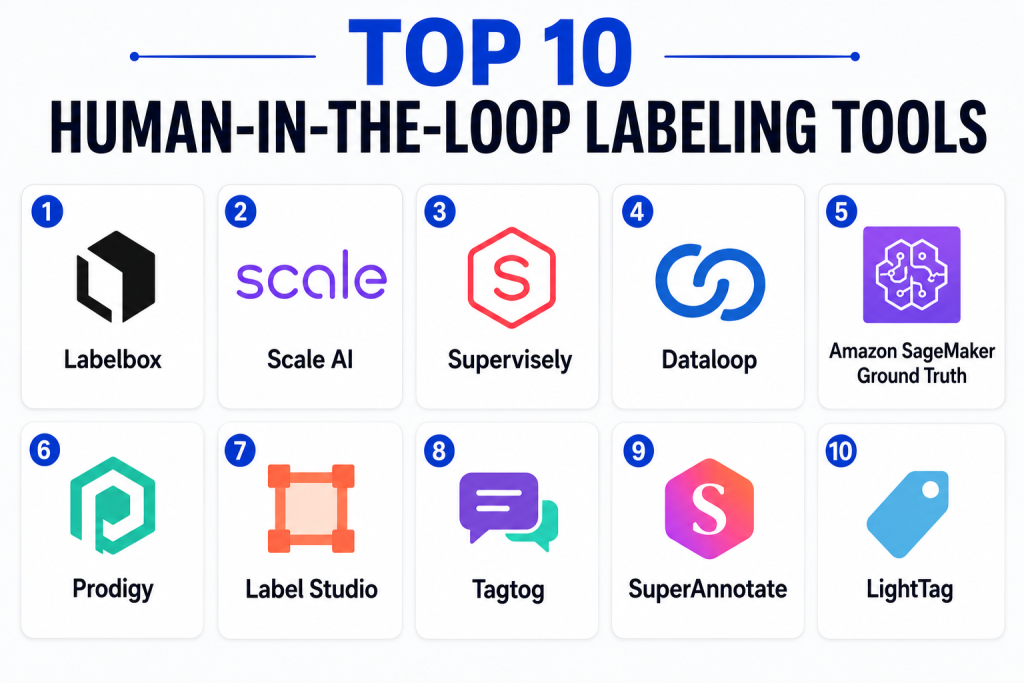
Top 10 Human‑in‑the‑Loop Labeling Tools
1 — Labelbox
Short description:
Labelbox is a versatile HITL labeling platform that combines AI‑assisted suggestions with human review workflows. It supports text, image, and video annotations, making it suitable for enterprise AI projects that need scalable, high‑quality labeled data delivered through collaborative workflows.
Key Features:
- AI‑guided pre‑labeling
- Multi‑modal annotation (text, image, video)
- Quality control dashboards
- Reviewer roles and consensus scoring
- API and SDK access
- Model performance monitoring
Pros:
- Flexible and scalable for large annotation teams
- Rich analytics for quality and throughput
Cons:
- Advanced features require enterprise plans
- Learning curve for complex workflows
Platforms / Deployment:
Web / Cloud / Hybrid
Security & Compliance:
Supports RBAC and encryption; specific certifications vary or are not publicly stated
Integrations & Ecosystem:
Integrates with machine learning frameworks and data platforms
- Python SDK
- REST APIs
- MLOps toolchain connectors
Support & Community:
Enterprise support available; documentation and active developer community
2 — Scale AI
Short description:
Scale AI offers enterprise‑grade human‑in‑the‑loop labeling with strong automation and quality assurance. Its platform supports multi‑modal data, including text, image, video, and specialized formats like LIDAR, enabling scalable labeling for sophisticated AI systems.
Key Features:
- Model‑assisted labeling workflows
- Quality metrics and auditing
- Multi‑modal support
- Scalable reviewer management
- Auto‑consensus and adjudication
- Custom task templates
Pros:
- Accurate, scalable labeling infrastructure
- Excellent for complex, multi‑modal tasks
Cons:
- Premium pricing structure
- Better suited to larger teams
Platforms / Deployment:
Web / Cloud
Security & Compliance:
Encryption and role‑based access; formal certifications vary / N/A
Integrations & Ecosystem:
- REST APIs
- Python SDK
- Data pipelines and analytics
Support & Community:
Commercial support with documentation and professional services
3 — Supervisely
Short description:
Supervisely provides HITL annotation tools with AI assistance for image, video, and 3D data labeling. Its platform also supports collaborative workflows and customizable annotation UIs for research and production.
Key Features:
- AI‑assisted annotation
- 3D point cloud and video support
- Custom task interfaces
- Analytics dashboards
- Collaboration tools
- API access
Pros:
- Strong visual labeling capabilities
- Customizable for specialized tasks
Cons:
- Technical setup can be complex
- Some enterprise features require premium plans
Platforms / Deployment:
Web / Cloud / Self‑hosted
Security & Compliance:
Encryption and role‑based access; formal certifications vary / N/A
Integrations & Ecosystem:
- Python SDK
- REST APIs
- Cloud storage connectors
Support & Community:
Active user community and documentation; enterprise support available
4 — Dataloop
Short description:
Dataloop is a labeling and data management platform focused on real‑time human review and AI‑assisted tagging. It emphasizes audit trails and collaboration for teams working with images, video, and text data.
Key Features:
- Live review queues
- Model‑based pre‑annotations
- Project management dashboards
- Annotation audit logs
- Role‑based workflows
- API and SDK access
Pros:
- Effective human review capabilities
- Easy pipeline integration
Cons:
- Primarily cloud‑focused
- Pricing details vary / N/A
Platforms / Deployment:
Web / Cloud
Security & Compliance:
Supports RBAC and encryption; formal certifications vary / N/A
Integrations & Ecosystem:
- Python and REST APIs
- ML frameworks
- Data storage connectors
Support & Community:
Documentation and enterprise support available
5 — Amazon SageMaker Ground Truth
Short description:
SageMaker Ground Truth is AWS’s managed HITL labeling service that integrates directly into the AWS machine learning ecosystem, offering automation, quality controls, and flexible labeling workflows for large data volumes.
Key Features:
- Managed labeling workflows
- Auto‑label suggestions
- Quality metrics
- Human review capabilities
- Integration with AWS ML tools
- Automated auditing
Pros:
- Seamless AWS integration
- Strong quality control tools
Cons:
- AWS dependency required
- Costs scale with usage
Platforms / Deployment:
Web / Cloud
Security & Compliance:
Uses AWS encryption and IAM controls; SOC 2 and GDPR supported
Integrations & Ecosystem:
- AWS ML suite
- S3 storage
- SDKs and APIs
Support & Community:
AWS enterprise support, documentation, and community resources
6 — Prodigy
Short description:
Prodigy is a Python‑based HITL labeling tool popular with data scientists for its scriptable, rapid annotation workflows. It’s especially well‑suited for NLP and computer vision research and development.
Key Features:
- Scriptable labeling tasks
- Active learning integration
- Quick annotation interface
- Supports multiple task types
- Export formats and tools
- Python integration
Pros:
- Highly customizable and fast
- Ideal for research workflows
Cons:
- Requires Python expertise
- Not an enterprise platform
Platforms / Deployment:
Linux, Windows / Self‑hosted
Security & Compliance:
Varies / Not publicly stated
Integrations & Ecosystem:
- Python ecosystem
- Custom script support
- Model retraining loops
Support & Community:
Strong community, documentation, and tutorials
7 — Label Studio
Short description:
Label Studio is an open‑source, flexible labeling toolkit that supports customizable annotation tasks across many data types with native human review and quality control features.
Key Features:
- Custom labeling UIs
- Multi‑modal workflows
- Reviewer management
- API and SDK access
- Export and import tools
- Quality feedback tools
Pros:
- Open‑source and extensible
- Supports numerous data formats
Cons:
- Hosted support may require paid plans
- Setup complexity for large deployments
Platforms / Deployment:
Linux, Windows / Cloud / Self‑hosted
Security & Compliance:
Varies / Not publicly stated
Integrations & Ecosystem:
- Python SDK
- REST APIs
- ML pipeline connectors
Support & Community:
Strong open‑source community and documentation
8 — Tagtog
Short description:
Tagtog focuses on collaborative text annotation with built‑in HITL review workflows and quality controls, making it suitable for NLP, legal, and research labeling tasks.
Key Features:
- Collaborative text annotation
- Human review workflows
- Inter‑annotator metrics
- Export and format support
- API access
Pros:
- Excellent text labeling capabilities
- Collaboration‑friendly interface
Cons:
- Limited to text
- Cloud deployment
Platforms / Deployment:
Web / Cloud
Security & Compliance:
RBAC, encryption; formal certifications vary / N/A
Integrations & Ecosystem:
- REST APIs
- NLP pipeline connectors
Support & Community:
Documentation and team support
9 — SuperAnnotate
Short description:
SuperAnnotate offers HITL labeling with AI accelerators for image, video, and point‑cloud data, accompanied by robust QA workflows and collaboration features for teams.
Key Features:
- AI‑based pre‑annotations
- Multi‑modal annotation
- Quality control workflows
- Team collaboration tools
- Analytics dashboards
- API support
Pros:
- Scalable for large datasets
- Strong QA and collaboration
Cons:
- Licensing cost can be high
- Requires training
Platforms / Deployment:
Web / Cloud
Security & Compliance:
RBAC, encryption; formal certifications vary / N/A
Integrations & Ecosystem:
- ML frameworks
- SDKs and APIs
- Data connector tools
Support & Community:
Documentation, enterprise support
10 — LightTag
Short description:
LightTag is a collaborative labeling tool designed for team‑based text annotation with built‑in workflows, reviewer analytics, and quality insights for supervised NLP tasks.
Key Features:
- Team roles and collaboration
- Quality analytics dashboards
- Annotation guidelines and notes
- Multi‑user roles
- API access
- Export formats
Pros:
- Great for team text tasks
- Analytics for quality
Cons:
- Text focus only
- Cloud‑dependent
Platforms / Deployment:
Web / Cloud
Security & Compliance:
RBAC, encryption; certifications vary / N/A
Integrations & Ecosystem:
- REST APIs
- NLP pipelines
- Analytics connectors
Support & Community:
Documentation and support tiers
Comparison Table (Top 10)
| Tool Name | Best For | Platform(s) Supported | Deployment | Standout Feature | Public Rating |
|---|---|---|---|---|---|
| Labelbox | Enterprise HITL | Web | Cloud/Hybrid | AI pre‑labeling | N/A |
| Scale AI | Multi‑modal labeling | Web | Cloud | Scalable workflows | N/A |
| Supervisely | Image/Video/3D | Web | Cloud/Self‑hosted | 3D & video support | N/A |
| Dataloop | Real‑time collaboration | Web | Cloud | Audit trails | N/A |
| SageMaker GT | AWS integration | Web | Cloud | Managed AWS workflows | N/A |
| Prodigy | Research & scripting | Linux/Windows | Self‑hosted | Scriptable | N/A |
| Label Studio | Flexible & open | Linux/Windows | Cloud/Self‑hosted | Custom UIs | N/A |
| Tagtog | Text annotation | Web | Cloud | Collaborative labeling | N/A |
| SuperAnnotate | QA‑focused labeling | Web | Cloud | AI accelerators | N/A |
| LightTag | Team NLP workflows | Web | Cloud | Collaboration analytics | N/A |
Evaluation & Scoring of Human‑in‑the‑Loop Labeling Tools
| Tool Name | Core (25%) | Ease (15%) | Integrations (15%) | Security (10%) | Performance (10%) | Support (10%) | Value (15%) | Weighted Total |
|---|---|---|---|---|---|---|---|---|
| Labelbox | 9 | 8 | 8 | 8 | 9 | 8 | 7 | 8.4 |
| Scale AI | 9 | 7 | 8 | 8 | 9 | 7 | 7 | 8.1 |
| Supervisely | 8 | 7 | 7 | 7 | 8 | 7 | 7 | 7.6 |
| Dataloop | 8 | 8 | 7 | 8 | 8 | 7 | 7 | 7.7 |
| SageMaker GT | 8 | 8 | 8 | 9 | 8 | 8 | 7 | 8.0 |
| Prodigy | 7 | 7 | 7 | 7 | 7 | 7 | 8 | 7.3 |
| Label Studio | 8 | 7 | 8 | 7 | 8 | 7 | 8 | 7.7 |
| Tagtog | 7 | 8 | 7 | 7 | 7 | 7 | 7 | 7.1 |
| SuperAnnotate | 8 | 7 | 8 | 7 | 8 | 7 | 7 | 7.7 |
| LightTag | 8 | 8 | 7 | 7 | 7 | 7 | 7 | 7.5 |
Weighted scores reflect comparative strengths in features, ease of use, integrations, security posture, performance, support, and value.
Which Human‑in‑the‑Loop Labeling Tool Is Right for You?
Solo / Freelancer
For individual projects or research tasks, lightweight and customizable tools like Prodigy and Label Studio provide flexibility without enterprise cost. Their scripting and open‑source capabilities allow bespoke labeling workflows.
SMB
Small and mid‑sized teams benefit most from tools with collaboration and quality controls like SuperAnnotate or Scale AI, which provide automation and reviewer management without excessive complexity.
Mid‑Market
Teams needing scalable workflows, analytics, and integration into ML pipelines should consider Labelbox, Dataloop, or SageMaker Ground Truth for balanced performance and enterprise features.
Enterprise
For large organizations with complex compliance, multi‑data modalities, and integrated reporting needs, Labelbox Enterprise, Scale AI, and SageMaker Ground Truth provide scalable, secure environments and deep analytics.
Budget vs Premium
Open‑source or self‑hosted tools (e.g., Label Studio, Prodigy) reduce cost but may require internal expertise. Cloud‑based premium tools offer ease and automated workflows with enterprise support.
Feature Depth vs Ease of Use
Tools like Labelbox and Scale AI offer deep feature sets but require onboarding. Tagtog and LightTag provide simpler, more accessible workflows for text labeling.
Integrations & Scalability
For extensive ML pipeline integration and scalable deployments, SageMaker Ground Truth, Dataloop, and SuperAnnotate connect well with data storage and model training systems.
Security & Compliance Needs
Enterprises in regulated domains should prioritize tools with RBAC, encryption, audit logs, and compliance readiness such as SageMaker Ground Truth and Labelbox Enterprise.
Frequently Asked Questions (FAQs)
1 — What pricing models are common for HITL labeling tools?
Pricing can be subscription‑based, per‑seat, or usage‑based depending on labeling volume and deployment models. Open‑source tools are free but may have hosting costs.
2 — How long does deployment take?
Simple labeling setups can be created in hours, while enterprise integration with quality workflows and ML pipelines may take days to weeks.
3 — Can these tools integrate with existing ML pipelines?
Yes — most tools support APIs, SDKs, or connectors that allow automatic export of labeled data into training and retraining loops.
4 — Do these platforms support collaboration?
Yes — enterprise tools provide user roles, review queues, and team dashboards; open‑source tools often require configuration for collaboration.
5 — Are quality assurance metrics included?
Top platforms include inter‑annotator agreement, consensus scoring, and reviewer performance dashboards to maintain high labeling quality.
6 — Can they automate labeling suggestions?
Many tools offer AI‑assisted pre‑labeling or active learning to speed up workflows and reduce manual labeling effort.
7 — What data types are supported?
Leading platforms support text, images, audio, video, and sometimes 3D point clouds for broad AI use cases.
8 — How are security and compliance handled?
Enterprise tools use RBAC, encryption, SSO/SAML, and audit logging to meet corporate and regulatory requirements.
9 — Are there tools suited for small teams?
Label Studio and Prodigy are strong options for smaller teams or research projects with limited annotation needs.
10 — What alternatives exist for small datasets?
For trivial datasets, simple Excel/CSV annotation, or lightweight scripts might provide a cost‑effective approach without full HITL tooling.
Conclusion
Human‑in‑the‑Loop Labeling Tools are fundamental for building high‑quality training datasets required for strong AI, search, and recommendation models. From research‑oriented tools like Prodigy and Label Studio to enterprise suites like Labelbox and Scale AI, there are options for every team size and project complexity.
