Introduction
AI Usage Control Tools are specialized platforms that monitor, regulate, and enforce policies around how AI models are accessed and utilized across organizations. In plain English, these tools help teams define rules, track AI outputs, and prevent unauthorized or unsafe use of AI systems. In , as AI adoption accelerates across enterprises in finance, healthcare, marketing, and other critical domains, controlling usage is vital to maintain compliance, mitigate operational risks, and enforce ethical standards.
Real-world use cases include:
- Restricting access to high-risk AI models in regulated industries.
- Enforcing data governance policies across AI pipelines.
- Monitoring AI-generated content in marketing automation platforms.
- Auditing and logging AI interactions to meet regulatory compliance.
- Preventing misuse of large language models or generative AI in enterprise environments.
Evaluation Criteria for Buyers often include:
- Granular access control and role-based policies
- Real-time monitoring and auditing
- Policy enforcement for sensitive models or data
- Scalability across enterprise AI deployments
- Integration with existing ML/AI pipelines
- Alerting and anomaly detection
- Compliance readiness (SOC 2, ISO 27001, GDPR, HIPAA)
- Usability and dashboard reporting
- Extensibility and API access
- Cost-effectiveness and support ecosystem
Best for: Enterprise AI teams, compliance officers, security teams, and data governance professionals in large organizations with multiple AI deployments.
Not ideal for: Small teams or startups using pre-validated cloud AI services with minimal internal governance requirements.
Key Trends in AI Usage Control Tools
- Integration of usage control policies with MLOps pipelines for automated enforcement.
- Real-time AI activity monitoring and logging for auditing purposes.
- Support for role-based and attribute-based access controls (RBAC/ABAC).
- Deployment in cloud-native, hybrid, and multi-cloud environments.
- AI-assisted recommendations for policy adjustments and anomaly detection.
- Compliance-oriented reporting for SOC 2, ISO 27001, GDPR, and HIPAA.
- Support for generative AI and large language model governance.
- Alerting for unauthorized or unsafe usage attempts.
- Subscription-based and usage-based pricing for flexible enterprise adoption.
- Ecosystem interoperability with identity providers, analytics dashboards, and AI model repositories.
How We Selected These Tools (Methodology)
- Evaluated market adoption and enterprise mindshare for AI governance tools.
- Assessed feature completeness across access control, monitoring, and auditing.
- Reviewed reliability and performance signals from large-scale deployments.
- Considered security posture, including encryption, authentication, and auditability.
- Analyzed integration capabilities with ML frameworks, MLOps platforms, and identity providers.
- Checked customer fit across SMB, mid-market, and enterprise AI teams.
- Evaluated scalability for multiple models, cloud environments, and global deployments.
- Reviewed support quality and community engagement for onboarding and troubleshooting.
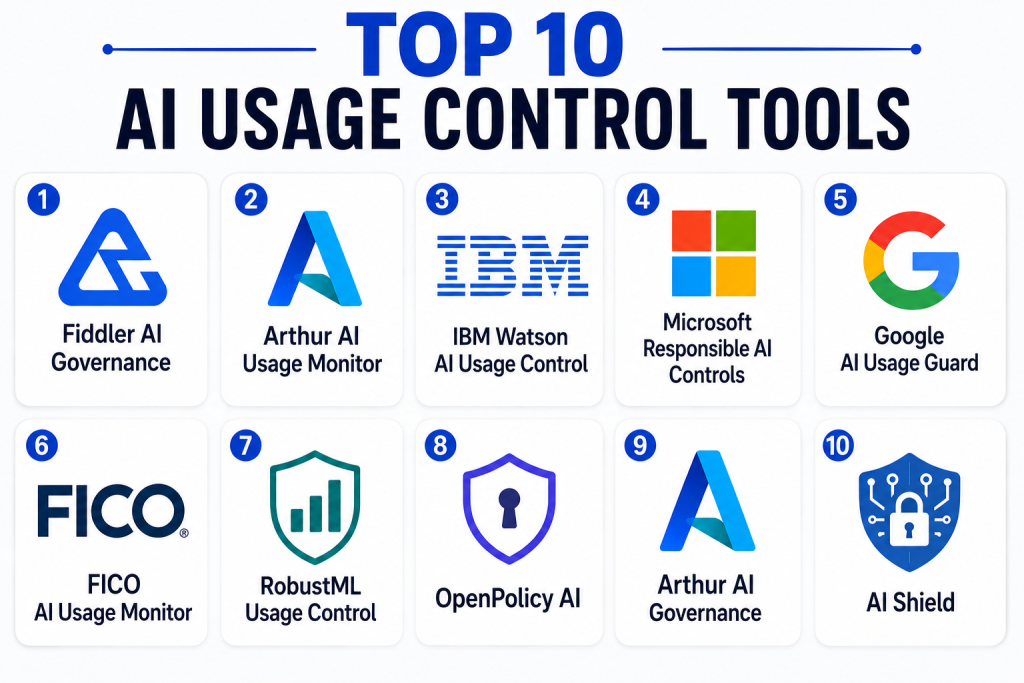
Top 10 AI Usage Control Tools
1- Fiddler AI Governance
Short description: Fiddler AI Governance enables organizations to enforce AI usage policies, track model access, and monitor outputs for compliance. Ideal for enterprises with multiple deployed AI models.
Key Features
- Role-based access control for AI models
- Real-time monitoring and usage logs
- Policy enforcement for sensitive AI operations
- Alerting for anomalous usage
- Dashboard reporting for compliance
- Integration with MLOps pipelines
Pros
- Enterprise-ready with granular controls
- Strong visibility into AI operations
Cons
- Requires configuration expertise
- Advanced features may be complex for small teams
Platforms / Deployment
- Web / Cloud / Hybrid
Security & Compliance
- SSO, MFA, encryption, audit logs
- SOC 2, ISO 27001, GDPR
Integrations & Ecosystem
- TensorFlow, PyTorch, scikit-learn
- REST APIs for automation
- Identity provider integrations
Support & Community
- Enterprise documentation and onboarding
- Active professional support channels
2- Arthur AI Usage Monitor
Short description: Arthur AI Usage Monitor tracks AI model interactions, enforces policy controls, and alerts teams about misuse or unusual activity. Suitable for mid-market to large enterprises.
Key Features
- Real-time AI usage tracking
- Policy enforcement and compliance reporting
- Alerts for abnormal behavior
- Integration with enterprise identity management
- Reporting dashboards
- Multi-cloud support
Pros
- Intuitive dashboards
- Automated monitoring and alerts
Cons
- Enterprise pricing may be high
- Requires integration effort
Platforms / Deployment
- Web / Cloud
Security & Compliance
- SSO, encryption, audit logs
- Not publicly stated for certifications
Integrations & Ecosystem
- TensorFlow, PyTorch
- REST APIs and webhooks
- Cloud identity systems
Support & Community
- Documentation and enterprise support tiers
- Developer community forums
3- IBM Watson AI Usage Control
Short description: IBM Watson AI Usage Control provides governance, access management, and audit capabilities for AI models in regulated enterprises. Ideal for compliance-driven sectors.
Key Features
- Policy enforcement for AI access
- Audit logging and reporting
- Role-based and attribute-based access controls
- Integration with IBM Cloud and MLOps tools
- Alerts for unauthorized usage
Pros
- Enterprise-grade governance
- Strong compliance and audit features
Cons
- Complexity for small-scale deployments
- IBM ecosystem integration required
Platforms / Deployment
- Web / Cloud / Hybrid
Security & Compliance
- SOC 2, ISO 27001, encryption, RBAC
- GDPR, HIPAA
Integrations & Ecosystem
- IBM Cloud Pak for Data
- REST APIs and Python SDKs
- Identity provider integrations
Support & Community
- Enterprise support, documentation, professional services
4- Microsoft Responsible AI Controls
Short description: Microsoft Responsible AI Controls enforces usage policies, monitors AI outputs, and ensures compliance for models deployed in Azure and hybrid environments.
Key Features
- Access control and policy enforcement
- Real-time usage monitoring
- Dashboard for compliance reporting
- Integration with Azure AD for identity management
- Alerts for policy violations
Pros
- Strong Azure integration
- Enterprise-focused policy management
Cons
- Limited outside Azure
- Learning curve for small teams
Platforms / Deployment
- Web / Cloud
Security & Compliance
- Azure security standards
- GDPR, SOC 2
Integrations & Ecosystem
- Azure ML, Azure AD
- REST APIs for automation
- PowerBI dashboards
Support & Community
- Enterprise support, documentation, community forums
5- Google AI Usage Guard
Short description: Google AI Usage Guard monitors AI interactions, enforces usage policies, and helps enterprises maintain compliance with cloud AI systems.
Key Features
- Policy enforcement for model access
- Real-time logging and monitoring
- Alerts for anomalous AI usage
- Multi-cloud support
- Dashboard reporting
Pros
- Cloud-native and scalable
- Real-time policy enforcement
Cons
- Focused on Google ecosystem
- Limited enterprise workflow integration outside GCP
Platforms / Deployment
- Web / Cloud
Security & Compliance
- Google Cloud security standards
- Not publicly stated for certifications
Integrations & Ecosystem
- TensorFlow, PyTorch
- GCP AI services
- REST API access
Support & Community
- Google Cloud documentation
- Developer community support
6- FICO AI Usage Monitor
Short description: FICO AI Usage Monitor tracks AI model access and enforces policies, primarily for financial institutions and risk management applications.
Key Features
- Policy enforcement for sensitive models
- Audit and compliance reporting
- Alerts for unauthorized AI access
- Integration with enterprise risk systems
- Multi-model monitoring
Pros
- Finance-focused enterprise solution
- Regulatory compliance ready
Cons
- Specialized for finance
- High onboarding complexity
Platforms / Deployment
- Web / Cloud / Hybrid
Security & Compliance
- SOC 2, encryption, audit logs
- GDPR
Integrations & Ecosystem
- Risk management software
- Python SDK, REST APIs
- Enterprise reporting systems
Support & Community
- Professional support, consulting, documentation
7- RobustML Usage Control
Short description: RobustML provides automated AI usage monitoring, policy enforcement, and reporting for enterprises managing multiple deployed models.
Key Features
- Automated policy enforcement
- Real-time usage logging
- Alerts for violations
- Multi-model support
- Compliance reporting
Pros
- Enterprise-ready with multi-cloud support
- Centralized dashboard
Cons
- Limited open-source community
- Setup requires enterprise IT support
Platforms / Deployment
- Web / Cloud / Hybrid
Security & Compliance
- SOC 2, encryption, RBAC
Integrations & Ecosystem
- TensorFlow, PyTorch, scikit-learn
- REST APIs for automation
- MLOps pipeline integration
Support & Community
- Enterprise documentation
- Professional support services
8- OpenPolicy AI
Short description: OpenPolicy AI is an open-source framework for defining and enforcing AI usage policies across research and development pipelines.
Key Features
- Open-source policy engine
- Access and usage control
- Logging and monitoring
- Integration with ML pipelines
- Extensible for custom workflows
Pros
- Free and flexible
- Developer-friendly
Cons
- Limited dashboards and visual reporting
- Requires manual deployment and monitoring
Platforms / Deployment
- Python / Cloud / Local
Security & Compliance
- Not publicly stated
Integrations & Ecosystem
- TensorFlow, PyTorch
- REST APIs
- Custom MLOps pipelines
Support & Community
- Open-source GitHub documentation
- Developer community support
9- Arthur AI Governance
Short description: Arthur AI Governance enforces AI usage policies, monitors model interactions, and provides reporting for compliance and risk management.
Key Features
- Usage policy enforcement
- Real-time monitoring and alerts
- Compliance dashboards
- Multi-cloud support
- Integration with identity providers
Pros
- Intuitive interface
- Automated compliance reporting
Cons
- Enterprise pricing
- Requires integration setup
Platforms / Deployment
- Web / Cloud
Security & Compliance
- SSO, encryption, audit logs
- Not publicly stated
Integrations & Ecosystem
- TensorFlow, PyTorch
- REST API and webhooks
- Identity management systems
Support & Community
- Documentation and enterprise support
10- AI Shield
Short description: AI Shield provides centralized AI usage control, monitoring, and policy enforcement for enterprise AI deployments across multiple clouds.
Key Features
- Centralized policy enforcement
- Real-time alerts and logging
- Multi-cloud and multi-model support
- Compliance dashboards
- Integration with MLOps frameworks
Pros
- Enterprise-grade monitoring
- Scalable for large organizations
Cons
- Limited open-source flexibility
- Complex initial setup
Platforms / Deployment
- Web / Cloud / Hybrid
Security & Compliance
- SOC 2, encryption, RBAC
Integrations & Ecosystem
- TensorFlow, PyTorch
- REST APIs, MLOps pipelines
Support & Community
- Enterprise support, documentation
Comparison Table (Top 10)
| Tool Name | Best For | Platform(s) Supported | Deployment | Standout Feature | Public Rating |
|---|---|---|---|---|---|
| Fiddler AI Governance | Enterprise monitoring | Web | Cloud / Hybrid | Granular policy enforcement | N/A |
| Arthur AI Governance | Mid-market | Web | Cloud | Real-time alerts | N/A |
| IBM Watson AI Usage Control | Regulated enterprises | Web | Cloud / Hybrid | Audit & compliance dashboards | N/A |
| Microsoft Responsible AI Controls | Azure deployments | Web | Cloud | Policy enforcement & monitoring | N/A |
| Google AI Usage Guard | Cloud-native AI | Web | Cloud | Real-time enforcement | N/A |
| FICO AI Usage Monitor | Financial AI | Web | Cloud / Hybrid | Risk & compliance ready | N/A |
| RobustML Usage Control | Enterprise AI pipelines | Web | Cloud / Hybrid | Multi-model monitoring | N/A |
| OpenPolicy AI | Research & dev | Python | Cloud / Local | Open-source policy engine | N/A |
| Arthur AI Governance | Mid-market / Enterprise | Web | Cloud | Compliance dashboards | N/A |
| AI Shield | Large organizations | Web | Cloud / Hybrid | Centralized multi-cloud control | N/A |
Evaluation & Scoring of AI Usage Control Tools
| Tool Name | Core (25%) | Ease (15%) | Integrations (15%) | Security (10%) | Performance (10%) | Support (10%) | Value (15%) | Weighted Total |
|---|---|---|---|---|---|---|---|---|
| Fiddler AI Governance | 9 | 8 | 8 | 9 | 9 | 8 | 8 | 8.7 |
| Arthur AI Governance | 8 | 8 | 7 | 8 | 8 | 7 | 7 | 7.8 |
| IBM Watson AI Usage Control | 9 | 7 | 8 | 9 | 9 | 7 | 7 | 8.1 |
| Microsoft Responsible AI Controls | 8 | 7 | 8 | 8 | 8 | 7 | 7 | 7.7 |
| Google AI Usage Guard | 8 | 8 | 7 | 7 | 8 | 7 | 8 | 7.8 |
| FICO AI Usage Monitor | 8 | 7 | 7 | 8 | 8 | 7 | 7 | 7.7 |
| RobustML Usage Control | 8 | 7 | 8 | 8 | 8 | 7 | 7 | 7.8 |
| OpenPolicy AI | 7 | 7 | 7 | 6 | 7 | 6 | 9 | 7.1 |
| Arthur AI Governance | 8 | 8 | 7 | 8 | 8 | 7 | 7 | 7.8 |
| AI Shield | 9 | 7 | 8 | 8 | 9 | 8 | 7 | 8.2 |
Interpretation: Weighted scores reflect relative strengths in core functionality, ease of use, integrations, security, performance, support, and value. Higher totals indicate stronger suitability for enterprise AI governance and usage control.
Which AI Usage Control Tool Is Right for You?
Solo / Freelancer
Open-source solutions like OpenPolicy AI are ideal for experimentation and small-scale usage tracking.
SMB
Arthur AI Governance and Google AI Usage Guard provide practical policy enforcement and monitoring with moderate complexity.
Mid-Market
Fiddler AI Governance and Microsoft Responsible AI Controls offer robust dashboards and real-time alerts for multiple AI models.
Enterprise
IBM Watson AI Usage Control, AI Shield, and FICO AI Usage Monitor provide centralized control, multi-cloud support, and regulatory compliance features.
Budget vs Premium
Open-source tools minimize cost but require technical expertise. Enterprise platforms deliver extensive features, reporting, and compliance at higher price points.
Feature Depth vs Ease of Use
Enterprise tools offer comprehensive controls and dashboards; open-source frameworks favor flexibility and developer customization.
Integrations & Scalability
Enterprise platforms scale across multi-cloud MLOps pipelines; open-source tools require manual integration for full enterprise-scale usage control.
Security & Compliance Needs
High-regulation environments benefit from IBM, FICO, or AI Shield. Smaller teams can use OpenPolicy AI or Google AI Usage Guard with basic compliance.
Frequently Asked Questions (FAQs)
1- What pricing models do AI Usage Control tools use?
Enterprise tools usually adopt subscription or usage-based pricing. Open-source tools are free but require internal deployment support.
2- How long does onboarding take?
Open-source frameworks can be implemented in days. Enterprise-grade solutions may require weeks for integration and workflow configuration.
3- What are common mistakes when using usage control tools?
Skipping policy definition, ignoring audit logs, and failing to enforce access restrictions are frequent errors.
4- Are these tools secure?
Enterprise platforms provide encryption, SSO/MFA, RBAC, and audit logs. Open-source tools rely on secure deployment practices.
5- Can these tools scale for large AI deployments?
Yes, enterprise-grade platforms support multiple models, multi-cloud environments, and large-scale pipelines.
6- How do these tools integrate with ML pipelines?
Most enterprise tools integrate with TensorFlow, PyTorch, scikit-learn, and MLOps frameworks. Open-source tools require manual integration.
7- Is switching between tools difficult?
Transition depends on pipelines and policy formats. APIs and standardized documentation simplify migration.
8- Are there alternatives to dedicated AI usage control tools?
Some MLOps and governance platforms include basic policy controls, but dedicated usage control tools provide granular enforcement and auditing.
9- How frequently should AI usage be audited?
Continuous monitoring is recommended. Periodic audits should occur at least quarterly for high-risk AI deployments.
10- Do these tools support regulatory compliance?
Enterprise tools often provide SOC 2, ISO 27001, GDPR, and HIPAA-ready reporting. Open-source frameworks require manual implementation.
Conclusion
AI Usage Control Tools are critical for governing, monitoring, and enforcing safe use of AI models in. Selection depends on team size, budget, regulatory requirements, and model complexity. Open-source frameworks like OpenPolicy AI suit experimentation and small teams, while enterprise platforms like IBM Watson AI Usage Control, Fiddler AI Governance, and AI Shield provide robust dashboards, policy enforcement, and multi-cloud support. A practical approach is to shortlist , run pilot deployments to test policy enforcement and monitoring, and validate integration with existing AI workflows to ensure secure and compliant AI operations across the organization.
