Introduction
Data Annotation Platforms are specialized tools designed to label, tag, and classify raw datasets for machine learning and AI model training. They streamline the preparation of large volumes of data, enabling accurate, high-quality models for computer vision, natural language processing, and speech recognition tasks.
In today’s AI-driven environment, properly annotated datasets are crucial for model accuracy, reducing bias, and speeding up deployment. Real-world applications include autonomous vehicles requiring labeled image data, e-commerce platforms classifying products, medical imaging for diagnostics, NLP-based chatbots understanding customer queries, and fraud detection systems analyzing transaction patterns.
When evaluating a data annotation platform, buyers should consider scalability, labeling accuracy, automation capabilities, AI-assisted features, integration with ML pipelines, cost, security and compliance, multi-format support, collaborative features, and speed of labeling.
Best for: AI teams, ML engineers, data scientists, enterprises with large datasets, companies in healthcare, automotive, retail, and NLP-focused industries.
Not ideal for: Small teams with minimal datasets, organizations relying on pre-annotated public datasets, or projects not requiring customized labeling.
Key Trends in Data Annotation Platforms
- AI-assisted annotation reducing manual effort and improving speed.
- Increased automation through active learning and predictive labeling.
- Integration with MLOps pipelines for seamless model training.
- Support for multi-modal data: images, video, audio, and text.
- Remote workforce collaboration for distributed labeling tasks.
- Enhanced security features for sensitive data and HIPAA compliance.
- Cloud and hybrid deployment options for flexibility and scalability.
- Real-time quality control and annotation validation mechanisms.
- Usage-based pricing and subscription models for cost efficiency.
- Standardized labeling formats for cross-platform compatibility.
How We Selected These Tools
- Market adoption and popularity among AI practitioners.
- Completeness and richness of labeling features.
- Accuracy and reliability in data annotation.
- Security posture, including encryption and access control.
- Integration capabilities with ML platforms and APIs.
- Customer fit across industries and dataset sizes.
- Support, training, and community strength.
- Flexibility in deployment and scalability.
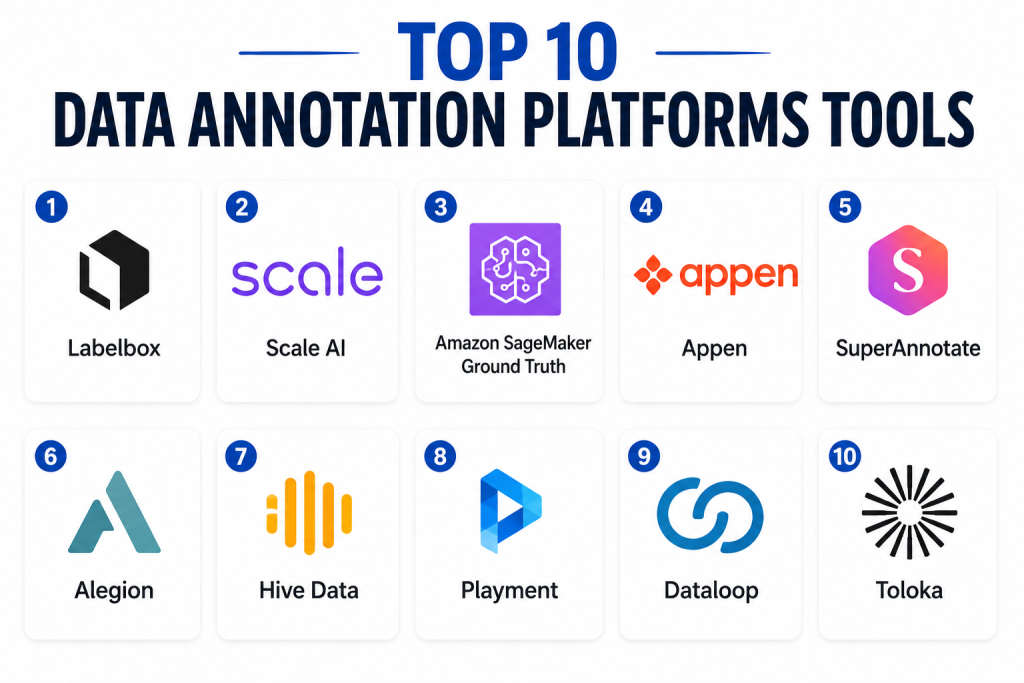
Top 10 Data Annotation Platforms Tools
1 — Labelbox
Short description: Labelbox offers a versatile data labeling platform supporting images, video, text, and 3D data. It is designed for enterprises aiming for scalable, high-quality annotated datasets.
Key Features
- AI-assisted labeling and pre-annotations.
- Multi-format data support including images, video, and text.
- Workflow management for large labeling teams.
- Quality assurance and review tools.
- Integrations with major ML pipelines and APIs.
Pros
- Accelerates dataset labeling.
- Reduces annotation errors with AI assistance.
Cons
- Enterprise pricing can be high for small teams.
- Some complex integrations require technical setup.
Platforms / Deployment
- Web / Windows / macOS
- Cloud
Security & Compliance
- SSO, MFA, RBAC
- SOC 2, GDPR
Integrations & Ecosystem
Supports APIs and integrates with AWS, GCP, Azure ML.
- TensorFlow, PyTorch
- Jupyter notebooks
- MLOps tools
- Custom APIs
Support & Community
Strong documentation, enterprise onboarding, and active community forums.
2 — Scale AI
Short description: Scale AI provides a high-throughput data annotation platform with a focus on computer vision, NLP, and autonomous driving datasets. It supports automated and manual labeling pipelines.
Key Features
- Automation and AI-assisted annotation.
- Advanced quality assurance tools.
- Support for 3D point cloud labeling.
- NLP annotation workflows.
- Integration with MLOps platforms.
Pros
- High accuracy in specialized domains.
- Efficient for large-scale datasets.
Cons
- Cost can be high for small-scale projects.
- Limited offline capabilities.
Platforms / Deployment
- Web
- Cloud
Security & Compliance
- Encryption at rest and transit
- SOC 2, ISO 27001
Integrations & Ecosystem
- AWS S3
- GCP Storage
- Custom ML pipelines
- Python SDKs
Support & Community
Enterprise-level support and responsive customer success team.
3 — Amazon SageMaker Ground Truth
Short description: AWS SageMaker Ground Truth enables semi-automated and human-labeled data for ML models. It supports a variety of data types, including images, text, and video.
Key Features
- Active learning for labeling efficiency.
- Multi-format data support.
- Integration with SageMaker ML pipelines.
- Built-in labeling workforce options.
- Labeling cost optimization features.
Pros
- Scales seamlessly within AWS ecosystem.
- Supports automated labeling.
Cons
- Best suited for AWS users; less flexible for other clouds.
- UI can be complex for beginners.
Platforms / Deployment
- Web
- Cloud
Security & Compliance
- IAM-based access control
- HIPAA eligibility, SOC 2
Integrations & Ecosystem
- SageMaker pipelines
- Lambda functions
- Custom ML workflows
Support & Community
AWS documentation and support plans are extensive.
4 — Appen
Short description: Appen specializes in human-in-the-loop annotation and AI training data for NLP, computer vision, and speech recognition projects, leveraging a global workforce.
Key Features
- Crowdsourced labeling and quality checks.
- Multi-language support.
- Audio and text annotation.
- Automated pre-labeling options.
- Workforce management dashboard.
Pros
- Global language coverage.
- High-quality human-labeled datasets.
Cons
- Turnaround time can vary for large datasets.
- Pricing may be high for continuous annotation.
Platforms / Deployment
- Web
- Cloud
Security & Compliance
- Encrypted workflows
- GDPR and SOC 2 compliance
Integrations & Ecosystem
- APIs for direct ML pipeline integration
- Python and REST SDKs
Support & Community
- Dedicated project managers
- Community forums and training material
5 — SuperAnnotate
Short description: SuperAnnotate provides a collaborative platform for image and video annotation with AI-assisted labeling tools and quality management for computer vision teams.
Key Features
- Collaborative annotation workflow.
- AI-assisted pre-labeling.
- Multi-format support.
- Quality assurance dashboard.
- Integration with ML pipelines.
Pros
- Improves labeling efficiency.
- Robust project management features.
Cons
- Can be expensive for smaller teams.
- Learning curve for advanced features.
Platforms / Deployment
- Web / macOS / Windows
- Cloud
Security & Compliance
- Role-based access
- Not publicly stated on SOC or ISO
Integrations & Ecosystem
- TensorFlow, PyTorch
- Cloud storage integrations
- REST API
Support & Community
Active support channels and documentation.
6 — Alegion
Short description: Alegion provides enterprise-grade data annotation solutions for computer vision and NLP, combining human intelligence with AI-assisted labeling for efficient dataset creation.
Key Features
- AI-assisted annotation.
- Crowdsourced labeling workforce.
- QA and validation workflows.
- Multi-format support (text, images, video).
- ML pipeline integrations.
Pros
- High-quality labeled datasets.
- Scalable for large enterprises.
Cons
- Less suited for small-scale projects.
- Setup and onboarding require time.
Platforms / Deployment
- Web
- Cloud
Security & Compliance
- Encryption in transit and at rest
- GDPR, SOC 2
Integrations & Ecosystem
- Python SDKs
- Cloud ML integrations
- REST APIs
Support & Community
- Project management support and documentation.
7 — Hive Data
Short description: Hive Data supports image, video, and text annotation with AI-assisted tools for computer vision, NLP, and autonomous vehicle datasets.
Key Features
- AI pre-labeling
- Collaborative labeling
- Video and image annotation
- NLP workflows
- Integration with ML platforms
Pros
- Fast labeling and high accuracy
- Supports large-scale projects
Cons
- Cloud-only; limited offline support
- Pricing varies per project
Platforms / Deployment
- Web / Linux / Windows
- Cloud
Security & Compliance
- Not publicly stated
Integrations & Ecosystem
- Python SDK
- REST API
- ML workflow tools
Support & Community
- Responsive support team
- Documentation available
8 — Playment
Short description: Playment provides annotation services for images, video, and LiDAR data with a mix of human and AI-assisted labeling workflows for computer vision teams.
Key Features
- AI-assisted pre-labeling
- Collaborative workflows
- LiDAR and 3D data support
- QA and validation
- Integration with ML pipelines
Pros
- Specialized for autonomous vehicles
- Reduces manual labeling time
Cons
- Limited NLP support
- Enterprise pricing
Platforms / Deployment
- Web
- Cloud
Security & Compliance
- GDPR compliant
- Not publicly stated
Integrations & Ecosystem
- REST APIs
- Python SDKs
- Cloud storage integrations
Support & Community
- Support teams and documentation
9 — Dataloop
Short description: Dataloop provides an AI-assisted annotation platform for images, video, and sensor data with workflow automation and quality management.
Key Features
- AI pre-labeling
- Workflow automation
- Multi-format support
- Quality control dashboards
- ML pipeline integration
Pros
- Supports complex datasets
- Scalable for enterprises
Cons
- Learning curve for beginners
- Cloud-only deployment
Platforms / Deployment
- Web
- Cloud
Security & Compliance
- SOC 2, GDPR
- RBAC
Integrations & Ecosystem
- Python SDK
- REST API
- TensorFlow, PyTorch
Support & Community
- Documentation and support team
10 — Toloka
Short description: Toloka is a crowdsourced data labeling platform for text, images, and audio, enabling fast human annotation for training AI models globally.
Key Features
- Global crowd workforce
- Multi-format support
- Quality management tools
- API integrations
- Workflow automation
Pros
- Cost-effective large-scale labeling
- Fast turnaround using crowdsourcing
Cons
- Less AI-assisted automation
- Limited enterprise support
Platforms / Deployment
- Web
- Cloud
Security & Compliance
- Not publicly stated
Integrations & Ecosystem
- REST API
- ML pipeline integration
- Python SDK
Support & Community
- Documentation and online support
Comparison Table (Top 10)
| Tool Name | Best For | Platform(s) Supported | Deployment | Standout Feature | Public Rating |
|---|---|---|---|---|---|
| Labelbox | Enterprises | Web, Windows, macOS | Cloud | AI-assisted labeling | N/A |
| Scale AI | Autonomous vehicles | Web | Cloud | 3D point cloud labeling | N/A |
| SageMaker Ground Truth | AWS ML users | Web | Cloud | Active learning | N/A |
| Appen | NLP & CV datasets | Web | Cloud | Human-in-the-loop | N/A |
| SuperAnnotate | Collaborative labeling | Web, macOS, Windows | Cloud | Project management | N/A |
| Alegion | Enterprise CV & NLP | Web | Cloud | Human + AI workflows | N/A |
| Hive Data | Large-scale CV projects | Web, Linux, Windows | Cloud | Fast labeling | N/A |
| Playment | Autonomous vehicles | Web | Cloud | LiDAR & 3D support | N/A |
| Dataloop | Complex datasets | Web | Cloud | Workflow automation | N/A |
| Toloka | Crowdsourced datasets | Web | Cloud | Global crowd workforce | N/A |
Evaluation & Scoring of Data Annotation Platforms
| Tool Name | Core (25%) | Ease (15%) | Integrations (15%) | Security (10%) | Performance (10%) | Support (10%) | Value (15%) | Weighted Total |
|---|---|---|---|---|---|---|---|---|
| Labelbox | 9 | 8 | 9 | 8 | 8 | 8 | 7 | 8.3 |
| Scale AI | 9 | 7 | 8 | 8 | 9 | 7 | 7 | 8.1 |
| SageMaker GT | 8 | 7 | 8 | 8 | 8 | 7 | 8 | 7.9 |
| Appen | 8 | 7 | 7 | 8 | 8 | 7 | 7 | 7.6 |
| SuperAnnotate | 8 | 8 | 7 | 7 | 7 | 7 | 7 | 7.5 |
| Alegion | 8 | 7 | 8 | 8 | 7 | 7 | 7 | 7.6 |
| Hive Data | 7 | 7 | 7 | 7 | 8 | 7 | 7 | 7.2 |
| Playment | 7 | 7 | 7 | 7 | 7 | 6 | 7 | 7.0 |
| Dataloop | 8 | 7 | 8 | 8 | 8 | 7 | 7 | 7.7 |
| Toloka | 7 | 6 | 6 | 6 | 7 | 6 | 7 | 6.5 |
Interpretation: Weighted totals reflect comparative performance across core features, usability, integrations, security, reliability, support, and value. Higher scores indicate platforms better suited for enterprise-grade, large-scale annotation projects.
Which Data Annotation Platform Is Right for You?
Solo / Freelancer
For individual ML engineers or data scientists with small datasets, tools like Labelbox or SuperAnnotate offer intuitive UIs and lightweight cloud workflows.
SMB
Small to medium businesses benefit from platforms like Appen and Toloka, which provide cost-effective crowdsourced labeling with managed quality.
Mid-Market
Mid-market enterprises can leverage Dataloop, Alegion, or Hive Data to handle larger, multi-modal datasets with workflow automation.
Enterprise
Large-scale AI projects requiring 3D, video, and multi-language support are best suited for Scale AI, Playment, or SageMaker Ground Truth.
Budget vs Premium
Smaller budgets prioritize crowdsourced platforms; premium tools provide automation, multi-format support, and enterprise-level security.
Feature Depth vs Ease of Use
Platforms like Labelbox balance usability with advanced features, while Scale AI focuses on depth and scalability for complex projects.
Integrations & Scalability
Enterprise teams should select platforms with robust ML pipeline integrations, REST APIs, and cloud scalability.
Security & Compliance Needs
Projects with sensitive data must prioritize SOC 2, HIPAA, or GDPR-compliant platforms such as SageMaker Ground Truth or Labelbox.
Frequently Asked Questions (FAQs)
1- What pricing models do data annotation platforms use?
Most platforms use subscription-based pricing, pay-per-label models, or enterprise contracts. Pricing scales with dataset size and annotation complexity.
2- How quickly can teams start labeling?
Cloud-based platforms offer immediate onboarding. Crowdsourced services may take longer due to workforce allocation and project setup.
3- Can these platforms handle multi-modal data?
Yes, leading platforms support images, video, text, audio, and even 3D/LiDAR datasets for autonomous systems.
4- How is annotation quality ensured?
Through a combination of AI-assisted labeling, human review, consensus, and quality assurance dashboards.
5- Are these tools suitable for small datasets?
Some tools may be overkill for small datasets. Lightweight platforms or built-in annotation features in ML frameworks may suffice.
6- Can platforms integrate with ML pipelines?
Yes, most offer APIs, SDKs, and integrations with popular ML frameworks like TensorFlow and PyTorch.
7- Is security of sensitive data handled?
Top platforms implement encryption, role-based access, and compliance with GDPR, HIPAA, or SOC 2 standards.
8- How do AI-assisted annotations work?
AI models pre-label data based on historical patterns, which human annotators validate, improving efficiency.
9- Can annotation tasks be distributed globally?
Crowdsourced platforms like Appen or Toloka allow distributed human labeling for faster dataset creation.
10- What are common pitfalls when choosing a platform?
Choosing based solely on cost without considering accuracy, integrations, or scalability can lead to suboptimal AI model performance.
Conclusion
Data annotation platforms are critical for high-quality AI model training. Choosing the right tool depends on dataset type, scale, and security requirements. Evaluate options based on automation, integrations, and workflow support. Shortlist 2–3 platforms, run pilots, and ensure the selected platform aligns with your AI strategy.
