Introduction
Relevance Evaluation Toolkits are software solutions designed to measure and optimize how well search engines, AI models, and recommendation systems return meaningful results. They allow teams to assess relevance, precision, recall, and other metrics, providing insights to improve algorithms and user experience.
These toolkits are vital for organizations that rely on search engines, recommender systems, or AI models to deliver accurate, context-aware results. They help validate the effectiveness of algorithms, compare model outputs, and ensure that users receive relevant content in various applications.
Real-world use cases include:
- Evaluating search engine result relevance for e-commerce platforms.
- Optimizing recommendations in streaming or retail apps.
- Validating AI-generated content and semantic search results.
- Benchmarking performance of ML models against ground truth datasets.
- Ensuring relevance in knowledge management and enterprise search applications.
Evaluation Criteria for Buyers:
- Metrics support (precision, recall, NDCG, MAP, etc.)
- Support for batch and real-time evaluation
- Integration with ML pipelines and search engines
- Visualization and reporting dashboards
- Multi-language and multi-domain testing
- Automation and CI/CD support for evaluation
- Scalability for large datasets
- API and SDK support
- Security, access control, and compliance
- Vendor support and community engagement
Best for: Data scientists, ML engineers, search engineers, and enterprises evaluating AI, search, or recommendation relevance.
Not ideal for: Small teams or projects without complex relevance evaluation needs; simple analytics or A/B testing may suffice.
Key Trends in Relevance Evaluation Toolkits
- AI-assisted evaluation and metric automation
- Multi-modal relevance assessment (text, image, audio, video)
- Integration with MLOps pipelines for automated validation
- Cloud-native and hybrid deployment support
- Real-time evaluation and continuous monitoring
- Advanced dashboards for visualization and reporting
- Multi-language and domain-specific evaluation
- Secure, compliant, and enterprise-ready platforms
- Low-code interfaces for non-technical users
- Consumption-based and subscription pricing models
How We Selected These Tools (Methodology)
- Evaluated market adoption and customer base
- Assessed feature completeness: metrics, evaluation workflows, integrations
- Verified performance, reliability, and scalability
- Reviewed security: RBAC, encryption, compliance
- Checked integrations with ML pipelines, search engines, and recommendation systems
- Considered usability across SMB, mid-market, and enterprise
- Prioritized platforms with AI/ML support for automated evaluation
- Reviewed support, documentation, and community engagement
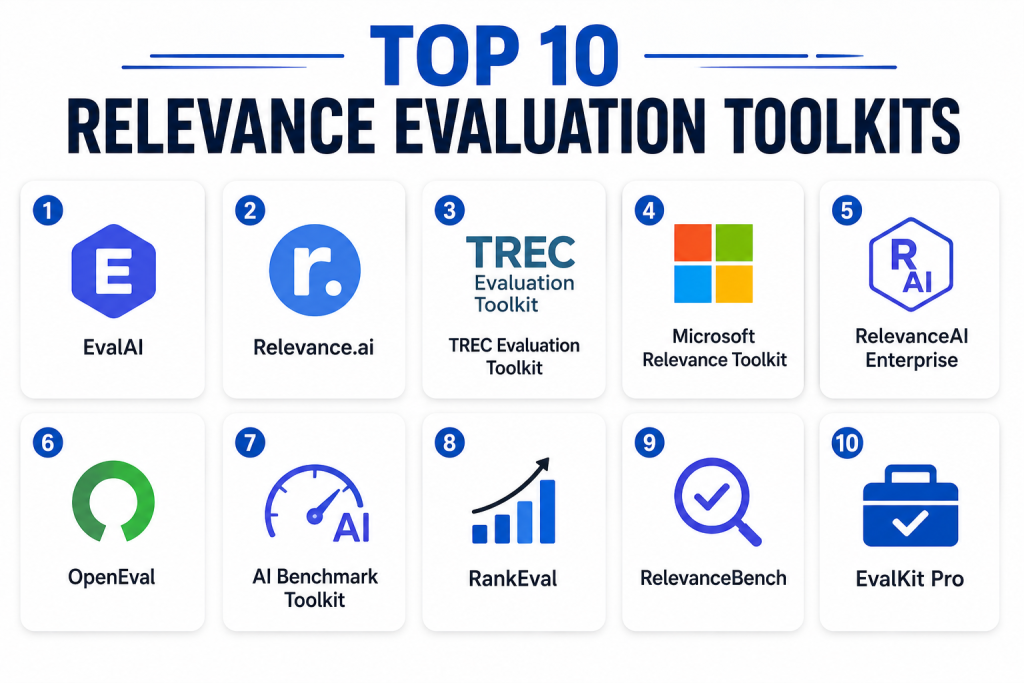
Top 10 Relevance Evaluation Toolkits
1- EvalAI
Short description: EvalAI is a platform for benchmarking AI models, evaluating relevance, and comparing model performance across various datasets for research and enterprise use.
Key Features
- Supports multiple evaluation metrics (precision, recall, NDCG)
- Automated leaderboard creation
- Integration with ML pipelines
- Multi-language dataset support
- Real-time result tracking
- API and SDK access
Pros
- Research and enterprise-ready
- Easy model comparison
- Extensible evaluation framework
Cons
- Requires ML expertise
- Cloud-only deployment
Platforms / Deployment
- Web / Cloud
Security & Compliance
- Authentication and access control
- Not publicly stated
Integrations & Ecosystem
- ML frameworks: TensorFlow, PyTorch
- REST APIs
- Dataset connectors
Support & Community
- Documentation, community forums, research support
2- Relevance.ai
Short description: Relevance.ai evaluates semantic search and recommendation results with ML-powered scoring for ranking and benchmarking relevance across datasets.
Key Features
- Semantic evaluation and embeddings comparison
- Multi-source integration
- Relevance scoring dashboards
- API and Python SDK support
- Automated evaluation pipelines
Pros
- AI-driven relevance scoring
- Multi-source support
- Flexible API
Cons
- Cloud-based
- Advanced features may require premium license
Platforms / Deployment
- Cloud
Security & Compliance
- RBAC, encryption
- Not publicly stated
Integrations & Ecosystem
- Python SDK, REST API
- BI dashboards
- ML frameworks
Support & Community
- Documentation, enterprise support, active community
3- TREC Evaluation Toolkit
Short description: TREC Evaluation Toolkit is an open-source framework for evaluating information retrieval systems using standard metrics for relevance benchmarking.
Key Features
- Standard IR metrics (MAP, NDCG, precision, recall)
- Open-source and extensible
- Batch evaluation support
- Supports multiple query formats
- Command-line interface
Pros
- Established research standard
- Open-source and flexible
- Lightweight and scriptable
Cons
- Limited UI
- Requires scripting knowledge
Platforms / Deployment
- Linux, Windows / Self-hosted
Security & Compliance
- Not publicly stated
Integrations & Ecosystem
- Python scripts
- Custom pipelines
- REST API possible via wrapper
Support & Community
- Research community, documentation, GitHub support
4- Microsoft Relevance Toolkit
Short description: Microsoft Relevance Toolkit provides evaluation for search and recommendation algorithms, supporting precision, recall, and user engagement metrics.
Key Features
- Multiple relevance metrics
- Integration with Microsoft ML tools
- API and SDK access
- Dashboard for result visualization
- Multi-language support
Pros
- Enterprise-grade
- Easy integration with MS stack
- Scalable evaluation
Cons
- Cloud dependency
- License required for enterprise features
Platforms / Deployment
- Cloud / Windows
Security & Compliance
- RBAC, encryption
- Not publicly stated
Integrations & Ecosystem
- Azure ML, Power BI
- Python SDK
- REST API
Support & Community
- Microsoft enterprise support, documentation, active forums
5- RelevanceAI Enterprise
Short description: RelevanceAI Enterprise supports large-scale evaluation of search and recommendation systems with automated relevance scoring, dashboards, and pipeline integration.
Key Features
- AI-based relevance scoring
- Multi-source evaluation
- Batch and real-time evaluation
- Analytics dashboards
- ML pipeline integration
Pros
- Enterprise-scale
- Automation-ready
- Multi-modal evaluation
Cons
- Premium pricing
- Cloud-only
Platforms / Deployment
- Cloud
Security & Compliance
- RBAC, encryption, SSO
- Not publicly stated
Integrations & Ecosystem
- Python SDK, REST APIs
- ML frameworks
- BI and analytics connectors
Support & Community
- Enterprise support, documentation, developer forums
6- OpenEval
Short description: OpenEval is an open-source framework for benchmarking search and recommendation systems, supporting customizable relevance metrics and datasets.
Key Features
- Customizable metrics
- Open-source and extensible
- Batch evaluation pipelines
- Multi-language support
- REST API and Python SDK
Pros
- Open-source and flexible
- Research-friendly
- Easy integration with pipelines
Cons
- No enterprise support
- Limited visualization
Platforms / Deployment
- Linux, Windows / Self-hosted
Security & Compliance
- Not publicly stated
Integrations & Ecosystem
- Python SDK, REST API
- ML frameworks
- Custom dataset connectors
Support & Community
- Community forums, GitHub documentation
7- AI Benchmark Toolkit
Short description: AI Benchmark Toolkit evaluates model relevance across recommendation engines, semantic search, and AI outputs using standard metrics and reporting dashboards.
Key Features
- Supports multiple ML evaluation metrics
- Dashboard reporting
- Batch and real-time evaluation
- API and SDK support
- Multi-language and multi-domain evaluation
Pros
- AI-driven benchmarking
- Scalable and extensible
- Easy to integrate
Cons
- Cloud subscription required
- Advanced analytics require enterprise license
Platforms / Deployment
- Cloud
Security & Compliance
- RBAC, encryption
- Not publicly stated
Integrations & Ecosystem
- Python SDK, REST API
- ML pipelines
- BI connectors
Support & Community
- Documentation, enterprise support, active community
8- RankEval
Short description: RankEval provides tools to assess the ranking quality of search engines and recommendation systems with standard relevance metrics and visualization dashboards.
Key Features
- Evaluation metrics (NDCG, MAP, precision, recall)
- Batch evaluation pipelines
- Dashboard visualization
- API and Python SDK
- Multi-language support
Pros
- Focused on ranking evaluation
- Scalable for large datasets
- Easy to integrate with ML pipelines
Cons
- Limited enterprise support
- UI is basic
Platforms / Deployment
- Linux, Windows / Cloud / Self-hosted
Security & Compliance
- Not publicly stated
Integrations & Ecosystem
- Python SDK
- REST API
- ML pipelines
Support & Community
- Community support, documentation
9- RelevanceBench
Short description: RelevanceBench allows teams to benchmark search relevance, recommendation algorithms, and AI output with automated scoring and dashboards.
Key Features
- Automated scoring pipelines
- Metrics for semantic relevance
- Dashboard analytics
- Batch and real-time evaluation
- API and SDK support
Pros
- Automated evaluation
- Scalable for large datasets
- Easy integration
Cons
- Commercial license required
- Cloud-only deployment
Platforms / Deployment
- Cloud
Security & Compliance
- RBAC, encryption
- Not publicly stated
Integrations & Ecosystem
- Python SDK, REST API
- ML frameworks
- BI connectors
Support & Community
- Enterprise support, documentation
10- EvalKit Pro
Short description: EvalKit Pro provides enterprise-ready evaluation of relevance for search engines, recommendations, and AI-generated results with metrics dashboards.
Key Features
- Multiple evaluation metrics
- Real-time and batch scoring
- Dashboard reporting
- API and SDK integration
- Multi-source support
Pros
- Enterprise-scale evaluation
- Automated reporting
- Scalable and secure
Cons
- Premium pricing
- Cloud-dependent
Platforms / Deployment
- Cloud / On-prem
Security & Compliance
- RBAC, SSO, encryption
- SOC 2, ISO 27001
Integrations & Ecosystem
- Python SDK, REST API
- ML pipelines
- BI dashboards
Support & Community
- Enterprise support, documentation, community forums
Comparison Table (Top 10)
| Tool Name | Best For | Platform(s) Supported | Deployment | Standout Feature | Public Rating |
|---|---|---|---|---|---|
| EvalAI | AI model benchmarking | Web | Cloud | Leaderboard & model comparison | N/A |
| Relevance.ai | Semantic scoring | Cloud | Cloud | AI-driven relevance | N/A |
| TREC Evaluation Toolkit | Research evaluation | Linux, Windows | Self-hosted | Standard IR metrics | N/A |
| Microsoft Relevance Toolkit | Enterprise search | Cloud, Windows | Cloud | ML integration & dashboards | N/A |
| RelevanceAI Enterprise | Enterprise-scale | Cloud | Cloud | Automated relevance pipelines | N/A |
| OpenEval | Open-source evaluation | Linux, Windows | Self-hosted | Customizable metrics | N/A |
| AI Benchmark Toolkit | AI/ML models | Cloud | Cloud | Semantic search scoring | N/A |
| RankEval | Search ranking evaluation | Linux, Windows | Cloud / Self-hosted | Ranking-focused metrics | N/A |
| RelevanceBench | Enterprise semantic scoring | Cloud | Cloud | Automated dashboards | N/A |
| EvalKit Pro | Enterprise evaluation | Cloud / Linux | Cloud / On-prem | Enterprise-ready dashboards | N/A |
Evaluation & Scoring of Relevance Evaluation Toolkits
| Tool Name | Core (25%) | Ease (15%) | Integrations (15%) | Security (10%) | Performance (10%) | Support (10%) | Value (15%) | Weighted Total |
|---|---|---|---|---|---|---|---|---|
| EvalAI | 9 | 8 | 8 | 7 | 8 | 8 | 7 | 8.0 |
| Relevance.ai | 8 | 8 | 8 | 7 | 8 | 7 | 7 | 7.7 |
| TREC Evaluation Toolkit | 8 | 7 | 7 | 7 | 8 | 7 | 7 | 7.4 |
| Microsoft Relevance Toolkit | 8 | 8 | 8 | 8 | 8 | 7 | 7 | 7.7 |
| RelevanceAI Enterprise | 9 | 7 | 8 | 8 | 8 | 7 | 7 | 7.9 |
| OpenEval | 7 | 7 | 7 | 7 | 8 | 7 | 7 | 7.2 |
| AI Benchmark Toolkit | 8 | 7 | 8 | 7 | 8 | 7 | 7 | 7.7 |
| RankEval | 7 | 8 | 7 | 7 | 7 | 7 | 7 | 7.2 |
| RelevanceBench | 8 | 7 | 8 | 7 | 8 | 7 | 7 | 7.7 |
| EvalKit Pro | 9 | 7 | 8 | 8 | 8 | 7 | 7 | 7.9 |
Interpretation: Weighted totals highlight relative strengths in evaluation metrics, integrations, usability, and enterprise readiness. Higher scores indicate more robust relevance evaluation capabilities.
Which Relevance Evaluation Toolkit Is Right for You?
Solo / Freelancer
- OpenEval or TREC Toolkit for research or small projects; lightweight and open-source.
SMB
- EvalAI or AI Benchmark Toolkit for managing ML model relevance evaluation pipelines.
Mid-Market
- Relevance.ai or Microsoft Relevance Toolkit for semantic search and recommendations.
Enterprise
- RelevanceAI Enterprise, EvalKit Pro, or RelevanceBench for scalable, automated, enterprise evaluation.
Budget vs Premium
- Open-source reduces cost; premium solutions offer dashboards, automation, and enterprise-grade support.
Feature Depth vs Ease of Use
- Microsoft Relevance Toolkit and EvalKit Pro provide advanced metrics; TREC and OpenEval balance simplicity with research-oriented evaluation.
Integrations & Scalability
- Enterprise platforms scale across pipelines, ML models, and multi-source datasets.
Security & Compliance Needs
- RBAC, SSO, encryption, and SOC 2 compliance provided by enterprise-grade platforms.
Frequently Asked Questions (FAQs)
1- What pricing models are common?
Open-source platforms are free, enterprise solutions charge subscription or licensing based on users, datasets, or compute usage.
2- How long does deployment take?
Small-scale deployments take hours, enterprise pipelines may require days for integration and automated evaluation.
3- Do these tools integrate with ML pipelines?
Yes, all top platforms support APIs and SDKs for TensorFlow, PyTorch, and other ML frameworks.
4- Can they handle real-time evaluation?
Many platforms provide real-time or near real-time scoring and dashboards for dynamic search and recommendation testing.
5- Are visualization dashboards included?
Enterprise solutions offer dashboards for analytics, model comparisons, and metric tracking, while open-source may require custom dashboards.
6- Can non-technical users leverage these toolkits?
Some provide low-code interfaces and reporting dashboards for analysts and product teams.
7- What are common adoption challenges?
Integration with multiple data sources, model versioning, and metric selection can be complex.
8- How is security enforced?
Enterprise platforms provide RBAC, SSO, encryption, and logging to meet compliance needs.
9- Can these tools support multi-language evaluation?
Yes, most enterprise platforms support multiple languages for content relevance testing.
10- What are alternatives for small datasets?
For small-scale evaluation, simple A/B testing or spreadsheet-based metrics may suffice.
Conclusion
Relevance Evaluation Toolkits are essential for assessing search engines, AI models, and recommendation systems. Open-source tools like TREC and OpenEval work well for research or small teams, while enterprise platforms such as RelevanceAI Enterprise and EvalKit Pro provide automation, scalability, and dashboards.
