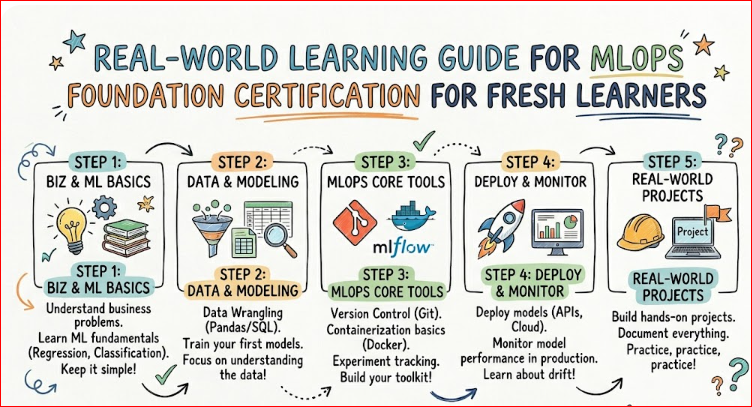
Introduction
The MLOps Foundation Certification serves as a critical bridge between the experimental world of machine learning and the rigorous requirements of production-grade software operations. This guide is designed for senior engineers, architects, and technical leaders who are witnessing the shift from “AI-as-a-project” to “AI-as-a-product.” By engaging with the ecosystem at aiopsschool.com, professionals can gain a structured understanding of how to stabilize, scale, and secure intelligent systems within a modern enterprise environment.
As platform engineering and cloud-native practices continue to evolve, the ability to manage the lifecycle of a model becomes just as important as the model’s architectural design. This guide helps technical professionals navigate the complexities of data versioning, model drift, and automated retraining pipelines, enabling them to make informed career decisions. Whether you are an SRE looking to support data science workloads or a manager planning a departmental roadmap, this certification provides the necessary technical and operational vocabulary.
In the current professional landscape, specialized skills in operationalizing artificial intelligence are in high demand across global markets. This certification helps bridge the gap between traditional DevOps practices and the unique requirements of non-deterministic machine learning systems. By the end of this guide, you will have a clear understanding of the certification levels, the skills you will acquire, and how this credential maps to real-world production roles in the industry.
What is the MLOps Foundation Certification?
The MLOps Foundation Certification is a formal recognition of an engineer’s ability to apply DevOps principles to the machine learning lifecycle. It exists to solve the fundamental problem of the “wall” that often exists between data scientists and IT operations teams. By establishing a shared set of standards and automated practices, this certification ensures that models can move from a researcher’s notebook to a production environment with minimal friction and maximum reliability.
The curriculum is built around real-world, production-focused learning, moving away from academic abstraction toward practical implementation. It aligns with modern engineering workflows by emphasizing the use of containers, orchestration, and continuous integration/continuous delivery (CI/CD) systems specifically tuned for ML artifacts. This ensures that enterprise practices remain consistent even as the underlying machine learning frameworks continue to change at a rapid pace.
For an organization, this certification represents a move toward mature, predictable delivery of AI-driven features. It validates that an engineer understands the complexities of maintaining a “live” system where the data is constantly changing. By focusing on these production-ready skills, the certification helps professionals build systems that are not only accurate but also robust, scalable, and maintainable over the long term.
Who Should Pursue MLOps Foundation Certification?
This certification is highly beneficial for DevOps engineers, Site Reliability Engineers (SREs), and Platform Engineers who are increasingly responsible for AI infrastructure. It is also highly relevant for data scientists who want to understand how their models are deployed and managed in the real world. Security and data professionals will find value in the sections dedicated to model governance, data lineage, and the protection of sensitive automated pipelines.
For beginners, the program offers a structured entry point into one of the most specialized fields in the technology sector today. For experienced engineers and technical leaders, it serves as a method to formalize their existing knowledge and fill in gaps related to specialized ML tooling. The global relevance of this certification is significant, as companies across the United States, Europe, and India are all seeking ways to reduce the failure rate of their machine learning projects.
Engineering managers and technical leaders should pursue this certification to better understand the resourcing, timelines, and technical requirements of MLOps initiatives. It provides them with the oversight needed to build high-performing teams and choose the right infrastructure investments. Regardless of your current title, if you are involved in the delivery of software that utilizes data models, this certification is a logical step in your professional development.
Why MLOps Foundation Certification is Valuable and Beyond
The value of the MLOps Foundation Certification lies in its focus on the longevity and operational stability of intelligent systems. As more enterprises move their AI experiments into production, the demand for professionals who can manage these systems will continue to outpace the supply. This certification provides a career “moat” by giving you a specialized skillset that is difficult to replicate through general software engineering knowledge alone.
In an industry where tools and frameworks change almost monthly, focusing on the foundational principles of MLOps ensures your skills remain relevant for years to come. The program teaches you how to think about systems holistically, considering the impact of data quality, model performance, and infrastructure costs. This principles-first approach is what allows professionals to pivot between different cloud providers or toolsets without losing their technical edge.
Furthermore, the return on time investment is high because it directly addresses the biggest bottleneck in the AI industry: the deployment gap. Companies are looking for engineers who can prove that they can handle the unique failure modes of machine learning, such as model drift and training-serving skew. By earning this certification, you position yourself as a rare professional capable of bridging the gap between cutting-edge science and reliable enterprise engineering.
MLOps Foundation Certification Overview
The program is delivered through the official training portal and hosted on the specialized educational site. It is structured to provide a logical progression from basic operational concepts to complex architectural patterns. The certification is designed for professionals who need to balance their learning with a full-time career, offering modular content that can be consumed at an individual pace.
The certification tracks are owned and governed by industry experts who ensure that the curriculum reflects current enterprise needs. Assessment is rigorous, involving both theoretical knowledge checks and practical validations of a candidate’s ability to design and implement pipelines. This dual approach ensures that the credential carries significant weight when presented to hiring managers or technical stakeholders.
Participants will gain a deep understanding of the core pillars of the field, including data management, model orchestration, and production monitoring. The structure also allows for specialization into areas like security, finance, or reliability, depending on the professional’s long-term career goals. By the end of the program, you will have a comprehensive toolkit for building and maintaining the infrastructure that powers modern artificial intelligence.
MLOps Foundation Certification Tracks & Levels
The certification hierarchy begins with the Foundation level, which establishes a baseline of knowledge regarding the machine learning lifecycle and standard terminology. This level is essential for ensuring that everyone on a technical team is working from the same conceptual framework. It covers the basics of versioning, basic deployment strategies, and the role of the feature store in modern architectures.
The Professional level moves into the implementation of these concepts using industry-standard tools and cloud services. This level is aimed at practitioners who are responsible for building and maintaining the actual pipelines that move models from training to inference. It introduces more complex topics such as distributed training, auto-scaling inference endpoints, and advanced monitoring for data and model drift.
The Advanced level and specialization tracks allow for deep dives into specific domains like DevSecOps for ML, FinOps for AI, or SRE for high-scale model serving. These tracks are designed for senior professionals who are architecting large-scale systems or managing entire departments. This tiered approach ensures that your certification journey can grow as your responsibilities and technical interests evolve over time.
Complete MLOps Foundation Certification Table
| Track | Level | Who it’s for | Prerequisites | Skills Covered | Recommended Order |
|---|---|---|---|---|---|
| Core MLOps | Foundation | Beginners, Managers | Basic Linux, Git | Lifecycle, CI/CD, Versioning | 1 |
| Engineering | Professional | SREs, DevOps | Foundation Level | Automation, Orchestration, K8s | 2 |
| Architecture | Advanced | Solutions Architects | Professional Level | Scalability, High Availability | 3 |
| Security | Specialist | Security Engineers | Foundation Level | Data Privacy, Model Security | 4 |
| Economics | Specialist | FinOps, Managers | Foundation Level | Cost Control, GPU Optimization | 5 |
Detailed Guide for Each MLOps Foundation Certification
MLOps Foundation Certification – Foundation Level
What it is
This certification validates the essential knowledge required to understand and participate in the machine learning operational lifecycle. It confirms that a professional understands the core differences between traditional software development and the data-driven nature of AI systems.
Who should take it
This is ideal for junior engineers, IT managers, and project coordinators who need to understand the technical flow of an ML project. It is also a perfect starting point for experienced DevOps professionals who are transitioning into the data science space.
Skills you’ll gain
- Proficiency in the end-to-end Machine Learning Lifecycle (MLLC).
- Fundamental concepts of data versioning and model registry management.
- Basic understanding of CI/CD for machine learning (CT – Continuous Training).
- Knowledge of monitoring tools for detecting model performance degradation.
Real-world projects you should be able to do
- Implement a basic automated training pipeline using standard Git workflows.
- Configure a model registry to track different versions of a production model.
- Setup basic performance dashboards to monitor inference latency and accuracy.
Preparation plan
- 7–14 days: Focus on learning the core vocabulary and the primary stages of the machine learning lifecycle.
- 30 days: Engage with basic hands-on labs involving model versioning and simple pipeline construction.
- 60 days: Review common production failure modes and participate in mock architectural design sessions.
Common mistakes
- Ignoring the data dependency and focusing only on the code aspects of the pipeline.
- Failing to account for the storage requirements of large model artifacts and datasets.
- Underestimating the importance of reproducible environments for training and inference.
Best next certification after this
- Same-track option: MLOps Professional Certification.
- Cross-track option: DataOps Foundation Certification.
- Leadership option: AI Strategy for Technical Leaders.
Choose Your Learning Path
DevOps Path
The DevOps path focuses on the automation of the machine learning lifecycle, extending traditional CI/CD concepts to handle model weights and data artifacts. You will learn how to build pipelines that not only build and test code but also validate the statistical performance of a model before it is released. This path is essential for engineers who want to reduce the manual effort involved in retraining and deploying models. It emphasizes the use of infrastructure-as-code to manage the complex environments required for machine learning.
DevSecOps Path
The DevSecOps path addresses the unique security challenges of the AI era, such as adversarial attacks on models and data privacy in training sets. You will learn how to implement automated security scans for container images used in ML and how to secure the data supply chain. This path is critical for professionals working in highly regulated industries like finance or healthcare. It ensures that the speed of innovation does not compromise the security posture or the compliance status of the organization.
SRE Path
The SRE path is dedicated to the reliability and observability of production machine learning systems. You will learn how to define and measure SLOs for model inference and how to handle the “silent failures” that occur when a model’s accuracy drops without a system crash. This path focuses on building resilient architectures that can handle high-velocity data and scale compute resources efficiently. It is ideal for engineers who enjoy the challenge of maintaining complex, high-availability systems that operate at the edge of technical possibility.
AIOps Path
The AIOps path focuses on the application of machine learning to the field of IT operations itself. In this track, you learn how to use AI to analyze logs, predict system failures, and automate the response to infrastructure incidents. It is about using data-driven insights to make the job of an operations engineer more efficient and proactive. This path is perfect for those who want to build the “self-healing” infrastructure of the future by leveraging the power of predictive analytics.
MLOps Path
The MLOps path is the primary technical track for those who want to master the delivery and maintenance of machine learning models. It covers the entire spectrum from feature stores and experimental tracking to model serving and retraining loops. You will focus on the technical implementation of the MLOps principles, learning how to use specialized tools to manage the unique lifecycle of AI products. This path is the core journey for anyone aiming to become a specialist in the operational side of the data science world.
DataOps Path
The DataOps path emphasizes the quality, speed, and reliability of the data pipelines that feed into machine learning systems. You will learn how to apply DevOps principles to data engineering, including automated data testing, versioning, and continuous integration of data workflows. This path is essential because the performance of any ML model is directly tied to the quality of the data it receives. It is the ideal track for data engineers who want to ensure their pipelines are production-ready and resilient to change.
FinOps Path
The FinOps path deals with the economic reality of running machine learning at scale, where compute costs can easily spiral out of control. You will learn how to track the cost of training jobs, optimize the usage of expensive GPU resources, and implement chargeback models. This path is vital for ensuring that an organization’s AI initiatives are financially sustainable and provide a clear return on investment. It bridges the gap between technical operations and financial management, making you an asset to the executive leadership team.
Role → Recommended MLOps Foundation Certifications
| Role | Recommended Certifications |
|---|---|
| DevOps Engineer | MLOps Foundation, Professional Level |
| SRE | MLOps Foundation, SRE Specialist Track |
| Platform Engineer | MLOps Foundation, Infrastructure Path |
| Cloud Engineer | MLOps Foundation, Cloud Specialization |
| Security Engineer | MLOps Foundation, DevSecOps Track |
| Data Engineer | MLOps Foundation, DataOps Path |
| FinOps Practitioner | MLOps Foundation, FinOps Specialist |
| Engineering Manager | MLOps Foundation, Leadership Track |
Next Certifications to Take After MLOps Foundation Certification
Same Track Progression
For those looking to deepen their expertise, the logical next step is the Professional and eventually the Advanced MLOps certifications. This path allows you to master complex orchestration tools like Kubernetes and specialized ML platforms like Kubeflow or SageMaker. Deepening your knowledge in a single track establishes you as a Subject Matter Expert (SME) who can solve the most difficult technical challenges in the industry.
Cross-Track Expansion
If your goal is to become a more versatile “T-shaped” engineer, expanding into DataOps or DevSecOps is highly recommended. Understanding the upstream data quality (DataOps) or the downstream security implications (DevSecOps) provides you with a holistic view of the technology stack. This cross-track knowledge is particularly valuable in leadership roles where you must oversee multiple different engineering disciplines simultaneously.
Leadership & Management Track
Transitioning into leadership requires a shift from technical execution to strategic oversight and team management. Certifications focused on AI strategy or engineering management help you understand how to align technical projects with business goals. This track is designed for senior engineers who want to move into Director or VP-level roles, where the focus is on building organizational capability rather than individual technical output.
Training & Certification Support Providers for MLOps Foundation Certification
DevOpsSchool
DevOpsSchool is a leading provider of technical training that specializes in the automation and operationalization of modern software systems. Their MLOps program is built on a foundation of years of experience in the DevOps field, ensuring that students receive a practical and industry-relevant education. They offer extensive hands-on labs and real-world project scenarios that help candidates prepare for the rigors of production environments. The instructors are experienced practitioners who bring deep technical insights into every session, helping students understand not just the “how” but also the “why” behind every practice. Many professionals in the Indian and global markets rely on their curriculum to stay ahead of the rapidly changing technological curve.
Cotocus
Cotocus provides a specialized learning platform that focuses on corporate training and individual professional development in high-growth technology sectors. Their approach to the MLOps certification path is highly collaborative, often involving live sessions with industry experts who have implemented these systems at scale. They provide a comprehensive suite of study materials, including detailed guides and practice assessments that closely mirror the actual certification process. Cotocus is known for its focus on enterprise-grade practices, ensuring that the skills learned are immediately applicable to large-scale organizational challenges. Their commitment to student success is reflected in their high completion rates and the positive feedback from their alumni who work at major global tech firms.
Scmgalaxy
Scmgalaxy is a robust community-driven platform that has been at the forefront of the configuration management and DevOps movement for over a decade. Their training for MLOps is deeply rooted in the principles of version control, reproducibility, and automation. They offer a wealth of free and paid resources, including video tutorials, technical articles, and community forums where students can ask questions and share their experiences. Scmgalaxy’s certification support is particularly strong for those who want to master the fundamental infrastructure tools that underpin modern machine learning pipelines. Their legacy in the software configuration management space ensures that they provide a stable and well-vetted perspective on operational best practices.
BestDevOps
BestDevOps focuses on delivering a curated and streamlined learning experience for busy professionals who want to acquire new skills quickly and efficiently. Their MLOps certification track is designed to eliminate the fluff and focus on the most important skills required by hiring managers today. They offer a combination of self-paced learning and mentor-led support, providing the flexibility that modern engineers need to balance their careers and education. BestDevOps also emphasizes career coaching and professional placement, helping candidates leverage their new certifications to secure high-paying roles in the industry. Their curriculum is frequently updated to reflect the latest trends and toolsets, ensuring that your knowledge is always at the cutting edge.
devsecopsschool.com
DevSecOpsSchool.com is the primary destination for professionals who want to integrate security into every stage of the software and machine learning lifecycle. Their MLOps training includes specialized modules on securing data pipelines, model registries, and inference endpoints. They teach students how to think like both an attacker and a defender, ensuring that the AI systems they build are resilient to unauthorized access and adversarial manipulation. The certifications offered here are highly valued by organizations that prioritize data privacy and organizational security. For those looking to specialize in the intersection of security and AI operations, this platform provides the most comprehensive and focused education available in the market.
sreschool.com
SRESchool.com is dedicated to the art and science of site reliability engineering, with a specific focus on the needs of complex, data-driven systems. Their MLOps program emphasizes the importance of observability, error budgets, and incident management in the context of production machine learning. They teach students how to build self-healing systems that can automatically detect and mitigate issues like model drift or performance degradation. The platform is ideal for senior engineers who are responsible for the uptime and performance of critical AI services. By focusing on reliability as a core feature of the system, SRESchool helps professionals build the trust necessary for wide-scale enterprise adoption of artificial intelligence.
aiopsschool.com
AIOpsSchool.com is a specialized educational hub that focuses exclusively on the fields of AIOps and MLOps, providing the most in-depth training in the industry. As the primary host for these certifications, they offer a direct and authoritative path to mastering the operational side of the AI world. Their curriculum is developed by a team of experts who are active in the field, ensuring that the content is both technically deep and practically relevant. The platform provides a seamless learning journey, from foundational concepts to advanced architectural patterns. For anyone serious about a long-term career in AI operations, AIOpsSchool is the definitive resource for education and professional certification.
dataopsschool.com
DataOpsSchool.com addresses the critical need for speed and quality in the data pipelines that power modern machine learning models. Their training focuses on the application of DevOps principles to data management, including automated testing, continuous integration, and versioning for datasets. They teach students how to break down the silos between data engineers, data scientists, and operations teams to create a more efficient and reliable workflow. This platform is essential for anyone who recognizes that data is the “source code” of machine learning and must be managed with the same level of rigor. Their certifications validate that a professional can ensure the integrity and availability of data in a high-velocity production environment.
finopsschool.com
FinOpsSchool.com provides the specialized knowledge needed to manage the costs of cloud and infrastructure resources in the era of artificial intelligence. Their MLOps-related modules focus on the unique challenges of tracking and optimizing the spend associated with expensive GPU compute and massive data storage. They teach students how to implement chargeback models and how to use data-driven insights to make better purchasing decisions for their technical teams. This knowledge is becoming increasingly critical as organizations look to scale their AI initiatives while maintaining fiscal discipline. FinOps professionals who understand the nuances of machine learning workloads are among the most highly sought-after experts in the modern enterprise landscape.
Frequently Asked Questions (General)
- How difficult is the MLOps Foundation Certification exam?
The foundation level is designed to be accessible for candidates with a basic background in IT or software development. It focuses more on conceptual understanding and the lifecycle of a project than on deep, complex mathematical algorithms or data science theory. - How much time is required to prepare for the certification?
Most working professionals find that they can successfully complete the certification within 30 to 60 days. This allows for a steady pace of studying for a few hours each week while also engaging with the required practical lab exercises. - What are the basic prerequisites for starting this track?
A fundamental understanding of the Linux command line, Git version control, and general cloud computing concepts is recommended. You do not need to be a professional data scientist or have an advanced degree in mathematics to pass the foundation level. - Is the certification exam conducted online or in-person?
The exam is conducted entirely online through a secure proctoring system, allowing you to take it from the comfort of your home or office. This makes the certification accessible to professionals living in any part of the world at any time. - Does the certification expire after a certain period?
Yes, like most high-level technical certifications, it typically remains valid for two to three years. To maintain the credential, professionals are encouraged to engage in continuous learning or move up to a higher level of certification. - What kind of career boost can I expect from this credential?
Earning this certification distinguishes you as an expert in a high-demand, niche field, which can lead to higher salaries and more senior roles. It proves to employers that you have the specialized skills needed to handle the complexities of production AI. - How does this certification differ from a standard DevOps certification?
While standard DevOps focuses on the lifecycle of code, this certification adds layers of complexity related to data versioning and model performance. It addresses the non-deterministic nature of machine learning, which standard DevOps tools are not always built to handle. - Are there practical labs included in the training program?
Yes, the training support providers emphasize hands-on learning through simulated production environments. This ensures that you not only understand the theory but can also implement the tools and workflows required in a real job setting. - Is this certification recognized by major tech companies?
The curriculum is based on industry-wide standards and the same tools used by companies like Google, Amazon, and Netflix. It is highly respected by hiring managers who are looking for validated skills in the operationalization of machine learning. - Can I skip the Foundation level and go straight to Professional?
It is generally recommended to start with the Foundation level to ensure you have a solid grasp of the terminology and the lifecycle principles. This builds the necessary base for the more complex technical implementation taught at the Professional level. - What is the focus of the assessment process?
The assessment focuses on your ability to design and maintain reliable ML pipelines, manage model versioning, and implement production monitoring. It tests both your theoretical knowledge and your ability to solve practical operational problems. - Is there any support available if I fail the exam on the first try?
Most training providers offer a structured retake policy and additional study support to help you identify and fill your knowledge gaps. The goal of the program is to ensure that you eventually master the material and the practical skills.
FAQs on MLOps Foundation Certification
- How is “Model Drift” covered in the MLOps Foundation track?
The program includes a specific module on observability that teaches you how to identify when a model’s performance has degraded due to changes in real-world data. You will learn the metrics and tools needed to detect this drift and trigger automated retraining. - What role does Kubernetes play in this certification?
Kubernetes is introduced as the primary orchestration tool for scaling both training jobs and inference endpoints. You will learn the basics of how to containerize ML models and deploy them into a cluster for high availability and efficient resource usage. - Does the course cover the use of Feature Stores?
Yes, the certification explains the concept of a feature store as a centralized repository for managing and serving data features. This is a critical component for ensuring consistency between the data used for training and the data used during inference. - How are data versioning and code versioning integrated?
The curriculum teaches you how to use tools like DVC alongside Git to ensure that every version of your code is linked to a specific version of the data. This level of traceability is essential for meeting compliance requirements and ensuring project reproducibility. - Is there a focus on cost optimization for expensive ML resources?
The certification introduces the concept of resource management, helping you understand how to monitor and control the costs associated with GPUs. This is a key skill for ensuring that machine learning projects remain economically viable for the organization. - How does the certification address model security?
The program covers the basics of the “secure supply chain” for machine learning, including scanning model weights for malware and protecting inference APIs. Security is treated as a foundational element of the operational lifecycle, not an afterthought. - What is the significance of the Model Registry in the training?
You will learn how to use a Model Registry to track the lineage of every model, from training metrics to deployment status. This provides a central “source of truth” that helps teams manage the promotion of models from staging to production. - How does the course handle the concept of Continuous Training (CT)?
Continuous Training is presented as an evolution of CI/CD, where the pipeline is triggered not just by code changes but also by data changes or performance drops. You will learn how to build loops that automatically retrain and validate models.
Final Thoughts
In my experience as a mentor and technical lead, the value of the MLOps Foundation Certification lies in its ability to turn a specialized, often chaotic field into a disciplined engineering practice. We have moved past the era of “AI experimentation” and into the era of “AI reliability.” For a professional, this means that the ability to deploy and maintain these systems is now just as valuable—if not more so—than the ability to build the models themselves.
This certification is not just a badge for your resume; it is a structured mental framework that will change how you approach every technical problem. It teaches you to look beyond the code and see the data, the infrastructure, and the costs as part of a single, unified system. For those who are willing to put in the time to master these principles, the career opportunities are immense, both in terms of compensation and the chance to work on the industry’s most challenging projects.
If you are currently working in DevOps, SRE, or data engineering, this is the most logical next step for your career. It positions you at the center of the most significant technological shift of our time, giving you the skills needed to lead rather than just follow. My advice is to approach this learning with a focus on practical application—take the labs seriously, understand the “why” behind the workflows, and use this certification as a springboard for your long-term professional growth.
