Introduction
Clinical Trial Management Systems (CTMS) are software platforms designed to manage, track, and streamline all aspects of clinical trials.
They provide tools for trial planning, patient enrollment, site management, data collection, and regulatory compliance.
CTMS platforms enhance operational efficiency, ensure adherence to study protocols, and facilitate collaboration among sponsors, CROs, and research sites.
Selecting the right CTMS ensures data integrity, compliance, and effective trial execution.
Real-world use cases:
- Pharmaceutical and biotech companies managing multi-site clinical trials
- Contract Research Organizations (CROs) overseeing sponsor-sponsored studies
- Academic research centers coordinating investigator-initiated trials
- Hospitals and clinical research networks tracking patient enrollment and data
- Government agencies managing public health studies
Key buyer evaluation criteria:
- Trial planning and protocol management
- Patient enrollment and site tracking
- Data management and reporting
- Regulatory compliance and audit support
- Integration with EDC, eTMF, and safety systems
- Workflow automation
- Multi-site and global trial scalability
- Security and access control
- Analytics dashboards and KPI tracking
Best for: Pharmaceutical companies, biotech firms, CROs, hospitals, and research networks conducting clinical trials.
Not ideal for: Organizations without clinical research or small observational studies with limited regulatory needs.
Key Trends in Clinical Trial Management Systems
- Cloud-based CTMS for global access and collaboration
- Integration with EDC (Electronic Data Capture) and eTMF (electronic Trial Master File)
- Patient engagement modules and eConsent integration
- AI-assisted enrollment forecasting and site selection
- Mobile access for clinical staff and site personnel
- Workflow automation for monitoring, compliance, and reporting
- Analytics dashboards for KPI and operational tracking
- Regulatory compliance support (FDA, EMA, ICH-GCP)
- API-based extensibility with third-party tools
- Flexible subscription and deployment models
How We Selected These Tools (Methodology)
- Market adoption and CRO/sponsor usage
- Feature coverage across study management, data collection, and reporting
- Reliability and performance in operational trials
- Security, compliance, and audit trail support
- Integration with EDC, eTMF, ePRO, and analytics platforms
- Scalability for single and multi-site global trials
- User adoption, ease of use, and training requirements
- Vendor support and community resources
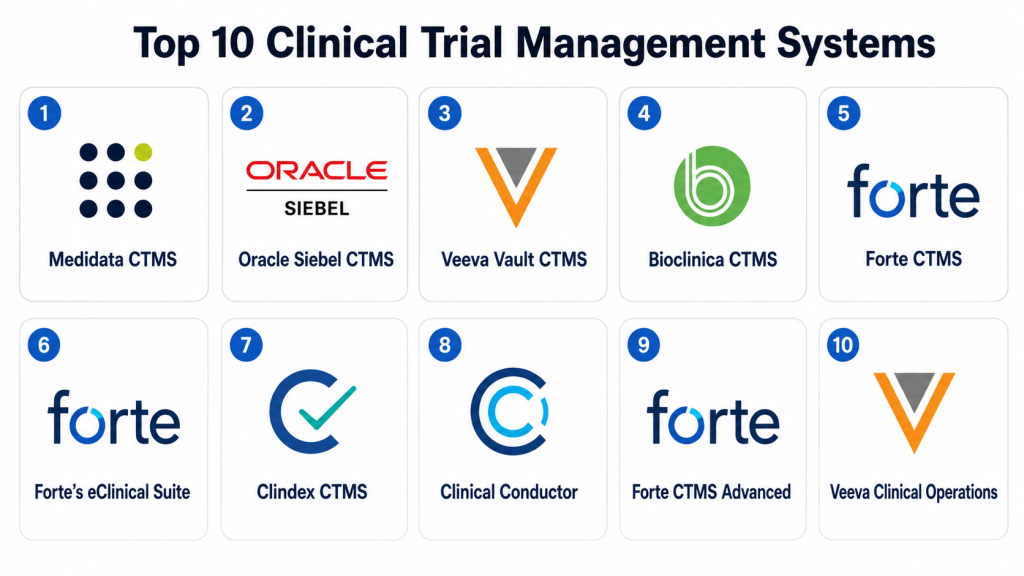
Top 10 Clinical Trial Management Systems
#1 — Medidata CTMS
Short description:
Medidata CTMS manages end-to-end clinical trial operations.
Supports patient recruitment, site management, and data tracking.
Provides compliance and reporting dashboards.
Ideal for large pharma and global CROs.
Key Features
- Patient enrollment tracking
- Site and investigator management
- Protocol and milestone management
- Regulatory compliance reporting
- Data integration with EDC/eTMF
Pros
- Cloud-based with global scalability
- Comprehensive trial management
- Regulatory-compliant workflows
Cons
- Subscription cost may be high
- Requires training for complex features
Platforms / Deployment
- Web
- Cloud
Security & Compliance
- SSO/SAML, encryption
- FDA 21 CFR Part 11, ICH-GCP compliance
Integrations & Ecosystem
- EDC, eTMF, ePRO integration
- API for analytics and reporting
- Instrumentation and lab systems
Support & Community
- Vendor support and training
- Documentation and knowledge base
- User community
#2 — Oracle Siebel CTMS
Short description:
Oracle Siebel CTMS is a robust solution for managing clinical trial workflows.
Supports site and subject tracking, reporting, and regulatory compliance.
Cloud and on-premises deployment available.
Ideal for global pharma trials and multi-site studies.
Key Features
- Site and patient management
- Protocol tracking and milestone management
- Reporting and analytics
- Regulatory compliance and audit trails
- Workflow automation
Pros
- Scalable for global trials
- Integration with Oracle analytics and EDC
- Comprehensive regulatory support
Cons
- High implementation complexity
- Licensing cost can be significant
Platforms / Deployment
- Web
- Cloud / On-premises
Security & Compliance
- Encryption, SSO
- FDA 21 CFR Part 11, ICH-GCP
Integrations & Ecosystem
- API for EDC/eTMF integration
- Oracle analytics connectors
- Third-party instrument integration
Support & Community
- Vendor support
- Documentation and training
- User forums
#3 — Veeva Vault CTMS
Short description:
Veeva Vault CTMS provides cloud-based clinical trial management and compliance.
Supports site, patient, and protocol management.
Includes dashboards for KPI tracking and reporting.
Ideal for biotech and global pharma studies.
Key Features
- Site and subject tracking
- Protocol and milestone management
- KPI dashboards and reporting
- Compliance and audit features
- Cloud-based multi-site access
Pros
- Cloud-native and scalable
- Integrated with Veeva Vault eTMF
- Strong regulatory compliance
Cons
- Subscription pricing is high
- Customization may require vendor support
Platforms / Deployment
- Web
- Cloud
Security & Compliance
- SSO, encryption
- FDA 21 CFR Part 11, GCP
Integrations & Ecosystem
- Veeva Vault eTMF, EDC integration
- Analytics and reporting APIs
Support & Community
- Vendor support and documentation
- User community and training programs
#4 — Bioclinica CTMS
Short description:
Bioclinica CTMS manages clinical trials with global visibility.
Tracks sites, patients, and study milestones efficiently.
Provides analytics and reporting dashboards.
Ideal for multi-site pharmaceutical trials.
Key Features
- Patient and site management
- Protocol tracking
- Analytics and KPI dashboards
- Compliance and regulatory reporting
- Multi-site collaboration
Pros
- Strong global trial support
- Cloud deployment
- Compliance-ready features
Cons
- Cost can be high
- Advanced setup may require IT resources
Platforms / Deployment
- Web
- Cloud
Security & Compliance
- Encryption, SSO
- FDA, ICH-GCP
Integrations & Ecosystem
- EDC and eTMF integration
- APIs for analytics and reporting
Support & Community
- Vendor support
- Documentation and training
#5 — Forte CTMS
Short description:
Forte CTMS offers end-to-end trial management solutions.
Supports patient enrollment, site management, and regulatory compliance.
Cloud-based with analytics dashboards.
Ideal for small to mid-sized pharmaceutical and biotech companies.
Key Features
- Site and subject management
- Protocol tracking
- Reporting and analytics
- Compliance management
- Workflow automation
Pros
- Easy-to-use interface
- Cloud deployment
- Rapid onboarding
Cons
- Limited scalability for large global trials
- Fewer integration options than enterprise systems
Platforms / Deployment
- Web
- Cloud
Security & Compliance
- Encryption
- Compliance: FDA 21 CFR Part 11
Integrations & Ecosystem
- API for EDC and reporting
- Cloud storage integration
Support & Community
- Vendor support
- Knowledge base and tutorials
#6 — Forte’s eClinical Suite
Short description:
Forte’s eClinical Suite integrates CTMS with EDC and ePRO.
Supports site, patient, and workflow management.
Provides compliance and reporting dashboards.
Ideal for mid-sized trials with integrated data management needs.
Key Features
- CTMS + EDC integration
- Patient and site tracking
- Reporting dashboards
- Workflow and compliance tools
Pros
- Integrated data management
- Cloud-based
- Workflow automation
Cons
- Higher cost than standalone CTMS
- Setup requires training
Platforms / Deployment
- Web
- Cloud
Security & Compliance
- Encryption, SSO
- FDA/GCP
Integrations & Ecosystem
- API for ELN, EDC, ePRO
- Reporting integration
Support & Community
- Vendor documentation
- Training programs
#7 — Clindex CTMS
Short description:
Clindex CTMS manages global clinical trial operations.
Supports protocol, patient, and site tracking.
Provides dashboards and analytics.
Ideal for CROs and pharma sponsors conducting multiple studies.
Key Features
- Multi-site study management
- Patient and site tracking
- Protocol management
- KPI dashboards and reporting
- Compliance management
Pros
- Strong multi-site support
- Easy reporting
- Cloud-based access
Cons
- Limited integration flexibility
- Training may be required
Platforms / Deployment
- Web
- Cloud
Security & Compliance
- Encryption, SSO
- FDA 21 CFR Part 11
Integrations & Ecosystem
- API for EDC/eTMF
- Analytics connectors
Support & Community
- Vendor support
- Knowledge base
#8 — Clinical Conductor
Short description:
Clinical Conductor offers centralized trial management for sponsors and CROs.
Tracks subjects, sites, and regulatory milestones.
Provides dashboards and analytics for decision-making.
Ideal for global clinical research operations.
Key Features
- Subject and site management
- Protocol and milestone tracking
- KPI dashboards
- Compliance and audit trails
- Workflow automation
Pros
- Multi-site and global trial support
- Cloud-native
- Regulatory compliance features
Cons
- Implementation may require training
- Premium pricing
Platforms / Deployment
- Web
- Cloud
Security & Compliance
- Encryption, SSO
- FDA/GCP
Integrations & Ecosystem
- API for EDC/eTMF
- Reporting integration
Support & Community
- Vendor support
- Documentation
#9 — Forte CTMS Advanced
Short description:
Advanced version of Forte CTMS with analytics and multi-site support.
Supports patient recruitment, site management, and compliance.
Cloud-based with KPI dashboards.
Ideal for mid-to-large scale trials requiring integrated analytics.
Key Features
- Patient and site management
- Protocol and milestone tracking
- Advanced analytics
- Workflow automation
- Compliance management
Pros
- Scalable
- Strong reporting
- Cloud access
Cons
- Licensing cost high
- Setup requires vendor support
Platforms / Deployment
- Web
- Cloud
Security & Compliance
- Encryption, SSO
- FDA/GCP
Integrations & Ecosystem
- API for data management
- Integration with EDC and eTMF
Support & Community
- Vendor support
- Training and documentation
#10 — Veeva Clinical Operations
Short description:
Veeva Clinical Operations CTMS offers cloud-based trial management.
Supports global study operations, regulatory compliance, and reporting.
Includes dashboards and workflow automation.
Ideal for pharma and biotech global trials.
Key Features
- Multi-site patient and site tracking
- Regulatory compliance
- Reporting dashboards
- Workflow automation
- KPI monitoring
Pros
- Cloud-native global trial support
- Integration with Veeva Vault
- Scalable for large trials
Cons
- High subscription cost
- Learning curve for advanced features
Platforms / Deployment
- Web
- Cloud
Security & Compliance
- Encryption, SSO
- FDA 21 CFR Part 11, GCP
Integrations & Ecosystem
- EDC, eTMF, ePRO integration
- Analytics connectors
Support & Community
- Vendor support
- Documentation and tutorials
Comparison Table (Top 10)
| Tool Name | Best For | Platform(s) | Deployment | Standout Feature | Public Rating |
|---|---|---|---|---|---|
| Medidata CTMS | Large global pharma | Web | Cloud | Global trial operations | N/A |
| Oracle Siebel CTMS | Multi-site trials | Web | Cloud/On-prem | Workflow automation | N/A |
| Veeva Vault CTMS | Biotech & pharma | Web | Cloud | Integrated with eTMF | N/A |
| Bioclinica CTMS | Global CROs | Web | Cloud | Multi-site trial support | N/A |
| Forte CTMS | Mid-sized pharma | Web | Cloud | Rapid deployment | N/A |
| Forte eClinical Suite | Integrated trials | Web | Cloud | CTMS + EDC | N/A |
| Clindex CTMS | CRO & sponsors | Web | Cloud | Global trial visibility | N/A |
| Clinical Conductor | Multi-site trials | Web | Cloud | Centralized trial management | N/A |
| Forte CTMS Advanced | Mid-large trials | Web | Cloud | Analytics dashboards | N/A |
| Veeva Clinical Operations | Pharma global trials | Web | Cloud | Multi-site clinical ops | N/A |
Evaluation & Scoring
| Tool | Core (25%) | Ease (15%) | Integrations (15%) | Security (10%) | Performance (10%) | Support (10%) | Value (15%) | Weighted Total |
|---|---|---|---|---|---|---|---|---|
| Medidata CTMS | 10 | 7 | 8 | 7 | 9 | 8 | 6 | 8.3 |
| Oracle Siebel CTMS | 9 | 7 | 8 | 7 | 8 | 7 | 6 | 7.8 |
| Veeva Vault CTMS | 9 | 7 | 8 | 7 | 8 | 7 | 6 | 7.8 |
| Bioclinica CTMS | 9 | 7 | 7 | 7 | 8 | 7 | 6 | 7.7 |
| Forte CTMS | 8 | 8 | 7 | 6 | 7 | 7 | 7 | 7.3 |
| Forte eClinical | 8 | 8 | 7 | 7 | 7 | 7 | 6 | 7.3 |
| Clindex CTMS | 8 | 7 | 7 | 7 | 7 | 7 | 6 | 7.1 |
| Clinical Conductor | 9 | 7 | 7 | 7 | 8 | 7 | 6 | 7.5 |
| Forte CTMS Advanced | 9 | 7 | 7 | 7 | 8 | 7 | 6 | 7.7 |
| Veeva Clinical Ops | 9 | 7 | 8 | 7 | 8 | 7 | 6 | 7.8 |
Decision Guide
Solo / Freelancer
Not typically applicable — CTMS best for institutional trials.
SMB / Small Teams
Forte CTMS or eClinical Suite – manageable, cloud-based, efficient for mid-sized trials.
Mid-Market
Clindex or Bioclinica – supports multiple sites and moderate global operations.
Enterprise
Medidata, Oracle Siebel, Veeva CTMS – scalable global trial management.
Budget vs Premium
Smaller CTMS solutions reduce cost; enterprise systems provide full global trial workflows.
Feature Depth vs Ease of Use
Enterprise CTMS provide comprehensive features; simpler systems prioritize usability.
Integrations & Scalability
Modern CTMS integrate with EDC, eTMF, ePRO, analytics platforms, and lab instruments.
Security & Compliance Needs
Enterprise CTMS include encryption, SSO, audit trails, and regulatory compliance for FDA, EMA, and GCP.
Frequently Asked Questions (FAQs)
1. What is the pricing model for CTMS?
Most enterprise CTMS use subscription pricing; small solutions may offer modular licenses.
2. How difficult is implementation?
Enterprise systems require weeks to months; cloud solutions streamline setup.
3. Can CTMS integrate with EDC and eTMF?
Yes, all modern CTMS provide API-based integration for operational efficiency.
4. Are CTMS compliant with regulations?
Yes, enterprise CTMS support FDA 21 CFR Part 11, EMA, and ICH-GCP compliance.
5. Can multiple sites be managed simultaneously?
Yes, CTMS are designed for multi-site global trial operations.
6. Do CTMS provide analytics dashboards?
Yes, dashboards track KPIs, enrollment, milestones, and operational metrics.
7. What common mistakes should sponsors avoid?
Avoid underestimating training needs, integration requirements, or over-customization.
8. Can CTMS handle patient recruitment and retention?
Yes, CTMS provide modules for enrollment tracking, subject management, and engagement.
9. Are mobile access options available?
Many CTMS offer web and mobile interfaces for staff on-site or remote.
10. Are there alternatives to enterprise CTMS?
Smaller solutions exist for single-site trials, but enterprise trials benefit from full CTMS functionality.
Conclusion
Choosing the right CTMS depends on trial size, complexity, and regulatory requirements. Mid-sized organizations may benefit from cloud-based CTMS with integrated EDC/eTMF, while large enterprises require scalable, compliance-ready platforms for global operations. Pilot trials and workflow validation are critical before full implementation. A well-chosen CTMS enhances operational efficiency, ensures data integrity, and improves collaboration across sites, sponsors, and research teams.
