Introduction
Genomics analysis pipelines are computational frameworks that process, analyze, and interpret genomic sequencing data.
They integrate raw sequencing reads, alignment, variant calling, annotation, and visualization into streamlined workflows.
These pipelines accelerate research in genomics, personalized medicine, and evolutionary biology by automating complex analyses.
Selecting the right genomics pipeline ensures reproducibility, scalability, and integration with multi-omics datasets for robust biological insights.
Real-world use cases:
- Whole-genome and exome sequencing for disease research
- RNA-seq transcriptomics studies
- Variant calling and annotation for clinical genomics
- Population genomics and evolutionary studies
- Multi-omics integration and personalized medicine projects
Key buyer evaluation criteria:
- Sequence alignment and variant calling accuracy
- Workflow automation and reproducibility
- Scalability to handle large datasets
- Integration with reference databases and annotation tools
- Compatibility with HPC or cloud platforms
- Quality control and visualization tools
- Open-source vs commercial support
- Pipeline modularity and extensibility
- Ease of deployment and documentation
Best for: Genomics research labs, clinical genomics teams, biotech and pharma R&D, and population genetics studies.
Not ideal for: Labs performing only small-scale sequencing or basic bioinformatics without high-throughput requirements.
Key Trends in Genomics Analysis Pipelines
- Cloud-native pipelines for scalable genomic computation
- AI/ML-assisted variant prioritization and functional annotation
- Automated end-to-end workflows from raw reads to interpretation
- Integration with multi-omics datasets for systems biology
- Containerized pipelines for reproducibility (Docker/Singularity)
- Support for population-scale data and cohort analyses
- Real-time quality control dashboards
- Modular and flexible pipeline frameworks
- Open-source community-driven pipeline development
- Adoption of workflow managers like Nextflow, Snakemake, and Cromwell
How We Selected These Tools (Methodology)
- Adoption and popularity in research and clinical genomics
- Accuracy of alignment, variant calling, and annotation
- Support for reproducible and automated workflows
- Integration with genomic databases and external tools
- Scalability across HPC and cloud environments
- Community support, documentation, and ease of use
- Compliance and data security considerations
- Modularity, customization, and extensibility
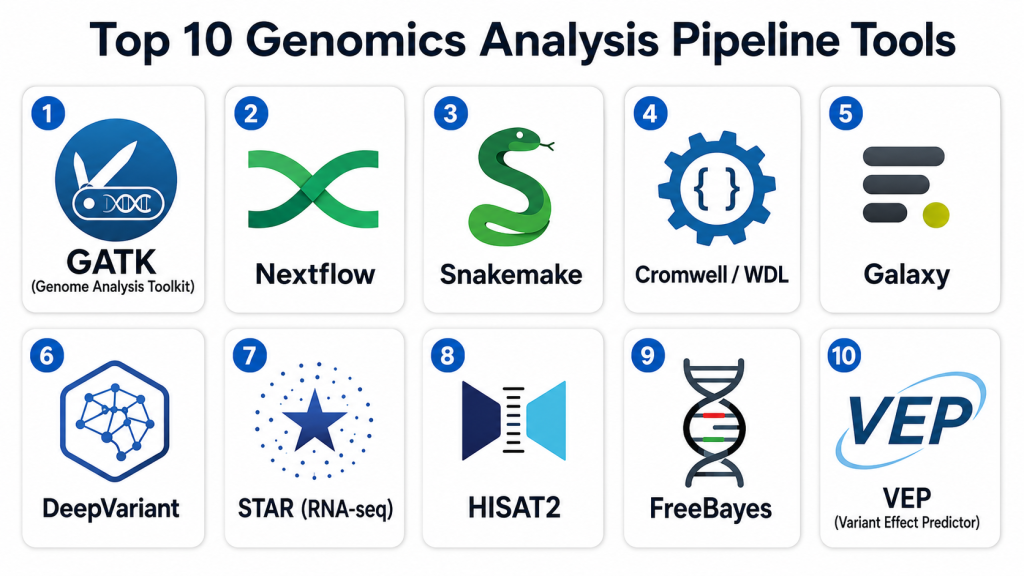
Top 10 Genomics Analysis Pipeline Tools
#1 — GATK (Genome Analysis Toolkit)
Short description:
GATK is a widely used toolkit for variant discovery and genotyping.
Supports best practices pipelines for germline and somatic analyses.
Handles large-scale sequencing projects efficiently.
Ideal for clinical and population genomics projects.
Key Features
- Variant calling and genotyping
- Best practices workflows
- Preprocessing and quality control
- Joint variant analysis
- Annotation integration
Pros
- Industry standard for variant analysis
- Accurate and scalable
- Active community support
Cons
- Requires computational expertise
- Licensing restrictions for commercial use
Platforms / Deployment
- Linux / macOS
- Cloud / On-premises
Security & Compliance
- Encryption and access control: Varies
- Regulatory compliance: Not publicly stated
Integrations & Ecosystem
- Integrates with reference genomes and dbSNP
- Supports workflow managers like WDL and Nextflow
- API and command-line interface
Support & Community
- Documentation and tutorials
- Active user forums and GitHub repository
#2 — Nextflow
Short description:
Nextflow is a workflow manager for scalable genomics pipelines.
Supports reproducible, portable, and automated analysis.
Enables seamless integration with cloud and HPC systems.
Ideal for bioinformatics teams needing reproducible and flexible pipelines.
Key Features
- Workflow automation and orchestration
- Container support (Docker, Singularity)
- Cloud and HPC scalability
- Modular pipeline design
- Integration with existing bioinformatics tools
Pros
- Reproducible and portable workflows
- Scalable across environments
- Flexible and modular
Cons
- Requires scripting knowledge
- Steeper learning curve for beginners
Platforms / Deployment
- Linux / macOS
- Cloud / HPC / On-premises
Security & Compliance
- Inherits container security practices
- Compliance: Not publicly stated
Integrations & Ecosystem
- Supports GATK, STAR, BWA, and custom tools
- APIs for monitoring and reporting
Support & Community
- Active community on GitHub
- Tutorials and workflow repositories
#3 — Snakemake
Short description:
Snakemake is a workflow management system for reproducible genomic pipelines.
Automates data processing, ensures reproducibility, and tracks dependencies.
Ideal for academic labs and bioinformatics teams.
Integrates easily with HPC and cloud environments.
Key Features
- Dependency-based workflow execution
- Container and environment support
- HPC and cloud scalability
- Logging and provenance tracking
- Modular pipeline design
Pros
- Simple yet powerful
- Ensures reproducibility
- Large community of workflows
Cons
- Requires Python scripting knowledge
- Complex workflows may need optimization
Platforms / Deployment
- Linux / macOS
- Cloud / HPC / On-premises
Security & Compliance
- Inherits container security
- Compliance: Not publicly stated
Integrations & Ecosystem
- Integrates with bioinformatics tools like BWA, STAR, GATK
- Supports Docker/Singularity containers
Support & Community
- Documentation and tutorials
- GitHub workflow repository
#4 — Cromwell / WDL
Short description:
Cromwell executes workflows written in WDL for genomics analyses.
Supports reproducibility, cloud/HPC deployment, and pipeline automation.
Ideal for research labs implementing GATK best practices.
Facilitates large-scale genomic studies.
Key Features
- WDL workflow execution
- Cloud and HPC support
- Task parallelization
- Container support
- Logging and reporting
Pros
- Reproducible and scalable
- Compatible with GATK pipelines
- Supports cloud-native workflows
Cons
- Requires scripting knowledge
- Setup complexity for large projects
Platforms / Deployment
- Linux / macOS
- Cloud / HPC / On-premises
Security & Compliance
- Container-based security
- Compliance: Not publicly stated
Integrations & Ecosystem
- Supports GATK, STAR, BWA pipelines
- APIs for monitoring and reporting
Support & Community
- Tutorials and community forum
- Documentation
#5 — Galaxy
Short description:
Galaxy is a web-based platform for accessible genomic analyses.
Offers GUI-based pipeline design and execution for sequencing workflows.
Ideal for academic labs and bioinformatics teaching.
Supports reproducible workflows without scripting.
Key Features
- Graphical workflow builder
- Integration with bioinformatics tools
- Reproducibility and provenance tracking
- Cloud and local deployment
- Community tool repository
Pros
- User-friendly GUI
- No scripting required
- Community-supported pipelines
Cons
- Limited performance for large-scale HPC
- Cloud usage may require configuration
Platforms / Deployment
- Web
- Cloud / Local server
Security & Compliance
- User-based access controls
- Compliance: Not publicly stated
Integrations & Ecosystem
- Integrates with BWA, STAR, GATK, DESeq2
- Workflow sharing in community
Support & Community
- Active user community
- Tutorials and tool repositories
#6 — DeepVariant
Short description:
DeepVariant uses deep learning for highly accurate variant calling.
Processes next-generation sequencing reads to detect SNPs and indels.
Ideal for clinical and research genomics projects.
Supports scalable cloud and HPC deployment.
Key Features
- AI-based variant calling
- Supports multiple sequencing technologies
- Scalable for large datasets
- Integration with pipelines like WDL/Nextflow
Pros
- High accuracy in variant calling
- Cloud and HPC ready
- Open-source
Cons
- Computationally intensive
- Requires data preprocessing
Platforms / Deployment
- Linux
- Cloud / HPC / On-premises
Security & Compliance
- Inherits cluster/container security
- Compliance: Not publicly stated
Integrations & Ecosystem
- Compatible with GATK pipelines
- API for workflow integration
Support & Community
- Open-source community
- Documentation and tutorials
#7 — STAR (RNA-seq)
Short description:
STAR is an aligner for RNA sequencing reads.
Performs spliced alignment of reads to reference genomes.
Ideal for transcriptomics and expression profiling.
Integrates with variant calling and quantification pipelines.
Key Features
- Splice-aware alignment
- Fast and memory-efficient
- Handles large datasets
- Output compatible with downstream analysis
Pros
- High performance and accuracy
- Widely used in RNA-seq
- Open-source
Cons
- Command-line interface
- Requires preprocessing and annotation
Platforms / Deployment
- Linux / macOS
- HPC / Cloud / On-premises
Security & Compliance
- Open-source, depends on host
- Compliance: Not publicly stated
Integrations & Ecosystem
- Works with DESeq2, featureCounts, GATK
- API and workflow integration via Nextflow/Snakemake
Support & Community
- Active user community
- Tutorials and publications
#8 — HISAT2
Short description:
HISAT2 is a spliced read aligner for genomic and transcriptomic datasets.
Supports fast, memory-efficient alignment of large datasets.
Ideal for RNA-seq and genome-wide studies.
Integrates with downstream variant calling workflows.
Key Features
- Splice-aware alignment
- Efficient memory usage
- Compatible with large reference genomes
- SAM/BAM output for downstream analysis
Pros
- High speed and accuracy
- Open-source
- Scalable to population-level studies
Cons
- CLI-only interface
- Requires pipeline integration
Platforms / Deployment
- Linux / macOS
- HPC / Cloud / On-premises
Security & Compliance
- Open-source, depends on host
- Compliance: Not publicly stated
Integrations & Ecosystem
- Compatible with StringTie, featureCounts
- Workflow integration with Nextflow/Snakemake
Support & Community
- Documentation and tutorials
- Open-source community
#9 — FreeBayes
Short description:
FreeBayes is an open-source variant caller for haplotype-based variant detection.
Processes aligned reads to detect SNPs, indels, and structural variants.
Ideal for research genomics and population studies.
Supports integration with downstream annotation pipelines.
Key Features
- Haplotype-based variant calling
- Multi-sample support
- Handles small and large genomes
- Flexible filtering options
Pros
- Open-source and widely used
- Supports complex variants
- Integrates with existing pipelines
Cons
- Command-line interface
- May require preprocessing
Platforms / Deployment
- Linux / macOS
- HPC / Cloud / On-premises
Security & Compliance
- Open-source, host-dependent
- Compliance: Not publicly stated
Integrations & Ecosystem
- Works with GATK, ANNOVAR, bcftools
- API for pipeline integration
Support & Community
- Open-source community
- Tutorials and user forums
#10 — VEP (Variant Effect Predictor)
Short description:
VEP annotates genomic variants for predicted functional impact.
Supports SNP, indel, and structural variant annotation.
Ideal for clinical genomics, population genetics, and variant prioritization.
Integrates with variant calling outputs from multiple pipelines.
Key Features
- Variant functional annotation
- Supports multiple genome assemblies
- Plugin-based extensibility
- Batch processing
Pros
- Widely used in research and clinical pipelines
- Open-source and flexible
- Integrates with FreeBayes, GATK, and other callers
Cons
- CLI interface
- Requires annotation resources
Platforms / Deployment
- Linux / macOS
- Cloud / HPC / On-premises
Security & Compliance
- Host-dependent security
- Compliance: Not publicly stated
Integrations & Ecosystem
- Integrates with GATK, FreeBayes, ANNOVAR
- Workflow integration via Nextflow/Snakemake
Support & Community
- Open-source documentation
- Active community
Comparison Table (Top 10)
| Tool Name | Best For | Platform(s) | Deployment | Standout Feature | Public Rating |
|---|---|---|---|---|---|
| GATK | Variant calling | Linux/macOS | Cloud/HPC | Best practices pipelines | N/A |
| Nextflow | Workflow orchestration | Linux/macOS | Cloud/HPC | Scalable reproducible pipelines | N/A |
| Snakemake | Workflow management | Linux/macOS | Cloud/HPC | Dependency-based reproducibility | N/A |
| Cromwell | WDL execution | Linux/macOS | Cloud/HPC | Reproducible WDL pipelines | N/A |
| Galaxy | GUI-based pipelines | Web | Cloud/Local | Accessible workflow GUI | N/A |
| DeepVariant | AI variant calling | Linux | Cloud/HPC | Deep learning SNP/indel | N/A |
| STAR | RNA-seq alignment | Linux/macOS | HPC/Cloud | Splice-aware alignment | N/A |
| HISAT2 | RNA-seq alignment | Linux/macOS | HPC/Cloud | Fast memory-efficient alignment | N/A |
| FreeBayes | Variant calling | Linux/macOS | HPC/Cloud | Haplotype-based detection | N/A |
| VEP | Variant annotation | Linux/macOS | HPC/Cloud | Functional annotation | N/A |
Evaluation & Scoring
| Tool | Core (25%) | Ease (15%) | Integrations (15%) | Security (10%) | Performance (10%) | Support (10%) | Value (15%) | Weighted Total |
|---|---|---|---|---|---|---|---|---|
| GATK | 10 | 7 | 8 | 7 | 9 | 8 | 6 | 8.3 |
| Nextflow | 9 | 7 | 8 | 7 | 8 | 7 | 6 | 7.8 |
| Snakemake | 8 | 8 | 7 | 7 | 8 | 7 | 7 | 7.6 |
| Cromwell | 8 | 7 | 7 | 7 | 8 | 7 | 6 | 7.4 |
| Galaxy | 7 | 9 | 7 | 6 | 7 | 7 | 8 | 7.4 |
| DeepVariant | 9 | 8 | 7 | 7 | 8 | 7 | 7 | 7.8 |
| STAR | 8 | 8 | 7 | 7 | 8 | 7 | 7 | 7.6 |
| HISAT2 | 8 | 8 | 7 | 7 | 8 | 7 | 7 | 7.6 |
| FreeBayes | 8 | 8 | 7 | 7 | 7 | 7 | 7 | 7.5 |
| VEP | 8 | 8 | 7 | 7 | 7 | 7 | 7 | 7.5 |
Decision Guide
Single-Lab / Academic Research
Galaxy or Snakemake for reproducibility without heavy HPC.
Multi-Site / Clinical Research
GATK, DeepVariant, and Cromwell for scalable, compliant pipelines.
RNA-seq Analysis
STAR and HISAT2 for accurate splice-aware alignment.
Variant Annotation
VEP integrates with variant callers for functional annotation.
AI-Driven Variant Discovery
DeepVariant for high-accuracy machine learning-based variant calling.
Frequently Asked Questions (FAQs)
1. What is the cost of genomics pipelines?
Many open-source tools are free; commercial cloud options may charge per compute usage.
2. How long does setup take?
Depends on expertise; CLI pipelines require configuration, cloud platforms deploy faster.
3. Can pipelines handle large datasets?
Yes, most scale to population genomics with HPC or cloud deployment.
4. Do pipelines integrate with annotation databases?
Yes, pipelines often integrate with dbSNP, ClinVar, ENSEMBL, and RefSeq.
5. Are pipelines reproducible?
Workflow managers like Nextflow and Snakemake ensure reproducible analyses.
6. Do they support RNA-seq analysis?
Yes, STAR, HISAT2, and associated pipelines handle transcriptomic data.
7. Can pipelines be used clinically?
Some, like DeepVariant, support clinical-grade variant calling with validation.
8. Are GUIs available?
Galaxy provides GUI-based workflows; others are CLI-focused.
9. How is security managed?
Depends on HPC/cloud environment; containerization adds reproducibility and security.
10. Are there AI tools for genomics?
Yes, DeepVariant and AI modules assist with variant calling and scoring.
Conclusion
Choosing the right genomics analysis pipeline depends on dataset scale, computational resources, and research goals. Open-source tools like GATK, STAR, and Snakemake offer flexibility for academic research, while cloud and AI-powered platforms like DeepVariant accelerate clinical and population-scale projects. Workflow management tools such as Nextflow and Cromwell ensure reproducibility and scalability. GUI-based platforms like Galaxy provide accessibility for teaching and small labs. Integrating pipelines with annotation and variant-calling tools ensures high-quality, reproducible genomic analyses.
