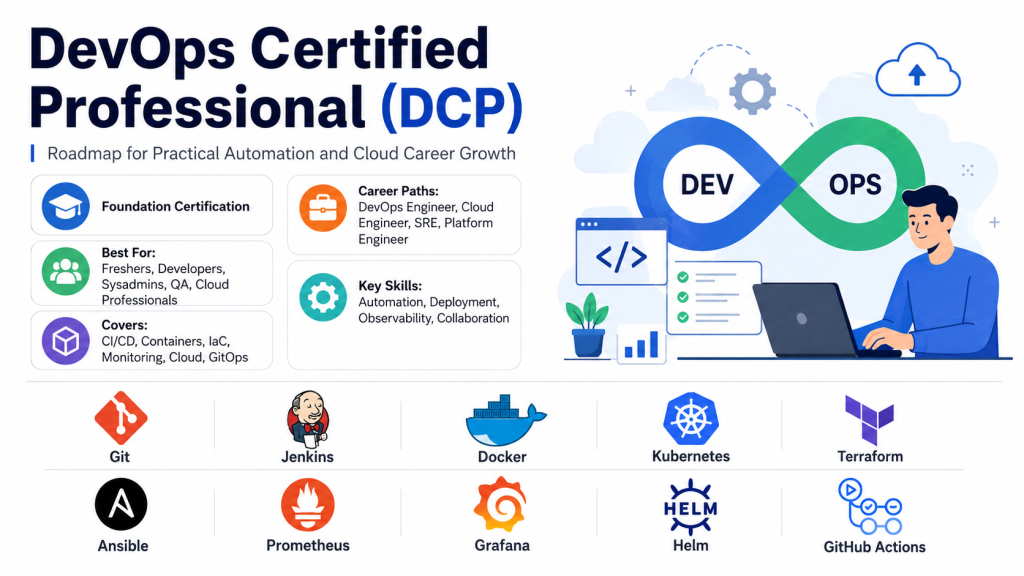
Meta Title: DevOps Certified Professional (DCP)
Meta Description: Master the DevOps Certified Professional system. Learn how the certification path works, evaluate your readiness, and build strategies to improve your professional results.
Introduction
Many professionals enter DevOps with strong interest, but they often feel confused when they face too many tools, certifications, cloud platforms, automation practices, and career paths at the same time. Therefore, they need a clear roadmap that connects learning with real industry expectations. The DevOps Certified Professional (DCP) helps learners understand DevOps foundations, continuous integration, continuous delivery, automation, containers, monitoring, collaboration, and practical delivery workflows in a structured way. Instead of learning random tools without direction, learners can use this certification path to evaluate their readiness, identify weak areas, and build a stronger DevOps career plan with confidence.
What Is a DevOps Certified Professional?
A DevOps Certified Professional is a structured certification path that helps learners understand DevOps culture, automation, CI/CD pipelines, infrastructure practices, containers, monitoring, and modern software delivery. It gives learners a practical foundation for working in fast-moving IT environments where development and operations teams must collaborate closely.
DevOps Certified Professional focuses on building both conceptual clarity and hands-on readiness. Therefore, it supports beginners, working engineers, system administrators, testers, developers, support professionals, and cloud learners who want to move into DevOps roles.
The Core Purpose of DevOps Certified Professional
The core purpose of DevOps Certified Professional is to help learners understand how software moves from planning to production. It teaches the mindset of collaboration, automation, feedback, and continuous improvement.
Moreover, it helps learners connect tools with real workflows. For example, Git supports version control, Jenkins supports automation, Docker supports containerization, Kubernetes supports orchestration, Terraform supports infrastructure automation, and Prometheus supports monitoring.
How the DevOps Certified Professional System Works
The DevOps Certified Professional system works like a skill-readiness framework. It helps learners check their understanding across important DevOps areas such as source code management, build automation, testing, deployment, cloud basics, containers, infrastructure as code, monitoring, and troubleshooting.
Therefore, learners can use it as a practical roadmap. First, they understand the DevOps lifecycle. Then, they learn major tools. After that, they practice real workflows. Finally, they measure their readiness for interviews, projects, and advanced certifications.
Eligibility Standards vs. Selection Criteria
Eligibility standards usually define who can begin the certification journey. A learner does not need to be an expert before starting DevOps Certified Professional. However, basic IT understanding, problem-solving ability, and interest in automation make the learning process easier.
Selection criteria focus more on career direction. A fresher may select this certification to enter DevOps. A system administrator may select it to move into automation. A developer may select it to understand deployment pipelines. A tester may select it to learn continuous testing and release practices. Therefore, the certification fits different learners when they use it with a clear goal.
DevOps Certified Professional Components: The Building Blocks
DevOps Certified Professional includes several building blocks that together create a strong DevOps foundation. These blocks help learners understand tools, processes, culture, automation, and real delivery systems.
Age Factors in DevOps Certified Professional
Age does not decide DevOps success. Instead, learning consistency, practical work, curiosity, and problem-solving mindset matter more. A young learner can start early and build a strong automation foundation. Similarly, an experienced professional can use existing system, support, development, or testing knowledge to move faster.
Therefore, learners should not treat age as a barrier. They should treat DevOps as a skill journey. If they can practice regularly, understand workflows, and solve technical problems, they can grow in this field.
Educational Evaluation for DevOps Certified Professional
A technical degree can help, but DevOps does not depend only on formal education. Many DevOps professionals come from Linux administration, networking, testing, software development, cloud support, system operations, and application support backgrounds.
Therefore, educational evaluation should focus on practical readiness. Learners should understand operating systems, basic networking, application deployment, logs, command-line work, and configuration files. These skills help them absorb DevOps concepts faster.
Performance Standards and Benchmarks
A strong DevOps Certified Professional learner should aim for clear performance benchmarks. These benchmarks show whether the learner can apply concepts in real situations.
Important benchmarks include:
- Creating a simple CI/CD pipeline
- Using Git for version control
- Building and running containers
- Writing basic infrastructure as code
- Deploying an application to a test environment
- Monitoring application health
- Reading logs and identifying failures
- Explaining rollback and release strategies
- Understanding team collaboration workflows
- Documenting project steps clearly
These benchmarks help learners move beyond theory and build workplace-ready confidence.
Professional Experience Verification
Professional experience does not only mean full-time employment. It can also include lab work, personal projects, internships, internal automation tasks, open-source practice, or guided assignments.
Learners should maintain proof of their practical work. For example, they can document CI/CD pipelines, Dockerfiles, Kubernetes manifests, Terraform configurations, monitoring dashboards, shell scripts, and deployment notes. As a result, they can explain their skills clearly in interviews and project discussions.
Primary Frameworks Governing DevOps Certified Professional
DevOps Certified Professional follows a practical framework based on collaboration, automation, measurement, sharing, reliability, security awareness, and continuous improvement. It helps learners understand both the cultural and technical sides of DevOps.
The Detailed Score Breakdown
| Score Area | Weight | Readiness Indicator |
|---|---|---|
| DevOps Certified Professional Foundation | 5% | Understands DevOps purpose, culture, lifecycle, and collaboration model |
| DevSecOps Certified Professional Awareness | 5% | Understands basic security integration across delivery stages |
| Site Reliability Engineering Fundamentals | 5% | Understands reliability, incidents, monitoring, and service ownership |
| Master in DevOps Engineering Direction | 5% | Understands advanced DevOps workflows and engineering maturity |
| Master in Azure DevOps Readiness | 5% | Understands Azure-based planning, pipelines, repositories, and delivery |
| AWS Certified DevOps Professional Alignment | 5% | Understands AWS deployment, automation, monitoring, and operations basics |
| Master in Python Programming Support | 5% | Uses scripting logic to support automation and operational tasks |
| Hashicorp Certified Terraform Associate Skills | 5% | Understands infrastructure as code, state, providers, and repeatable provisioning |
| Certified Kubernetes Administrator Knowledge | 5% | Understands clusters, workloads, scheduling, storage, and troubleshooting |
| Docker Certified Associate Skills | 5% | Understands images, containers, registries, networking, and runtime basics |
| Envoy ISTIO Certification Awareness | 5% | Understands service mesh, traffic routing, telemetry, and microservice communication |
| MLOps Certification Training Direction | 5% | Understands model lifecycle, automation, deployment, and monitoring concepts |
| Google Cloud Professional Cloud DevOps Engineer Fit | 5% | Understands Google Cloud delivery, reliability, monitoring, and automation ideas |
| Master in Machine Learning Support | 5% | Understands machine learning workflow basics for AI-enabled delivery environments |
| Master in Artificial Intelligence Awareness | 5% | Understands AI concepts that support intelligent automation and operations |
| Master in AppDynamics Monitoring | 5% | Understands application performance monitoring and production visibility |
| Master in Data Science Foundation | 5% | Understands data-driven thinking, analytics, and operational insight |
| Master in Deep Learning Awareness | 5% | Understands deep learning basics for advanced automation and AI use cases |
| Prometheus with Grafana Observability | 5% | Understands metrics, alerts, dashboards, and system health tracking |
| GitOps Certified Professional Practice | 5% | Understands Git-based deployment, desired state, and automated operations |
Real-World Application Scenarios
In real projects, DevOps Certified Professional knowledge helps teams reduce manual work, improve release quality, and respond faster to production issues. For example, a team can automate build and deployment steps through CI/CD. As a result, developers spend less time waiting for manual approvals.
Similarly, an operations team can use monitoring and logging to detect problems earlier. A platform team can use infrastructure as code to provision environments consistently. A security team can add automated checks into the pipeline. Therefore, DevOps creates value across the full software delivery lifecycle.
International Pathways for DevOps Certified Professional
DevOps skills apply globally because software teams everywhere need faster delivery, stable systems, secure workflows, and reliable automation. However, the exact path may differ based on region, company size, cloud adoption, and business domain.
Key Categories and Classes
DevOps Certified Professional can connect with several related pathways:
| Category | Related Direction | Best Fit |
|---|---|---|
| DevOps Foundation | DevOps Certified Professional | Beginners and career switchers |
| DevSecOps | Security-focused DevOps | Security engineers and DevOps teams |
| SRE | Reliability engineering | Operations, platform, and production teams |
| Cloud DevOps | AWS, Azure, and Google Cloud DevOps | Cloud engineers |
| Infrastructure Automation | Terraform and configuration automation | Platform and infrastructure teams |
| Containers | Docker and Kubernetes | Application deployment teams |
| Observability | Prometheus, Grafana, AppDynamics | Monitoring and support teams |
| GitOps | Git-based deployment model | Kubernetes and platform teams |
| MLOps | ML lifecycle automation | Data and AI engineering teams |
| AI and Data | AI, ML, data science, deep learning | Advanced automation learners |
Comparative Results Summary
DevOps Certified Professional works best as a foundation. After completing it, learners can move into more focused areas. For example, learners interested in security can choose DevSecOps. Learners interested in production reliability can choose SRE. Learners interested in containers can choose Kubernetes and Docker. Learners interested in cloud automation can choose AWS, Azure, or Google Cloud DevOps paths.
Therefore, this certification creates a base, while advanced paths create specialization.
Advanced Regional Requirements for DevOps Certified Professional
Different regions and markets expect different skill combinations. In some places, employers focus heavily on cloud platforms. In others, they expect strong Linux, scripting, and deployment knowledge. Meanwhile, enterprise environments often expect compliance awareness, audit readiness, documentation, access control, and change management.
Professional registration usually does not act as a strict requirement for DevOps roles. However, certification, project proof, interview confidence, Git-based work samples, and practical labs can improve professional credibility.
Learners should also understand local hiring expectations. For example, service companies may value multi-tool flexibility. Product companies may value platform thinking and automation depth. Enterprise IT teams may value reliability, security, and documentation.
The Global Landscape of DevOps Certified Professional
The global DevOps certification landscape includes foundational, intermediate, and specialized paths. DevOps Certified Professional acts as a starting point for learners who want to understand the full lifecycle before entering advanced areas.
| Global Version or Path | Primary Focus | Suitable Learner |
|---|---|---|
| DevOps Certified Professional | Foundation DevOps skills | Beginners and career switchers |
| DevSecOps Certified Professional | Security in DevOps | Security-aware professionals |
| Site Reliability Engineering Certified Professional | Reliability and operations | Production support and platform teams |
| Master in DevOps Engineering | Advanced DevOps maturity | Experienced DevOps learners |
| Master in Azure DevOps | Azure platform delivery | Azure-focused professionals |
| AWS Certified DevOps Professional | AWS automation and operations | AWS cloud engineers |
| Hashicorp Certified Terraform Associate | Infrastructure as code | Cloud and platform engineers |
| Certified Kubernetes Administrator | Kubernetes operations | Container platform engineers |
| Docker Certified Associate | Container fundamentals | Developers and system engineers |
| GitOps Certified Professional | Git-based operations | Platform and Kubernetes teams |
This global landscape shows that DevOps does not end with one certification. Instead, it grows into several connected career paths.
Benefits of Utilizing a DevOps Certified Professional
DevOps Certified Professional gives learners a clear career direction. It helps them understand where they stand and where they need to improve. Therefore, it works like a practical readiness map.
First, it improves cost efficiency because learners avoid random learning. Instead of jumping from one tool to another, they follow a structured path.
Second, it gives instant reality checks. Learners can compare their current knowledge with expected DevOps skills. As a result, they can focus on weak areas before interviews or projects.
Third, it supports strategic long-term planning. A learner can start with DevOps Certified Professional and then move toward DevSecOps, SRE, Kubernetes, Terraform, GitOps, cloud DevOps, or MLOps.
Moreover, it builds confidence. When learners understand the delivery lifecycle, they can explain their work better to managers, interviewers, and project teams.
Step-by-Step Guide to Mastering DevOps Certified Professional
Gathering Necessary Documents
Start by collecting your resume, project notes, learning records, and technical profile. Then, list your current knowledge in Linux, Git, scripting, cloud, containers, CI/CD, monitoring, and troubleshooting.
This step gives you a clear starting point. Moreover, it helps you avoid overestimating your skills.
Practicing the Core Assessments
Next, practice the core DevOps areas one by one. Create a small application project. Then, store it in Git, build it through a pipeline, package it in a container, deploy it, and monitor it.
This practical flow teaches more than theory. Therefore, learners should build at least one complete workflow before claiming DevOps readiness.
Checking Market Demand Lists
After practicing basics, review job descriptions for DevOps Engineer, Cloud Engineer, SRE, Platform Engineer, Build and Release Engineer, and DevSecOps Engineer roles.
Then, identify repeated skills. Usually, employers ask for Git, CI/CD, Docker, Kubernetes, cloud platforms, Terraform, scripting, monitoring, and troubleshooting. This comparison helps learners align their preparation with real market demand.
Adding Secondary Factors
Secondary factors can improve your profile. These include communication skills, documentation, incident explanation, teamwork, basic security understanding, and ownership mindset.
DevOps does not work only through tools. It also needs culture, clarity, and shared responsibility. Therefore, learners should build both technical and soft skills.
Calculating the Final Result
Finally, calculate your readiness score. Rate yourself from one to ten across DevOps fundamentals, Git, CI/CD, containers, cloud, infrastructure as code, monitoring, and security awareness.
If your score stays low in multiple areas, continue practicing. If your score looks balanced, prepare for certification, update your resume, and document your projects clearly.
Strategies to Optimize Your DevOps Certified Professional Score
The Performance Enhancement Strategy
The best strategy is practical repetition. Read a concept, then apply it immediately. For example, do not only read about CI/CD. Create a pipeline. Do not only read about Docker. Build an image and run a container. Do not only read about Terraform. Provision a simple resource through code.
This practice improves confidence and helps learners explain real problems during interviews.
Bonus Qualification Advantages
Bonus qualifications can increase your score and career value. These include Linux basics, shell scripting, Python fundamentals, YAML, Git branching strategy, cloud basics, troubleshooting, and documentation.
Additionally, learners who understand security checks, monitoring dashboards, and incident response can stand out because modern DevOps teams value reliability and risk reduction.
Specialized Opportunity Pathways
After DevOps Certified Professional, learners can choose a specialized path:
- DevSecOps for security automation
- SRE for reliability and production operations
- Kubernetes for container orchestration
- Terraform for infrastructure automation
- GitOps for declarative deployment
- Cloud DevOps for platform-specific delivery
- MLOps for machine learning lifecycle automation
This approach helps learners grow step by step without confusion.
Common Mistakes in the DevOps Certified Professional Process
Many learners make mistakes because they focus only on certification names and ignore practical ability.
First, they overestimate their attributes. For example, they may say they know CI/CD, but they have never created a working pipeline.
Second, they choose the wrong classification path. A learner may jump directly into Kubernetes without understanding Git, Linux, Docker, and CI/CD. As a result, advanced topics feel difficult.
Third, learners use expired or outdated documents. They should update resumes, project notes, and technical profiles with recent practice and accurate skills.
Fourth, they memorize definitions instead of building workflows. DevOps interviews often test practical understanding. Therefore, learners should explain what they built, what failed, and how they fixed it.
Fifth, they ignore monitoring and troubleshooting. However, DevOps teams must not only deploy applications. They must also keep systems stable after deployment.
Real-Life Case Scenarios Using DevOps Certified Professional
The Early Career Scenario
A fresher wants to start a DevOps career but feels confused by too many tools. They begin with DevOps Certified Professional because it gives a structured foundation.
First, they learn Git and Linux basics. Then, they practice CI/CD, Docker, Kubernetes fundamentals, and monitoring. After that, they build a small deployment project. As a result, they can explain DevOps flow in interviews with more confidence.
The Experienced Professional Scenario
A system administrator already understands servers, logs, and troubleshooting. However, they lack CI/CD and automation exposure. They choose DevOps Certified Professional to connect their operations experience with automation, pipelines, containers, and cloud delivery.
Because they already understand production issues, they quickly relate DevOps concepts to real problems. Later, they move toward Terraform, Kubernetes, or SRE.
The Specialized Hero Scenario
A cloud engineer wants to become a platform engineer. They already know cloud basics but need stronger automation and delivery knowledge. They use DevOps Certified Professional as a foundation and then move into Kubernetes, Terraform, GitOps, and observability.
This learner eventually helps teams create reusable platforms, automated deployments, better monitoring, and safer release systems.
Frequently Asked Questions
- What is DevOps Certified Professional?
DevOps Certified Professional is a structured certification path that helps learners understand DevOps culture, automation, CI/CD, containers, monitoring, and modern software delivery practices.
- Who should choose DevOps Certified Professional?
Freshers, developers, testers, system administrators, support engineers, cloud learners, and IT professionals can choose this certification to build a strong DevOps foundation.
- Does DevOps Certified Professional require coding knowledge?
Basic scripting knowledge helps, but advanced coding does not become mandatory at the beginning. However, learners should understand commands, configuration files, automation logic, and troubleshooting.
- Which tools should learners practice for this certification?
Learners should practice Git, Jenkins, Docker, Kubernetes, Terraform, Ansible, Prometheus, Grafana, Helm, and GitHub Actions to build practical DevOps confidence.
- Does DevOps Certified Professional help in cloud careers?
Yes, it helps because cloud teams use DevOps practices for automation, deployment, monitoring, infrastructure management, and release control.
- Can non-developers learn DevOps Certified Professional?
Yes, non-developers can learn it. System administrators, QA professionals, support engineers, and network engineers often move into DevOps by learning automation and delivery workflows.
- What should I learn before starting DevOps Certified Professional?
You should learn basic Linux commands, networking basics, Git fundamentals, software delivery flow, and simple scripting before going deeper into DevOps tools.
- Is DevOps Certified Professional enough for a job?
It helps build the foundation, but job readiness also needs hands-on projects, interview preparation, troubleshooting practice, and clear project documentation.
- Which certification should I take after DevOps Certified Professional?
You can choose DevSecOps, SRE, Kubernetes, Terraform, AWS DevOps, Azure DevOps, Google Cloud DevOps, GitOps, or MLOps based on your career goal.
- What is the biggest mistake learners make in DevOps preparation?
The biggest mistake is learning tool names without building real workflows. Learners should create pipelines, deploy applications, monitor systems, and document practical work.
- Does DevOps Certified Professional include monitoring skills?
Yes, monitoring forms an important DevOps area because teams need metrics, logs, alerts, dashboards, and feedback loops to improve reliability.
- Can DevOps Certified Professional support career switching?
Yes, it can support career switching when learners combine certification preparation with practical labs, project work, resume updates, and interview-ready explanations.
Conclusion
DevOps Certified Professional gives learners a clear and practical starting point for building DevOps skills. It helps reduce confusion by organizing the journey into culture, automation, CI/CD, containers, infrastructure as code, monitoring, reliability, and continuous improvement. However, learners should not treat it as only a certificate. They should treat it as a roadmap for practical growth. Therefore, they should practice real workflows, build projects, document their work, improve weak areas, and then move toward specialized paths such as DevSecOps, SRE, Kubernetes, Terraform, GitOps, cloud DevOps, or MLOps. With a focused approach, this certification can support long-term career confidence and stronger technical direction.
