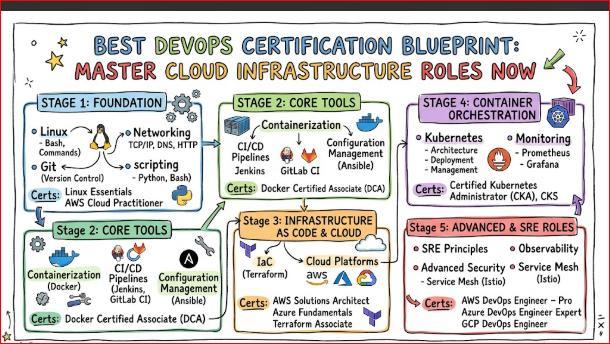
This comprehensive guide provides a clear, strategic roadmap for professionals navigating the complex Best DevOps Certification landscape to build a resilient career. Instead of chasing fleeting trends or collecting unnecessary credentials, you learn to prioritize a structured learning path that aligns with core infrastructure automation, cloud-native scalability, and real-world engineering demands. By focusing on high-impact certifications such as the CKA and Terraform Associate, you gain the validated technical expertise and practical troubleshooting skills required to dominate modern platform roles. This blueprint serves as your definitive resource for avoiding common training pitfalls, mastering essential DevOps tools, and executing a consistent growth strategy that ensures long-term professional success in the cloud infrastructure sector.
Why DevOps Certifications Matter
Certifications will never replace dirt-under-the-fingernails engineering experience, but a strategic path transforms chaotic learning into a structured weapon. Instead of bouncing between random tutorial videos, a rigorous certification forces you to master an entire technical ecosystem systematically.
[Structured Learning Path] ──> [Rigorous Exam Environment] ──> [Enterprise Validation]
- Hardened Skill Validation: They provide explicit, external proof to technical leaders that your skills have been tested against demanding, production-level baselines.
- Destroying Silos: Working in a single role can trap you inside a narrow, internal toolset. Certification preparation forces you into alternative architectures and global best practices.
- Real-World Interview Domination: Performance-based exams simulate live infrastructure emergencies. When you survive those, you can confidently ace the toughest technical interviews.
Who Should Read This Guide
This blueprint is built specifically for aggressive professionals ready to scale their career trajectories and dominate modern infrastructure roles:
- System Administrators & Linux Engineers: Ready to abandon brittle, manual bash scripting and ad-hoc patching for scalable, repeatable Infrastructure as Code.
- Software Developers: Determined to master system engineering, immutable packaging, and automated delivery engines.
- Cloud & Security Engineers: Focused on weaponizing security, injecting automated compliance guardrails directly into active CI/CD loops.
- SRE & Platform Aspirants: Obsessed with distributed systems metrics, platform stability, and deep, actionable system observability.
Types of DevOps Certifications
                       ┌───────────────────────────────┐
                       │     Advanced / Specialized    │
                       │   (GitOps, MLOps, FinOps)     │
                       └───────────────┬───────────────┘
                                       │
                       ┌───────────────▼───────────────┐
                       │     SRE & Platform Eng.       │
                       │   (Observability, Chaos)      │
                       └───────────────┬───────────────┘
                                       │
                       ┌───────────────▼───────────────┐
                       │       Cloud & DevSecOps       │
                       │     (AWS, Azure, GCP)         │
                       └───────────────┬───────────────┘
                                       │
                       ┌───────────────▼───────────────┐
                       │    Tool-Based Architecture    │
                       │   (Kubernetes, Terraform)     │
                       └───────────────┬───────────────┘
                                       │
                       ┌───────────────▼───────────────┐
                       │    Foundational Knowledge     │
                       │    (Linux, Git, Core Concepts)│
                       └───────────────────────────────┘
Foundational Knowledge
The bedrock principles. These certify your grasp of collaborative workflows, systemic feedback loops, and continuous testing strategies before you ever touch a single line of tool configuration.
Tool-Based Architecture
Deep-dive specializations centered on industry-standard open-source platforms that dominate modern infrastructure:
- Containerization & Orchestration: Docker engines, Kubernetes clusters (CKA).
- Infrastructure as Code: HashiCorp Terraform automation.
- Automation Engines: Git-driven architectures and core Linux system operations.
Cloud DevOps Platforms
Provider-specific ecosystems (AWS, Azure, Google Cloud) that test your ability to build, scale, and govern massive infrastructure operations using managed platform tools.
DevSecOps Essentials
Shifting security completely to the left. These focus on automated dependency scanning, secure runtime operations, and automated secrets management directly inside continuous delivery engines.
SRE & Platform Engineering
The reliability vanguard. These tracks shift focus toward distributed systems metrics, service-level objectives, log aggregation engines, and real-world system resilience.
Advanced Specialties
Cutting-edge horizons covering GitOps deployment patterns, cloud cost optimization pipelines (FinOps), and highly specialized data infrastructure for machine learning operations (MLOps).
Best DevOps Certifications at a Glance
| Certification Name | Best For | Technical Level | Core Target Focus |
| DevOps Foundation | Beginners & Managers | Foundational | Core workflows, vocabularies, and cultural patterns. |
| Docker Certified Associate (DCA) | Container Enthusiasts | Intermediate | Container runtimes, local networking, and storage images. |
| Certified Kubernetes Administrator (CKA) | Infrastructure Engineers | Advanced | Enterprise cluster scheduling, networking, and recovery. |
| HashiCorp Certified: Terraform Associate | Automation Architects | Intermediate | Declarative cloud provisioning and state state automation. |
| AWS Certified DevOps Engineer – Professional | AWS Systems Engineers | Advanced | Managed CI/CD, auto-scaling architectures, and governance. |
| Azure DevOps Engineer Expert | Enterprise Architects | Advanced | Microsoft stack delivery pipelines, boards, and test management. |
| Google Cloud Professional DevOps Engineer | Cloud Native Engineers | Advanced | Data-driven SRE, cloud operations, and GKE delivery. |
Detailed Certification Deep Dive
1. Certified Kubernetes Administrator (CKA)
What It Is
A ferocious, performance-based practical exam from The Linux Foundation and CNCF that completely skips multiple-choice questions to test your ability to build and fix live Kubernetes clusters in real time.
Who Should Take It
Engineers who own production uptime, manage microservices platforms, and need to know how to handle multi-node system stress.
Career Alignment & Scope
- Best Career Fit: Kubernetes Engineer, Systems Infrastructure Engineer, Platform Engineer, SRE.
- Industry Demand: Monumental. Enterprise tech stacks run on containers, making CKA the definitive gold standard.
Skills & Tools Covered
- Provisioning robust cluster architectures and upgrading worker nodes securely.
- Mastering pod placement, advanced scheduling primitives, and core controller logic.
- Wiring cluster-wide networking policies, internal services, and persistent storage arrays.
- Resuscitating crashed control planes and broken system agents under the clock.
- Core Tools: Kubernetes CLI (
kubectl),kubeadm, Docker/containerd, Linux networking utilities.
Exam Details
- Format: 100% Live practical lab environment.
- Duration: 2 Hours.
- Passing Score: 66%.
- Validity: 3 Years.
- Cost: Varies by provider.
Study Roadmap & Use Case
- Preparation Plan: Spin up raw virtual machines locally, build clusters via
kubeadmrepeatedly, destroy them intentionally, and drill speed-scenarios using simulation sandboxes. - Real-World Application: Instantly diagnosing a cluster-wide CoreDNS failure or executing zero-downtime rolling node migrations when runtime vulnerabilities hit production.
[Isolate Failing Node] ──> [Cordon/Drain Pods] ──> [Fix Kubelet Configuration] ──> [Restore Node]
Pros & Cons
- Pros: Explodes resume credibility because it proves you can actually execute commands under fire; highly respected by technical hiring leads.
- Cons: Demands high technical stamina; absolutely requires comfortable fluency with Linux command-line workflows.
Strategic Recommendation
Non-negotiable for serious cloud-native infrastructure engineers. Skip it only if your immediate responsibilities are strictly confined to basic code development or low-touch SaaS interfaces.
2. HashiCorp Certified: Terraform Associate
What It Is
A high-velocity exam testing your mastery of declarative Infrastructure as Code (IaC) principles and your ability to orchestrate cross-cloud architectures using HashiCorp Configuration Language (HCL).
Who Should Take It
Engineers tired of clicking through cloud dashboards who want to build, version, and destroy complex multi-provider topologies via clean code files.
Career Alignment & Scope
- Best Career Fit: Cloud DevOps Engineer, Automation Architect.
- Industry Demand: Extremely high baseline requirement; automated state-file tracking is expected across modern platform engineering.
Skills & Tools Covered
- Writing scalable infrastructure definitions utilizing declarative configuration syntax.
- Securing state backends, managing remote locks, and running dry-run executions safely.
- Designing highly reusable infrastructure modules across dev, staging, and production.
- Core Tools: Terraform CLI, HCL Syntax, Cross-Cloud Provider Plugins.
Exam Details
- Format: Multiple choice and multiple select.
- Duration: 1 Hour.
- Passing Score: Varies by provider.
- Validity: 2 Years.
- Cost: Varies by provider.
Study Roadmap & Use Case
- Preparation Plan: Fork real infrastructure modules, experiment with variable mappings, build cross-region cloud testbeds, and master the art of state imports.
- Real-World Application: Launching an entire multi-region network infrastructure with load balancers, security rules, and compute layers in minutes via a single command string.
Pros & Cons
- Pros: Highly applicable across all cloud providers; fast preparation timeline if you understand core cloud networking.
- Cons: Traditional exam format instead of a live interactive lab; needs hands-on build repositories to truly solidify knowledge.
Strategic Recommendation
The perfect starting catalyst for engineers ready to dive headfirst into infrastructure automation. Fast, high-impact, and immediately useful in your daily workflow.
3. AWS Certified DevOps Engineer – Professional
What It Is
An elite, hyper-focused situational exam that evaluates your ability to architect, automate, secure, and operate massive application lifecycle pipelines inside the Amazon Web Services catalog.
Who Should Take It
Seasoned systems professionals charged with implementing cross-account governance, high-velocity delivery pipelines, and elastic auto-scaling patterns.
Career Alignment & Scope
- Best Career Fit: Senior Cloud Engineer, Enterprise DevOps Architect.
- Industry Demand: Tremendous traction among corporate enterprises anchored firmly in the AWS ecosystem.
Skills & Tools Covered
- Designing resilient deployment engines utilizing advanced patterns (Canary, Blue/Green, Immutable).
- Implementing predictive automated scaling architectures and zero-loss healing loops.
- Enforcing organizational compliance guardrails and real-time security scanning pipelines.
- Architecting centralized log streaming and deep microservices trace maps.
- Core Tools: AWS CodePipeline, CloudFormation engines, Systems Manager, CloudWatch telemetry, IAM.
Exam Details
- Format: Complex, text-heavy scenario questions.
- Duration: 3 Hours.
- Passing Score: Varies by provider.
- Validity: 3 Years.
- Cost: Varies by provider.
Study Roadmap & Use Case
- Preparation Plan: Deep-dive into AWS Well-Architected whitepapers, build real cross-account code delivery engines, and simulate multi-region application rollbacks.
- Real-World Application: Architecting an automated system that evaluates real-time metric spikes and automatically triggers low-impact rollbacks when a new release exhibits subtle memory leaks.
[Deploy Code v2] ──> [Monitor Error Spikes] ──> [Threshold Breached] ──> [Auto-Route Traffic to v1]
Pros & Cons
- Pros: Deeply covers complex real-world enterprise scenarios; well-regarded across the industry.
- Cons: Challenging, text-heavy situational questions that require significant mental stamina; heavily tied to a single cloud ecosystem.
Strategic Recommendation
An exceptional milestone for specialists operating deeply within AWS domains. If your group focuses on multi-cloud open-source orchestration, start with tool-agnostic credentials like the CKA first.
DevOps Certification Comparison Table
| Certification | Best For | Level | Main Focus | Difficulty | Recommended Role | Link |
| DevOps Certified Professional (DCP) | Core Lifecycle Automation | Foundational | CI/CD, Git, Jenkins, Core Workflows | Low | Junior DevOps Engineer | View Course |
| DevSecOps Certified Professional (DSOCP) | Pipeline Vulnerability Scanning | Advanced | Shift-Left Security, SAST/DAST, Compliance | High | DevSecOps Engineer | View Course |
| Site Reliability Engineering (SRE) | System Resiliency & Observability | Advanced | SLOs, Error Budgets, Chaos Engineering | High | Site Reliability Engineer | View Course |
| Master in DevOps Engineering (MDE) | End-to-End Enterprise Strategy | Expert | Architecture Design & Production Release | High | Senior DevOps Architect | View Course |
| Master in Azure DevOps | Microsoft Ecosystem Specialists | Advanced | Azure Pipelines, Boards, Repos Setup | Medium | Azure Cloud Engineer | View Course |
| AWS Certified DevOps Professional | Amazon Web Services Architecture | Advanced | AWS Developer Tools, CloudFormation, Auto Scaling | High | AWS Infrastructure Engineer | View Course |
| Master in Python Programming | Infrastructure Automation Scripting | Intermediate | Scripting, Custom CLI Tools, API Automation | Medium | Automation Engineer / Developer | View Course |
| Certified Kubernetes Administrator (CKA) | Production Container Orchestration | Advanced | Cluster Architecture, Networking, Troubleshooting | High | Kubernetes Specialist | View Course |
| Docker Certified Associate (DCA) | Application Containerization | Intermediate | Image Optimization, Container Runtimes, Volumes | Medium | Systems Administrator | View Course |
| Google Cloud DevOps Engineer | Google Cloud Native Platforms | Advanced | GKE Administration, GCP Operations Suite | High | GCP Cloud Engineer | View Course |
| Master in Data Science | Enterprise Data Engineering | Advanced | Statistical Analytics, Scalable Data Pipelines | High | Data Infrastructure Engineer | View Course |
| Hashicorp Certified Terraform Associate | Multi-Cloud Infrastructure as Code | Intermediate | Declarative State Files, Module Management | Medium | Cloud Automation Specialist | View Course |
| Master in Artificial Intelligence | Intelligent System Automation | Advanced | Neural Networks, Automated Model Training | High | AI Operations Specialist | View Course |
| Master in Deep Learning | Advanced Model Topologies | Advanced | Complex Layer Compute, Topology Deployments | High | Deep Learning Engineer | View Course |
| GitOps Certified Professional (GOCP) | Declarative Continuous Delivery | Intermediate | ArgoCD, Flux, Git-Driven Cluster State | Medium | Platform Engineer | View Course |
| Envoy ISTIO Certification Training | Microservices Service Mesh | Advanced | Traffic Splitting, mTLS Encryption, Sidecars | High | Network Infrastructure Architect | View Course |
| Prometheus with Grafana | Cloud-Native Systems Monitoring | Intermediate | Time-Series Metrics, Dashboard Visuals, Alerting | Medium | Monitoring & Operations Engineer | View Course |
| MLOps Certification Training Course | Machine Learning Pipeline Scale | Advanced | Model Lifecycle Automation, Data Versioning | High | MLOps Engineer | View Course |
| Master in Machine Learning | Predictive Operational Algorithms | Advanced | Supervised/Unsupervised Modeling Deployments | High | ML Infrastructure Engineer | View Course |
| Master in AppDynamics | Enterprise Performance Tracking | Intermediate | APM Dashboards, JVM/CLR Code Diagnostics | Medium | Application Support Engineer | View Course |
The Multi-Stage DevOps Certification Roadmap
  [Stage 1: Foundational]         [Stage 2: Core Tooling]         [Stage 3: Cloud & Native]
   • Linux Administration          • Container Packaging           • Infrastructure as Code
   • Git Code Versioning          • Local Configurations          • Advanced Orchestration
   • Basic Networking             • Basic Pipelines               • Enterprise Cloud Ecosystems
Stage 1: Foundational Systems
Before touching automation platforms, master the system fundamentals:
- Linux Essentials: Command execution, user permissions, and native process diagnostics.
- Version Control: Branch isolation patterns, merge conflict resolution, and history management using Git.
- Basic Networking: Core DNS behavior, subnets, and HTTP/S message handling.
Stage 2: Core Tooling & Containerization
Package code efficiently and consistently:
- Container Runtimes: Isolate code environments, build slim images, and manage container volumes with Docker.
- Basic Automation: Run automated verification test runners on every code push.
Stage 3: Cloud Platforms & Native Scaling
Orchestrate major operations across distributed targets:
- Infrastructure as Code: Turn multi-tier server setups into repeatable, automated Terraform configurations.
- Production Orchestration: Scale container fleets, configure automatic self-healing systems, and manage traffic routing via Kubernetes.
- Enterprise Cloud Integration: Connect your systems cleanly with managed cloud platforms, explicit security roles, and global networks.
Recommended Certification Path by Role
The Infrastructure Engineer Path
For those who build platforms, manage bare-metal elements, and deploy virtualization:
- Linux Foundation Certified System Administrator (LFCS)
- HashiCorp Certified: Terraform Associate
- Certified Kubernetes Administrator (CKA)
The Cloud Native Specialist Path
Optimized for high-velocity teams operating microservices fleets:
- Docker Certified Associate (DCA)
- Certified Kubernetes Administrator (CKA)
- AWS Professional / Azure Expert DevOps Track
The Security-First (DevSecOps) Path
For compliance, pipeline security validation, and automated vulnerability tracking:
- HashiCorp Terraform Associate (for secure baseline building)
- Certified Kubernetes Security Specialist (CKS)
Real-World Career Scenarios
Scenario A: Transitioning from Manual System Administration
An engineer spent years manually adjusting configuration parameters and responding to late-night server errors.
- The Fix: They avoided diving straight into complex Kubernetes patterns. Instead, they focused on standard version control, built repeatable server templates with Terraform, and verified their configurations automatically. This shifted their daily work from manual fire-fighting to managing predictable, automated environments.
Scenario B: Software Developer Expanding into Production Operations
A developer understood application features well but often encountered problems where code worked locally but failed after being deployed.
- The Fix: They learned to package code cleanly inside isolated container environments with Docker to guarantee operational consistency. They then studied Kubernetes to master cluster scaling, internal communications, and smooth update deployments.
Common Mistakes to Avoid
- Skipping Core System Foundations: Trying to diagnose network rules inside an advanced orchestration tool without understanding standard Linux routing or DNS makes troubleshooting much more difficult.
- Chasing Credentials Over Code Practice: Scoring passing grades on theoretical multiple-choice quizzes by memorizing text strings leaves you unprepared for active engineering roles.
- Scaling Up Architecture Too Fast: Learning to orchestrate large cluster fleets before mastering how a single container behaves locally leads to confusion. Start with the basics, then scale.
Hands-On Projects for Portfolio Validation
Showcase your skills to engineering teams with functional, open portfolio repositories:
Project 1: Immutable Automated Cloud Platform
- Goal: Create a reusable Terraform module that provisions a multi-zone network, complete with load balancers and automated compute balancing.
- Why it matters: Proves you can deploy secure, repeatable cloud systems from code without relying on manual cloud dashboards.
Project 2: Container Delivery Pipeline
- Goal: Code an automated repository loop that validates tests on every update, builds a streamlined container image, scans for security issues, and updates a target setup.
[Code Push] ──> [Run Automated Tests] ──> [Build & Scan Container] ──> [Deploy to Staging]
- Why it matters: Demonstrates your practical knowledge of deployment testing, automated checks, and continuous integration feedback loops.
Tools and Free Learning Resources
- Interactive Environments: Practice live multi-node setups safely in your browser using sandboxes like Killercoda or Play with Docker.
- Local Run Spaces: Build, test, and break configurations locally with lightweight utilities like Minikube, Kind, or Vagrant without incurring cloud provider costs.
- Reference Libraries: Review public GitHub repositories for production-grade Terraform templates and Kubernetes layouts to learn clean code structures and module separation.
How to Choose the Right DevOps Certification
Match your training with your technical background and immediate career goals:
                  What is your primary technical goal?
                                   │
         ┌─────────────────────────┴─────────────────────────┐
         ▼                                                   ▼
[Master Cloud Environments]                             [Orchestrate Containers]
         │                                                   │
         ▼                                                   ▼
Is your workplace platform-specific?                  Do you manage live microservices?
   ├── Yes ──> [AWS/Azure/GCP Track]                        ├── Yes ──> [Focus on CKA Exam]
   └── No  ──> [Focus on Terraform]                         └── No  ──> [Start with Docker]
- Analyze Your Production Stack: If your engineering group operates heavily on one cloud provider, focus on that vendor’s professional tracks to fix your current deployment issues.
- Align with Hiring Requirements: Check job specifications for your target positions. If they focus on container operations, prioritize hands-on engineering exams like the CKA.
- Optimize Your Preparation Budget: Interactive lab testing often requires more focused preparation time. Choose credentials that offer official lab simulations to make the most of your training.
Frequently Asked Questions (FAQs)
1.Which DevOps certification is best for absolute beginners?
The HashiCorp Certified: Terraform Associate serves as an ideal entry point. It features straightforward declarative language, establishes clear automated design patterns, and applies broadly across major cloud providers without demanding deep programming experience.
2. Is a Kubernetes certification worth the effort?
Yes, absolutely. The Certified Kubernetes Administrator (CKA) carries strong weight because it is a practical, performance-based test. You must modify actual configurations on running systems, proving real capability over simple text memorization.
3. Which cloud provider certification path should I choose first?
Align this with your immediate target market or employer infrastructure. AWS maintains widespread usage across tech companies and startups, while Microsoft Azure retains strong placement across large enterprise systems.
4. Do DevOps engineers need to write software code?
Yes, basic programming logic is necessary. While you won’t need to develop complex application features, you must write clean scripts, parse logs, define infrastructure configurations, and orchestrate delivery engines using options like Python, Go, or Bash.
5. How much time does it take to prepare for a professional-level certification?
For focused tool configurations like Terraform, expect 4 to 6 weeks of regular practice. For advanced, lab-driven tests like the CKA or professional cloud architectures, budget 3 to 5 months of hands-on platform construction.
6. Is a Docker certification still relevant?
Understanding container concepts is essential, but transitioning your focus toward Kubernetes tracks often delivers a stronger return. Kubernetes credentials teach core container patterns while showing you how to scale them across distributed systems.
7. Which certifications are best for Site Reliability Engineering (SRE) roles?
The CKA provides an outstanding foundation for system scaling. Pair this with cloud infrastructure engineering tracks, and dedicate your focus toward metric aggregation systems, tracing engines, and telemetry monitoring.
8. Do certifications guarantee a cloud engineering job?
No, they do not. A strong certification can help your profile pass early recruitment filters, but you must validate your knowledge during live technical loops. Combine your study with public code repositories to demonstrate practical skill.
9. Should I study Kubernetes before learning Docker fundamentals?
No. Kubernetes is built to orchestrate containers. If you don’t understand how a single application is containerized, isolated, and stored locally with Docker, managing large fleets across a cluster will be much more difficult.
10. How often do these cloud infrastructure certifications expire?
Most major platform and tool credentials run on a 2-to-3-year expiration cycle. This forces engineers to stay up to date with new features, rolling security standards, and tool iterations.
11. Are open-source tool certifications better than specific cloud vendor credentials?
They serve different purposes. Open-source certificates like the CKA teach vendor-neutral structural strategies applicable across any environment, while cloud-specific paths focus on deep integration within a provider’s ecosystem.
12. What is the most effective roadmap for learning DevOps from scratch?
Master core Linux system navigation and Git source workflows first. Next, transition into application containerization with Docker, automate resource blueprints using Terraform, and scale your deployments using Kubernetes orchestration.
Final Recommendation & Next Steps
Do not collect certifications just to add lines to a resume. Choose a strategic path that matches your current engineering background and your immediate professional goals. If you are new to automated infrastructure, focus on version control and learning to build clean cloud resources with Terraform. If you are already managing live systems, prioritize practical, lab-driven options like the Certified Kubernetes Administrator (CKA) to build deep, resilient troubleshooting skills. The most effective way to validate your knowledge is to apply it. As you complete each certification chapter, build a functional project, commit the code to a repository, and write a clean document explaining how you designed the solution. This combination of structural knowledge and practical engineering is what builds a sustainable career in cloud infrastructure.
