Introduction
Reverse Proxy Tools sit in front of web servers, applications, APIs, and backend services to receive client requests and forward them to the right destination. Instead of users connecting directly to backend servers, the reverse proxy handles routing, SSL/TLS termination, caching, compression, security filtering, and traffic control. This improves performance, protects backend infrastructure, and simplifies application delivery.
In and beyond, reverse proxies are critical because modern applications run across microservices, Kubernetes, cloud platforms, APIs, serverless workloads, and hybrid environments. Teams need reliable tools to route traffic, secure applications, reduce latency, support zero-trust access, and manage high availability across distributed systems.
Real-World Use Cases
- API traffic routing: Route requests to different backend services based on hostname, path, headers, or API version.
- SSL/TLS termination: Handle certificates and encrypted connections before forwarding traffic to backend services.
- Application security: Add WAF, access control, rate limiting, bot protection, and request filtering.
- Performance optimization: Use caching, compression, connection reuse, and request buffering to improve response times.
- Microservices and Kubernetes routing: Direct traffic to services, containers, and ingress resources in dynamic environments.
Evaluation Criteria for Buyers
When evaluating reverse proxy tools, buyers should consider:
- Layer 7 routing capabilities
- SSL/TLS termination and certificate management
- Caching and compression support
- API gateway and authentication features
- Security controls such as WAF and rate limiting
- Kubernetes and container support
- Load balancing and failover capabilities
- Monitoring, logging, and observability
- Automation, APIs, and infrastructure-as-code support
- Deployment model, licensing, and operational complexity
Best for: DevOps teams, platform engineers, SRE teams, API teams, cloud architects, SaaS companies, e-commerce platforms, media platforms, security teams, and enterprises running web applications or distributed services.
Not ideal for: Very small static websites, applications with no traffic management needs, or teams that only need basic DNS routing without SSL management, security controls, caching, or backend service routing.
Key Trends in Reverse Proxy Tools
- Reverse proxy and API gateway roles are converging: Many teams now use reverse proxies for API routing, authentication, rate limiting, and developer platform workflows.
- Kubernetes ingress adoption continues to grow: Reverse proxy tools are increasingly deployed as ingress controllers for containerized workloads.
- Security is becoming built-in: WAF, bot protection, DDoS mitigation, mTLS, OAuth, JWT validation, and zero-trust access are now major buying criteria.
- Edge reverse proxy usage is expanding: More traffic is routed through global edge networks to reduce latency and improve availability.
- Automation is expected: Teams want configuration through APIs, Terraform, GitOps, CI/CD pipelines, and Kubernetes-native resources.
- Observability is a priority: Buyers expect metrics, traces, logs, dashboards, request inspection, and anomaly detection.
- Hybrid and multi-cloud routing is increasing: Enterprises need reverse proxies that work across legacy data centers, cloud platforms, and Kubernetes clusters.
- Performance optimization matters more: Caching, compression, HTTP/2, HTTP/3 support, and connection optimization help reduce backend load.
- Service mesh overlap is growing: Reverse proxies increasingly interact with service mesh tools for east-west and north-south traffic control.
- Policy-based traffic management is becoming standard: Teams need fine-grained routing rules based on headers, paths, users, geolocation, and application context.
How We Selected These Tools
The following reverse proxy tools were selected using a practical SaaS, DevOps, and enterprise infrastructure evaluation approach:
- Market adoption and recognition: Widely used reverse proxy and application delivery tools were prioritized.
- Feature completeness: Tools with routing, SSL/TLS, caching, load balancing, security, and observability scored higher.
- Cloud-native readiness: Kubernetes, container, service mesh, and cloud platform support were strongly considered.
- Performance and reliability: Preference was given to tools known for stable production traffic handling.
- Security posture signals: WAF integration, authentication support, rate limiting, mTLS, and secure configuration options were reviewed.
- Integration ecosystem: DevOps, monitoring, cloud, CI/CD, IaC, and API platform integrations were considered.
- Customer fit: The final list balances open-source, enterprise, cloud-native, edge-based, and developer-friendly options.
- Support and maturity: Documentation, community strength, commercial support, and enterprise adoption influenced selection.
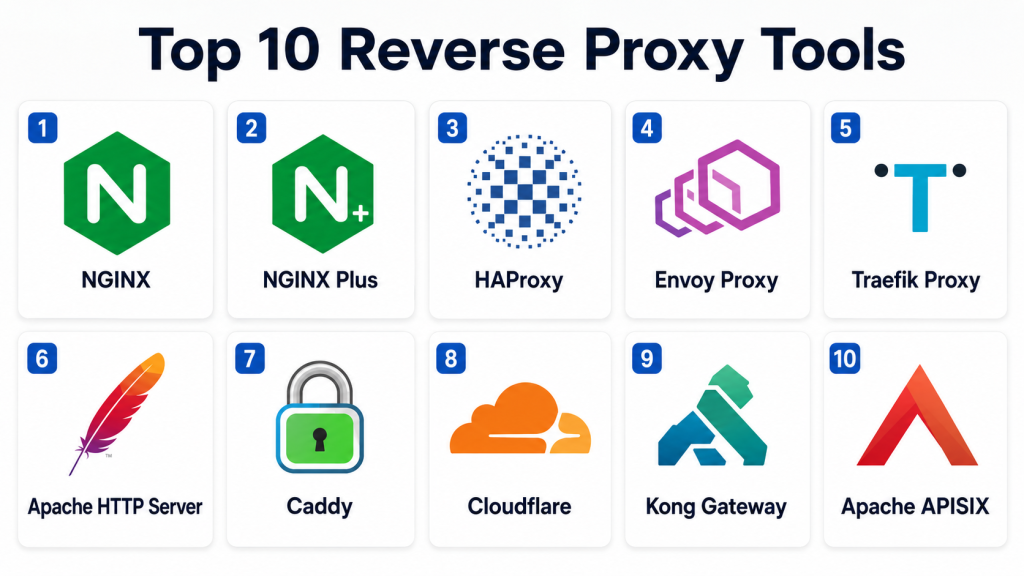
Top 10 Reverse Proxy Tools
1- NGINX
Short description: NGINX is one of the most widely used reverse proxy and web server technologies for modern application delivery. It handles HTTP traffic, SSL/TLS termination, caching, compression, load balancing, and routing for websites, APIs, and microservices. Developers, DevOps teams, and enterprises use NGINX because it is lightweight, fast, flexible, and mature. It is commonly deployed in cloud VMs, containers, Kubernetes ingress environments, and traditional server infrastructure. NGINX is suitable for simple websites as well as complex production architectures. Its strongest value is reliable high-performance reverse proxy functionality with broad ecosystem support.
Key Features
- HTTP and HTTPS reverse proxy
- SSL/TLS termination
- Load balancing and upstream routing
- Static content serving and caching
- Compression and connection optimization
- Kubernetes ingress support
- Flexible configuration and module ecosystem
Pros
- High performance and widely adopted
- Strong fit for web apps, APIs, and microservices
- Large community and broad documentation
Cons
- Advanced configuration requires technical expertise
- Some enterprise features require commercial offerings
- Complex dynamic environments may need additional tooling
Platforms / Deployment
- Linux
- Windows support varies
- Cloud
- Self-hosted
- Hybrid
- Kubernetes deployment options
Security & Compliance
Supports SSL/TLS, access controls, request filtering, rate limiting, and secure proxy configuration. Specific compliance certifications are not publicly stated for the open-source tool and depend on deployment and configuration.
Integrations & Ecosystem
NGINX integrates with modern application delivery and DevOps environments.
- Kubernetes
- Docker
- Prometheus
- Grafana
- CI/CD pipelines
- Cloud platforms
Support & Community
NGINX has a large global community, extensive documentation, tutorials, commercial support options, and strong adoption across developers and enterprises.
2- NGINX Plus
Short description: NGINX Plus is the commercial version of NGINX, designed for enterprise-grade reverse proxy, load balancing, API gateway, monitoring, and application delivery use cases. It adds features such as advanced health checks, dynamic configuration, session persistence, activity monitoring, and enterprise support. Organizations use NGINX Plus when they need the performance and flexibility of NGINX with additional operational control and vendor support. It fits SaaS companies, enterprises, platform teams, and API-driven environments. NGINX Plus is also commonly used with Kubernetes and containerized workloads. Its strongest value is production-ready software-defined application delivery with commercial support.
Key Features
- Reverse proxy and API gateway capabilities
- Advanced Layer 7 routing
- SSL/TLS termination
- Active health checks
- Session persistence
- Real-time activity monitoring
- Dynamic configuration and management API
Pros
- Adds enterprise features to NGINX
- Strong fit for production SaaS and API environments
- Commercial support helps enterprise operations
Cons
- Requires paid subscription
- Configuration knowledge is still needed
- May be more than small teams need
Platforms / Deployment
- Linux
- Cloud
- Self-hosted
- Hybrid
- Kubernetes deployment options
Security & Compliance
Supports SSL/TLS, secure routing, access controls, rate limiting, and security-focused configuration options. Specific compliance certifications should be verified during procurement.
Integrations & Ecosystem
NGINX Plus fits strongly into cloud-native, API, and DevOps workflows.
- Kubernetes ingress
- Docker
- Prometheus and Grafana
- CI/CD tools
- Cloud platforms
- API management workflows
Support & Community
Commercial support, enterprise documentation, training resources, and the broader NGINX community make it suitable for production environments.
3- HAProxy
Short description: HAProxy is a high-performance open-source reverse proxy and load balancer commonly used for websites, APIs, SaaS platforms, and high-traffic applications. It supports TCP and HTTP traffic management, SSL/TLS termination, health checks, request routing, and traffic shaping. HAProxy is known for performance, reliability, and efficiency under heavy traffic. It is commonly used by technical teams that need fine-grained control over traffic behavior. HAProxy can be deployed in self-hosted, cloud, hybrid, and containerized environments. Its strongest value is fast and flexible traffic management for demanding production workloads.
Key Features
- HTTP and TCP reverse proxy
- Layer 4 and Layer 7 load balancing
- SSL/TLS termination
- Health checks and failover
- ACL-based routing
- Traffic shaping and rate limiting
- Metrics and observability support
Pros
- Excellent performance under high traffic
- Strong routing and load balancing flexibility
- Open-source option with mature ecosystem
Cons
- Configuration can be complex for beginners
- Advanced enterprise management requires commercial options
- UI and management experience may require additional tools
Platforms / Deployment
- Linux
- Cloud
- Self-hosted
- Hybrid
- Container deployment options
Security & Compliance
Supports SSL/TLS, access control lists, rate limiting, and secure proxy patterns. Compliance depends on deployment, configuration, and surrounding infrastructure.
Integrations & Ecosystem
HAProxy integrates with modern infrastructure and monitoring ecosystems.
- Kubernetes
- Docker
- Prometheus
- Grafana
- Cloud platforms
- CI/CD automation
Support & Community
HAProxy has strong documentation, community knowledge, commercial support options, and broad adoption in high-performance application delivery.
4- Envoy Proxy
Short description: Envoy Proxy is a cloud-native reverse proxy and edge/service proxy designed for modern distributed systems. It is widely used in service mesh, microservices, Kubernetes, and API infrastructure environments. Envoy supports advanced Layer 7 routing, observability, retries, circuit breaking, load balancing, and dynamic configuration. It is commonly used as a data plane component in modern service mesh platforms and application networking systems. Platform engineering teams use Envoy when they need programmable, cloud-native traffic control across many services. Its strongest value is modern proxy architecture for microservices and service-to-service communication.
Key Features
- Layer 7 reverse proxy
- Dynamic service discovery
- Advanced traffic routing
- Retries, timeouts, and circuit breaking
- Observability through metrics and tracing
- mTLS and service mesh support
- HTTP/2 and gRPC support
Pros
- Strong fit for microservices and Kubernetes
- Powerful observability and traffic control
- Commonly used in service mesh architectures
Cons
- More complex than traditional reverse proxies
- Requires strong platform engineering skills
- Configuration model can be difficult for beginners
Platforms / Deployment
- Linux
- Cloud
- Self-hosted
- Hybrid
- Kubernetes environments
Security & Compliance
Supports mTLS, secure service communication, access control patterns, and policy-driven traffic management. Specific compliance depends on deployment and management layer.
Integrations & Ecosystem
Envoy is widely integrated into modern cloud-native networking ecosystems.
- Kubernetes
- Istio
- Consul
- gRPC services
- Prometheus
- OpenTelemetry
Support & Community
Envoy has an active open-source community, strong technical documentation, cloud-native ecosystem adoption, and commercial support through related platforms.
5- Traefik Proxy
Short description: Traefik Proxy is a modern reverse proxy and ingress controller designed for cloud-native and containerized applications. It automatically discovers services from platforms such as Kubernetes, Docker, and other orchestrators, making it popular with DevOps teams. Traefik supports HTTP routing, SSL/TLS automation, middleware, load balancing, and dynamic configuration. It is often used by teams that want easier reverse proxy setup in dynamic environments. Traefik is useful for microservices, development platforms, SaaS apps, and Kubernetes ingress scenarios. Its strongest value is simplicity and automation for container-first application delivery.
Key Features
- Dynamic reverse proxy configuration
- Kubernetes ingress controller
- Docker and container service discovery
- Automatic certificate handling
- Middleware-based routing controls
- Load balancing and traffic routing
- Dashboard and observability features
Pros
- Easy to use in container environments
- Automatic service discovery reduces manual configuration
- Good fit for Kubernetes and DevOps teams
Cons
- May not match deepest enterprise ADC features
- Advanced routing and security policies require careful setup
- Performance tuning may be needed for large environments
Platforms / Deployment
- Cloud
- Self-hosted
- Hybrid
- Kubernetes
- Docker environments
Security & Compliance
Supports SSL/TLS, middleware policies, authentication integrations, and secure routing options. Specific compliance certifications should be verified for commercial offerings.
Integrations & Ecosystem
Traefik integrates well with container orchestration and DevOps tools.
- Kubernetes
- Docker
- Consul
- Prometheus
- Let’s Encrypt-style certificate workflows
- CI/CD environments
Support & Community
Traefik has strong documentation, active community support, commercial offerings, and adoption among cloud-native teams.
6- Apache HTTP Server
Short description: Apache HTTP Server is a mature web server that can also function as a reverse proxy through modules such as mod_proxy. It is widely used in enterprise, hosting, legacy, and traditional web application environments. Apache supports proxying, SSL/TLS termination, virtual hosts, access controls, rewriting, caching, and integration with many modules. Organizations often use Apache where existing infrastructure, compatibility, and module flexibility matter. It may not be the newest cloud-native proxy, but it remains reliable and familiar for many teams. Its strongest value is mature web server and reverse proxy capability with broad platform support.
Key Features
- Reverse proxy through proxy modules
- SSL/TLS termination
- Virtual host routing
- URL rewriting and redirects
- Access control and authentication modules
- Caching module support
- Broad module ecosystem
Pros
- Mature and widely understood
- Strong module ecosystem
- Good fit for traditional web environments
Cons
- May require tuning for high-concurrency workloads
- Less cloud-native than newer proxy tools
- Configuration can become complex over time
Platforms / Deployment
- Linux
- Windows
- macOS
- Cloud
- Self-hosted
- Hybrid
Security & Compliance
Supports SSL/TLS, access controls, authentication modules, logging, and secure configuration practices. Compliance depends on deployment and server hardening.
Integrations & Ecosystem
Apache integrates with many traditional and modern web stacks.
- Linux servers
- PHP applications
- Java application servers
- Monitoring tools
- CI/CD workflows
- Enterprise authentication systems
Support & Community
Apache has a large open-source community, long-standing documentation, hosting ecosystem support, and extensive administrator knowledge resources.
7- Caddy
Short description: Caddy is a modern web server and reverse proxy known for simple configuration and automatic HTTPS. It is popular among developers, small teams, startups, and modern web projects that want secure defaults with minimal operational overhead. Caddy can reverse proxy to backend services, handle certificates automatically, serve static files, and support modern protocols. It is often used for personal projects, internal tools, small SaaS apps, and developer-friendly deployments. Caddy’s configuration is generally easier than many older reverse proxy tools. Its strongest value is simplicity, automatic certificate management, and secure-by-default behavior.
Key Features
- Reverse proxy support
- Automatic HTTPS
- Simple configuration file
- Static file serving
- Modern protocol support
- Plugin-based extensibility
- Container-friendly deployment
Pros
- Very easy to configure
- Automatic HTTPS reduces certificate management effort
- Good fit for small and modern web deployments
Cons
- Smaller enterprise ecosystem than NGINX or HAProxy
- Advanced traffic policies may require plugins or custom setup
- Not always the first choice for very large enterprise environments
Platforms / Deployment
- Linux
- Windows
- macOS
- Cloud
- Self-hosted
- Containers
Security & Compliance
Supports automatic HTTPS, TLS configuration, access controls through configuration and plugins. Specific compliance certifications are not publicly stated.
Integrations & Ecosystem
Caddy fits developer-friendly web and container workflows.
- Docker
- Linux servers
- Cloud VMs
- Static sites
- Backend services
- Plugin ecosystem
Support & Community
Caddy has clear documentation, an active community, plugin contributors, and commercial support options through related offerings.
8- Cloudflare
Short description: Cloudflare provides edge-based reverse proxy, CDN, security, DNS, and traffic management services. When traffic passes through Cloudflare, it acts as a reverse proxy between users and origin servers, helping improve performance and protect applications. It is commonly used by websites, SaaS platforms, APIs, e-commerce companies, media brands, and global applications. Cloudflare can provide caching, DDoS mitigation, WAF, bot protection, SSL/TLS, and global traffic routing. It is especially useful for teams that want edge security and performance without managing proxy infrastructure directly. Its strongest value is global reverse proxy delivery with integrated security and performance services.
Key Features
- Edge reverse proxy
- CDN caching
- SSL/TLS termination
- DDoS mitigation
- Web application firewall
- Bot protection and access controls
- Global traffic routing features
Pros
- Fully managed global edge network
- Strong security and performance combination
- Easy to adopt for websites and SaaS platforms
Cons
- Best value inside Cloudflare ecosystem
- Advanced enterprise controls may require higher-tier plans
- Less control over internal reverse proxy behavior than self-hosted tools
Platforms / Deployment
- Cloud
- Web
Security & Compliance
Supports SSL/TLS, DDoS mitigation, WAF, bot protection, access controls, and security monitoring. Specific certifications and compliance details should be verified during procurement.
Integrations & Ecosystem
Cloudflare integrates with cloud origins, web platforms, APIs, and security workflows.
- Cloudflare DNS
- Cloudflare CDN
- Cloudflare WAF
- API security workflows
- Cloud origin infrastructure
- CI/CD and automation APIs
Support & Community
Cloudflare provides documentation, customer support options, enterprise assistance, and a large community of web performance and security users.
9- Kong Gateway
Short description: Kong Gateway is an API gateway and reverse proxy built to manage, secure, and route API traffic. It is commonly used by API teams, platform engineers, microservices teams, and enterprises that need authentication, rate limiting, transformations, observability, and service routing. Kong supports plugin-based extensibility and can be deployed in cloud, self-hosted, Kubernetes, and hybrid environments. It is particularly useful when reverse proxy needs overlap with API management. Teams use Kong to centralize API policies and route traffic across backend services. Its strongest value is reverse proxy functionality combined with API gateway governance.
Key Features
- API gateway and reverse proxy
- Authentication and authorization plugins
- Rate limiting and traffic control
- Request and response transformations
- Service routing and load balancing
- Kubernetes ingress support
- Observability and logging integrations
Pros
- Strong API management capabilities
- Flexible plugin ecosystem
- Good fit for microservices and platform teams
Cons
- More complex than simple reverse proxy tools
- Enterprise features may require commercial licensing
- Requires good API governance planning
Platforms / Deployment
- Cloud
- Self-hosted
- Hybrid
- Kubernetes deployment options
Security & Compliance
Supports authentication, authorization, rate limiting, SSL/TLS, logging, and access control through plugins and configuration. Specific compliance claims should be verified during procurement.
Integrations & Ecosystem
Kong integrates with API, DevOps, and observability ecosystems.
- Kubernetes
- Docker
- Prometheus
- OpenTelemetry
- Identity providers
- CI/CD workflows
Support & Community
Kong has documentation, community resources, commercial support options, partner ecosystem, and strong adoption among API platform teams.
10- Apache APISIX
Short description: Apache APISIX is an open-source cloud-native API gateway and reverse proxy designed for dynamic traffic management. It supports routing, load balancing, authentication, rate limiting, observability, and plugin-based extensibility. APISIX is commonly used by teams building API platforms, microservices environments, and Kubernetes-native architectures. It offers dynamic configuration and high-performance traffic handling for modern application environments. Organizations use APISIX when they want open-source API gateway capabilities with reverse proxy functions. Its strongest value is cloud-native, extensible, open-source traffic management.
Key Features
- Reverse proxy and API gateway capabilities
- Dynamic routing and service discovery
- Plugin-based architecture
- Authentication and rate limiting
- Load balancing and traffic control
- Kubernetes ingress support
- Observability integrations
Pros
- Open-source and extensible
- Good fit for API and microservices teams
- Dynamic configuration supports modern environments
Cons
- Requires technical expertise to operate well
- Enterprise support may depend on vendor ecosystem
- Smaller mainstream adoption than NGINX in some markets
Platforms / Deployment
- Cloud
- Self-hosted
- Hybrid
- Kubernetes deployment options
Security & Compliance
Supports SSL/TLS, authentication plugins, access control, rate limiting, and logging. Specific compliance certifications are not publicly stated and depend on deployment and support provider.
Integrations & Ecosystem
Apache APISIX integrates with cloud-native and API platform ecosystems.
- Kubernetes
- Docker
- Prometheus
- OpenTelemetry
- Identity providers
- Service discovery systems
Support & Community
Apache APISIX has open-source documentation, community support, plugin contributors, and commercial ecosystem options through vendors and service providers.
Comparison Table
| Tool Name | Best For | Platform(s) Supported | Deployment | Standout Feature | Public Rating |
|---|---|---|---|---|---|
| NGINX | General reverse proxy and web traffic | Linux, Windows support varies, containers | Cloud / Self-hosted / Hybrid | High-performance web proxy | N/A |
| NGINX Plus | Enterprise reverse proxy and API delivery | Linux, Kubernetes, cloud | Cloud / Self-hosted / Hybrid | Enterprise NGINX features | N/A |
| HAProxy | High-traffic apps and APIs | Linux, containers, cloud | Cloud / Self-hosted / Hybrid | High-throughput traffic control | N/A |
| Envoy Proxy | Microservices and service mesh | Linux, Kubernetes, cloud | Cloud / Self-hosted / Hybrid | Cloud-native service proxy | N/A |
| Traefik Proxy | Container and Kubernetes routing | Kubernetes, Docker, cloud | Cloud / Self-hosted / Hybrid | Automatic service discovery | N/A |
| Apache HTTP Server | Traditional web applications | Linux, Windows, macOS | Cloud / Self-hosted / Hybrid | Mature module ecosystem | N/A |
| Caddy | Simple secure reverse proxy | Linux, Windows, macOS, containers | Cloud / Self-hosted | Automatic HTTPS | N/A |
| Cloudflare | Global edge reverse proxy | Web and cloud origins | Cloud | Edge security and caching | N/A |
| Kong Gateway | API gateway and reverse proxy | Kubernetes, cloud, self-hosted | Cloud / Self-hosted / Hybrid | API traffic governance | N/A |
| Apache APISIX | Open-source API gateway proxy | Kubernetes, containers, cloud | Cloud / Self-hosted / Hybrid | Dynamic plugin-based routing | N/A |
Evaluation & Scoring of Reverse Proxy Tools
| Tool Name | Core 25% | Ease 15% | Integrations 15% | Security 10% | Performance 10% | Support 10% | Value 15% | Weighted Total |
| NGINX | 9 | 8 | 9 | 8 | 9 | 8 | 10 | 8.8 |
| NGINX Plus | 9 | 8 | 9 | 8 | 9 | 9 | 8 | 8.7 |
| HAProxy | 9 | 7 | 8 | 8 | 10 | 8 | 9 | 8.6 |
| Envoy Proxy | 9 | 6 | 9 | 9 | 9 | 8 | 8 | 8.3 |
| Traefik Proxy | 8 | 9 | 9 | 8 | 8 | 8 | 9 | 8.4 |
| Apache HTTP Server | 8 | 7 | 8 | 8 | 7 | 8 | 9 | 7.9 |
| Caddy | 7 | 10 | 7 | 8 | 8 | 7 | 9 | 8.0 |
| Cloudflare | 8 | 9 | 8 | 9 | 9 | 8 | 8 | 8.4 |
| Kong Gateway | 9 | 7 | 9 | 9 | 8 | 8 | 7 | 8.2 |
| Apache APISIX | 8 | 7 | 8 | 8 | 8 | 7 | 9 | 7.9 |
These scores are comparative and should not be treated as universal rankings. A higher score means the tool performs strongly across reverse proxy features, integrations, security, performance, and value. The right choice depends on whether the use case is a simple web proxy, API gateway, Kubernetes ingress, edge proxy, or enterprise traffic platform. Buyers should validate routing behavior, TLS handling, monitoring, scalability, and security policies before production rollout.
Which Reverse Proxy Tool Is Right for You?
Solo / Freelancer
Solo developers usually need simplicity, fast setup, and low maintenance. Caddy is a strong choice because of automatic HTTPS and simple configuration. NGINX is also excellent if the user wants broader control and learning value. Cloudflare can be practical when the goal is to protect and accelerate a public website without managing infrastructure.
SMB
SMBs need reliable routing, SSL/TLS, basic security, and simple operations. NGINX, Caddy, Traefik Proxy, Cloudflare, and NGINX Plus are practical options depending on budget and architecture. If the team uses containers or Kubernetes, Traefik is especially attractive. If the company needs managed global protection, Cloudflare may be a better fit.
Mid-Market
Mid-market teams often need stronger automation, monitoring, API routing, and Kubernetes support. NGINX Plus, HAProxy, Traefik, Envoy, Kong Gateway, and Apache APISIX can be good candidates. These teams should evaluate how each tool handles configuration management, observability, certificate automation, rate limiting, and API traffic governance.
Enterprise
Enterprises should prioritize scalability, security, governance, global routing, support, and operational consistency. NGINX Plus, HAProxy Enterprise, Envoy-based platforms, Cloudflare, Kong Gateway, and Apache APISIX are strong options depending on the architecture. Enterprises should test performance, failover, mTLS, policy enforcement, logging, and integration with security platforms.
Budget vs Premium
Budget-conscious teams may prefer open-source NGINX, HAProxy, Caddy, Envoy, Traefik, or Apache APISIX. Premium buyers may prefer NGINX Plus, Kong commercial offerings, Cloudflare enterprise plans, or supported HAProxy options for stronger support and governance. Cost should include not only licensing but also engineer time, monitoring, maintenance, and downtime risk.
Feature Depth vs Ease of Use
Caddy and Traefik are easier for many modern teams, especially when automatic discovery or HTTPS matters. NGINX and HAProxy provide deeper control and proven performance but require more configuration skill. Envoy, Kong, and Apache APISIX offer advanced cloud-native and API traffic management but require stronger platform engineering maturity.
Integrations & Scalability
For Kubernetes ingress, Traefik, NGINX, Envoy, Kong, and Apache APISIX are strong candidates. For API gateway use cases, Kong and APISIX are better aligned. For global edge traffic, Cloudflare is a strong option. For classic web and application reverse proxy use cases, NGINX, NGINX Plus, HAProxy, Apache, and Caddy are practical choices.
Security & Compliance Needs
Security-focused buyers should evaluate SSL/TLS handling, mTLS, WAF integration, authentication, authorization, bot protection, rate limiting, request logging, and access controls. Cloudflare, Kong, NGINX Plus, Envoy-based systems, and Apache APISIX can support strong security architectures when configured properly. Compliance depends on deployment model, logging, policies, and vendor documentation.
Frequently Asked Questions
1- What is a reverse proxy?
A reverse proxy sits between users and backend servers. It receives client requests, forwards them to the correct backend, and returns the response to the user while hiding backend infrastructure.
2- How is a reverse proxy different from a load balancer?
A reverse proxy focuses on routing, security, caching, SSL/TLS, and request handling. A load balancer distributes traffic across multiple backend servers. Many modern tools perform both roles.
3- Why do businesses use reverse proxy tools?
Businesses use reverse proxies to improve security, performance, scalability, routing control, and application availability. They also simplify SSL/TLS management and protect backend servers from direct exposure.
4- Can a reverse proxy improve website performance?
Yes. Reverse proxies can cache content, compress responses, reuse connections, terminate SSL/TLS, and route traffic more efficiently. This can reduce backend load and improve user response times.
5- Are reverse proxies useful for APIs?
Yes. Reverse proxies are widely used for API routing, authentication, rate limiting, versioning, request transformation, and observability. API gateways often build on reverse proxy concepts.
6- Do reverse proxies work with Kubernetes?
Yes. Many reverse proxy tools work as Kubernetes ingress controllers or gateways. NGINX, Traefik, Envoy, Kong, and Apache APISIX are common choices for Kubernetes environments.
7- What are common reverse proxy mistakes?
Common mistakes include weak TLS configuration, missing health checks, poor timeout settings, exposing internal services, no rate limiting, insufficient logging, and failing to test routing rules before production.
8- How much do reverse proxy tools cost?
Open-source tools can be free to use but require operational expertise. Commercial and managed tools may charge by subscription, traffic volume, features, users, or support level. Buyers should compare total operating cost.
9- Can reverse proxies help with security?
Yes. Reverse proxies can enforce SSL/TLS, authentication, rate limiting, request filtering, IP restrictions, WAF integration, and backend isolation. Security depends on proper configuration and monitoring.
10- How should teams choose a reverse proxy tool?
Start by identifying traffic type, deployment model, Kubernetes needs, API requirements, security controls, monitoring expectations, and team skills. Then shortlist tools, test routing and TLS behavior, and validate performance under real traffic.
Conclusion
Reverse Proxy Tools are essential for modern application delivery because they help teams route traffic, secure applications, manage SSL/TLS, improve performance, and protect backend systems. NGINX and HAProxy remain strong choices for high-performance web and API traffic, while NGINX Plus adds enterprise support and advanced operational features. Envoy is ideal for cloud-native and service mesh environments, while Traefik is highly practical for Kubernetes and container-first teams. Apache HTTP Server remains valuable for traditional web environments, and Caddy is excellent for simple secure deployments with automatic HTTPS. Cloudflare provides global edge reverse proxy capabilities with integrated security and performance services. Kong Gateway and Apache APISIX are strong choices when reverse proxy needs overlap with API gateway governance. The best tool depends on your architecture, traffic patterns, security requirements, cloud strategy, and team maturity. Start by shortlisting two or three tools, run a pilot with real traffic, validate routing, TLS, security, and monitoring, then scale the reverse proxy that best supports your long-term application delivery strategy.
