Introduction
Service Discovery Tools help applications, microservices, containers, and distributed systems automatically find and communicate with each other. In modern environments, services are constantly created, scaled, moved, restarted, or replaced. Service discovery solves this by maintaining an updated registry of available services and routing requests to healthy endpoints without manual configuration.
In and beyond, service discovery is critical because organizations increasingly run applications across Kubernetes, cloud platforms, service meshes, APIs, edge environments, and hybrid infrastructure. Without reliable discovery, microservices can fail to communicate, deployments become fragile, and scaling becomes harder. Strong service discovery improves resilience, automation, traffic routing, observability, and platform reliability.
Real-World Use Cases
- Microservices communication: Help services locate each other dynamically in distributed architectures.
- Kubernetes networking: Discover pods, services, and endpoints inside container orchestration environments.
- Cloud-native application scaling: Automatically update service endpoints as workloads scale up or down.
- Service mesh integration: Support traffic routing, health checks, retries, and secure service-to-service communication.
- Hybrid infrastructure: Connect services running across cloud, on-premises, and multi-region environments.
Evaluation Criteria for Buyers
When evaluating Service Discovery Tools, buyers should consider:
- Dynamic service registration
- Health checking and failure detection
- DNS-based and API-based discovery
- Kubernetes and container support
- Service mesh compatibility
- Cloud and hybrid deployment options
- Security, encryption, and access controls
- Observability and monitoring
- Scalability and performance
- Ease of administration and automation
Best for: Platform engineers, DevOps teams, SRE teams, cloud architects, backend developers, Kubernetes teams, SaaS companies, fintech platforms, e-commerce businesses, and enterprises running distributed or microservices-based applications.
Not ideal for: Small monolithic applications, static server environments, very simple websites, or teams that do not need dynamic service registration, automatic endpoint updates, or distributed traffic coordination.
Key Trends in Service Discovery Tools
- Kubernetes-native discovery continues to dominate: Kubernetes service discovery is now the default starting point for many containerized application teams.
- Service mesh adoption is expanding: Tools such as Consul, Istio, Linkerd, and Envoy-based platforms are making service discovery part of broader traffic control and security strategies.
- Zero-trust networking is influencing discovery: Teams increasingly want discovery combined with identity, mTLS, policy enforcement, and workload authentication.
- Hybrid discovery is becoming more important: Enterprises need to discover services across Kubernetes, VMs, cloud platforms, and legacy systems.
- DNS and API discovery are being combined: Modern platforms often support both DNS-based lookup and richer API-based metadata discovery.
- Observability is now essential: Teams expect service maps, health status, dependency visibility, and failure detection.
- Automation and GitOps are growing: Service discovery configuration is increasingly managed through infrastructure-as-code, CI/CD, and platform automation.
- Multi-cluster and multi-region discovery is rising: Global applications need service visibility across regions, clusters, and cloud providers.
- Security policies are moving closer to discovery: Access control, service identity, and encrypted communication are now core requirements.
- Platform engineering teams are standardizing discovery: Internal developer platforms increasingly include service discovery as a foundation for reliable application delivery.
How We Selected These Tools
The following Service Discovery Tools were selected using a practical cloud-native and enterprise infrastructure evaluation approach:
- Market adoption and recognition: Tools widely used by Kubernetes, DevOps, SRE, and platform engineering teams were prioritized.
- Feature completeness: Service registration, health checks, DNS discovery, API discovery, routing, and observability were considered.
- Cloud-native readiness: Kubernetes, containers, service mesh, and cloud platform support were reviewed closely.
- Reliability and scalability: Preference was given to tools proven in distributed, high-availability, and production environments.
- Security posture signals: mTLS, identity, ACLs, RBAC, encryption, and policy enforcement were considered where confidently known.
- Integration ecosystem: Monitoring, CI/CD, infrastructure automation, cloud services, and mesh platforms were included in the evaluation.
- Customer fit: The final list balances open-source tools, enterprise platforms, cloud-native services, and developer-friendly options.
- Support and maturity: Documentation, community activity, commercial support, and long-term adoption influenced selection.
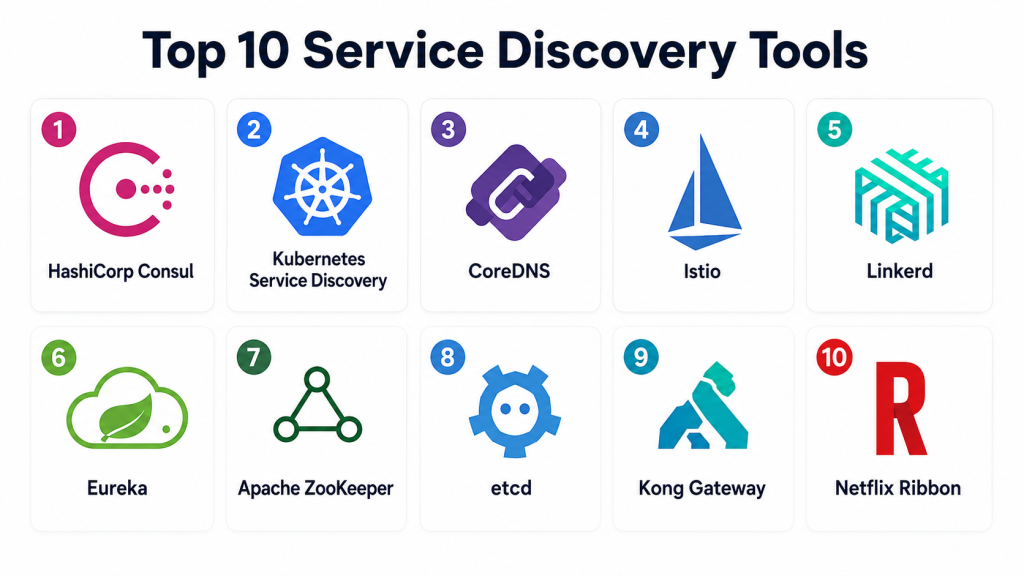
Top 10 Service Discovery Tools
1- HashiCorp Consul
Short description: HashiCorp Consul is a widely used service networking and service discovery platform for distributed applications. It provides service registration, health checking, DNS and API-based discovery, service mesh capabilities, and secure service-to-service communication. Consul is commonly used by platform engineering teams operating across Kubernetes, virtual machines, cloud, and hybrid environments. It is especially valuable when organizations need service discovery beyond a single Kubernetes cluster. Consul can support multi-data-center architectures and zero-trust service networking patterns. Its strongest value is flexible service discovery and networking across hybrid infrastructure.
Key Features
- Service registration and discovery
- DNS and HTTP API discovery
- Health checks and failure detection
- Multi-data-center support
- Service mesh capabilities
- Access control and service identity
- Kubernetes and VM support
Pros
- Strong hybrid and multi-platform discovery
- Good fit for enterprises with Kubernetes and VM workloads
- Mature service networking ecosystem
Cons
- Operational complexity can increase at scale
- Advanced service mesh features require careful planning
- Smaller teams may find it more than they need
Platforms / Deployment
- Cloud
- Self-hosted
- Hybrid
- Kubernetes
- VM-based environments
Security & Compliance
Supports ACLs, service identity, encrypted communication, and service mesh security features. Specific compliance certifications depend on deployment and commercial offering, so buyers should verify directly.
Integrations & Ecosystem
Consul integrates strongly with DevOps, cloud, Kubernetes, and infrastructure automation workflows.
- Kubernetes
- Nomad
- Terraform
- Envoy
- Prometheus
- Cloud platforms
Support & Community
HashiCorp provides documentation, enterprise support options, training, community resources, and a strong ecosystem of practitioners.
2- Kubernetes Service Discovery
Short description: Kubernetes Service Discovery is the native mechanism that allows pods and services inside a Kubernetes cluster to locate and communicate with each other. It uses Kubernetes Services, DNS records, labels, selectors, and endpoints to provide dynamic discovery as workloads scale or change. It is the default choice for containerized applications running inside Kubernetes. Developers and platform teams rely on it to route traffic between microservices without manually tracking pod IP addresses. It works well for cluster-local discovery and can be extended with ingress, service mesh, or multi-cluster tools. Its strongest value is built-in discovery for Kubernetes-native applications.
Key Features
- Native Kubernetes Services
- DNS-based service discovery
- Label and selector-based endpoint mapping
- ClusterIP, NodePort, and LoadBalancer patterns
- Endpoint and endpoint slice management
- Integration with ingress controllers
- Works with Kubernetes-native scaling
Pros
- Built into Kubernetes
- Simple and reliable for cluster-local discovery
- Strong ecosystem compatibility
Cons
- Primarily focused on Kubernetes environments
- Multi-cluster discovery requires additional tools
- Limited advanced service mesh features by itself
Platforms / Deployment
- Kubernetes
- Cloud
- Self-hosted
- Hybrid depending on cluster environment
Security & Compliance
Security depends on Kubernetes RBAC, network policies, secrets management, mTLS add-ons, and cluster configuration. Specific compliance depends on the Kubernetes distribution and environment.
Integrations & Ecosystem
Kubernetes Service Discovery integrates with cloud-native and container ecosystems.
- CoreDNS
- Ingress controllers
- Service mesh tools
- Kubernetes network policies
- Cloud load balancers
- Observability platforms
Support & Community
Kubernetes has extensive documentation, a large open-source community, cloud provider support, and strong ecosystem adoption.
3- CoreDNS
Short description: CoreDNS is a flexible DNS server and service discovery component widely used in Kubernetes environments. It provides DNS-based discovery for services and can be extended through plugins for different infrastructure patterns. CoreDNS is commonly deployed as the default DNS service inside Kubernetes clusters, enabling workloads to resolve service names dynamically. It is lightweight, extensible, and suitable for cloud-native environments where DNS reliability is critical. Platform teams use CoreDNS to support internal service discovery, custom DNS behavior, and Kubernetes DNS resolution. Its strongest value is plugin-based DNS service discovery for cloud-native systems.
Key Features
- DNS-based service discovery
- Kubernetes DNS integration
- Plugin-based architecture
- Lightweight and extensible design
- Custom DNS routing support
- Service name resolution
- Cloud-native deployment support
Pros
- Standard DNS component in many Kubernetes clusters
- Flexible plugin ecosystem
- Lightweight and production-proven
Cons
- DNS-focused rather than full service networking
- Advanced configuration requires DNS expertise
- Health and security features depend on surrounding platform
Platforms / Deployment
- Kubernetes
- Linux
- Cloud
- Self-hosted
- Hybrid
Security & Compliance
Supports DNS security patterns depending on configuration and plugins. Broader security and compliance depend on Kubernetes, network policies, and infrastructure setup.
Integrations & Ecosystem
CoreDNS integrates with Kubernetes and DNS-based infrastructure patterns.
- Kubernetes
- Cloud DNS systems
- Prometheus
- Service discovery plugins
- Container networking
- Internal platform DNS workflows
Support & Community
CoreDNS has open-source documentation, community support, Kubernetes ecosystem adoption, and technical resources for DNS administrators.
4- Istio
Short description: Istio is a service mesh platform that provides traffic management, service discovery integration, security, observability, and policy enforcement for microservices. It typically works with Kubernetes and Envoy proxies to manage service-to-service communication. While Istio is more than a service discovery tool, it enhances discovery by adding routing rules, identity, mTLS, telemetry, retries, and circuit breaking. It is commonly used by enterprises and platform teams with complex microservices environments. Istio helps teams make service communication more secure and observable. Its strongest value is combining service discovery with advanced mesh-based traffic control and zero-trust security.
Key Features
- Service mesh traffic management
- Service discovery integration
- mTLS and service identity
- Routing, retries, and circuit breaking
- Observability and telemetry
- Policy enforcement
- Kubernetes-native architecture
Pros
- Strong security and traffic control
- Excellent fit for complex microservices
- Improves visibility into service-to-service communication
Cons
- Operational complexity can be high
- Requires service mesh expertise
- May be unnecessary for simple environments
Platforms / Deployment
- Kubernetes
- Cloud
- Self-hosted
- Hybrid
Security & Compliance
Supports mTLS, service identity, access policies, telemetry, and secure service communication. Compliance depends on deployment, configuration, and surrounding platform controls.
Integrations & Ecosystem
Istio integrates deeply with Kubernetes and cloud-native observability systems.
- Kubernetes
- Envoy Proxy
- Prometheus
- Grafana
- Jaeger
- OpenTelemetry
Support & Community
Istio has a large open-source community, extensive documentation, cloud-native ecosystem support, and commercial support through multiple vendors.
5- Linkerd
Short description: Linkerd is a lightweight service mesh that helps Kubernetes services communicate securely and reliably. It supports service discovery integration, mTLS, traffic metrics, retries, load balancing, and observability for service-to-service traffic. Linkerd is often selected by teams that want service mesh benefits without the heavier complexity of some alternatives. It is especially useful for Kubernetes teams that need secure service communication and clear visibility into service health. Linkerd focuses on simplicity, performance, and operational ease. Its strongest value is lightweight service discovery enhancement and secure service communication for Kubernetes environments.
Key Features
- Kubernetes service mesh
- Service discovery integration
- Automatic mTLS
- Service-to-service metrics
- Retries and load balancing
- Traffic visibility
- Lightweight control plane
Pros
- Easier to operate than many service mesh alternatives
- Strong Kubernetes fit
- Useful for secure and observable service communication
Cons
- Kubernetes-focused
- Fewer advanced traffic policy features than some larger meshes
- Enterprise requirements should be validated carefully
Platforms / Deployment
- Kubernetes
- Cloud
- Self-hosted
- Hybrid depending on cluster environment
Security & Compliance
Supports automatic mTLS and secure service-to-service communication. Compliance depends on deployment, cluster configuration, and organizational controls.
Integrations & Ecosystem
Linkerd integrates with Kubernetes and observability systems.
- Kubernetes
- Prometheus
- Grafana
- Jaeger
- OpenTelemetry
- Ingress controllers
Support & Community
Linkerd has open-source documentation, active community support, and commercial ecosystem options for enterprise adoption.
6- Eureka
Short description: Eureka is a service discovery tool originally associated with the Netflix OSS ecosystem and commonly used in Java and Spring Cloud environments. It allows services to register themselves and discover other services dynamically. Eureka is often used in microservices architectures where services frequently scale, restart, or move across hosts. It is especially familiar to teams using Spring-based applications and legacy microservices patterns. While newer Kubernetes-native approaches have become more common, Eureka remains relevant in many Java enterprise environments. Its strongest value is application-level service registry for Spring and Java microservices.
Key Features
- Service registration and discovery
- Client-side service discovery
- Health check integration patterns
- Spring Cloud compatibility
- REST-based registry access
- Useful for Java microservices
- Supports dynamic application scaling
Pros
- Familiar to Spring and Java teams
- Simple application-level discovery model
- Useful for legacy microservices environments
Cons
- Less modern than Kubernetes-native discovery
- Requires application integration
- Not ideal for polyglot cloud-native platforms without extra work
Platforms / Deployment
- Self-hosted
- Cloud
- Hybrid
- Java application environments
Security & Compliance
Security depends on deployment, network protection, authentication setup, and surrounding platform controls. Specific compliance certifications are not publicly stated.
Integrations & Ecosystem
Eureka works best with Java and Spring-based microservices.
- Spring Cloud
- Java applications
- API gateways
- Load balancers
- Monitoring systems
- Microservices frameworks
Support & Community
Eureka has community knowledge from the Netflix OSS and Spring ecosystem, but buyers should evaluate long-term support needs carefully.
7- Apache ZooKeeper
Short description: Apache ZooKeeper is a distributed coordination service used for configuration management, leader election, naming, and service discovery patterns in distributed systems. It has long been used by platforms such as Kafka, Hadoop, and other distributed infrastructure tools. ZooKeeper is not a modern application service discovery platform in the same way as Consul or Kubernetes, but it remains important in infrastructure-level discovery and coordination. Teams use it when they need reliable distributed state and coordination primitives. It is suited for technical infrastructure teams with strong distributed systems knowledge. Its strongest value is mature coordination for distributed infrastructure.
Key Features
- Distributed coordination
- Naming and registry patterns
- Leader election
- Configuration synchronization
- High availability through quorum
- Infrastructure-level service discovery support
- Strong consistency model for coordination
Pros
- Mature distributed systems technology
- Strong fit for infrastructure coordination
- Widely used in older distributed platforms
Cons
- Not a simple application service discovery tool
- Requires operational expertise
- Newer platforms often prefer Kubernetes or service mesh discovery
Platforms / Deployment
- Self-hosted
- Cloud
- Hybrid
- Linux environments
Security & Compliance
Supports access control and secure configuration options depending on deployment. Compliance depends on infrastructure, configuration, and operational controls.
Integrations & Ecosystem
ZooKeeper integrates with distributed data and infrastructure platforms.
- Apache Kafka legacy architectures
- Hadoop ecosystem
- Distributed databases
- Search platforms
- Custom distributed systems
- Monitoring tools
Support & Community
ZooKeeper has mature open-source documentation, long-standing community knowledge, and enterprise support through related infrastructure vendors.
8- etcd
Short description: etcd is a distributed key-value store used for reliable configuration storage and coordination in distributed systems. It is best known as the backing store for Kubernetes cluster state. While etcd is not primarily a user-facing service discovery tool, it plays an important role in infrastructure discovery, state management, and coordination patterns. Kubernetes uses etcd to store cluster data that supports service discovery and orchestration behavior. Technical teams may also use etcd in custom distributed systems where consistent state and coordination are required. Its strongest value is reliable distributed state storage for cloud-native infrastructure.
Key Features
- Distributed key-value storage
- Strong consistency
- Watch APIs for change detection
- Cluster coordination support
- Kubernetes backing store
- High availability through clustering
- Useful for infrastructure state management
Pros
- Critical component of Kubernetes infrastructure
- Strong consistency and reliable state management
- Useful for custom distributed systems
Cons
- Not a complete standalone service discovery platform
- Requires careful operational management
- Misconfiguration can impact critical infrastructure
Platforms / Deployment
- Linux
- Cloud
- Self-hosted
- Hybrid
- Kubernetes infrastructure
Security & Compliance
Supports TLS, authentication, and access control configuration. Compliance depends on deployment, encryption, backup, access management, and operational procedures.
Integrations & Ecosystem
etcd is deeply connected with Kubernetes and distributed infrastructure.
- Kubernetes
- Cloud-native platforms
- Custom controllers
- Distributed systems
- Monitoring tools
- Backup and recovery workflows
Support & Community
etcd has strong open-source documentation, Kubernetes ecosystem adoption, and technical community support.
9- AWS Cloud Map
Short description: AWS Cloud Map is a cloud-native service discovery tool that helps applications discover resources and services running in AWS. It allows developers to define service names, register resources, and discover healthy service endpoints through API calls or DNS queries. AWS Cloud Map is commonly used with Amazon ECS, EKS, EC2, and microservices architectures. It is especially useful for teams building distributed applications inside AWS that need managed service discovery. Cloud Map reduces the need to maintain a custom registry for AWS-based services. Its strongest value is managed service discovery for AWS cloud-native applications.
Key Features
- Managed service discovery
- DNS and API-based discovery
- Service registration
- Health checking integration
- ECS and EKS compatibility
- Cloud-native namespace management
- AWS-native automation support
Pros
- Fully managed AWS-native discovery
- Good fit for ECS, EKS, and AWS microservices
- Reduces operational overhead
Cons
- Best suited for AWS environments
- Less useful for non-AWS infrastructure
- Advanced hybrid patterns may need extra architecture
Platforms / Deployment
- Cloud
- AWS ecosystem
Security & Compliance
Supports AWS IAM, service permissions, and AWS security controls. Compliance depends on AWS account configuration, workload design, and customer governance.
Integrations & Ecosystem
AWS Cloud Map integrates with AWS compute and networking services.
- Amazon ECS
- Amazon EKS
- Amazon EC2
- AWS Lambda
- Route 53
- AWS IAM
Support & Community
AWS provides documentation, cloud architecture resources, enterprise support, training, and partner ecosystem support.
10- Netflix Ribbon
Short description: Netflix Ribbon is a client-side load balancing and service discovery library historically used in Java microservices environments. It was commonly paired with Eureka and Spring Cloud patterns to help applications discover and route requests to service instances. While newer cloud-native and Kubernetes-native tools have largely replaced it in many modern architectures, Ribbon remains relevant in legacy Java microservices environments. It is useful for teams maintaining older Spring Cloud systems that still rely on client-side discovery patterns. Buyers should treat Ribbon as a legacy-compatible option rather than a first-choice modern platform. Its strongest value is maintaining older Java microservices architectures that still use Netflix OSS patterns.
Key Features
- Client-side load balancing
- Service discovery integration
- Java microservices support
- Spring Cloud ecosystem compatibility in legacy environments
- Rule-based routing patterns
- Retry and server selection behavior
- Useful for older Netflix OSS architectures
Pros
- Familiar to legacy Java microservices teams
- Works with Eureka-based discovery patterns
- Useful for maintaining existing systems
Cons
- Not ideal for new cloud-native projects
- Modern alternatives are usually preferred
- Long-term modernization should be considered
Platforms / Deployment
- Java application environments
- Self-hosted
- Cloud
- Hybrid
Security & Compliance
Security depends on the surrounding application, network, authentication, and platform configuration. Specific compliance certifications are not publicly stated.
Integrations & Ecosystem
Ribbon is most relevant in older Java and Spring Cloud service discovery architectures.
- Eureka
- Spring Cloud legacy patterns
- Java microservices
- API gateways
- Monitoring tools
- Custom service clients
Support & Community
Ribbon has historical community knowledge, but teams should evaluate modernization paths and long-term support carefully.
Comparison Table
| Tool Name | Best For | Platform(s) Supported | Deployment | Standout Feature | Public Rating |
|---|---|---|---|---|---|
| HashiCorp Consul | Hybrid service discovery and service mesh | Kubernetes, VMs, cloud, hybrid | Cloud / Self-hosted / Hybrid | Multi-platform service registry | N/A |
| Kubernetes Service Discovery | Kubernetes-native applications | Kubernetes clusters | Cloud / Self-hosted / Hybrid | Built-in cluster discovery | N/A |
| CoreDNS | DNS-based Kubernetes discovery | Kubernetes, Linux, DNS systems | Cloud / Self-hosted / Hybrid | Plugin-based DNS discovery | N/A |
| Istio | Advanced service mesh discovery | Kubernetes and Envoy-based systems | Cloud / Self-hosted / Hybrid | mTLS and traffic policy control | N/A |
| Linkerd | Lightweight Kubernetes service mesh | Kubernetes | Cloud / Self-hosted / Hybrid | Simple secure service mesh | N/A |
| Eureka | Java and Spring microservices | Java, Spring Cloud environments | Cloud / Self-hosted / Hybrid | Application-level service registry | N/A |
| Apache ZooKeeper | Distributed coordination | Linux, distributed systems | Self-hosted / Hybrid | Coordination and naming service | N/A |
| etcd | Infrastructure state and coordination | Linux, Kubernetes infrastructure | Cloud / Self-hosted / Hybrid | Strongly consistent key-value store | N/A |
| AWS Cloud Map | AWS-native service discovery | AWS services | Cloud | Managed AWS discovery | N/A |
| Netflix Ribbon | Legacy Java client-side discovery | Java application environments | Cloud / Self-hosted / Hybrid | Client-side service routing | N/A |
Evaluation & Scoring of Service Discovery Tools
| Tool Name | Core 25% | Ease 15% | Integrations 15% | Security 10% | Performance 10% | Support 10% | Value 15% | Weighted Total |
| HashiCorp Consul | 10 | 7 | 9 | 9 | 9 | 9 | 8 | 8.8 |
| Kubernetes Service Discovery | 9 | 9 | 10 | 8 | 9 | 9 | 10 | 9.2 |
| CoreDNS | 8 | 8 | 9 | 7 | 9 | 8 | 10 | 8.5 |
| Istio | 9 | 6 | 9 | 10 | 8 | 8 | 8 | 8.2 |
| Linkerd | 8 | 8 | 8 | 9 | 9 | 8 | 9 | 8.4 |
| Eureka | 7 | 7 | 7 | 6 | 7 | 6 | 8 | 7.0 |
| Apache ZooKeeper | 7 | 5 | 7 | 7 | 8 | 7 | 8 | 7.0 |
| etcd | 7 | 6 | 8 | 8 | 9 | 8 | 9 | 7.8 |
| AWS Cloud Map | 8 | 9 | 8 | 8 | 8 | 9 | 8 | 8.3 |
| Netflix Ribbon | 6 | 6 | 6 | 5 | 6 | 5 | 7 | 5.9 |
These scores are comparative and should not be treated as universal rankings. Kubernetes Service Discovery scores highly for Kubernetes-native environments, while Consul is stronger for hybrid and multi-platform use cases. Istio and Linkerd add service mesh security and traffic control, while CoreDNS, etcd, and ZooKeeper serve more infrastructure-level discovery or coordination roles. The right choice depends on your architecture, cloud provider, application stack, security needs, and operational maturity.
Which Service Discovery Tool Is Right for You?
Solo / Freelancer
Solo developers usually do not need a complex standalone service discovery platform. Kubernetes Service Discovery is enough if the project runs on Kubernetes. Caddy, NGINX, or simple DNS may be sufficient for small web apps, but for microservices, lightweight Kubernetes-native discovery or Docker networking may be more practical than enterprise tools. Eureka may be useful only for older Java projects.
SMB
SMBs running containerized applications should start with Kubernetes Service Discovery and CoreDNS. If the team needs secure service-to-service communication, Linkerd is a simpler service mesh option. AWS-based SMBs may use AWS Cloud Map when working with ECS, EKS, or serverless architectures. The focus should be reliability, simplicity, and low operational overhead.
Mid-Market
Mid-market organizations often need multi-service observability, stronger security, and hybrid support. Consul, Istio, Linkerd, Kubernetes Service Discovery, CoreDNS, and AWS Cloud Map can all be strong candidates depending on architecture. These teams should evaluate health checks, service maps, mTLS, multi-cluster support, and operational cost before choosing.
Enterprise
Enterprises should prioritize scalability, security, governance, multi-platform discovery, and support. HashiCorp Consul is strong for hybrid environments with Kubernetes and VMs. Istio is suitable for advanced service mesh requirements. Kubernetes Service Discovery remains the foundation for Kubernetes workloads. AWS Cloud Map is practical for AWS-native architectures, while etcd and ZooKeeper are more infrastructure-level components.
Budget vs Premium
Budget-conscious teams may rely on Kubernetes Service Discovery, CoreDNS, etcd, Eureka, or open-source service mesh tools. Premium buyers may choose enterprise Consul, managed cloud service discovery, or commercially supported service mesh platforms for better support and governance. Cost should include not only licensing but also engineering time, monitoring, training, and incident risk.
Feature Depth vs Ease of Use
Kubernetes Service Discovery and AWS Cloud Map are easier for teams already using those platforms. Consul provides deeper hybrid discovery but requires more planning. Istio offers advanced traffic and security controls but has higher operational complexity. Linkerd is often easier for teams that want service mesh benefits with less overhead.
Integrations & Scalability
For Kubernetes-only environments, Kubernetes Service Discovery and CoreDNS are the default foundation. For hybrid VM and Kubernetes workloads, Consul is stronger. For service mesh architectures, Istio and Linkerd are strong options. For AWS-native services, AWS Cloud Map is the natural fit. For Java legacy systems, Eureka and Ribbon may remain relevant during modernization.
Security & Compliance Needs
Security-focused buyers should evaluate service identity, mTLS, RBAC, ACLs, audit logging, network policy integration, certificate rotation, and access controls. Istio and Linkerd provide strong mTLS patterns, while Consul supports service networking security across hybrid environments. Compliance depends heavily on deployment model, configuration, logging, and governance policies.
Frequently Asked Questions
1- What is service discovery?
Service discovery is the process of automatically finding available services and their network locations. It helps applications communicate without manually tracking IP addresses, ports, or constantly changing endpoints.
2- Why is service discovery important in microservices?
Microservices often scale, restart, and move across infrastructure. Service discovery keeps communication reliable by automatically updating where services are located and whether they are healthy.
3- What is the difference between DNS-based and API-based discovery?
DNS-based discovery lets services find each other using names. API-based discovery provides richer metadata, health status, tags, and service details through an API or registry.
4- Is Kubernetes service discovery enough?
For many Kubernetes-only applications, native Kubernetes Service Discovery is enough. However, multi-cluster, hybrid, zero-trust, and advanced traffic control needs may require service mesh or external discovery tools.
5- How does service discovery relate to service mesh?
A service mesh uses service discovery to understand where services are, then adds traffic control, security, retries, observability, and policy enforcement between services.
6- What are common service discovery mistakes?
Common mistakes include poor health checks, stale service entries, weak DNS configuration, no monitoring, missing security controls, and using a tool that does not match the application architecture.
7- Can service discovery work across clouds?
Yes, some tools support hybrid and multi-cloud discovery. Consul is often used for multi-platform discovery, while cloud-native tools usually work best inside their own provider ecosystem.
8- Do service discovery tools improve security?
They can support better security when combined with identity, ACLs, mTLS, network policies, and service mesh controls. Discovery alone is not enough; secure communication and policy enforcement are also needed.
9- How much do service discovery tools cost?
Open-source and built-in tools may have no license cost but require operational expertise. Enterprise and managed platforms may charge based on nodes, services, clusters, users, or support level.
10- How should teams choose a service discovery tool?
Start by mapping your architecture, including Kubernetes, VMs, cloud provider, microservices count, security needs, and multi-region plans. Then test discovery reliability, health checks, observability, and operational complexity before standardizing.
Conclusion
Service Discovery Tools are foundational for modern distributed applications because they help services find each other reliably across dynamic infrastructure. Kubernetes Service Discovery and CoreDNS are the natural starting points for Kubernetes environments, while HashiCorp Consul is a strong choice for hybrid infrastructure that includes both Kubernetes and virtual machines. Istio and Linkerd extend discovery with service mesh security, traffic control, and observability, making them useful for advanced microservices platforms. AWS Cloud Map is practical for AWS-native applications, while Eureka and Ribbon remain relevant mainly for legacy Java and Spring Cloud architectures. ZooKeeper and etcd are important infrastructure coordination tools rather than simple application discovery products. The best choice depends on your platform, workload type, security model, team skills, and long-term architecture. Start by shortlisting two or three options, test service registration and health checks, validate security and observability, and then standardize on the tool that best supports your application delivery strategy.
